
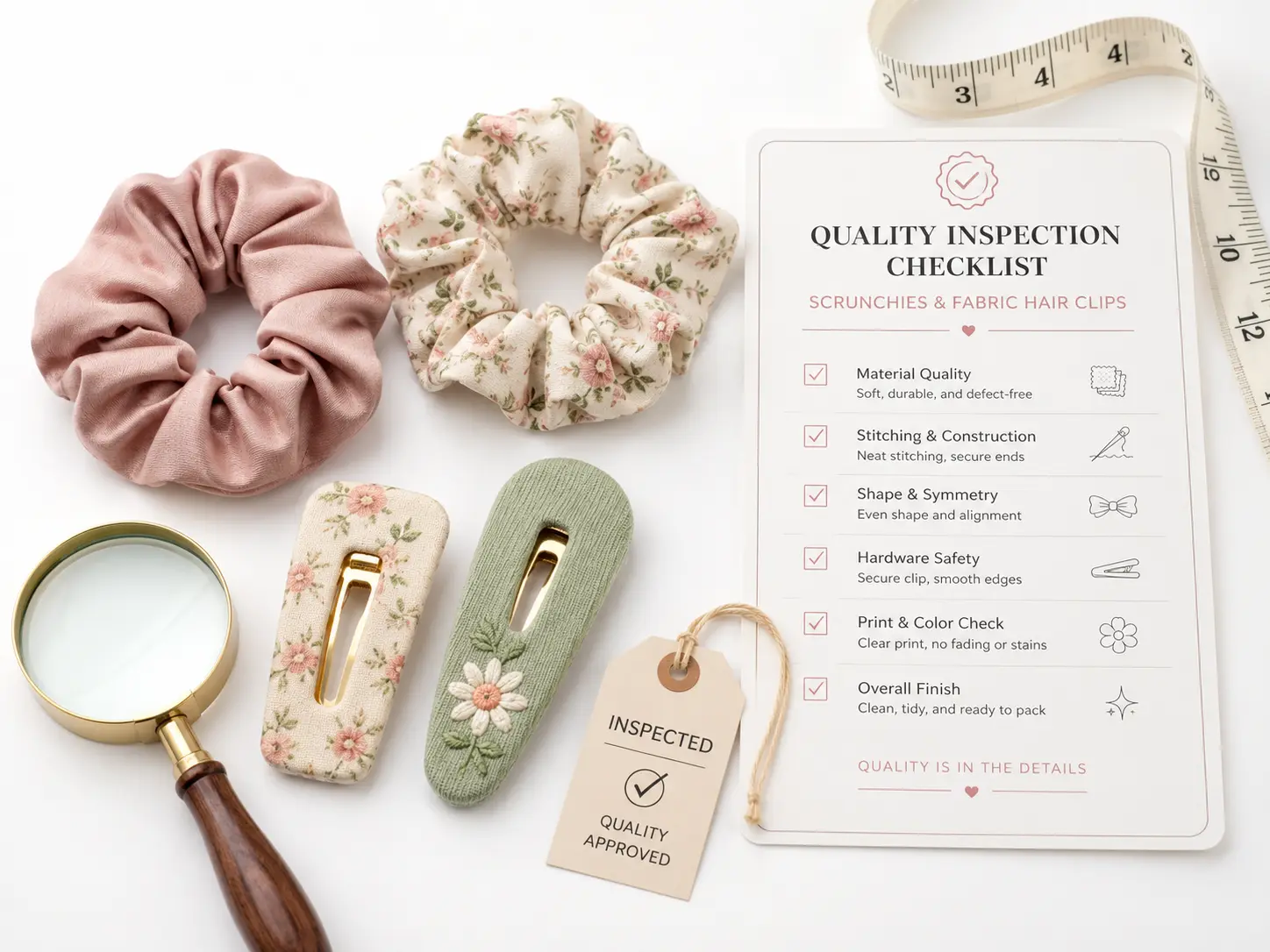
A reliable program evaluates materials, dimensions, appearance, function, safety, packaging, and lot consistency through defined sampling, defect classes, acceptance criteria, corrective action, and traceability.
This guide provides a manufacturer-ready quality inspection checklist for scrunchies and fabric-covered clips. It explains pre-production controls, inline and final tests, AQL sampling, defect categories, a real recall case, and the records buyers should request before shipment.
Why Quality Inspection Matters for Scrunchies and Fabric Hair Clips
Protecting Product Performance
Appearance is only one quality dimension. Scrunchies need stable elastic recovery, seams, and hair hold; fabric clips need repeatable opening, grip, attachment, edge safety, and balanced weight.
Maintaining Consistency Across Production
Consistency comes from controlling fabric shade, elastic length, seam allowance, gathering, bow folds, adhesive weight, clip springs, and packing pressure before final sorting.
Reducing Returns and Customer Complaints
| Quality risk | Consumer impact | Best inspection stage |
|---|---|---|
| Elastic loses force | Scrunchie slips or requires extra wraps | Incoming elastic, pilot test, final performance test |
| Bow attachment loosens | Decoration rotates or detaches | Inline assembly and final pull/torque test |
| Metal edge or burr | Hair snag or skin injury | Incoming clip inspection and final safety check |
| Shade variation | Mismatched sets and inconsistent retail display | Fabric receiving, cutting bundles, final assortment check |
| Crushed packaging | Poor first impression and permanent deformation | Packaging trial and shipment simulation |
Expert principle: Final inspection verifies a lot; it does not repair an uncontrolled process. The most effective program places quality gates before cutting, after the first production batch, during assembly, and before packing.
Pre-Production Inspection for Scrunchies and Fabric Hair Clips
Fabric Color and Texture Inspection
Inspect fabric against the approved color standard under controlled lighting. Check shade, face and back, texture, print registration, nap, stretch, weight, usable width, stains, holes, coating defects, and odor.
For velvet, corduroy, and directional prints, control cutting direction and define whether motifs in pairs are matched, mirrored, centered, or random. Record roll and dye-lot numbers.
Elastic Quality Inspection
Check elastic construction, width, thickness, cut length, surface damage, extension, recovery, and joining compatibility. ASTM D4964 offers a tensile-test framework, while the buyer defines relevant loads.
Metal Clip and Hardware Inspection
Inspect clip dimensions, plating, spring pressure, alignment, teeth, rounded edges, corrosion, scratches, burrs, clasp function, and closed gap across cartons.
Children’s products require particular attention to coatings and component materials. In May 2025, the U.S. Consumer Product Safety Commission recalled Dlesot children’s snap clips because painted surfaces contained lead above the federal limit. The case demonstrates that a metal clip can look visually acceptable while failing a chemical requirement.
Logo and Packaging Material Inspection
Check logo artwork, spelling, color, size, position, foil adhesion, embroidery density, label edges, display-card dimensions, print quality, barcode data, warning text, responsible-party details, and carton markings.
| Incoming material | Inspection points | Recommended evidence |
|---|---|---|
| Fabric | Shade, texture, weight, width, print, defects, shrinkage | Approved swatch, roll report, test report where required |
| Elastic | Width, length, working force, recovery, surface condition | Lot sample, tensile data, supplier declaration |
| Clip base | Dimensions, spring, plating, edges, teeth, corrosion | Golden base, component report, material/coating documentation |
| Logo component | Artwork, color, attachment points, sharp edges | Approved artwork and pre-production sample |
| Packaging | Size, print, barcode, warnings, assortment coding | Signed dieline and barcode verification result |
Scrunchies and Fabric Hair Clips: Scrunchie Appearance Inspection
Finished Size and Shape
Lay the scrunchie flat and relaxed with even gathers. Measure outer diameter, inner opening, tube width, and weight when specified, without stretching or compressing it.
Gathering Distribution
Gathers should be even around the loop without flat sections, hard lumps, twisted elastic, or concentrated seam bulk.
Fabric Defects, Stains, and Color Variation
Reject holes, cuts, oil, chalk, glue, severe snags, unacceptable weave defects, color migration, print misregistration, and shade mismatch within sets.
Seam and Opening Closure Quality
Check skipped stitches, broken thread, seam grin, puckering, raw edges, exposed elastic, weak backstitching, and visible closure gaps.
| Scrunchie appearance item | Measurement or check | Common defect classification |
|---|---|---|
| Outer diameter | Measure relaxed against specification | Major if fit/packaging is affected; minor if slight and cosmetic |
| Gathering | Inspect full circumference | Major for twisted elastic or severe flat section |
| Shade | Compare under approved lighting | Major for mismatched set or wrong approved color |
| Stain or hole | Visual check at agreed viewing distance | Major when readily visible; critical only if it creates a safety risk |
| Closure seam | Visual and gentle tension check | Major for exposed elastic or opening seam |
Scrunchies and Fabric Hair Clips: Scrunchie Performance Inspection
Elastic Stretch and Recovery
An elastic recovery test records original circumference, force at working extension, post-cycle circumference, and recovery after rest. Dimensional recovery and force recovery are separate.
Hair-Holding Strength
Apply the finished product to defined tresses or ponytail bundles. Record wrap count, installation effort, slippage, comfort, and removal for each claimed hair type.
Seam Strength
Inspect seams under real wrapping stress. ISO 13935-2:2026 can inform laboratory evaluation of applicable straight sewn seams, although it is not a scrunchie-specific legal requirement.
Repeated Use and Washing Performance
Cycle finished scrunchies to the approved working extension. Development programs may use checkpoints such as 100, 500, or 1,000 cycles, but these are brand targets rather than universal legal thresholds.
ISO 6330:2021 provides standardized domestic washing and drying procedures. Test the exact care method the brand plans to publish, whether hand washing, machine washing in a bag, line drying, or flat drying.
| Performance test | Record | Example acceptance logic |
|---|---|---|
| Working-force test | Force at defined extension | Within the signed range across tested pieces |
| Recovery test | Permanent growth and force loss | Below the brand’s validated limit after rest |
| Hair-hold test | Slippage, wrap count, comfort | Meets the stated hair type and wear scenario |
| Seam test | Seam opening, rupture, exposed elastic | No functional failure at the approved load |
| Wash test | Shrinkage, color, seam, recovery, appearance | Remains functional after the claimed care procedure |
Fabric Hair Clip Appearance Inspection
Bow Shape and Symmetry
Place the finished clip on a template and compare loop width, tails, center band, pleats, height, and angle. Measure endpoint differences when symmetry is a selling point.
Fabric Position and Print Alignment
Check grain, nap, stripe direction, motif position, mirrored pairs, and logo orientation. Fabric must remain clear of the hinge, teeth, spring, and clasp.
Glue Marks, Loose Threads, and Fraying
Inspect adhesive, glue strings, hard ridges, scorch marks, solvent stains, loose thread, raw edges, and fraying.
Clip Alignment and Decoration Placement
The decoration should be centered over the intended base area. Off-center weight causes rotation and can alter grip. Confirm that the clip is horizontal unless the design intentionally specifies an angle.
| Clip appearance checkpoint | Method | Reject condition |
|---|---|---|
| Bow symmetry | Template and dimensional comparison | Loop or tail difference exceeds tolerance |
| Print alignment | Compare with artwork placement standard | Upside-down, off-center, or mismatched pair |
| Glue control | Inspect front, back, edges, and inner jaw | Visible stain, hard ridge, or adhesive in functional area |
| Decoration position | Measure from clip center line | Placement affects balance or brand appearance |
| Fabric edge | Visual and light-rub inspection | Fraying, sharp heat seal, or exposed interfacing |
Scrunchies and Fabric Hair Clips: Clip Function Inspection
Opening and Closing Performance
Cycle the finished clip and confirm that fabric, adhesive, thread, wraps, and grip components do not restrict the mechanism. Compare closing force before and after cycling.
Grip Strength and Slip Resistance
Test the clip on the intended hair profile. Record static displacement over time and movement during head turns or walking simulation. Fine, conditioned hair may require teeth, a textured lining, silicone, or a smaller closed gap.
Attachment Strength
A clip attachment strength test applies controlled pull or torque based on size, weight, age, and use, recording whether adhesive, stitches, fabric, or metal fails.
Sharp-Edge and Small-Part Safety
Inspect burrs, wire, pointed teeth, sharp heat seals, lifted grip strips, exposed staples, and loose charms. For products primarily intended for children aged 12 or younger in the United States, applicable rules may require third-party testing through a CPSC-accepted laboratory and a Children’s Product Certificate.
CPSC guidance lists barrettes and certain grooming clips among products excluded from the federal small-parts ban. That exclusion does not remove other potentially applicable lead, coating, tracking-label, or general safety obligations.
| Function test | What it detects | Possible critical condition |
|---|---|---|
| Opening cycle | Spring, snap, or clasp fatigue | Unexpected release that creates a safety hazard |
| Slip test | Insufficient grip or excessive decoration weight | Usually major, not critical |
| Attachment pull/torque | Weak glue, stitches, or fabric | Detachable hazardous component in an applicable children’s product |
| Edge inspection | Burrs, wire, sharp teeth, hard adhesive | Sharp point or edge capable of injury |
| Coating review | Restricted substances or coating failure | Non-compliance with applicable chemical limits |
Measurement and Tolerance Inspection
Product Dimensions
Define relaxed scrunchie diameter, inner opening, fabric-tube width, bow width and height, tail length, and packaged dimensions. Inspectors must use the same orientation and conditioning method used during sample approval.
Elastic Length and Clip Size
For elastic, distinguish cut length from joined circumference. For clips, define total length, jaw width, opening height, base-plate width, and closed gap when functional.
Logo Position and Decoration Placement
Use datums rather than vague descriptions such as “centered.” For example: logo center within ±2 mm of the bow center line; woven label bottom edge 5 ±1 mm from seam; metal charm aligned vertically within an agreed angle.
| Measurement | Tool | Example tolerance approach |
|---|---|---|
| Scrunchie outer diameter | Flat ruler or template | Size- and fabric-specific flexible tolerance |
| Elastic cut length | Relaxed ruler measurement before joining | Tighter control for mini sizes |
| Bow dimensions | Template, ruler, or digital caliper | Separate width, height, and tail tolerances |
| Clip length | Digital caliper | Component drawing tolerance |
| Logo position | Transparent overlay or coordinate gauge | Measured from fixed product datums |
Inspection note: Tolerances should reflect function and consumer visibility. A one-millimeter error may be irrelevant on a jumbo organza scrunchie but obvious on a pair of 30 mm children’s clips.
Packaging Inspection for Scrunchies and Fabric Hair Clips
Display Card Positioning
Check that clips are closed correctly on the card, scrunchies are not overstretched, products face the intended direction, and slots do not scratch plating or distort mechanisms. The card must support the product without crushing the decoration.
Quantity and Assortment Accuracy
Verify pieces per set, color ratios, sizes, left/right pairs, style codes, inner-pack quantities, carton quantities, and purchase-order assortment. Use a packing reference showing every approved combination.
Barcode, Label, and Warning Information
Confirm product name, item number, GTIN or other identifier, color, country-of-origin statement where required, age information, warnings, responsible-party information, care instructions, and traceability code.
GS1 advises checking barcode check digits, quiet zones, bar-and-space contrast, colors, construction, and position. Scan printed production samples rather than relying only on the digital artwork.
Protection Against Crushing and Deformation
A packaging inspection should evaluate unit packaging, inner cartons, master cartons, dividers, tissue supports, and stacking pressure. Conduct packed drop or vibration simulations when large bows, padded clips, metal charms, or premium boxes are involved.
| Packaging check | Failure example | Prevention |
|---|---|---|
| Card attachment | Clip opens or bow rotates | Use correct slots, ties, or secondary retention |
| Scrunchie mounting | Elastic stored under constant tension | Use a card or loop that does not overstretch it |
| Barcode | Wrong data or failed scan | Verify artwork and scan production print |
| Assortment | Wrong colors or missing pair | Use pack photos, checklists, and weight/count controls |
| Shape protection | Flattened bow or bent clip | Add clearance, inserts, dividers, and carton-strength controls |
Final Random Inspection Before Shipment
Sampling Plan and AQL Standards
ISO 2859-1:2026 specifies acceptance-sampling plans for inspection by attributes using lot size, inspection level, AQL, sample code, and acceptance/rejection numbers.
AQL is a statistical lot-acceptance tool, not a guarantee of zero defects or a replacement for process control and safety testing.
A common buyer example is Critical 0 / Major 2.5 / Minor 4.0 under normal General Level II. The actual plan depends on the current standard, risk, lot, severity, and contract.
Critical, Major, and Minor Defects
Critical defects can create an unsafe or legally non-compliant product. Major defects materially affect function, durability, saleability, or the expected appearance. Minor defects are small deviations that do not substantially affect use.
| Defect class | Scrunchie examples | Fabric clip examples |
|---|---|---|
| Critical | Prohibited chemical non-compliance where applicable; sharp concealed component | Sharp burr; hazardous loose component; non-compliant coating |
| Major | Broken elastic, open seam, wrong size, severe stain, poor recovery | Clip does not close, decoration detaches, weak grip, severe asymmetry |
| Minor | Small loose thread, slight non-functional variation | Minor cosmetic glue trace or small alignment deviation |
Inspection Records and Corrective Actions
A failed inspection should trigger containment, sorting or rework, root-cause analysis, corrective action, evidence of process change, and reinspection.
Case Study: Dlesot Children’s Snap Hair Clip Recall
On May 1, 2025, the U.S. Consumer Product Safety Commission announced a recall of Dlesot children’s snap hair clips sold on Amazon. The painted clips contained lead above the federal lead-paint limit and posed a lead-poisoning hazard. The remedy was a refund.
The important lesson is that visual inspection alone could not identify the core defect. The clips could have correct dimensions, acceptable spring action, neat packaging, and consistent color while remaining legally non-compliant.
| Quality gate | Control that could detect or prevent the risk |
|---|---|
| Supplier qualification | Approved coating source, material declaration, and change-control agreement |
| Pre-production testing | Applicable coating and substrate testing by a qualified laboratory |
| Incoming inspection | Lot identity, coating color, supplier lot, and test-report linkage |
| Production traceability | Component batch connected to product and shipment lots |
| Final documentation review | Correct CPC and supporting CPSC-accepted laboratory reports when applicable |
Case-study takeaway: Product quality has three layers: workmanship, performance, and compliance. Passing only the first two does not make a children’s hair accessory ready for sale.
Pros and Cons of Quality Inspection Approaches
| Approach | Advantages | Limitations |
|---|---|---|
| 100% visual sorting | Can remove obvious appearance defects | Expensive, prone to inspector fatigue, and weak for latent performance defects |
| Final random AQL inspection | Efficient statistical lot decision | Does not guarantee zero defects or replace safety testing |
| Inline inspection | Finds process drift before the full lot is completed | Requires trained staff and rapid corrective action |
| Laboratory performance testing | Produces measurable elastic, seam, chemical, and durability evidence | Adds cost and may not represent every production unit |
| Golden-sample comparison | Clear visual and tactile reference | Can become subjective without written measurements and tolerances |
| Combined control plan | Addresses materials, process, finished goods, and shipment | Requires planning, documentation, and supplier cooperation |
Expert Buyer Checklist
- Approve specifications before production. Include materials, dimensions, tolerances, performance tests, packaging, and defect classifications.
- Control incoming lots. Link fabric, elastic, clip, coating, logo, and packaging batches to inspection and test records.
- Inspect the first production output. Confirm appearance and function before the full quantity is assembled.
- Test finished products. Raw elastic and bare clips do not represent decorated, sewn, glued, and packed items.
- Separate safety from cosmetic AQL. Use preventive controls and applicable laboratory testing for chemical, sharp-edge, and children’s-product requirements.
- Verify packaging data. Scan barcodes and check assortment, warnings, traceability, and destination-market information.
- Use the current sampling standard. Record the ISO 2859-1:2026 plan, lot size, inspection level, severity, AQL, sample, and Ac/Re decision.
- Require corrective action. A failed lot needs containment, root cause, process correction, and evidence before reinspection.
Brands can review custom materials, quality controls, logo options, packaging, sampling, and private-label production at Q&N Beauty and its hair accessories manufacturing page.
Frequently Asked Questions
How do you inspect the quality of scrunchies?
Check fabric, dimensions, gathering, seams, elastic width and length, working force, recovery, hair hold, repeated-use performance, washing performance, logo, packaging, quantity, and traceability.
How do manufacturers test fabric hair clips?
They inspect dimensions, bow symmetry, plating, edges, alignment, opening cycles, grip, slip resistance, decoration attachment, chemical compliance where applicable, and packaging protection.
What AQL level should be used for hair accessories?
A common commercial example is Critical 0, Major 2.5, and Minor 4.0 under normal General Level II inspection. The correct plan depends on the buyer contract, risk, lot size, product age classification, and current ISO 2859-1 tables.
What are critical, major, and minor defects?
Critical defects create safety or legal risk. Major defects materially affect function, durability, saleability, or expected appearance. Minor defects are limited deviations that do not substantially affect use.
How do you test scrunchie elastic recovery?
Measure initial circumference and force, cycle the finished scrunchie to its working extension, and remeasure immediately and after a defined rest period. Record both permanent growth and force loss.
Should every hair accessory receive 100% inspection?
Critical process checks and obvious defects may justify 100% controls, but final lot decisions often use random sampling. A strong program combines supplier control, inline inspection, laboratory tests, targeted 100% checks, and final AQL inspection.
What documents should buyers receive before shipment?
Request the final inspection report, measurement and functional results, packing list, barcode verification where relevant, traceability records, approved sample reference, corrective actions, and applicable compliance certificates and test reports.
Conclusion: Inspect Scrunchies and Fabric Hair Clips as Complete Systems
Consistent scrunchies and fabric hair clips require controlled materials, measured production, finished-product testing, accurate packaging, traceability, and documented corrective action.
Scrunchies need recovery, hold, seam, and wash checks. Fabric clips need symmetry, opening, grip, attachment, edge, and loose-part checks. Both need accurate dimensions and packaging.
ISO 2859-1:2026 provides a current statistical framework for final lot acceptance, but AQL cannot replace preventive quality control or product-specific safety testing. The strongest inspection plan combines material approval, pilot testing, inline monitoring, final random inspection, and documented corrective action.
Future quality programs will use digital inspection forms, barcode-linked component traceability, automated image measurement, force sensors for elastic and clip testing, defect trend dashboards, and transport simulations tailored to delicate fabric structures.
Ready to develop a quality-controlled private-label collection? Visit Q&N Beauty to discuss custom scrunchies, fabric hair clips, materials, samples, performance testing, packaging, inspection standards, and production quotations.
Sources and External Link Placements
- Grand View Research: Hair Accessories
- Grand View Research: Clips & Pins
- Statista: Accessories Forecast
- Google: People-First Content
- Google: AI Search Guidance
- ISO 2859-1:2026
- ASTM D4964
- ISO 13935-2:2026
- ISO 6330:2021
- GS1 Barcode Checks
- CPSC Dlesot Recall
- CPSC Children’s Products
- CPSC Certificate Guidance
- CPSC Small-Parts Scope
- EU GPSR



[…] the more focused scrunchie and fabric hair clip QC guide when those products form the main […]
[…] burrs, surface scratches, cracks, plating consistency, and ornament attachment. Use the detailed scrunchie and fabric clip QC checklist when those categories are […]
[…] For category-specific checkpoints, use Q&N Beauty’s scrunchie and fabric hair clip quality-control guide. […]