Bulk hair accessory production can expose problems that were invisible in a single approved sample. Fabric from another dye lot may look different, elastic may lose recovery after sewing, clip springs may vary between cartons, bows may shift during hand assembly, and retail packaging may crush a product that looked correct before packing.
When these issues are found late, buyers face more than cosmetic defects. Sorting, remaking, repacking, retesting, and expedited shipping can increase landed cost and delay a launch. This guide explains the most common problems across scrunchies, fabric clips, hair bows, padded headbands, heatless curling sets, and claw clips—and the factory controls that should prevent them.
For an early risk review, send your design, reference sample, target market, quantity, and packaging concept through Q&N Beauty’s custom hair accessory service. Recommended materials, tolerances, tests, MOQ, and production timing remain subject to specification review.
Why Bulk Hair Accessory Production Can Differ From the Sample
A Sample Proves One Build, Not the Entire Manufacturing System
An approved sample confirms that a particular combination of material, component, pattern, worker method, and finishing can produce an acceptable item. It does not prove that thousands of pieces will remain consistent without controlled specifications and production checks.
Bulk orders introduce multiple material lots, operators, assembly stations, and cartons. Variation can accumulate into visible or functional failure, so the sample must become measurable production standards.
Vague Specifications Create Subjective Decisions
Instructions such as “match the sample,” “strong elastic,” “good grip,” or “no obvious glue” leave too much room for interpretation. A production specification should define materials, finished dimensions, measurement points, tolerances, color references, component models, assembly methods, performance tests, branding, packaging, and defect classifications.
The golden sample remains valuable, but it should support written criteria rather than replace them. Label every approved sample with the SKU, version, date, colorway, and accepted deviations.
Uncontrolled Changes Cause Repeat-Order Drift
A supplier may replace an unavailable elastic, adhesive, spring, fabric, padding, coating, or packaging board. Even a similar-looking substitute can affect performance or compliance.
Use formal change control: identify the change, compare specifications, sample it, assess risk, obtain approval, and update the bill of materials.
| Production problem | Likely root cause | Preventive control | Evidence buyers should request |
|---|---|---|---|
| Shade variation | Mixed dye lots or uncontrolled lighting | Lot segregation and approved color standard | Roll records and production shade photos |
| Size inconsistency | Pattern, cutting, molding, or assembly drift | Fixed datums, gauges, and inline measurement | First-piece and patrol inspection records |
| Weak function | Wrong elastic, spring, filling, or construction | Approved components and finished-product tests | Lot-linked test results |
| Loose decoration | Poor surface preparation or attachment control | Defined glue, stitch, pull, or torque process | Attachment test and defect records |
| Packaging damage | Insufficient clearance or carton support | Pack trial and approved packing standard | Packed sample and carton photos |
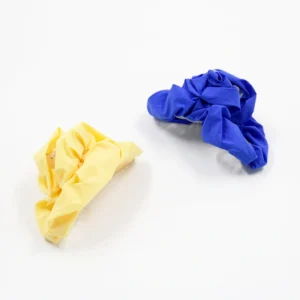
Material, Color, and Print Problems in Bulk Orders
Fabric Shade and Dye-Lot Variation
Silk, polyester satin, velvet, cotton, organza, chiffon, linen, nylon, and terry cloth respond differently to dyes, finishes, pile direction, and lighting. Even when a Pantone reference is used, the finished appearance depends on fiber content, fabric construction, luster, coating, and production lot.
The factory should approve lab dips or production swatches on the actual substrate, record roll and dye-lot numbers, inspect under agreed lighting, and avoid mixing visibly different lots within a set. Directional fabrics such as velvet also require consistent cutting direction.
Fabric Weight, Texture, and Hand-Feel Changes
A fabric can match color but differ in weight, density, softness, stretch, shine, or surface friction. That variation may change scrunchie fullness, bow shape, headband pleating, seam behavior, or the grip of a heatless curling rod.
Specify composition, construction, weight or thickness where relevant, finish, face side, stretch direction, and approved hand feel. Incoming inspection should compare production rolls with the sealed swatch before cutting. Subjective hand-feel approval is stronger when paired with measurable material information.
Print Registration and Pattern-Placement Errors
Common failures include blurred artwork, incorrect scale, color shifts, misregistration, upside-down motifs, visible repeat breaks, and mismatched pairs. A digital artwork file does not define how a motif should land on a small bow, scrunchie tail, or headband crown.
Approve a print strike-off and cutting-placement rule. State whether motifs must be centered, mirrored, matched in pairs, or may fall randomly. The factory should mark grain and direction, bundle cut parts by lot, and approve first production pieces before full cutting.
Material Substitution Without Revalidation
Switching from one satin, elastic, metal coating, plastic resin, adhesive, or filling to another can alter both performance and compliance. The purchasing team should require written approval and determine which appearance, function, durability, or laboratory tests need to be repeated.
The U.S. Consumer Product Safety Commission defines a material change in a children’s product as a change in design, manufacturing process, or component source that could affect compliance. Its material change testing guidance explains when affected products or components must be retested. Applicability depends on the product and market; this principle should not be treated as a universal test rule for every hair accessory.
Fabric Construction, Sewing, and Elastic Failures
Scrunchie Size, Gathering, and Seam Inconsistency
Scrunchies often vary because fabric strip width, strip length, seam allowance, elastic length, joining overlap, and gathering distribution are not controlled together. Symptoms include flat sections, bulky joins, twisted elastic, exposed elastic, uneven diameter, skipped stitches, or an open closure seam.
Factories can use cutting templates, seam guides, defined elastic cut lengths, approved joining methods, and relaxed-size gauges. First-piece approval should confirm the complete scrunchie rather than separate fabric and elastic measurements.
Elastic Stretch and Recovery Problems
Two elastics with the same width can have different construction, force, extension, and recovery. Heat, overstretching during assembly, weak joining, or long-term tension on a display card may further reduce performance.
Test the finished item at its validated working extension. Record initial size, cycling method, post-cycle size, rest period, and any force change. Acceptance limits should be approved during sample evaluation. Packaging should not hold the elastic under unnecessary permanent tension.
Bow Shape, Symmetry, and Edge-Finishing Defects
Hair bows can become uneven when cutting templates, fold points, pleats, center wraps, tail angles, or seam allowances vary. Organza and chiffon may fray; velvet and padded fabrics can shift; heat-sealed edges can become sharp or discolored.
Use templates for finished width, height, tails, loops, and center position. Control fold sequence and seam direction, and select edge finishing for the fabric. Inspect bow balance after attachment because an aligned loose bow can move when glued or stitched to a clip.
Stitching Damage and Weak Seams
Needle size, thread, stitch density, tension, seam allowance, and handling must suit the material. Lightweight satin may pucker or snag, velvet can creep, organza can perforate, and thick padded structures can hide skipped stitches.
Approve seam construction on production-intent material. Inspect both appearance and performance under foreseeable wrapping, opening, or bending. For recurring failures, the factory should investigate machine settings, operator method, thread compatibility, and material feeding rather than merely trimming loose threads.
Clip, Headband, and Heatless Curler Assembly Problems
Weak Grip, Uneven Spring Tension, and Misaligned Hinges
Claw clips, French barrettes, alligator clips, and snap clips rely on component geometry and assembly. Weak or excessive tension, tilted hinges, tooth mismatch, an incorrect closed gap, or decorations that change balance can reduce holding performance.
Approve the exact clip base and spring, then inspect incoming component batches. Finished clips should be cycled and tested on a defined hair tress or validated fixture. Hand feel alone is not repeatable enough for a bulk acceptance standard.
Cracks, Burrs, Scratches, and Plating Variation
Rigid clips may show molding flash, sink marks, warping, stress whitening, cracks near the hinge, scratches, poor polishing, or color variation. Metal parts may have burrs, pits, incomplete plating, discoloration, peeling, or corrosion risk.
Prevention begins with approved resin or sheet material, controlled molding or forming, protected work surfaces, component separation, and edge inspection before assembly. Plating or coating should be evaluated against the product’s material, contact conditions, claims, and destination requirements.
Uneven Padding, Twisted Bases, and Pressure Points
Padded headbands can vary in crown height, width, padding distribution, pleat spacing, and end finish. Exposed inserts, wires, staples, or hardened glue may create discomfort. Excessive packing pressure can permanently flatten the profile.
Use a base fixture and profile template, control padding dimensions or weight, mark crown and end datums, and inspect symmetry during covering. Fit and shape recovery should be checked using the approved sample and agreed method.
Heatless Curling Rod Lumps, Slippage, and Deformation
Heatless curling sets may fail because rod diameter, filling density, straightness, fabric friction, seam location, fasteners, or included scrunchies vary. Voids and lumps affect wrapping; overly slippery fabric may move; packaging can bend or compress the rod.
Factories should control filling quantity and distribution, rod dimensions, seam closure, fastener position, and set contents. Performance tests should use a defined wrapping procedure and intended hair profile. Satin, velvet, terry cloth, rod size, and filling require different acceptance criteria.
| Product category | Typical bulk defect | Critical process control | Buyer verification |
|---|---|---|---|
| Scrunchie | Weak recovery or uneven gathers | Elastic lot control and finished cycling | Recovery data and relaxed-size results |
| Fabric bow clip | Asymmetry, rotation, or visible glue | Templates and controlled attachment | Front/back photos and pull result |
| Padded headband | Uneven profile or pressure point | Padding and base fixture | Profile measurements and fit review |
| Heatless curler | Lumps, slippage, or pack deformation | Filling and packing standard | Use-test record and packed sample |
| Claw or metal clip | Crack, weak grip, burr, or plating defect | Component approval and mechanism test | Cycle, grip, edge, and surface records |
Logo, Decoration, and Packaging Problems
Incorrect Logo Size, Position, or Finish
Woven labels, embroidery, heat transfer, printing, debossing, metal plates, and molded logos behave differently on curved, gathered, padded, or moving surfaces. Common problems include wrong scale, drifting position, poor legibility, distorted embroidery, lifted transfers, or plates that affect comfort and balance.
Approve the logo on the finished product. Define dimensions, datums, orientation, color, finish, and attachment. Use placement guides or fixtures where possible, then check first production pieces before the full lot is branded.
Glue Marks and Loose Pearls, Rhinestones, or Charms
Too little adhesive can cause detachment; too much creates stains, strings, hard ridges, blocked hinges, or an unfinished appearance. Surface contamination, insufficient curing, changing adhesive, or inconsistent hand pressure can also weaken the bond.
Define the approved adhesive, preparation, quantity, location, curing conditions, and attachment test. Where sewing, prongs, rivets, or combined methods are practical, compare their appearance, durability, labor, and safety implications. Pull or torque tests must be adapted to the component and target user.
Wrong Assortments, Barcodes, and Retail Labels
A technically correct product can still fail commercially if colors, pairs, SKUs, pack counts, barcodes, or warnings are wrong. Artwork approval does not prove that production labels encode the correct data.
Create a packing reference for every SKU and assortment. Scan printed barcodes, verify human-readable information, and check piece, inner-pack, and carton quantities. Required responsible-party information, origin marking, age grading, care information, traceability, and warnings depend on the market and product.
Crushing, Scratching, and Shape Loss in Transit
Display cards can overstretch scrunchies, slots can scratch plating, ties can dent padding, and cartons can flatten bows or heatless curling rods. Claw-clip teeth may rub against adjacent products or break under stacking pressure.
Approve the fully packed product, inner pack, master carton, and packing orientation. Use clearance, sleeves, tissue, dividers, inserts, or supports where justified. A packaging trial or transport simulation may be needed for delicate structures, premium boxes, or long distribution routes.
If your design includes new materials, heavy decorations, unusual clip bases, or custom packaging, submit drawings and reference photos through the Q&N Beauty project inquiry page for a manufacturability and packing-risk review before sampling.
How Factories Prevent Production Problems at Each Stage
Pre-Production Risk Review and Approved Standards
The factory should identify high-risk characteristics before ordering materials. These may include a tight Pantone match, directional print, narrow tolerance, untested elastic, custom spring, new adhesive, complex hand assembly, children’s use, or packaging that applies pressure.
The output should be a controlled specification, bill of materials, golden sample, quality checklist, test plan, packaging standard, and change-control process. Risks without owners or acceptance criteria usually reappear during bulk production.
Incoming Material and Component Inspection
Incoming inspection verifies fabric shade, texture, weight or thickness, defects, print, elastic, clip dimensions, springs, padding, decoration, logo parts, coatings, and packaging. Inspectors should link results to supplier lots and segregate accepted, rejected, and pending materials.
Pros: incoming control prevents unsuitable materials from consuming production labor. Limitation: a component that passes separately may still fail after sewing, gluing, bending, or packing, so finished-product tests remain necessary.
First-Piece and Inline Process Control
First-piece approval checks the actual bulk materials, machines, tooling, and operator method before full output. Inline inspection then monitors size, color, seams, gathers, folds, padding, glue, clip alignment, logo placement, and other critical points while corrective action is still practical.
Pros: process drift is detected before the entire lot is completed. Limitation: inline checks add no value if records are incomplete or defects are accepted without containment and root-cause action.
Finished Testing and Final Random Inspection
Finished tests evaluate how the assembled product behaves: elastic recovery, seam performance, grip, clip cycling, attachment strength, shape recovery, barcode function, and packaging protection. Final inspection verifies the production lot, quantities, workmanship, function, packing, and documents before release.
ISO 2859-1:2026 defines AQL-indexed acceptance-sampling schemes for lot-by-lot inspection by attributes. The actual sampling plan and critical, major, and minor defect rules must be agreed for the product. AQL is a lot-decision tool, not a guarantee of zero defects or a substitute for process control.
| Quality gate | Primary purpose | Typical checks | Action when failed |
|---|---|---|---|
| Specification approval | Define requirements | Materials, dimensions, function, logo, packing | Resolve ambiguity before purchasing |
| Incoming inspection | Block unsuitable inputs | Shade, component, elastic, coating, packaging | Quarantine and replace or approve deviation |
| First production piece | Validate real process setup | Construction, size, appearance, operation | Adjust setup before full production |
| Inline inspection | Control process drift | High-risk dimensions and workmanship | Stop, contain, correct, and verify |
| Finished testing | Confirm product performance | Recovery, grip, cycles, attachment, packing | Investigate materials and construction |
| Final inspection | Make shipment decision | Random sample, defects, quantity, documents | Hold lot for disposition and reinspection |

Quality, Compliance, and Change-Control Risks
Visual Inspection Cannot Confirm Chemical Compliance
An inspector cannot identify restricted lead, phthalates, nickel release, dyes, or other substances by sight. Build a testing plan around the exact product, material, coating, adhesive, target age, sales market, and applicable requirements.
For the EU, the General Product Safety Regulation establishes general product-safety, risk-analysis, technical-documentation, identification, and traceability obligations for relevant economic operators. REACH restrictions depend on the substance, material, use, and applicable entry. Do not treat “REACH compliant” as a permanent generic certificate for every component.
Children’s Products Need Market- and Age-Specific Review
When a hair accessory is intended primarily for children, buyers should assess small parts, sharp points and edges, lead and restricted substances, flammability where applicable, tracking labels, and packaging warnings. The exact U.S., EU, UK, Canadian, or retailer requirements vary with product design and age grading.
A hair bow is not automatically a toy, and not all hair clips follow identical small-parts rules. Obtain competent regulatory advice and ensure testing laboratories have the necessary scope.
Technical Files and Traceability Must Match Production
Test reports should identify the relevant product, materials, colors, coatings, components, and manufacturing location. Production records should connect incoming lots to finished SKUs and shipments. If an affected material or process changes, review whether the existing evidence remains valid.
The UK Office for Product Safety and Standards advises manufacturers and importers to minimize risk, maintain technical documentation, label products appropriately, and keep supply-chain traceability. Great Britain and Northern Ireland requirements should be reviewed separately.
Final Inspection Does Not Replace Preventive Quality Control
A shipment can pass visual sampling while containing a systematic latent problem, such as weak elastic recovery or a nonconforming coating. Use laboratory testing where required, finished-product performance tests, process controls, and traceability in addition to final random inspection.
For category-specific checkpoints, use Q&N Beauty’s scrunchie and fabric hair clip quality-control guide.
Manage Failed Lots, Costs, Lead Time, and Supplier Performance
Require Containment, Root Cause, and Corrective Action
When an inspection fails, hold the affected lot and determine whether defects are isolated, carton-specific, component-linked, or systematic. The factory should propose sorting, rework, replacement, repacking, retesting, or another contractually approved disposition.
- Define the defect and affected SKUs or lots.
- Contain suspect materials and finished goods.
- Identify the technical root cause and escape point.
- Implement corrective and recurrence-prevention actions.
- Verify the correction with fresh samples and records.
- Reinspect before shipment release.
Illustrative Manufacturing Scenario: a claw-clip lot develops cracks near the hinge. Removing visibly cracked units may protect the immediate shipment, but lasting prevention requires reviewing resin, molding parameters, hinge geometry, spring assembly, handling, and cycle-test results. This is an illustrative example, not a claimed customer case.
Understand the Cost and Schedule Impact of Prevention
Pre-production samples, lab dips, first-piece checks, fixtures, performance tests, and packaging trials add work before shipment. Their value is avoiding larger costs after the whole lot is assembled or imported. The appropriate control level depends on product risk, novelty, order size, retail requirements, and supplier history.
A realistic schedule should include material approval, sample revisions, testing, production gates, inspection, possible corrective action, and transport. Compressing approvals may shift risk downstream rather than genuinely shorten development.
Evaluate Whether the Factory Can Prevent Recurrence
- Can the factory convert the approved sample into measurable specifications?
- Are fabric, elastic, clip, spring, decoration, and packaging lots traceable?
- Does it approve first production pieces and record inline measurements?
- Can it test the completed product rather than only raw components?
- Does it control subcontracted dyeing, printing, plating, molding, or testing?
- Are substitutions and process changes submitted for approval?
- Does a failed inspection trigger documented root-cause and corrective action?
- Can compliance evidence be matched to the actual SKU and destination?
Use the broader guide on evaluating a hair accessories manufacturer when qualifying a new bulk-production partner.
Bulk Hair Accessory Production FAQ
Why Does Bulk Production Look Different From the Approved Sample?
Bulk production uses more material lots, components, operators, machines, and packing cartons. If the sample is not converted into controlled specifications, small variations can accumulate. First-piece approval and inline inspection help keep the production process aligned.
What Are the Most Common Scrunchie Production Problems?
Common issues include shade variation, uneven gathering, incorrect dimensions, twisted or weak elastic, open seams, exposed elastic, skipped stitches, and packaging that overstretches the product. Control fabric lots, elastic specifications, cutting, joining, sewing, and finished recovery.
How Do Factories Prevent Hair Clip Grip Problems?
They approve the exact clip body, spring, hinge, teeth, and closed gap; inspect incoming components; control assembly; and test finished clips on a defined tress or validated fixture. Heavy decorations and fabric coverings should be included in the test.
Should Every Hair Accessory Receive 100% Inspection?
Not always. Targeted 100% sorting can remove visible defects but is labor-intensive and can miss latent failures. A stronger system combines incoming control, first-piece approval, inline inspection, performance testing, risk-based 100% checks, and final random sampling.
What Should Buyers Do When a Bulk Lot Fails Inspection?
Hold the lot, define the affected scope, review root cause, approve a disposition, verify corrective action, and reinspect newly selected samples. Safety or compliance failures may require qualified laboratory or regulatory advice rather than ordinary cosmetic rework.
Expert Summary, Future Trends, and Production Inquiry
Expert Summary: Prevent Defects Before Final Inspection
Reliable bulk hair accessory production depends on controlling variation before it becomes finished inventory. Buyers should approve measurable specifications, production-intent materials, functional tests, golden samples, packaging, defect rules, and change-control requirements before the factory begins the full order.
The strongest factories do not rely on final sorting alone. They verify incoming materials, approve first pieces, monitor critical processes, test complete products, trace lots, and use corrective-action evidence to prevent recurrence.
Future Trends in Hair Accessory Production Control
Production programs are moving toward digital tech packs, barcode-linked material lots, image-assisted measurement, force data for elastic and clip tests, and defect dashboards by SKU and process. These tools can identify drift earlier when they are connected to clear acceptance criteria.
Recycled materials, mixed-material decorations, reduced packaging, and modular product platforms will create new control questions around consistency, traceability, attachment, and transport protection. Each new material or structure should receive a fresh risk review.
Request a Manufacturability Review, Sample, or Bulk Quote
To receive practical production recommendations, provide:
- Product type
- Product dimensions
- Reference photos, design drawings, or tech pack
- Fabric and material requirements
- Pantone colors or print artwork
- Logo file and preferred branding method
- Target quantity
- Packaging requirements
- Delivery country
- Target delivery date
- Applicable market or compliance requirements
Contact Q&N Beauty to review materials, structure, sampling, logo and packaging options, bulk-production controls, and pre-shipment inspection for scrunchies, fabric clips, hair bows, padded headbands, heatless curling sets, and claw clips. Feasibility, MOQ, price, testing, sampling, and lead time are subject to specification review and written confirmation.