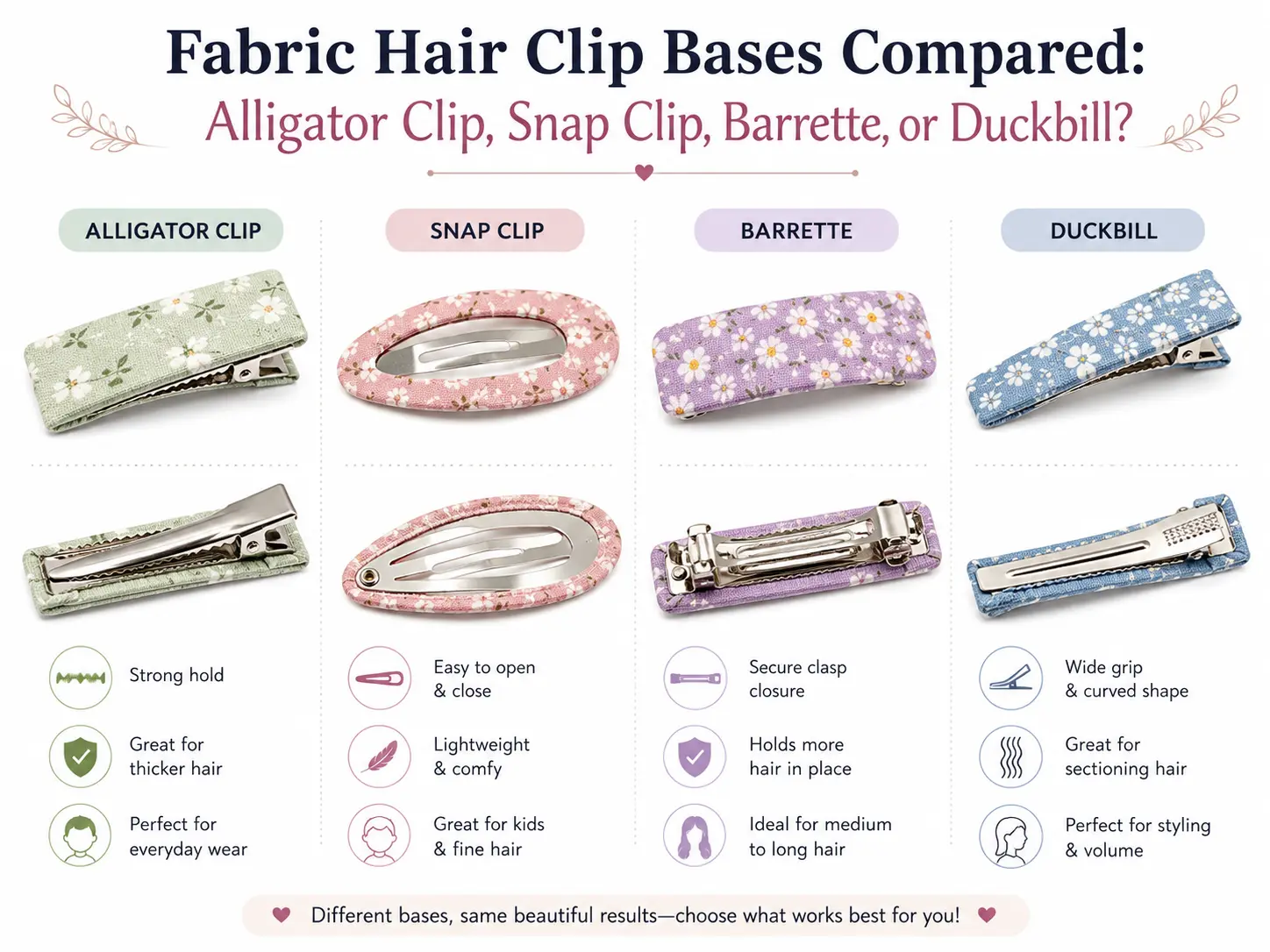
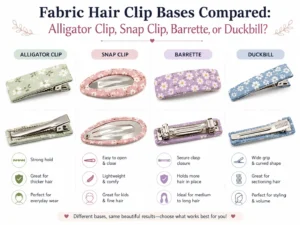
Alligator clips, snap clips, barrettes, and duckbill clips may look interchangeable in a quotation sheet, but their mechanisms behave differently. They vary in contact length, spring pressure, closed gap, decoration area, assembly time, suitability for different hair densities, and ability to carry heavy fabric structures.
The market rewards better decisions. Grand View Research values the global clips-and-pins segment at USD 5.66 billion in 2025 and projects 8.1% annual growth through 2033. Statista’s USD 758.14 billion 2026 forecast covers the much broader accessories market and is included only as consumer-spending context.
This guide compares the four main bases from a buyer and manufacturing perspective. It explains how each mechanism works, where it performs best, which decorations it can support, what production problems to expect, how packaging affects the choice, and which safety questions brands should answer before mass production.
Why the Fabric Hair Clip Type Matters
Holding Strength and Comfort
A clip holds through spring force, contact area, jaw geometry, texture, teeth, curvature, and the amount of hair captured. More force is not always better; excessive pressure can cause discomfort, creasing, or concentrated contact at a metal edge.
Hair is not a consistent substrate. A 2025 friction review found that surface chemistry, roughness, product treatment, and environment influence grip, while a 2024 study reported different friction dynamics among straight, wavy, and curly hair.
Product Appearance and Function
The clip base determines how much of the mechanism remains visible and how much decoration area is available. Snap clips lie close to the head. Barrettes provide a broad platform for a statement bow. Alligator clips can hide beneath a narrow center band. Duckbill clips create a long, slim silhouette but may extend beyond a small decoration.
The mechanism must remain functional after fabric is added. Thick ribbon can block alligator teeth. A padded cover can prevent a snap clip from reaching its closed position. Adhesive can enter a barrette clasp. A center wrap can restrict the spring of a duckbill clip.
Target Hair Type and Age Group
Fine hair often needs a smaller closed gap, lower decoration weight, and added friction. Thick or curly hair needs greater opening capacity and stable spring recovery. Children’s clips require careful edge finishing, secure attachments, age-appropriate dimensions, and a product-specific compliance review.
| Design question | Why it changes the base choice | Example decision |
|---|---|---|
| How much hair will be captured? | Determines opening capacity and closed gap. | Choose a barrette for a thick half-up section rather than a small snap clip. |
| How heavy is the decoration? | Heavy fabric creates downward force and rotation. | Use a longer platform for a layered velvet bow. |
| Is the clip decorative or functional? | Primary hold needs stronger retention than styling over another tie. | A jumbo bow may use a barrette for display but sit over a separate ponytail elastic. |
| Who will wear it? | Hair density, age, comfort, and compliance differ. | A lightweight lined alligator clip may suit a children’s bow pair. |
Expert rule: Approve the finished decorated clip, not the empty metal base. Fabric, glue, labels, padding, and ornaments can change the mechanism’s force, balance, and usable opening.
Alligator Clip Bases
Structure and Working Mechanism
An alligator clip base uses two elongated jaws connected by a spring-loaded hinge. The user presses the rear levers to open the front. Versions include single-prong, double-prong, smooth-jaw, toothed, fully lined, partially lined, and unlined clips.
The long jaw creates a useful contact zone. Teeth can engage a small hair section, while ribbon or silicone can increase friction. Typical development lengths range from approximately 30 to 80 mm, although larger and smaller options exist.
Main Advantages
Alligator clips are versatile, easy to hide behind bows, and compatible with sewing, adhesive, wrapping, or hybrid attachment. Toothed versions can perform well on fine hair when tips are rounded and the closed gap is controlled.
Main Limitations
Exposed teeth can snag if poorly finished. Thick lining can reduce opening, and heavy decorations may rotate on the narrow base.
Best Fabric Hair Accessory Applications
Alligator bases suit classic bows, sailor bows, mini bow pairs, fabric flowers, ribbon rosettes, school clips, and lightweight children’s sets. They are often the best first prototype for a small or medium fabric bow clip.
Snap Clip Bases
Structure and Working Mechanism
A snap hair clip is usually a curved, pre-stressed metal shell. Pressing the center changes it between convex and concave positions, creating a bistable snap action. Unlike an alligator clip, it does not rely on a conventional rear hinge with two moving jaws.
The base follows the head closely and captures a relatively flat section of hair. Common lengths for fabric-covered products begin around 30–70 mm, depending on intended age and decoration.
Main Advantages
Snap clips are lightweight, low profile, economical, and effective for bangs or fine front sections. Their outer shell can carry flat fabric, ribbon, crochet, or appliqué.
Main Limitations
Opening capacity is limited for thick hair. Over-flexing can weaken the snap action, while excess fabric or adhesive can prevent full closure.
Best Fabric Hair Accessory Applications
Snap bases suit mini bows, slim padded clips, fabric-covered pairs, embroidered motifs, appliqué shapes, and low-profile children’s sets. They work best when the decoration remains light and does not cover the flexing zones.
Barrette Clip Bases
Structure and Working Mechanism
A barrette usually includes a decorative platform or upper plate, a curved tension arm, and an automatic clasp. A French barrette may use a removable or adjustable center bar to accommodate different hair quantities. The broad platform spreads decoration weight across a larger area than most alligator clips.
Main Advantages
Barrettes provide the largest stable decoration platform. They suit large bows, layered structures, beading, padded designs, bridal accessories, and half-up hairstyles.
Main Limitations
Barrettes are heavier and costlier than basic snap or alligator clips. Their clasps add inspection steps, and an oversized base may not close securely on fine hair.
Best Fabric Hair Accessory Applications
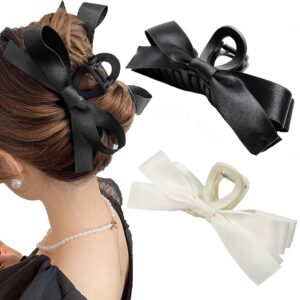
Barrette bases suit oversized satin bows, velvet statement pieces, bridal bows, layered flowers, embroidered panels, padded knots, and premium gift collections. They are usually the strongest option when the accessory itself is large enough to conceal the mechanism.
Duckbill Clip Bases
Structure and Working Mechanism
A duckbill sectioning clip uses long, narrow jaws that taper toward the front. A spring near the rear opens and closes the jaws. Many professional versions have smooth or lightly textured metal surfaces and a slight curve that follows the head.
Main Advantages
Duckbill clips are strong choices for sectioning, pin curls, roller sets, skincare routines, and temporary styling control. Their length offers precision with low visual bulk.
Main Limitations
Smooth jaws may slide on conditioned fine hair. The narrow body supports less decoration area, and fabric near the spring can interfere with opening.
Best Fabric Hair Accessory Applications
Duckbill bases work for elongated bows, slim side clips, fabric-covered styling clips, creaseless padded designs, professional kits, and long appliqué decorations. They are less suitable for compact, heavy bows that need a wide support plate.
Comparing Each Fabric Hair Clip Type
Grip Strength Comparison
Toothed alligator clips usually grip small sections most strongly. Barrettes hold larger bundles, snap clips suit flat fine sections, and duckbill clips offer long contact but may need added texture.
Comfort Comparison
Comfort depends on pressure distribution and edge quality. Snap clips lie flat, barrettes spread load, alligator teeth require careful finishing, and duckbill clips are better suited to temporary wear.
Decoration Area Comparison
Barrettes provide the largest stable platform; alligator clips offer a narrow versatile zone; snap clips support flat decorations; duckbill clips suit long lightweight designs.
Cost and Assembly Comparison
Snap clips are generally the simplest and least costly. Alligator clips remain economical, barrettes add parts and inspection, and duckbill cost varies with metal and spring quality.
Packaging and Shipping Comparison
Snap clips pack flat. Alligator and duckbill clips should be secured to prevent opening or scratches, while barrettes need clasp protection and deeper packs for large decorations.
| Criterion | Alligator | Snap | Barrette | Duckbill |
|---|---|---|---|---|
| Grip on small fine-hair section | High with teeth/grip strip | Medium to high | Variable by closed gap | Medium unless textured |
| Capacity for thick hair | Medium | Low | High | Medium |
| Decoration area | Medium | Small to medium | High | Long but narrow |
| Relative component cost | Low to medium | Low | Medium to high | Low to medium |
| Assembly complexity | Low to medium | Medium when fully covered | Medium to high | Low to medium |
| Shipping efficiency | Good when fixed to card | Excellent | Moderate | Good but needs tip protection |
| Best core use | Bows and flowers | Mini flat clips | Statement accessories | Sectioning and elongated designs |
Choosing a Fabric Hair Clip Type by Hair Profile
Fine and Thin Hair
Fine hair benefits from low decoration weight, a small closed gap, and controlled friction. Toothed alligator clips, curved snap clips, and fine-hair barrettes can work when pressure remains comfortable.
Avoid solving slippage only by increasing pressure. The hair-friction research cited earlier shows that hair condition and surface treatment affect grip. A comfortable design should combine moderate pressure with sufficient contact area and controlled texture.
Thick and Curly Hair
Thick and curly hair needs opening capacity and stable recovery. A medium or large barrette is often the best decorative option, while long alligator or duckbill clips suit temporary sectioning.
Children’s Hair
Light alligator or snap clips are common for children’s bows. Use rounded metal, secure edges, controlled spring pressure, durable attachment, and a product-specific compliance review.
In the United States, CPSC guidance lists barrettes and certain grooming clips among products excluded from the federal small-parts ban. That exemption does not remove other potentially applicable requirements. A children’s product subject to applicable CPSC rules may still require third-party testing and a Children’s Product Certificate.
Professional Styling and Sectioning
Duckbill clips are the strongest match for precision sectioning, roller placement, cutting, coloring, and temporary control. Alligator-style sectioning clips provide stronger grip on large sections, while smooth duckbill clips are preferred when low bulk and accurate placement matter.
| Target user or task | Recommended starting base | Reason | Validation test |
|---|---|---|---|
| Fine side section | Toothed alligator or curved snap | Small closed gap and focused contact | Static and dynamic slip test |
| Thick half-up style | French barrette | Greater opening and broad support | Closure, hold, and accidental-release test |
| Children’s bow pair | Light lined alligator or snap | Compact scale and familiar use | Attachment, edge, age, and compliance review |
| Salon sectioning | Duckbill clip | Long, precise, low-profile jaw | Cycle, corrosion, and wet-hair hold test |
How Fabric Decoration Affects Clip Base Selection
Lightweight Bows and Small Flowers
Mini cotton bows, organza flowers, and ribbon decorations can use snap or alligator bases. Keep the center of mass close to the clip to reduce rotation.
Large Bows and Layered Decorations
Large satin, velvet, or layered bows usually need a barrette or long alligator base with enough support to prevent twisting.
Padded and Embellished Fabric Designs
Padded knots, pearls, charms, stones, and embroidery increase weight. Use a broad attachment area and keep all components clear of the hinge or clasp.
| Decoration | Preferred base | Design adjustment | Main failure risk |
|---|---|---|---|
| Mini cotton bow | Snap or small alligator | Use thin center wrap and low glue weight. | Off-center appearance and blocked closure |
| Classic grosgrain bow | Toothed alligator | Keep teeth exposed and center the bow over the spine. | Rotation or ribbon entering hinge |
| Oversized satin bow | Non-slip barrette | Use low-weight construction and broad attachment. | Sagging, rotation, and crushed tails |
| Padded embellished clip | Barrette or reinforced alligator | Add mechanical stitching and secure loose parts. | Detachment and excessive weight |
| Long skincare clip | Duckbill | Use thin washable padding. | Loss of spring travel |
How Buyers Should Test Clip Bases
| Test | Method | What it reveals |
|---|---|---|
| Opening-cycle test | Open and close to a defined count, then compare force and alignment. | Spring fatigue, snap weakening, clasp failure, and fabric interference |
| Static slip test | Place on a standardized hair tress and measure movement over time. | Retention on the target hair profile |
| Dynamic wear test | Simulate walking, head turning, or professional styling movement. | Rotation, release, and real-use stability |
| Attachment pull/torque | Apply a product-specific load to the decoration. | Adhesive, stitch, fabric, or base failure mode |
| Edge and snag test | Insert and remove repeatedly from hair tresses. | Burrs, lifted lining, hard glue, and snag risk |
| Packaging simulation | Pack, vibrate, drop, and inspect. | Crushing, bent bases, card tears, and surface scratches |
Questions to Confirm Before Production
Who Is the Target Customer?
How Will the Clip Be Used?
Clarify whether the clip holds a primary hairstyle, decorates hair already secured, controls bangs, supports rollers, or serves as a professional sectioning tool.
What Grip Strength Is Required?
Specify the hair bundle, wear time, movement conditions, reference sample, and measurable slip or closure criteria.
What Safety Standards Must Be Met?
Confirm age classification, destination, materials, coatings, restricted substances, labeling, traceability, and testing responsibility. The EU GPSR has applied since December 13, 2024.
| Purchase-order field | Example specification |
|---|---|
| Base type | 45 mm toothed alligator clip |
| Material and finish | Steel, light-gold plated, rounded edges |
| Decoration | Grosgrain bow, 90 × 55 mm |
| Grip component | Textured ribbon on inner upper jaw |
| Attachment | Adhesive positioning plus stitched center wrap |
| Functional claim | Side clip for fine-to-medium hair |
| QC | Cycle, slip, attachment, edge, appearance, and packaging tests |
| Reference | Approved golden sample FH-03 |
Brands can review clip bases, fabrics, grip components, logo methods, packaging, sampling, and private-label development at Q&N Beauty and its custom hair accessories manufacturing page.
Case Study: Three Base Strategies in the Market
Mimi & Lula: Alligator Bases for Children’s Bow Sets
Mimi & Lula lists a bow pack containing a large hand-tied grosgrain bow on a 4.5 cm alligator clip and smaller velvet bows on alligator clips. The product also states that it is not suitable for children under 36 months. The case shows how a recognizable base, light fabric construction, coordinated set packaging, and clear age communication work together.
Lele Sadoughi: A Non-Slip Barrette for a Statement Bow
Lele Sadoughi lists an oversized poly-satin bow measuring 15 by 8 inches with a non-slip barrette closure. A bow of this scale needs a wide support area, controlled weight, stable balance, and packaging that protects its shape. A small alligator or snap clip would not provide the same design platform.
Fromm: Duckbill Clips as Professional Tools
Fromm markets Precision Hold Duck Bill Clips for securing rollers and sectioning hair. This demonstrates that the duckbill’s strongest value is precision and low-profile control rather than carrying a heavy fashion decoration.
Case-study takeaway: The base should reinforce the product promise. Alligator clips support compact bow sets. Barrettes support large fashion statements. Duckbill clips support professional accuracy. Trying to use one base across all three positions would weaken the consumer benefit.
Pros and Cons Summary
| Base | Primary advantages | Primary limitations |
|---|---|---|
| Alligator | Versatile, strong grip options, easy to hide, suitable for many bows | Teeth and spring require careful comfort and snag control |
| Snap | Low cost, low profile, efficient packaging, good for fine front sections | Limited hair capacity and sensitive to thick fabric covering |
| Barrette | Large decoration area, strong half-up hold, suitable for statement designs | Higher cost, weight, assembly complexity, and packaging volume |
| Duckbill | Precise sectioning, long slim form, professional versatility | Limited decoration width and lower grip on smooth hair without modification |
Frequently Asked Questions
What is the best clip base for fabric hair bows?
A toothed alligator clip is a strong default for small and medium bows. Large or heavy bows usually perform better on a barrette. Mini flat decorations can use snap clips, while elongated styling designs may suit duckbill clips.
Are alligator clips better than snap clips?
Alligator clips usually provide more opening capacity and stronger grip options. Snap clips are flatter, lighter, and better for small front sections. The better choice depends on hair quantity, decoration weight, and desired profile.
Which hair clip is best for fine hair?
A toothed alligator clip, curved snap clip, or fine-hair barrette can work well. The finished closed gap, contact area, decoration weight, and grip surface matter more than the base name alone.
What is the difference between duckbill and alligator clips?
Both use a rear spring, but an alligator clip usually has more pronounced jaws or teeth for grip. A duckbill clip is longer, slimmer, and commonly used for precise sectioning, roller placement, and temporary styling.
Which clip base is best for thick or curly hair?
A medium or large barrette generally provides the best opening capacity and support for a decorative half-up style. Professional sectioning may use long alligator or duckbill clips.
Can fabric cover the entire hair clip base?
It can cover decorative surfaces, but it should not block teeth, hinges, springs, snap-flex zones, or clasps. The finished covered clip must be retested for opening, closing, holding, and snagging.
How should children’s fabric clips be tested?
Complete a product-specific review covering intended age, edges, attachment security, coatings, materials, tracking and labeling, applicable chemical rules, and required certification. Do not rely on a generic toy or small-parts checklist.
Conclusion: Choose the Fabric Hair Clip Type by Function
The best fabric hair clip type is the one that supports the intended hairstyle, decoration, consumer, and price point without creating unnecessary pressure, weight, or production risk.
Alligator clips offer the broadest versatility for bows and flowers. Snap clips provide a lightweight, low-profile option for small decorations and fine front sections. Barrettes provide the largest stable platform for thick hair and statement pieces. Duckbill clips excel in professional sectioning and elongated, lightweight designs.
Future product development will use more hair-type-specific closed gaps, calibrated spring forces, molded grip zones, recycled textile coverings, lighter statement structures, and digital QC records linked to golden samples. Packaging will also become more base-specific as brands seek to reduce scratches, crushing, and shipping volume.
Ready to select a clip base for your collection? Visit Q&N Beauty to discuss alligator clips, snap clips, barrettes, duckbill clips, fabrics, anti-slip components, custom logos, samples, testing, packaging, and production quotations.
Sources and External Link Placements
- Grand View Research: Clips & Pins
- Statista: Accessories Forecast
- Google: People-First Content
- Google: AI Search Guidance
- Human Hair Friction Review
- Hair-Type Friction Study
- CPSC: Children’s Product Certificate
- CPSC: Small Parts and Barrettes
- European Commission: Product Safety
- Mimi & Lula Alligator Case
- Lele Sadoughi Barrette Case
- Fromm Duckbill Case
- Goody Clip Platform