A hair accessory quality control checklist should answer one commercial question: is this production lot ready to ship? A visually attractive carton can still contain stretched elastic, weak bow attachments, misaligned claw-clip hinges, mixed dye lots, incorrect barcodes, or packaging that crushes the product in transit. If those faults are discovered after import, the buyer may face sorting, rework, delayed launches, chargebacks, returns, or a product-safety response.
This guide gives purchasing teams a practical framework for approving scrunchies, hair bows, fabric clips, padded headbands, heatless curling sets, claw clips, and other private-label hair accessories. It covers the approved standard, random sampling, defect classification, product-specific checks, functional tests, compliance records, packaging, and failed-inspection decisions.
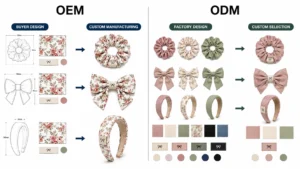
If you are preparing an order, send your design, target market, product specification, and packaging plan through Q&N Beauty’s custom hair accessory service to discuss material choices and an inspection plan. Any test method, tolerance, MOQ, cost, or schedule should be confirmed after specification review.
Build the Hair Accessory Quality Control Checklist Before Production
Freeze the Product Specification and Approved Sample
Final inspection cannot resolve an undefined requirement. Before cutting fabric, molding components, or assembling decorations, issue a controlled specification for every SKU. It should identify the approved materials, construction, finished dimensions, tolerances, color references, logo artwork, packaging, performance requirements, and destination market.
Keep a signed pre-production sample, often called the golden sample, at both the buyer’s office and the factory. Label it with the version, approval date, SKU, colorway, and any approved deviations. A sample is strongest when paired with measurements: “match approved sample” is not enough if two people interpret softness, spring tension, symmetry, or acceptable glue visibility differently.
- Scrunchies: fabric composition and weight, tube width, relaxed dimensions, elastic construction, gathering, seam method, and label position
- Hair bows and fabric clips: finished width and height, tail length, fold geometry, clip type and direction, attachment method, and motif placement
- Padded headbands: band width, internal base, padding material and thickness, end finish, covering alignment, and target fit
- Heatless curling sets: rod length and diameter, filling type and density, fabric, closure, matching scrunchies, and set contents
- Claw clips: material, dimensions, weight when relevant, tooth profile, hinge, spring, opening, surface finish, decoration, and logo
Define Inspection Scope, Tools, and Evidence
State the required production status. Final random inspection is most useful when the lot is complete and most units are packed, subject to the readiness condition agreed in the purchase contract.
List required tools, such as a caliper, scale, color reference, barcode scanner, force gauge, template, hair tress, or cycle fixture. Define the test sample and required photographs.
Compare 100% Sorting, Random Sampling, and Combined Control
| Inspection approach | Advantages | Limitations | Recommended use | Quality risk |
|---|---|---|---|---|
| 100% visual sorting | Can remove visible defects and wrong variants | Labor-intensive; inspector fatigue; weak for latent failures | Defined high-visibility features or containment after a failure | A checked unit can still fail function or compliance |
| Final random sampling | Efficient lot-acceptance decision using a defined plan | Does not prove every unit is conforming | Routine shipment release for stable production | Rare or clustered defects may be missed |
| Inline inspection | Finds process drift before the lot is finished | Requires timely records and corrective action | New designs, new materials, and complex assembly | Later processes can introduce new defects |
| Combined risk-based control | Covers incoming materials, process, finished goods, and packing | Needs planning and supplier cooperation | Private-label programs and repeat orders | Weak specifications still create inconsistent decisions |
A practical program combines process controls, targeted 100% checks, functional tests, and statistically defined final sampling. Inspection does not replace product engineering or applicable laboratory testing.
Set the Sampling Plan and Defect Classification
Use an AQL Plan Without Treating It as a Quality Guarantee
ISO 2859-1:2026 defines acceptance-sampling schemes for inspection by attributes. Lot size, inspection level, AQL, sampling type, and inspection severity determine the sample and acceptance or rejection numbers. The 2026 edition replaced the earlier 1999 edition and includes updated sampling guidance.
The buyer and supplier should name the standard edition and agreed plan in the purchase order or inspection instruction. Do not copy an AQL value from another product and assume it is suitable. A basic fabric scrunchie, a rhinestone children’s clip, and a plated metal claw clip have different failure modes. Safety-critical controls may require prevention, applicable testing, and zero-acceptance rules rather than reliance on ordinary cosmetic sampling.
Classify Critical, Major, and Minor Defects Before Inspection
| Defect class | Purchasing meaning | Hair accessory examples | Typical decision logic |
|---|---|---|---|
| Critical | Potential safety hazard or legal nonconformity | Accessible sharp burr; prohibited substance failure; hazardous loose part where applicable; wrong mandatory warning | Use the contract’s strict critical-defect rule and contain the affected lot |
| Major | Material loss of function, durability, saleability, or approved appearance | Broken elastic; clip will not close; severe shade mismatch; detached bow; wrong SKU or barcode | Count against the agreed major-defect acceptance plan |
| Minor | Limited deviation that does not materially impair normal use | Small trim inconsistency or slight nonfunctional alignment variation within defined limits | Count against the agreed minor-defect acceptance plan |
Classification depends on context. A loose thread may be minor, while exposed wire can create a safety concern. An off-center logo may be major on a premium bow. Maintain a photo-based defect library for recurring orders.
Make the Lot, Carton, and Sample Selection Traceable
Confirm what constitutes the lot: one purchase order, SKU, color, component batch, production period, or another defined grouping. The inspector should select cartons across the shipment rather than accept factory-preselected units. Record carton numbers and the number of units inspected by SKU and color.
For multiple styles or colorways, define separate or proportional sample coverage so small sub-lots are represented. Retain the report, defect photographs, measurements, and selection record.
Verify Order Identity, Quantity, Materials, and Color
Match the Purchase Order, SKUs, and Assortments
Begin with identity, not workmanship. Compare the purchase order, approved packing list, production records, and physical goods. Count finished units and cartons using an agreed verification method. Check item number, style, size, color, set composition, pair orientation, inner-pack quantity, carton quantity, and assortment ratio.
Open cartons from different pallet positions. Check mixed-color sets piece by piece, especially similar shades and mirrored bow pairs.
Confirm Fabric, Elastic, Clip Bases, Padding, and Decorations
Compare materials with approved swatches, component samples, bills of materials, and purchase specifications. For fabric, check composition documentation where required, weight or thickness if specified, texture, luster, stretch, nap direction, stains, holes, snags, and odor. For elastic, confirm width, cut length or joined circumference, construction, surface condition, and recovery behavior.
Inspect metal clips, springs, plastic or acetate bodies, padding, wire, combs, pearls, rhinestones, and logo plates against approved components. Any substitution should trigger documented review and, where necessary, renewed testing.
Control Pantone Color, Prints, and Dye-Lot Variation
Define whether color is approved against a physical standard, lab dip, material-specific Pantone reference, or signed sample. Inspect under agreed lighting and compare within sets and across cartons; fiber, luster, pile, and dye lot affect appearance.
For prints, check scale, repeat, registration, orientation, color, and motif placement. Define whether motifs are centered, mirrored, paired, or random, and control one-way cutting.
Inspect Workmanship by Hair Accessory Type
Scrunchies, Hair Ties, and Fabric Loops
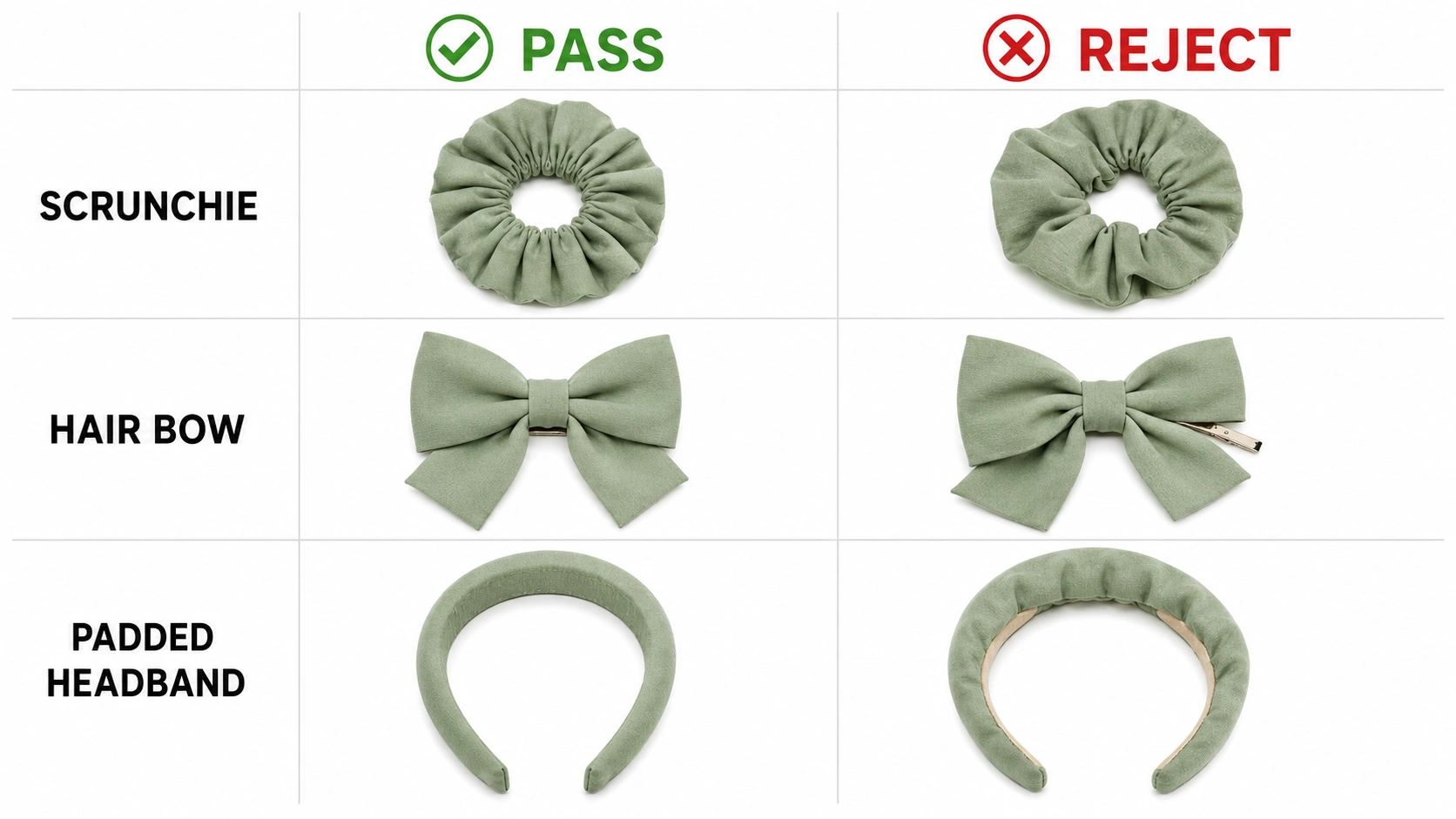
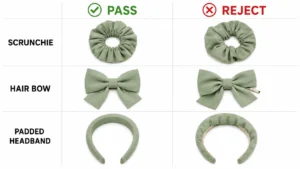
Lay each scrunchie flat and check size, tube width, roundness, gathering, fabric direction, and label placement. Inspect for skipped stitches, open closure, exposed elastic, raw edges, loose threads, stains, and damage.
Then evaluate the finished elastic system. A raw elastic strip can pass incoming inspection but fail after joining, sewing, or exposure to heat. Measure initial dimensions, stretch the product to the approved working extension, cycle it as specified, allow the defined rest period, and remeasure. Acceptance values must be validated for the design and confirmed after sample evaluation.
Hair Bows and Fabric-Covered Clips
Use a template to compare bow dimensions, shape, tails, center wrap, and angle. Confirm pattern matching, clip direction, and centerline; off-center weight can rotate the bow.
Inspect glue from the front, back, edges, hinge, teeth, and clasp. Reject visible stains, glue strings, hard ridges in contact areas, fabric trapped in the mechanism, fraying, or exposed interfacing according to the approved defect standard. Pull or torque the completed attachment using the agreed method rather than testing the bare clip alone.
Padded Headbands and Heatless Curling Sets
For padded headbands, measure total width, crown height, padding thickness, end dimensions, and symmetry. Check that padding is evenly distributed and that the inner base, wire, staples, or hard adhesive cannot be felt or exposed. Assess covering seams, pleat direction, print position, end wrapping, surface dents, shape recovery, and fit against the approved fixture or wear protocol.
For heatless curling sets, verify rod dimensions, filling density, straightness, seams, fabric, fasteners, and set contents. Check for lumps, voids, twisting, fabric slippage, or packaging deformation. Use an approved procedure because material, rod size, and filling change grip and comfort.
Claw Clips, Barrettes, and Metal Components
Measure the body, jaw, teeth, hinge, closed gap, and decoration where they affect use. Inspect for cracks, flash, warping, scratches, color variation, poor plating coverage, pits, or peeling.
Open and close the finished clip repeatedly using the approved cycle. Observe spring action, hinge alignment, tooth contact, clasp engagement, noise, side play, and unexpected release. Run a finger-safe visual and tactile check for burrs, sharp edges, pointed wire, protruding pins, and hardened glue. Grip tests should use defined hair tresses or a validated fixture; hand feel alone is not a repeatable acceptance method.
| Product type | Key inspection points | Common quality risks | Useful evidence |
|---|---|---|---|
| Scrunchie | Size, gathering, seam, elastic recovery, shade | Slippage, exposed elastic, dye-lot mismatch | Measurements, cycle results, shade photos |
| Fabric bow clip | Symmetry, motif, clip direction, glue, attachment | Rotation, detachment, fraying, blocked hinge | Template photo, pull/torque record |
| Padded headband | Width, padding, symmetry, end finish, fit | Dents, pressure points, exposed base, twisting | Profile measurements, fixture comparison |
| Heatless curling set | Rod dimensions, filling, seam, set contents, recovery | Lumps, deformation, missing pieces, fabric slip | Set photo, measurements, use-test record |
| Claw or metal clip | Hinge, spring, teeth, grip, surface, edges | Cracks, weak hold, burrs, plating variation | Cycle log, grip result, close-up photos |
Test Function, Durability, and Product Safety
Turn Subjective Expectations Into Repeatable Tests
Words such as “strong,” “comfortable,” and “premium” are not inspection criteria. Define the setup, conditioning, equipment, action, duration, and pass/fail result. For a grip test, name the hair-tress type, thickness, preparation, orientation, movement, and allowable displacement. For elastic recovery, define working extension, cycles, speed, rest time, and allowable permanent growth or force loss.
Establish viable criteria during development and record them in the specification. New materials, heavier decorations, alternative springs, or a different elastic lot may require evaluation before existing limits are reused.
Check Seams, Attachments, Springs, and Surface Durability
Apply tests to the completed product. Inspect seam opening under the intended wrapping or bending load. Test woven labels, bows, pearls, rhinestones, charms, logo plates, and fabric coverings at their weakest attachment direction. Examine what fails first: adhesive, thread, fabric, decoration, coating, or base component.
For clips, record operation before and after cycling. Select rub, perspiration, corrosion, or colorfastness tests after reviewing materials, claims, contact, and market requirements. Methods and limits are product-specific.
Screen for Sharp Edges, Loose Parts, and Foreseeable Misuse
Inspect accessible edges, teeth, wires, staples, broken plastic, metal burrs, and hard adhesive. Flex the product as it may be handled, dropped, opened, or worn; hidden components can become accessible after reasonable deformation. Check whether decorations can detach and whether their size, shape, or material creates a risk for the target age group.
Do not assume every small hair clip is legally a toy or that every barrette falls under the same children’s-product rules. In the United States, classification depends on whether the product is designed or intended primarily for children 12 or younger. The CPSC’s Children’s Product Certificate guidance explains that products subject to applicable children’s product safety rules require certification based on the required third-party testing. The importer or domestic manufacturer is responsible for the certificate.
Separate Visual Inspection From Chemical and Regulatory Testing
Chemical limits cannot be verified by sight. Build the test plan from the product, substrate, coating, adhesive, age grading, claims, and sales market. Link reports to current materials and control supplier changes.
For the EU, the General Product Safety Regulation requires consumer products within scope to be safe and establishes obligations including risk analysis, technical documentation, identification, and traceability. Chemical restrictions under REACH depend on the substance, material, use, and applicable entry. Ordinary hair accessories are not automatically CE-marked products.
For the UK, obligations vary between Great Britain and Northern Ireland. The UK Office for Product Safety and Standards guidance directs manufacturers and importers to minimize risk, retain technical documentation, provide appropriate labeling, and maintain traceability. Confirm current rules for the destination and product before production; a factory audit or management-system certificate does not substitute for product-specific compliance.
If you need a manufacturability review before locking these controls, submit your reference photos, drawings, tech pack, material list, logo artwork, and target market through the Q&N Beauty project inquiry page. The team can review how proposed construction, components, branding, and packaging affect sampling and production inspection.
Inspect Branding, Retail Packaging, and Shipment Documents
Verify Logos, Labels, Barcodes, and Traceability
Compare labels, embroidery, transfers, logo plates, debossing, cards, and stickers with signed files. Check spelling, size, color, position, edge finish, adhesion, and effects on comfort or operation.
Scan production barcodes rather than approving only the artwork. Match the encoded data with the human-readable number, SKU, color, and pack quantity. Verify country-of-origin marking, responsible-party information, batch or traceability identifiers, care statements, age information, and warnings where required by the destination market and product risk assessment.
Check Unit Packs, Inner Cartons, and Master Cartons
Packaging must not overstretch scrunchies, scratch clips, dent padding, or crush bows and teeth. Compare bags, sleeves, inserts, dividers, seals, and retail presentation with the approved pack sample.
For inner and master cartons, verify quantities, assortments, dimensions, gross weight, marks, box condition, sealing, and palletization where applicable. Delicate structures or long routes may justify a packaging trial or transport test, subject to logistics review.
Complete the Shipment Release File
A pass mark is useful only when the evidence is complete. The release file should identify the purchase order, SKU, lot, quantity, production location, inspection date, sampling plan, inspected quantity, defect counts, measurements, test results, carton selection, photographs, and conclusion.
- Signed specification and current approved sample reference
- Final inspection report with defect and measurement detail
- Packing list, carton marks, and barcode verification
- Material declarations and lot traceability where required
- Applicable test reports and certificates matched to the product
- Corrective-action and reinspection records if the lot previously failed
- Buyer-authorized deviation approval for any accepted exception
Use the more focused scrunchie and fabric hair clip QC guide when those products form the main order.
Handle Failed Inspections and Supplier Corrective Action
Contain, Sort, Rework, and Reinspect the Lot
A failed inspection should stop automatic shipment release. Use a documented recovery sequence:
- Quarantine the affected lot.
- Determine whether defects are isolated, clustered, batch-linked, or systematic.
- Approve sorting, rework, replacement, repacking, or retesting as appropriate.
- Verify corrective work and select fresh samples.
- Release, reject, or approve a written deviation under the purchase contract.
Reinspection should use newly selected samples after corrective work is complete. Do not simply remove the defects found in the first sample and present the same goods again. For a safety or compliance concern, obtain competent regulatory and laboratory advice; cosmetic rework cannot cure an unverified chemical or structural risk.
Require Root Cause and Corrective Evidence
Ask why the defect occurred, why controls did not prevent it, and why earlier checks missed it. Evidence might include a revised template, calibrated gauge, controlled adhesive quantity, changed fixture, lot segregation, retraining, or added first-piece approval.
Illustrative Manufacturing Scenario: a padded headband lot fails because the logo drifts and crown thickness varies. Sorting may protect the current shipment, but recurrence prevention needs fixed placement datums, a padding-weight or profile control, an approved first-piece check, and recorded inline measurements. This example illustrates decision logic; it is not a claimed customer case.
Avoid Common Buyer Mistakes and Supplier Red Flags
- Starting production with only a reference photo and no dimensional or functional specification
- Approving color on a screen without a physical material standard or lighting condition
- Testing raw elastic or bare clips but not the fully assembled product
- Using one defect list for adult scrunchies, children’s bows, and rigid claw clips
- Accepting a generic test report that does not match the materials, colors, components, or production lot
- Letting the factory preselect inspection samples
- Authorizing shipment before corrective work and reinspection are documented
Red flags include poor traceability, inconsistent samples, undocumented substitutions, refusal of random carton selection, and reports containing only a pass/fail summary. A capable supplier can show controls, isolate nonconforming goods, and link evidence to the product.
Q&N Beauty’s published company and manufacturing information describes OEM/ODM work across fabric and rigid hair-accessory categories. For any project, buyers should still verify current capability, audit and certification scope, subcontracted processes, testing responsibilities, and the exact QC plan for their order.
Hair Accessory Quality Control FAQ
What Should Buyers Inspect Before Hair Accessories Are Shipped?
Verify product identity, quantity, materials, color, dimensions, workmanship, function, safety-related features, branding, retail packaging, carton packing, and shipment documents. Use the approved sample and written specification, select samples randomly, record defects by class, and release the lot only after all agreed criteria and applicable compliance requirements are met.
What AQL Should Be Used for Hair Accessories?
There is no universal AQL for every hair accessory order. Select the current sampling standard, inspection level, AQLs, and critical-defect rule based on product risk, lot history, customer requirements, and contract terms. Document the plan before production. AQL sampling does not replace safety controls or laboratory testing.
How Do You Inspect Scrunchie Elastic Recovery?
Record the initial relaxed dimension and, where relevant, force at a defined extension. Cycle the finished scrunchie to its validated working extension, allow the specified rest period, and repeat the measurements. Compare permanent growth and force change with limits approved during sample evaluation.
How Do You Test a Hair Clip’s Holding Strength?
Use a defined hair tress or validated fixture that represents the intended hair profile. Specify tress size, preparation, clip position, movement or load, test duration, and allowable slip. Also inspect spring action, tooth contact, hinge alignment, closed gap, and decoration weight, because each can affect hold.
What Documents Should a Buyer Receive Before Shipment?
Request the signed specification, approved-sample reference, final inspection report, packing list, barcode and label verification, traceability records, approved deviations, corrective actions, and applicable product-specific test reports or certificates. Check that document descriptions, dates, materials, model numbers, and production locations match the order.
Expert Summary, Future Trends, and Shipment-Ready Inquiry
Expert Summary: Release the Lot, Not Just the Sample
The strongest hair accessory quality control checklist connects design intent to a traceable shipment decision. It starts with a measurable specification and approved sample, uses risk-based process controls, classifies defects consistently, selects final samples independently, tests finished-product function, verifies packaging and documentation, and defines what happens when the lot fails.
A report showing selected cartons, measurements, function tests, defects, traceability, and corrective action is more useful than a page stating “quality passed.” Final inspection cannot compensate for uncontrolled materials or vague approvals.
Future Trends in Hair Accessory Inspection
Quality programs are moving toward digital inspection records, barcode-linked component lots, image-assisted measurement, force data for elastic and clip tests, and defect dashboards by SKU and process. These tools can make trends easier to see, but the purchasing team must still define meaningful criteria and validate the test setup.
Expect greater emphasis on material traceability, supplier change control, packaging optimization, and documentation that connects a retail SKU to its risk assessment and evidence. Brands developing recycled fabrics, mixed-material decorations, specialty coatings, or reduced packaging will need to review new failure modes rather than reuse an old checklist unchanged.
Request a Sample, QC Plan, or Bulk Production Review
For a useful manufacturability assessment, sample plan, or bulk quotation, provide:
- Product type
- Product dimensions
- Reference photos, design drawings, or tech pack
- Fabric and material requirements
- Pantone colors or print artwork
- Logo file and preferred branding method
- Target quantity
- Packaging requirements
- Delivery country
- Target delivery date
- Applicable market or compliance requirements
Share these details with Q&N Beauty to review samples, customization, mass-production controls, pre-shipment inspection, and packaging. Feasibility, MOQ, price, sampling, testing, and production timing are subject to specification review and written confirmation.