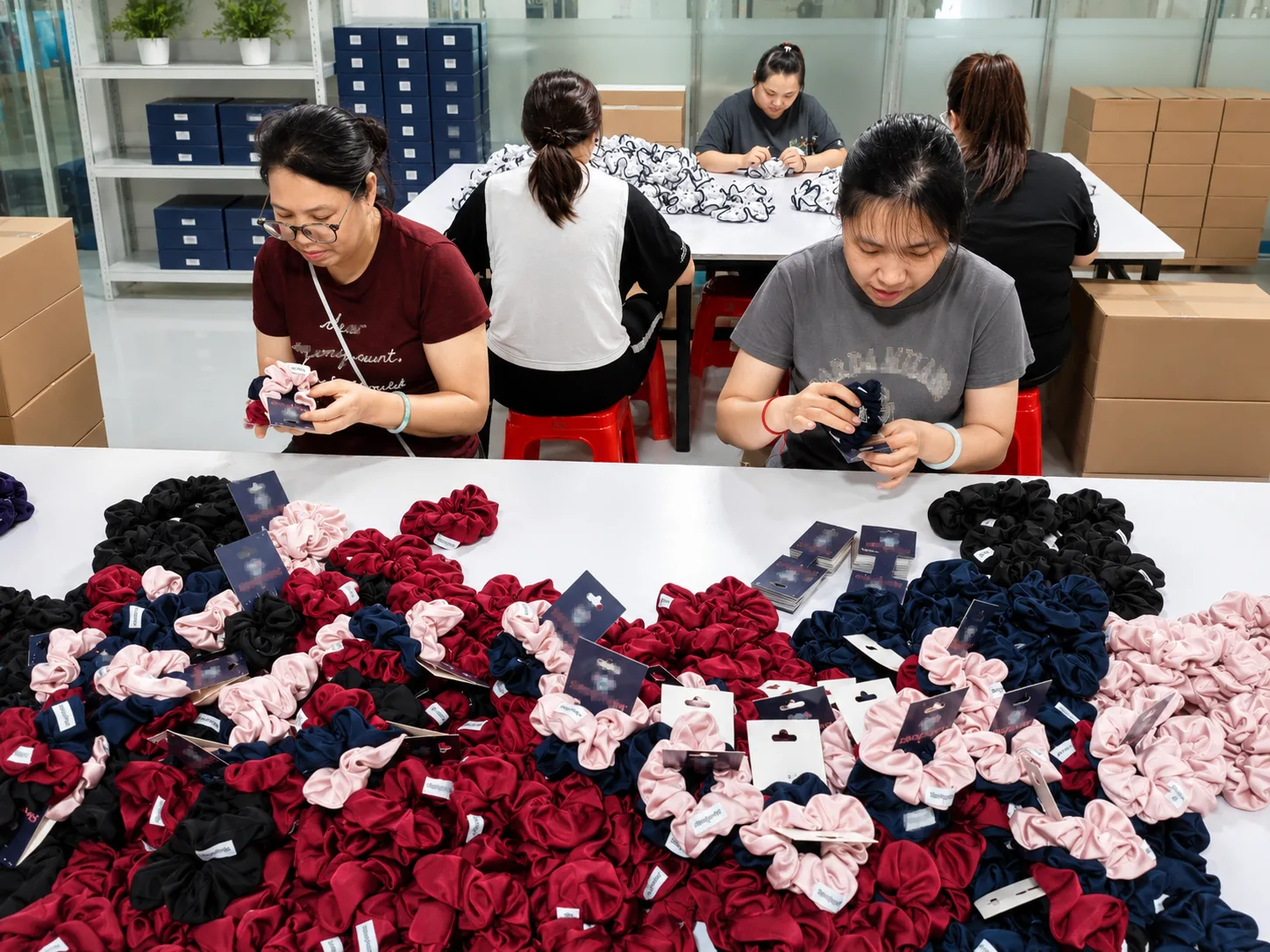
OEM vs ODM Hair Accessories: Which Manufacturing Model Is Better for Your Brand?
Choosing between OEM vs ODM hair accessories affects far more than the logo on the finished product. It determines who creates the design, how much specification work the buyer must complete, which components can be changed, who pays for development, how quickly samples can be approved, and what rights each party has to drawings, molds, and product concepts.
A poor model choice can create avoidable sampling rounds, unexpected tooling costs, an unprotectable design, unsuitable MOQ expectations, or a product that is difficult to reproduce consistently. This guide gives brands, importers, retailers, and product developers a practical framework for choosing OEM, ODM, or a hybrid route for scrunchies, hair bows, fabric clips, padded headbands, heatless curling sets, and claw clips.
If you already have a design or product direction, share it through Q&N Beauty’s custom hair accessory service for an initial manufacturability review. The recommended model, materials, MOQ, costs, and schedule remain subject to specification review.
What OEM and ODM Mean in Hair Accessory Manufacturing
OEM Starts With the Buyer’s Product Definition
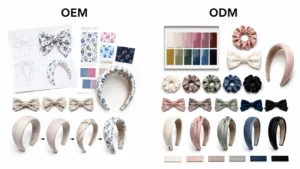
In a typical OEM project, the buyer controls the product concept and supplies enough information for the manufacturer to engineer, sample, and produce it. Inputs may include a tech pack, design drawing, reference sample, dimensions, material requirements, Pantone colors, print artwork, logo files, component specifications, packaging, and performance criteria.
The manufacturer converts those requirements into production instructions, identifies manufacturability issues, sources approved materials, makes samples, and produces to the sealed standard. The factory may recommend construction changes, but the commercial starting point is the buyer’s defined design rather than a supplier-owned product platform.
ODM Starts With a Manufacturer’s Existing Product Platform
In a typical ODM project, the supplier provides an existing design, construction, component platform, or development concept that the buyer can adapt. Customization may include fabric, color, print, elastic, clip base, decoration, logo application, set composition, and packaging. The range of changes depends on the platform and the agreement.
An ODM hair accessory is not necessarily an off-the-shelf item. A padded headband shape might remain standard while the covering, pleating, logo plate, and packaging become brand-specific. A claw clip may use an existing body and spring while receiving a custom color, surface effect, charm, or retail card.
Private Label and White Label Are Not Exact Synonyms
Private label describes a product sold under the buyer’s brand; it does not by itself establish who designed the item. Both OEM and ODM products can be private labeled. “White label” commonly refers to a standardized product offered to multiple buyers with limited changes, although suppliers use the term differently.
Because terminology varies, never rely on the letters alone. The quotation and manufacturing agreement should define design source, permitted changes, ownership, exclusivity, tooling, approvals, quality criteria, and compliance responsibilities.
OEM vs ODM Hair Accessories: Side-by-Side Comparison
Compare Control, Development Work, and Commercial Risk
| Decision factor | OEM model | ODM model | Buyer implication |
|---|---|---|---|
| Design starting point | Buyer concept, sample, drawing, or tech pack | Supplier platform or proposed design | Confirm who controls the design definition |
| Product differentiation | Potentially high when specifications are proprietary | Depends on depth of permitted customization | Ask whether similar versions are sold to others |
| Development input | Buyer must provide clear requirements and approvals | Supplier provides a developed starting structure | ODM can reduce early technical work, but not buyer review |
| Tooling | New molds, dies, gauges, or fixtures may be required | Existing tooling may be available | Clarify charges, ownership, maintenance, and storage |
| Sampling risk | Higher when the design is new or technically unresolved | Often lower for unchanged, proven structures | New materials or decorations can still create risk |
| Cost structure | More development and setup may be required | Existing components may reduce setup | Unit price still depends on materials, labor, volume, and packing |
| Lead time | May include engineering, sourcing, and tooling | May begin faster when components are available | No timing should be assumed before review |
| Intellectual property | Must be assigned or licensed by contract | Supplier may retain platform rights | OEM does not automatically give the buyer every right |
OEM Pros and Cons
Advantages: OEM gives the buyer greater control over product positioning, dimensions, structure, materials, performance, branding, and packaging. It suits products whose value depends on a recognizable shape, proprietary construction, coordinated collection, or retailer-specific specification.
Limitations: The buyer needs stronger product-development inputs and faster approval decisions. New tooling, custom-dyed materials, untested assemblies, or complex handmade decorations can increase development work and minimum-order constraints. A creative idea without tolerances or performance criteria is not yet a production-ready OEM specification.
ODM Pros and Cons
Advantages: ODM can reduce the work required to define basic construction and may use components, patterns, or processes the factory already understands. It can help a brand test a category, add a seasonal color, build a promotional set, or expand a range without engineering every structure from the beginning.
Limitations: Differentiation may be limited if the buyer changes only color and logo. Component availability can constrain dimensions, grip, padding, or surface finish. Exclusivity must be negotiated rather than assumed, and the buyer still needs to validate quality, packaging, claims, and market compliance.
Which Manufacturing Model Fits Your Brand and Product?
Choose OEM for Distinctive, Specification-Led Products
OEM is usually the stronger route when the product must meet a unique brief. Examples include a proprietary claw-clip silhouette requiring a new mold, a padded headband with a controlled crown profile, an engineered anti-slip fabric clip, or a branded heatless curling set with defined rod density and use performance.
It also suits established retailers that already maintain tech packs, approved material standards, compliance protocols, packaging manuals, and inspection criteria. The benefit comes from control, not from the OEM label itself.
Choose ODM for Faster Category Entry or Lower Design Complexity
ODM can fit brands that have a clear customer and visual identity but do not need a proprietary structure. A buyer might select an approved scrunchie size, existing French barrette, standard padded band base, or proven heatless curling rod, then customize fabric, Pantone color, print, label, logo, set configuration, and packaging.
This route can make evaluation easier because the buyer can review a physical base product before commissioning changes. However, availability, MOQ, customization limits, and delivery remain dependent on the selected materials and components.
Use a Hybrid Model When Existing Engineering Meets Custom Design
Many viable projects are hybrid. The factory may supply an existing clip base, elastic construction, headband insert, or curling-rod core, while the buyer owns the exterior pattern, custom print, decoration layout, logo, and packaging system.
Typical Buyer Example: a beauty brand selects a tested heatless curling rod structure but specifies an exclusive print, revised rod dimensions, matching scrunchies, embroidered logo, and a gift box. This illustrative example combines ODM platform efficiency with OEM-style product control; it is not a claimed customer case.
| Product direction | Likely starting model | Useful customization | Key risk to review |
|---|---|---|---|
| Signature molded claw clip | OEM | Body shape, teeth, color, spring, logo | Tooling ownership, shrinkage, hinge and grip performance |
| Seasonal satin scrunchie set | ODM or hybrid | Fabric, colors, size, label, packaging | Shade consistency, elastic recovery, assortment MOQ |
| Premium padded headband | OEM or hybrid | Base profile, padding, pleats, decoration | Comfort, symmetry, shape recovery, hand assembly |
| Fabric bow on existing clip | Hybrid | Bow shape, print placement, attachment, card | Grip, glue visibility, decoration attachment |
| Promotional heatless curling set | ODM or hybrid | Fabric, rod size, set contents, logo, box | Performance, filling consistency, pack deformation |
Prepare Materials and Specifications for Either Model
Start With a Decision-Ready Product Brief
Even an ODM inquiry needs more than “send your best price.” State the product category, consumer positioning, target age, sales market, quantity range, target delivery date, expected packaging, and mandatory product claims. Add reference photos and mark which features are required, preferred, or open to factory recommendation.
For OEM, prepare a design sketch or tech pack with front, side, back, and construction views. Use fixed measurement points and tolerances. Identify functional priorities such as hair type, desired wrap count, clip opening, grip level, headband fit, decoration weight, or curling-rod use scenario.
Specify Fabrics, Elastic, Bases, Padding, and Trims
Fabric names alone are insufficient. Silk, polyester satin, velvet, cotton, organza, chiffon, linen, nylon, and terry cloth vary by composition, weight, construction, finish, luster, stretch, and dye lot. Define the characteristics that affect appearance, sewing, comfort, durability, print quality, and care.
For scrunchies, specify elastic width, construction, cut length or joined circumference, working extension, and recovery expectation. For clips, define base type, dimensions, metal or plastic material, spring, teeth, plating, closed gap, and holding requirement. Headbands need an approved insert, padding thickness or profile, wire where used, and finished fit.
Control Dimensions, Pantone Colors, and Print Placement
Use finished-product dimensions rather than relying only on fabric cutting sizes. Define relaxed and stretched measurements where relevant. Establish tolerances after sample evaluation, because a suitable tolerance for a large organza scrunchie may be unsuitable for a small children’s bow or molded claw clip.
Pantone references should be evaluated on the intended material. Fiber, texture, luster, coating, and lighting change perceived color. For prints, approve artwork scale, repeat, orientation, registration, color sequence, and rules for motif placement, mirrored pairs, or random cutting.
Define Performance Before Requesting a Quote
State how function will be judged. Examples include elastic stretch and recovery, seam stability, clip opening cycles, holding strength, headband shape recovery, attachment strength, colorfastness, or packed-product deformation. Methods and acceptance values should be confirmed during development rather than invented at final inspection.
Clear criteria help the manufacturer choose appropriate materials and prevent a low quote based on an under-specified construction.
Plan Custom Branding and Intellectual Property
Match the Logo Method to the Product Structure
Available branding can include woven labels, embroidery, heat transfer, printing, metal logo plates, debossing, molded marks, or customized packaging. Select the method according to fabric, surface geometry, logo detail, skin contact, wash or rub exposure, and production quantity.
Specify logo dimensions, placement datums, orientation, color, finish, and attachment method. A heavy metal plate can change bow balance or headband comfort; embroidery can distort lightweight satin; a rigid mark near a scrunchie seam can affect gathering. Approve the logo on the actual product, not on a separate swatch alone.
Put Design, Tooling, and Exclusivity Rights in Writing
Define ownership of buyer artwork, supplier platform designs, revised drawings, cutting patterns, molds, dies, fixtures, samples, photography, and packaging files. State who pays for tooling, who may use it, where it will be stored, how long it will be retained, and what happens when the relationship ends.
The World Intellectual Property Organization’s supplier agreement guidance distinguishes tools such as IP licensing and non-disclosure agreements. WIPO also explains that trade-secret protection generally requires commercially valuable information to remain secret and be protected by reasonable steps. An NDA helps, but it does not replace ownership, license, exclusivity, and permitted-use clauses.
Distinguish Exclusivity From Customization
A custom color or logo does not automatically make an ODM structure exclusive. If exclusivity matters, define its scope: exact product, mold, artwork, colorway, territory, sales channel, customer, or time period. Also define minimum commitments, exceptions, and remedies with qualified legal advice.
Before sharing sensitive drawings, provide only the information required for initial feasibility, identify confidential files, control access, and maintain version records.
Move From Sampling to Bulk Production
Request a Feasibility Review Before Sampling
The supplier should review construction, materials, components, decoration, packaging, testing, quantity, and timing before issuing a production-ready proposal. For OEM, this may identify weak seam geometry, an impractical mold feature, unstable decoration, or a mismatch between material and print method. For ODM, it should clarify which platform features are fixed and which can change.
Send your reference photos, drawings, tech pack, and target market through the Q&N Beauty project inquiry page for a manufacturability assessment. Ask for all assumptions and exclusions to appear in the quotation.
Evaluate Samples Against a Written Checklist
Review the sample for material, color, dimensions, structure, workmanship, logo, function, packaging, and foreseeable use. Record comments with annotated photographs and measurements. Avoid instructions such as “make it stronger” or “more premium”; specify the result that needs to change.
OEM samples often need more engineering decisions because the structure is new. ODM samples may need fewer structural changes, but custom fabric, printing, plating, decoration, or packaging can still create multiple approval rounds.
Seal the Golden Sample and Production Specification
After approval, sign and date a physical golden sample and freeze the corresponding specification version. Record any accepted deviations. Both buyer and manufacturer should retain controlled references, including color swatches, component samples, logo artwork, packaging dielines, test methods, and defect criteria.
No change to fabric, elastic, clip, spring, padding, adhesive, coating, decoration, or packaging should enter production without review. A substitute can affect cost, appearance, performance, or compliance.
Use Production Gates Instead of Relying on Final Inspection
- Approve incoming fabrics, components, colors, and packaging materials.
- Inspect first production pieces before full cutting or assembly.
- Monitor high-risk processes such as pleating, gluing, hand assembly, plating, and print placement.
- Test finished-product function using the approved method.
- Complete final random inspection and packaging verification before shipment release.
The production control plan should be adapted to each fabric-based or rigid structure rather than reused unchanged across the collection.
Assign Quality Control and Compliance Responsibilities
Use Product-Specific Quality Standards
Scrunchies require checks for fabric defects, gathering, stitching, elastic length, stretch, recovery, and seam closure. Hair bows and fabric clips add symmetry, pattern direction, glue control, clip alignment, grip, and decoration attachment. Padded headbands require padding distribution, profile, comfort, end finishing, and shape recovery.
Claw clips and metal components require checks for dimensions, hinge alignment, spring action, holding strength, teeth, sharp edges, burrs, surface scratches, cracks, plating consistency, and ornament attachment. Use the detailed scrunchie and fabric clip QC checklist when those categories are included.
Do Not Assume the Manufacturing Model Transfers Legal Responsibility
OEM and ODM describe a development relationship, not a universal legal allocation. The brand, importer, manufacturer, distributor, or marketplace operator may carry responsibilities depending on the jurisdiction and supply chain. Contracts can allocate tasks and costs, but they may not remove statutory obligations.
In the United States, the Consumer Product Safety Commission explains that manufacturers and importers must test and certify products when applicable rules require it. Children’s products subject to applicable rules require CPSC-accepted third-party testing. Not every hair accessory is a children’s product or subject to the same rule set.
For the EU, the General Product Safety Regulation establishes obligations for relevant economic operators, including safety, risk analysis, technical documentation, identification, and traceability. The UK Office for Product Safety and Standards advises manufacturers and importers to minimize risks, maintain technical documentation, and provide appropriate labeling. Great Britain and Northern Ireland requirements should be reviewed separately.
Build the Test Plan Around Product, Age, and Market
Confirm requirements based on target age, materials, coatings, accessible components, claims, and destination. Children’s hair accessories may require review of small parts, sharp points and edges, lead or other restricted substances, flammability where applicable, tracking labels, and packaging warnings. A barrette exclusion from one requirement would not remove other applicable obligations.
REACH, CPSIA, Prop 65, retailer protocols, and packaging rules do not apply identically to every hair accessory. Obtain competent compliance advice and use qualified laboratories where required. Link reports to the exact colors, substrates, coatings, components, and production configuration.
Compare MOQ, Cost, Lead Time, and Supplier Capability
Understand What Actually Drives MOQ and Cost
| Cost or MOQ driver | OEM impact | ODM impact | Buyer action |
|---|---|---|---|
| Custom fabric or dyeing | May require dedicated material minimums | Same impact if platform fabric is replaced | Consolidate colors or use available materials |
| New mold or tooling | Common for proprietary rigid shapes | Often avoided when existing tooling is retained | Confirm fee, ownership, life, and maintenance |
| Hand assembly | Complex designs increase labor and variation risk | Added trims can remove ODM efficiency | Simplify attachment points and approve workmanship |
| Color assortment | Each material or component may have a color minimum | Existing stock colors may offer flexibility | Ask for MOQ by style, color, and component |
| Logo and packaging | Custom plates, labels, cards, and boxes add setup | Same when private-label elements are customized | Separate reusable setup from recurring unit cost |
| Testing | New construction may need broader validation | Changed materials can invalidate prior evidence | Define who arranges, pays, owns, and updates reports |
ODM is not automatically cheaper, and OEM does not always require a high MOQ. A heavily customized ODM item can cost more than a simple OEM fabric design. Request a cost breakdown by product, tooling, sampling, branding, packaging, testing, and logistics without asking the supplier to disclose protected internal costing.
Build a Realistic Development and Delivery Schedule
Map approval dependencies: artwork, material sourcing, lab dips, print strike-offs, tooling, sample revisions, testing, packaging, bulk production, inspection, and transport. ODM can be faster when the chosen platform and materials are available, but custom colors, exclusive fabrics, new packaging, or compliance work may remove that advantage.
Use a target delivery date and work backward with contingency for buyer approvals and corrective action. Sample and bulk timelines must be confirmed for the actual specification.
Evaluate an OEM/ODM Hair Accessory Manufacturer
- Can the supplier explain which design and components are existing, modified, or new?
- Does it produce the relevant category and control any subcontracted processes?
- Can it convert drawings or reference samples into measurable specifications?
- Does it offer appropriate fabric, elastic, clip, padding, plating, logo, and packaging options?
- Can it show sample revision, change-control, traceability, and inspection procedures?
- Will it define tooling ownership, permitted use, confidentiality, and exclusivity?
- Can it support the required testing and documentation without making generic compliance claims?
- Does the quotation clearly state assumptions, MOQ basis, exclusions, and approval responsibilities?
The broader guide on evaluating a hair accessories manufacturer provides additional supplier-verification questions for bulk orders.
OEM vs ODM Hair Accessories FAQ
What Is the Main Difference Between OEM and ODM Hair Accessories?
OEM typically begins with the buyer’s product design or specification, while ODM begins with a supplier-developed platform or concept that the buyer adapts. Actual rights and responsibilities depend on the contract, not the abbreviation.
Is OEM or ODM Better for a New Hair Accessory Brand?
ODM or a hybrid model may reduce early technical work when the brand is testing a category. OEM may be better when the brand’s value depends on a distinctive structure or performance specification. Choose according to differentiation, development capability, budget, timing, and risk.
Who Owns an OEM Hair Accessory Design?
Ownership is not automatic. The agreement should address buyer artwork, supplier know-how, revised drawings, molds, tooling, patterns, exclusivity, permitted use, and post-project rights. Obtain legal advice for commercially important intellectual property.
Does ODM Always Have a Lower MOQ and Faster Lead Time?
No. Existing tooling and available materials may reduce setup, but custom dyeing, prints, trims, packaging, testing, or color assortments can create new minimums and time requirements. Both must be confirmed after specification review.
Can a Brand Combine OEM and ODM in One Collection?
Yes. A collection can include a proprietary OEM hero product, hybrid products using existing components with exclusive fabrics, and ODM supporting items customized by color and branding. Document the rights, specifications, and QC plan for each SKU.
Expert Summary, Future Trends, and B2B Inquiry
Expert Summary: Choose the Responsibility Model, Not the Label
The decision between OEM vs ODM hair accessories should follow the product strategy. Choose OEM when the buyer needs high control over structure, performance, and differentiation and can provide clear development inputs. Choose ODM when a proven supplier platform meets the commercial brief and the brand can differentiate through materials, colors, branding, assortments, and packaging. Use a hybrid model when it gives the best balance.
Whichever route you choose, put specifications, approvals, tooling, intellectual property, change control, quality, compliance, and corrective action in writing. A successful manufacturing model makes responsibilities visible before sampling starts.
Future Trends in OEM and ODM Hair Accessory Development
Hair accessory programs are moving toward modular development: shared bases combined with custom fabrics, replaceable decorations, smaller coordinated color capsules, and packaging systems that work across several SKUs. Digital tech packs, version-controlled approvals, image-assisted inspection, and component traceability can make hybrid programs easier to manage.
Brands are also asking for clearer material origin, change control, repairability, and packaging reduction. These priorities may favor adaptable platforms, but they also require better documentation. Faster development should not mean weaker product definition.
Request an OEM, ODM, or Hybrid Project Review
To receive useful development guidance, a sample proposal, or a bulk quotation, provide:
- Product type
- Product dimensions
- Reference photos, design drawings, or tech pack
- Fabric and material requirements
- Pantone colors or print artwork
- Logo file and preferred branding method
- Target quantity
- Packaging requirements
- Delivery country
- Target delivery date
- Applicable market or compliance requirements
Contact Q&N Beauty to compare OEM, ODM, and hybrid options for scrunchies, fabric clips, hair bows, padded headbands, heatless curling sets, claw clips, and coordinated private-label packaging. Feasibility, materials, MOQ, price, sampling, testing, and lead time are subject to specification review and written confirmation.