Choosing the right fabric for custom scrunchies, hair bows, and padded headbands is a product-engineering decision, not a color-selection exercise. A fabric that gives a scrunchie soft volume may be too unstable for a structured bow. A smooth satin that looks premium on a headband may slip unless the base, padding, and construction compensate for its surface. If buyers approve fabric by photograph alone, they risk inconsistent shape, color transfer, puckered logos, weak seams, delayed production, or customer complaints.
This guide shows B2B buyers how to compare fabric specifications, performance, customization, testing, MOQ, and cost for each product construction.
For material suggestions based on your target price and product design, review Q&N Beauty’s custom hair accessory development service and share your reference images before selecting bulk fabric.
Define the Product Brief Before Selecting Hair Accessory Fabric
Match Fabric to the Target Customer, Retail Position, and Sales Channel
Begin with the commercial role of the product. A silk scrunchie sold as a premium beauty accessory has different requirements from a promotional polyester bow, a spa headband, or a children’s clip set. Define the target customer, intended age, retail price position, channel, expected care, delivery market, packaging, and launch date.
The channel changes fabric priorities. E-commerce products must retain shape in parcels; gift sets need coordinated shades; retail displays add handling; and spa headbands may require repeated cleaning. Include these conditions in the brief.
Separate Appearance Requirements from Functional Requirements
Translate subjective terms into observable characteristics. “Luxury” may mean natural luster, soft hand, rich pile, clean pleating, or precise color. “Strong hold” may depend on elastic or the insert, while a full bow may need backing rather than heavier fabric.
Rank visual and functional requirements as mandatory, preferred, or flexible so alternatives preserve the product’s defining features.
Prepare a Fabric-Ready Specification for Supplier Comparison
- Product type, finished dimensions, silhouette, and intended use;
- Fiber composition and fabric construction;
- Weight, density, thickness, stretch, or pile direction where relevant;
- Surface finish, luster, hand feel, drape, and friction requirement;
- Pantone reference, stock shade, or custom print artwork;
- Print repeat, direction, and placement requirements;
- Elastic, clip, insert, padding, backing, wire, and decoration details;
- Logo process, dimensions, location, and backing requirements;
- Quantity per product and color, packaging, target market, and testing needs.
If fabric is unconfirmed, request named alternatives for the same construction. Do not compare quotes based on different assumed weights, finishes, or compositions.
Understand What a Fabric Name Does and Does Not Tell a Buyer
Fiber Composition, Fabric Construction, Weight, Density, and Finish
“Silk” identifies a fiber, while “satin” identifies a construction made from silk, polyester, or other fibers. Velvet varies by fiber, pile, backing, stretch, and finish; “cotton” does not identify the weave or weight.
Combine composition, construction, and measurable attributes—for example, polyester satin with an approved weight and finish. Establish targets from swatches and samples rather than copying them across products.
Compare Drape, Luster, Texture, Friction, Stretch, and Shape Retention
| Fabric option | Appearance and hand feel | Structure and grip | Customization compatibility | Main advantages | Limitations and quality risks | Recommended applications | Cost impact |
|---|---|---|---|---|---|---|---|
| Polyester satin | Smooth with visible luster | Fluid; surface may be slippery | Dyeing, suitable printing, labels, selected heat transfer | Versatile and repeatable | Snags, shine variation, heat sensitivity | Scrunchies, bows, wrapped headbands | Usually cost-efficient; specification dependent |
| Silk satin | Soft with natural luster | Fluid and lightweight | Premium labels and careful embroidery | Premium material story | Higher cost, delicate handling, shade variation | Premium scrunchies and soft bows | High material and yield impact |
| Velvet | Plush with rich depth | Good visual body and friction | Labels, selected embroidery, decorations | Strong seasonal and premium appearance | Pile direction, pressure marks, lint, shade perception | Scrunchies, structured bows, headbands | Moderate to high |
| Cotton woven | Matte and natural | Stable; varies by weave | Good for prints, labels, and embroidery | Easy styling and print versatility | Shrinkage, creasing, dye-lot variation | Casual scrunchies, bows, headbands | Varies by quality and finish |
| Organza or chiffon | Sheer, light, decorative | Organza is crisper; chiffon drapes | Layering, all-over prints, decoration | Creates volume with low visual weight | Fraying, seam visibility, alignment difficulty | Layered bows and statement scrunchies | Labor can exceed fabric impact |
| Linen or linen blend | Dry, textured, natural | Moderate structure | Labels, embroidery, selected printing | Distinct matte appearance | Creasing, slubs, shrinkage, lot variation | Natural-look bows and headbands | Specification dependent |
| Nylon | Technical or smooth | Lightweight; stretch varies | Printing and branding depend on finish | Useful for sport-led products | Heat sensitivity and surface variation | Sports headbands and technical accessories | Varies by construction |
| Terry cloth | Soft, absorbent, looped | Bulkier with surface grip | Embroidery and labels need trial | Functional spa positioning | Lint, loop pulls, bulk, drying behavior | Spa and makeup headbands | Material and sewing impact vary |
Balance Premium Appearance with Sewability and Bulk Consistency
Premium fabric must still cut and sew consistently. Satin can shift, velvet needs controlled pile direction, sheer fabric exposes seams, stretch fabric can distort, and thick terry creates bulky joins.
Assess cutting yield, edge behavior, seam appearance, logo distortion, wrapping, and production variation. A different weight or backing may improve consistency without changing the visual direction.
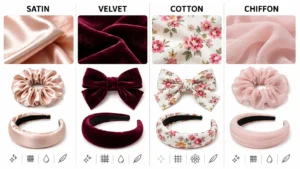
How to Choose Fabric for Custom Scrunchies
Match Fabric Hand Feel and Friction to the Scrunchie Positioning
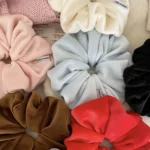
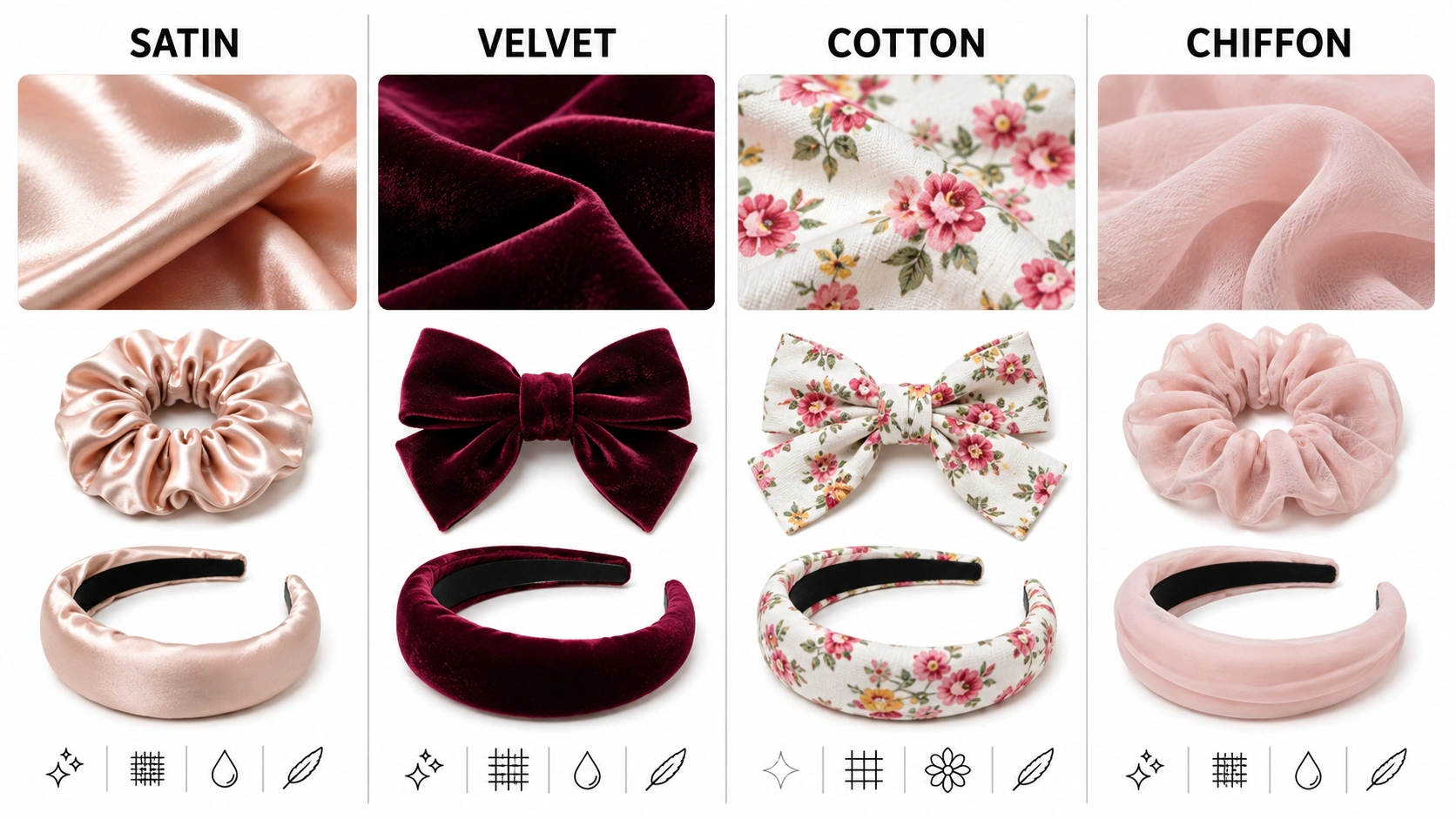
Scrunchie fabric affects volume, grip, hair contact, and quality perception. Silk or satin is smooth but offers less friction; velvet adds grip; cotton is matte and stable; organza creates crisp volume; and chiffon gives softer movement.
Define whether the style is skinny, standard, oversized, scarf-style, or layered. Fabric behavior changes with tube width, cut length, gathering, and elastic, so approve the finished product.
Specify Gathering Ratio, Elastic, Seams, and Finished Dimensions Together
Fullness comes from cut fabric length relative to the elastic loop. More gathering changes consumption, labor, bulk, and appearance; width, seam allowance, and closing method affect the visible body.
Record elastic type, width, length, joint, stretch, recovery, and intended wraps. Define outer diameter, opening, tube width, and tolerances. Fabric cannot compensate for weak elastic or an opening seam.
Pros and Cons of Silk, Satin, Velvet, Cotton, Organza, and Chiffon Scrunchies
- Silk: Premium hand feel and positioning; higher material cost, more delicate handling, and tighter shade control.
- Polyester satin: Broad color and print flexibility; the selected grade must control snagging, shine, and heat response.
- Velvet: Strong volume, grip, and seasonal appeal; pile direction, lint, and pressure marks need inspection.
- Cotton: Stable sewing and a natural matte look; shrinkage, creasing, and print registration must be reviewed.
- Organza: Crisp transparency and statement volume; visible seams and fraying can raise finishing labor.
- Chiffon: Soft, lightweight movement; cutting stability and seam quality require careful sampling.
For a more focused material comparison, see Q&N Beauty’s guide to silk, satin, and recycled-fabric scrunchies.
How to Choose Fabric for Custom Hair Bows and Fabric Clips
Select Drape or Structure According to the Bow Silhouette
A tied bow needs controlled drape; a symmetrical bow needs shape retention and possibly backing. Organza depends on transparency and crisp edges, while layered or decorated velvet can become heavy.
Specify width, height, tails, layers, fold sequence, center wrap, profile, and any backing coverage or stiffness. Backing, doubling, pleating, or wire changes the same face fabric.
Control Fraying, Edge Finishing, Backing, and Pattern Placement
Match edge construction to the fabric: turned edges, narrow hems, stitching, suitable heat sealing, binding, or controlled raw edges. Sample the method for scorching, puckering, unraveling, and excess thickness.
For prints, document direction, repeat, scale, centering, and alignment. Placement designs, stripes, checks, and borders require more cutting control than random all-over prints.
Match Fabric Weight to Alligator Clips, French Barrettes, and Decorations
The clip must support the bow without twisting. Confirm dimensions, relevant metal thickness, spring tension, opening, holding strength, plating, and edges; large layered bows may need a different base.
Decorations add weight and assembly. Define position, attachment, glue limits, suitable pull resistance, and scratch protection. Detachable parts also affect children’s product assessment.
How to Choose Fabric for Custom Padded Headbands
Coordinate the Outer Fabric, Padding, and Headband Insert
A padded headband is a system: the base controls pressure, padding creates the profile, and fabric provides color, texture, friction, and finish. Thick velvet may add bulk; thin satin may reveal uneven padding.
Specify insert dimensions, flexibility, ends, padding, finished profile, seam position, and fabric direction. Approve appearance and comfort on the prototype.
Evaluate Grip, Comfort, Stretch, Pleating, and End Finishing
Smooth fabrics may need support to reduce slipping. Velvet and textured cotton add friction. Stretch helps wrapping, but too much can distort prints, pleats, and logos.
Knots, braids, twists, and pleats add labor and consumption. Define their dimensions and symmetry, underside seams, ends, and glue limits. Prevent exposed insert edges and pressure points.
Compare Satin, Velvet, Cotton, Linen, Nylon, and Terry Cloth Headbands
| Headband fabric | Visual direction | Functional advantage | Key limitation | Best construction | Approval focus |
|---|---|---|---|---|---|
| Satin | Smooth and polished | Clean pleats and color presentation | Slip and pressure marks | Wrapped or knotted fashion headband | Wrapping stability and surface quality |
| Velvet | Rich and dimensional | Surface grip and visual body | Pile direction and bulk | Padded or statement headband | Shade, pile, seam, and compression |
| Cotton | Matte and casual | Stable handling and print suitability | Creasing and shrinkage | Printed, knotted, or padded headband | Print, shrinkage, and seam finish |
| Linen blend | Natural and textured | Moderate shape and distinct hand | Slubs, creasing, lot variation | Structured fashion headband | Texture limits and color consistency |
| Nylon | Technical or sporty | Lightweight and adaptable | Heat and finish sensitivity | Sports or performance-led headband | Stretch, recovery, and logo adhesion |
| Terry cloth | Soft and spa-oriented | Absorbency and comfort | Lint, loop pulls, drying, bulk | Spa and makeup headband | Fit, closure, laundering, and seam bulk |
Buyers can review custom headband product directions before deciding whether the collection needs a rigid padded base, fashion wrapping, or a softer spa construction.
Color, Printing, Branding, and Sample Approval
Pantone Color Matching, Lab Dips, and Dye-Lot Variation
A Pantone reference is a target; fiber, weave, pile, luster, lighting, and finish change its appearance. Approve a physical lab dip or production-material standard under agreed lighting.
Record the approved supplier, material code, dye lot, and shade standard. When exact cross-material matching is impossible, define an acceptable coordinated appearance rather than demanding an unsupported claim of perfect identity.
Custom Printing, Repeat Size, Print Alignment, and Pattern Placement
Provide production-ready artwork, color references, repeat dimensions, print direction, motif scale, and placement rules. The printing method must suit the fiber and finish. Sublimation is commonly considered for suitable polyester materials, while other fibers may require different dye or pigment systems. The final route is subject to specification review by the fabric and print supplier.
Approve a strike-off before bulk. Then assess color, sharpness, hand feel, show-through, penetration where relevant, repeat joins, and how motifs appear after cutting, gathering, folding, pleating, or wrapping.
Woven Labels, Embroidery, Heat Transfer, and Metal Logo Plates
- Woven labels: Work across many sewn constructions, but label size, fold, seam placement, and skin contact need review.
- Embroidery: Provides a premium textile finish; stitch count, backing, and fabric distortion can affect delicate or stretchy materials.
- Heat transfer: Supports detailed artwork on compatible surfaces; adhesion, cracking, heat response, and hand feel require testing.
- Metal logo plates: Add structure and premium detail; weight, tooling, plating, attachment, sharp edges, and scalp contact must be controlled.
Evaluate Fabric Swatches, Prototype Samples, and the Sealed Bulk Standard
- Approve the physical fabric swatch, composition, relevant weight, finish, and color.
- Make the sample with production-intended fabric, elastic, clip, padding, backing, logo, and packaging.
- Check finished dimensions, drape, gathering, bow symmetry, headband profile, seams, edges, and comfort.
- Evaluate color and print under controlled conditions and review functional performance.
- Record every revision in the tech pack and bill of materials.
- Approve a sealed sample or signed specification as the bulk-production standard.
Mid-project CTA: Send your reference photos, design sketch, Pantone colors, artwork, and preliminary specifications through the Q&N Beauty project inquiry page for fabric recommendations and a manufacturability review before sampling.
Quality Control, Testing, and Market Compliance
Product-Specific Fabric and Construction Inspection Checklist
| Inspection area | Scrunchie check | Hair bow or clip check | Padded headband check | Common defect |
|---|---|---|---|---|
| Fabric and shade | Hand feel, snags, dye lot | Direction and pattern placement | Shade, pile, stretch, pressure marks | Color variation, stains, surface damage |
| Dimensions and shape | Outer size, opening, tube width | Width, height, tails, symmetry | Base width, height, profile, symmetry | Incorrect size or uneven shape |
| Sewing and edges | Seam, closing point, loose threads | Edge finish, folding, center wrap | Wrap seam, ends, pleats | Open seams, fraying, puckering |
| Function | Elastic stretch and recovery | Clip alignment and holding strength | Grip, pressure, comfort, insert coverage | Weak hold or uncomfortable fit |
| Branding and decoration | Label position and comfort | Logo alignment and attachment | Logo distortion and scalp contact | Loose parts, glue marks, crooked logos |
| Packaging | Shape and cleanliness | Bow and clip protection | Compression control | Crushing, scratches, incorrect SKU |
Colorfastness, Dimensional Stability, Seam Strength, and Attachment Testing
Testing should reflect expected use, care claims, material, target market, and buyer requirements. The official ISO 105-X12 colorfastness-to-rubbing method covers resistance to rubbing and staining other materials. If the product is intended to be laundered, ISO 105-C06 describes methods for evaluating textile colorfastness to domestic or commercial laundering.
Depending on the design, buyers may also request dimensional-change, seam-strength, elastic-recovery, pull, attachment, abrasion, or corrosion-related checks. Do not invent one passing level for all products. The method, sample preparation, acceptance criteria, and responsible laboratory must be agreed for the exact SKU.
REACH, U.S. Children’s Product Rules, Prop 65, and UK Product Safety
Compliance depends on product classification, intended age, materials, decoration, marketing, and destination. The U.S. Consumer Product Safety Commission’s children’s product guidance explains that products primarily intended for children 12 or younger can be subject to children’s product requirements, third-party testing, and a Children’s Product Certificate when applicable rules apply.
For the EU, the European Commission states that Regulation (EU) 2023/988 on general product safety has applied since December 13, 2024. Buyers should review risk assessment, traceability, economic-operator, labeling, and online-offer obligations for the specific product. ECHA explains that REACH restrictions can apply to substances in articles, which may include dyes, prints, coatings, plastics, adhesives, and metal finishes.
California programs may require a product-specific Proposition 65 exposure assessment; it is not a universal certificate. UK buyers should identify whether products are placed in Great Britain or Northern Ireland because the applicable route may differ. Compliance scope and testing are subject to specification review with qualified specialists.
Small Parts, Sharp Edges, Restricted Substances, and Children’s Accessories
For children’s bows, clips, and headbands, evaluate intended age, small decorations, detachable parts, sharp points and edges, accessible metal, coatings, adhesives, and foreseeable misuse. Consider attachment strength, restricted substances, flammability where applicable, tracking information where applicable, and required packaging warnings.
Do not assume every hair accessory is a toy or that all adult products require children’s testing. Classification should be based on the actual product, target age, sizing, decoration, packaging, and marketing. An age label alone may not override the product’s design and intended use.
Cost, MOQ, Lead Time, and Fabric Supplier Evaluation
How Fabric Choice Changes Consumption, Cutting Yield, Labor, and Cost
Fabric price per unit of area is only one cost. Width, usable yield, defect allowance, pile direction, print placement, shrinkage, fraying, stretch, and layer count affect consumption. Slippery, sheer, directional, or high-value materials may require slower cutting, additional handling, backing, edge finishing, or more inspection.
Ask the factory to identify the main cost drivers. A fabric with a slightly higher purchase price may create better cutting yield or fewer defects. Conversely, an inexpensive sheer fabric may require layered construction and labor that removes the expected saving.
Stock Colors, Custom Dyeing, Printing Minimums, and MOQ per SKU
Stock fabric can reduce development work and material minimums. Custom dyeing and printing introduce supplier batches, lab dips or strike-offs, setup, and approval time. The total order quantity may not solve the minimum if it is divided among many unrelated fabrics and colors.
State quantity per product and color. Ask whether scrunchies, bows, and headbands can share one fabric lot, whether different constructions require separate cutting or finishing, and what happens to excess custom material. Document storage, ownership, and repeat-order conditions.
Supplier Questions for Repeatable Fabric Quality and Bulk Production
- What are the exact fiber composition, construction, weight, width, finish, and material code?
- Is the fabric stock, made to order, custom dyed, or custom printed?
- How are color, dye lot, pile direction, stretch, and surface defects controlled?
- Can the supplier reproduce the same material for reorders?
- Which operations are most sensitive during cutting, sewing, wrapping, or finishing?
- What substitutions are permitted, and who must approve them?
- Which physical samples and test reports define the bulk standard?
- How are incoming inspection, in-line control, final inspection, and packing managed?
Q&N Beauty’s OEM/ODM manufacturing profile describes 15+ years of experience, 200+ skilled workers, a design team, and BSCI-certified production. Published capabilities include scrunchies, fabric clips, bows, padded headbands, heatless curling sets, material sourcing, custom colors and prints, branding, packaging, sampling, bulk production, inspection, and pre-shipment quality control. Each material and test plan should still be confirmed for the exact project.
Illustrative Product Development Scenario: One Fabric Is Not Right for Every Product
Illustrative Product Development Scenario: A brand plans a coordinated satin collection using one fabric for an oversized scrunchie, a structured bow, and a high padded headband. The satin performs well on the scrunchie but collapses in the bow and reveals padding irregularities on the headband. Instead of changing the collection color, the team keeps the approved satin for the scrunchie, adds suitable backing to the bow, and selects a related satin grade with better coverage for the headband.
This is not a customer case. It demonstrates why coordinated products can share a color direction without requiring identical fabric specifications.
Frequently Asked Questions About Fabrics for Custom Hair Accessories
What Is the Best Fabric for Custom Scrunchies?
There is no universal best fabric. Silk suits premium positioning, polyester satin offers versatility, velvet provides texture and grip, cotton supports a matte natural look, and organza or chiffon creates decorative volume. Select according to hand feel, friction, gathering, care, branding, target price, and customer expectations.
Is Silk Better Than Polyester Satin for Scrunchies?
Silk and polyester satin serve different briefs. Silk offers a natural premium fiber story but has higher cost and more delicate handling. Polyester satin usually offers broader color and print flexibility. Compare physical swatches and finished samples rather than treating one as automatically superior.
What Fabric Weight Should Buyers Specify for Hair Accessories?
The correct weight depends on fiber, construction, product size, number of layers, backing, padding, and desired drape. A number suitable for a scrunchie may fail on a bow or headband. Use an approved physical swatch and finished sample alongside the recorded weight.
How Can Buyers Prevent Color Transfer or Fading?
Approve production-intended material, identify the expected use and care conditions, agree relevant colorfastness methods and acceptance criteria, and control dye lots. Dark, saturated, printed, or pile fabrics may need particular attention. Testing should be performed by a qualified party when required.
Can the Same Fabric Be Used for Scrunchies, Bows, and Padded Headbands?
Sometimes, especially when the fabric has suitable drape, structure, coverage, and sewability for all three. Often the products need different backing, layer counts, or fabric grades. Approve each finished construction even when the color and material family are shared.
Future Fabric Trends, Expert Summary, and B2B Sourcing Action
Traceable Materials, Performance Specifications, and Coordinated Collections
Fabric sourcing is moving toward clearer composition records, supplier references, dye-lot traceability, controlled artwork, and evidence supporting material claims. Buyers are also building coordinated collections from a shared color palette while selecting product-specific weights, finishes, and backing.
Another useful direction is performance-based approval. Instead of specifying only “premium satin,” brands define the required hand feel, opacity, drape, color, sewability, and finished-product behavior. This gives manufacturers room to propose workable materials while preserving the customer experience.
Expert Summary: Select Fabric as Part of the Product System
The right fabric for custom scrunchies, hair bows, and padded headbands must work with the product’s dimensions, elastic, clip, insert, padding, backing, decoration, branding, packaging, and intended use. Define composition and construction, approve a physical swatch, test the finished sample, and seal measurable standards before bulk production.
Do not choose by fiber name, photograph, or price alone. Compare advantages, limitations, manufacturing risks, customer expectations, compliance scope, MOQ, and repeat-order consistency.
Request Fabric Recommendations, Samples, or a Bulk Quotation
To receive a specification-based recommendation or quotation, provide:
- Product type and finished dimensions;
- Reference photos, design drawings, or tech pack;
- Preferred fabric composition, construction, hand feel, and finish;
- Pantone colors or print artwork;
- Elastic, clip, padding, backing, and decoration requirements;
- Logo file and preferred branding method;
- Target quantity by product and color;
- Individual, retail, and shipping packaging;
- Delivery country and target delivery date;
- Intended age, sales market, and known compliance requirements.
Share these details with Q&N Beauty to compare fabric options, prepare a sample plan, and receive a bulk quotation based on the intended product rather than a generic material description.