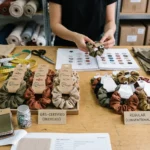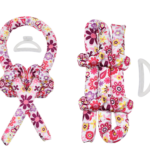
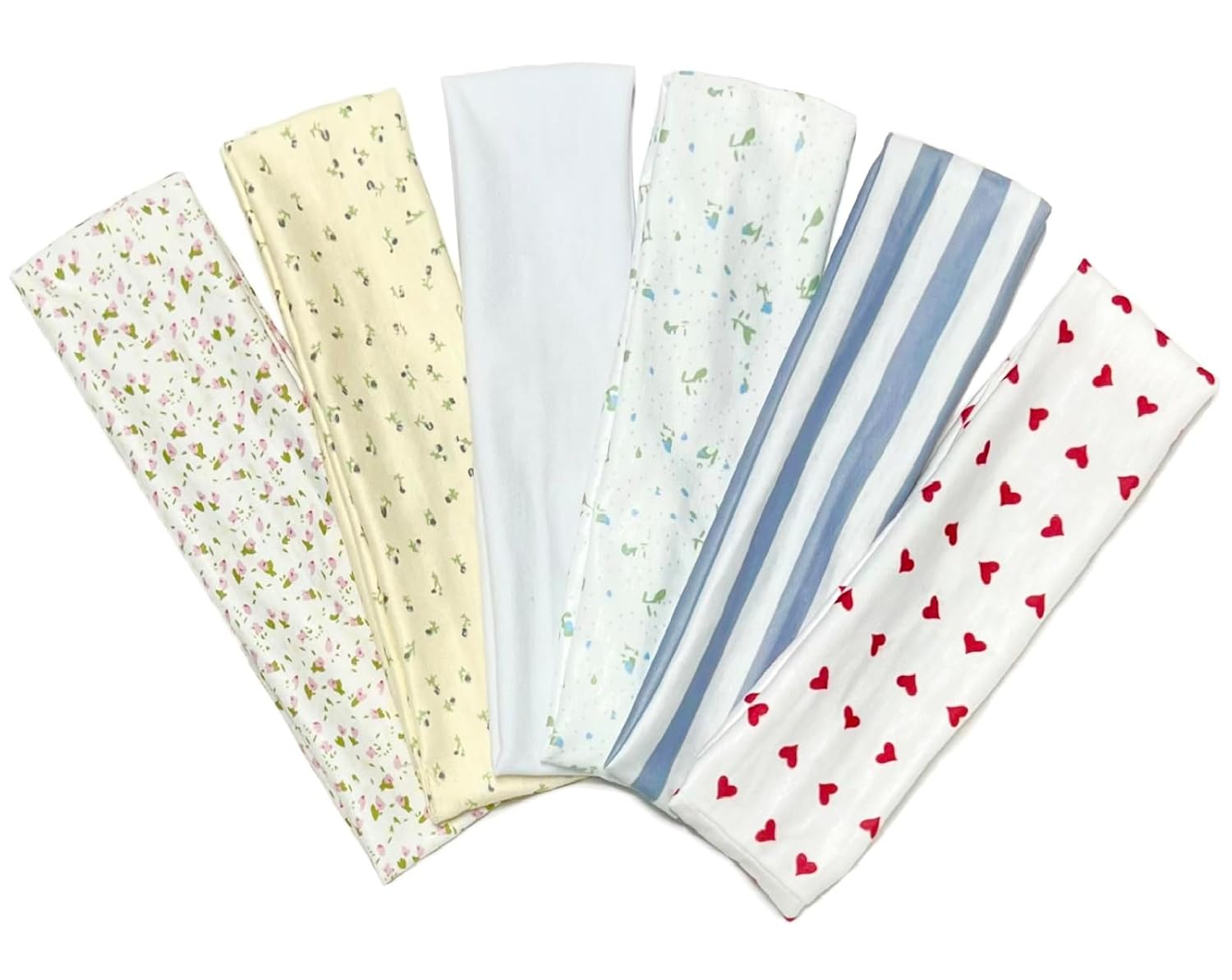
Reducing custom hair accessory unit cost does not have to mean thinner fabric, weaker elastic, loose decorations, or skipped inspection. For B2B buyers, those shortcuts often return as complaints, rework, replacement freight, delayed launches, and damaged retailer relationships. The better approach is to remove waste, unnecessary complexity, fragmented purchasing, and unclear specifications while preserving the features customers notice and the performance they expect.
This guide shows buyers how to lower the cost of scrunchies, hair bows, fabric clips, padded headbands, heatless curling sets, claw clips, and coordinated collections through design, materials, MOQ, sampling, quality, packaging, and supplier planning.
Need a realistic cost-reduction plan? Send QN Beauty your design, target quantity, current specification, packaging, destination, and target cost through the custom hair accessory inquiry page. A specification review can identify which changes are commercially useful and which would create unacceptable quality risk.
Define the Real Custom Hair Accessory Unit Cost Before Negotiating
Unit Price, Landed Cost, and Total Cost of Ownership
A lower ex-factory price can be offset by bulky packaging, poor carton utilization, repeated samples, inspection failures, delays, or defects. Compare offers using the same Incoterm, specification, packaging, test scope, quantity, currency, and destination.
Separate three cost views:
- Product unit cost: materials, labor, process loss, branding, packaging, overhead, and the commercial terms included in the quotation.
- Landed unit cost: product cost plus freight, insurance where applicable, duties, brokerage, and inland delivery.
- Total cost of ownership: landed cost plus sampling, testing, inspections, inventory holding, rework, replacements, returns, and markdown exposure.
A saving is real only when it lowers the relevant total without moving excessive risk to another line.
Set a Target Cost and a Non-Negotiable Quality Floor
Translate the retail plan into a target landed cost, then calculate allowable product cost after logistics, duties, channel margin, promotion, and operating expenses. Pair every target price with a specification.
Define the quality floor in measurable terms. For a scrunchie, this might cover finished diameter, fabric composition and weight, elastic width, stretch and recovery, seam security, gathering, color, and logo position. For a claw clip, it could include dimensions, substrate, tooth profile, spring tension, hinge alignment, holding performance, surface finish, and sharp-edge requirements. Values remain subject to specification review and sample evaluation.
Rank Cost-Reduction Levers by Risk and Commercial Value
| Cost Lever | How It Saves | Quality Risk | Safe Use Condition | Relative Opportunity |
|---|---|---|---|---|
| Reduce SKU and color fragmentation | Larger compatible production lots; fewer changeovers | Narrower assortment | Sales data supports concentrated options | Often high |
| Standardize hidden components | Improves purchasing and line efficiency | Poor fit if over-standardized | Function is validated in each style | Medium to high |
| Simplify construction | Removes labor and process steps | Changed silhouette or durability | Approved sample preserves appearance and function | Medium to high |
| Optimize material consumption | Improves cutting yield and reduces waste | Smaller or lighter product than intended | Finished dimensions and performance remain fixed | Medium |
| Right-size packaging | Reduces packaging material and shipping volume | Compression, scratches, or weak presentation | Packed-product protection is evaluated | Medium |
| Remove testing or inspection | Creates an immediate visible saving | Safety, compliance, defects, and claims | Not an acceptable general cost strategy | High downside |
Reduce Design Complexity Before Downgrading Materials
Remove Operations Customers Cannot See or Value
Every operation adds handling, setup, inspection, and defect opportunity. Review cutting, printing, dyeing, sewing, edge finishing, pleating, padding, assembly, gluing, polishing, and plating. Retain steps that create customer value, performance, or compliance.
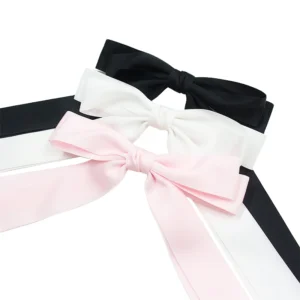
Hidden bow tacks, a complex internal headband wrap, or multiple gift-set insert materials may be simplified. Use the least complex construction that passes approved appearance and performance criteria.
Standardize Dimensions, Components, and Construction
A collection may share an elastic, alligator clip, French barrette, headband insert, padding grade, label, card, or carton. Visible fabrics, colors, prints, and branding can still differentiate the assortment.
Standardization must be product-specific. The elastic suitable for a lightweight satin scrunchie may not provide the right recovery in velvet or terry cloth. A clip that holds a small bow may not support a larger structured ornament. Approve each finished assembly.
Compare Cost Drivers Across Scrunchies, Bows, Headbands, and Clips
Scrunchie cost reflects fabric, gathering, elastic, sewing, and closure. Bows add layers, folding, pattern placement, and clip attachment. Padded headbands add inserts, padding, wrapping, and symmetry control. Heatless curling sets combine fabric tubes, internal structure, accessories, and set packaging.
Fabric clips and claw clips introduce hardware, springs, hinges, molding or cutting, polishing, plating, gluing, and decoration attachment. Compare alternatives within the same functional category. Replacing a padded headband with a flat band may cut cost, but it also changes the product proposition.
Optimize Fabrics and Components Without Lowering Product Performance
Choose Fabric by Product Function, Not Fiber Name Alone
Fiber composition alone does not determine cost or quality. Construction, weight, width, finish, color, print, quantity, yield, defects, and sewing behavior also matter. Polyester satin can suit consistent commercial programs; silk may support premium positioning.
Cotton, velvet, organza, chiffon, linen, nylon, terry cloth, and recycled fabrics each create different cutting, fraying, pile, colorfastness, shrinkage, and seam risks. Compare actual swatches and finished samples rather than approving an option from a fiber label alone. QN Beauty’s guide to silk, satin, and recycled-fabric scrunchies provides additional product-positioning context.
Engineer Elastic, Clips, Padding, and Decorations to Specification
Define elastic width, length, extension, recovery, and joining. For clips, define dimensions, thickness, spring behavior, finish, burr control, and holding. For headbands, confirm insert, stiffness, padding, comfort, and recovery.
Pearls, rhinestones, metal plates, combs, wire, and ornaments should be sized and attached for the intended product and age group. Fewer decorations can reduce labor and attachment risk, but a signature center piece may carry more brand value than a cheaper cluster of generic elements.
Controlled Material Substitution: Pros, Cons, and Validation
| Proposed Change | Potential Advantage | Limitation or Risk | Quality to Preserve | Validation Needed |
|---|---|---|---|---|
| Silk to selected satin | May improve sourcing consistency and print compatibility | Different fiber story, hand feel, and positioning | Surface, drape, seam quality, color | Swatch, finished sample, applicable performance checks |
| Custom-dyed fabric to stocked color | Removes a dyeing dependency | Less exact brand matching; stock may change | Approved shade and lot consistency | Bulk swatch and quantity reservation |
| Custom clip to validated standard clip | Avoids tooling and improves availability | Less exclusive shape or hardware | Holding, dimensions, comfort, finish | Finished-product functional review |
| Thick padding to engineered thinner grade | Reduces material and packing volume | Can flatten silhouette or reduce comfort | Profile, recovery, wear comfort | Side-by-side sample and packing evaluation |
| Multiple ornaments to one focal element | Reduces hand assembly | Changes visual balance | Brand recognition and attachment security | Visual approval and attachment assessment |
Never approve a substitution from the unit price alone. Record the old and new specification, compare physical samples, review compliance evidence, and issue written authorization before bulk material is released.
Control Custom Colors, Prints, Logos, and Tooling Costs
Reduce Color and Print Complexity Without Weakening the Collection
Each color can create material minimums, dye lots, setup, changeovers, and inventory. Concentrate initial volume in evidence-backed core colors, then add seasonal options after demand is proven.
For prints, simplify the number of colors, avoid unnecessary exact-position placement, and use a repeat compatible with the cutting pattern. This can improve yield and reduce alignment labor. Pantone targets should still be approved on the actual substrate because material and finish affect visual color.
Match the Logo Method to Order Volume and Product Structure
Woven labels, heat transfer, embroidery, metal plates, debossing, printing, and custom hardware carry different setup and labor. A label may serve several styles; metal plates add purchasing and attachment checks; embroidery can distort light fabrics.
Compare the installed result, not a standalone logo sample. The QN Beauty logo customization guide explains common branding routes and approval considerations.
Simplify Decorations While Protecting Brand Recognition
Decoration count is not the same as perceived value. One well-proportioned bow, plate, pearl, or printed motif can be more distinctive than several low-cost additions. Reduce hand-glued details first when they add limited visual value and create attachment or glue-mark risk.
Keep the brand code that buyers recognize: a particular silhouette, color combination, fabric surface, print scale, or logo placement. Cost engineering should concentrate investment on these visible signals and simplify low-value hidden complexity.
Use Sampling and Design for Manufacturability to Prevent Expensive Rework
Prepare a Cost-Ready Tech Pack and Reference Set
Provide references, drawings, dimensions, tolerances, materials, construction, colors, artwork, logo details, components, packaging, quantity, market, age grade, and required date. Mark mandatory and optimizable features.
Ask for alternatives in a controlled format: proposed change, reason, unit-cost direction, setup or MOQ implication, quality risk, sample needed, and effect on lead time. This creates a decision trail instead of a series of informal substitutions.
Evaluate Samples Against Both Quality and Repeatability
A beautiful sample can be difficult to reproduce. Check whether pleats, gathering, print placement, glue, decoration, bow symmetry, wrapping, or polishing need excessive manual adjustment. Ask what bulk tolerances are achievable.
Measure the sample, test its function, compare it with the target cost, and assess packaging fit. If a lower-cost alternative is proposed, evaluate it side by side with the original rather than from photographs alone when hand feel, recovery, holding force, surface finish, or comfort matters.
Seal the Sample and Control Changes Before Bulk Production
Approve a versioned pre-production sample with the bill of materials, measurement table, color reference, artwork, workmanship criteria, packaging, and testing plan. Keep buyer and factory records. A late change to fabric, elastic, plating, adhesive, logo, or packaging may invalidate the cost, lead time, performance review, or compliance evidence.
Mid-project review: Submit your reference photo, design drawing, or tech pack through QN Beauty’s OEM/ODM development service for a manufacturability review. The team can compare construction, materials, branding, packaging, and quantity options before a bulk quotation is finalized.
Use MOQ, SKU Planning, and Production Efficiency to Lower Unit Cost
How MOQ Affects Custom Hair Accessory Pricing
MOQ spreads setup, sourcing, tooling, printing, packaging, and line-change costs. Larger orders can still increase storage, cash-flow, markdown, and obsolescence exposure.
Ask for MOQ by style, color, material, logo, component, and packaging. Upstream inputs may have different minimums. Confirm quantities and price breaks after specification review.
Consolidate Compatible SKUs, Colors, Materials, and Packaging
Consolidation works when products genuinely share inputs or processes. Several scrunchie sizes might use one fabric lot and label. A bow and headband may share a print. Different products may use one retail card format or carton footprint. This increases usable purchasing volume and reduces changeovers.
Do not combine incompatible specifications merely to reach a headline MOQ. Mixing fabrics with different cutting behavior, hardware with different finishes, or products needing different safety assessments can add management cost rather than remove it.
Improve Forecasting, Repeat Orders, and Capacity Planning
Stable forecasts help suppliers reserve material, capacity, and repeatable components. Buyers can separate a collection into core replenishment styles and higher-risk seasonal tests. For repeat orders, keep approved material references, component codes, artwork versions, packaging files, and inspection results so development is not restarted.
Place orders with enough planning time to avoid unnecessary rush labor or premium freight. If a launch is uncertain, compare a controlled pilot with a staged reorder rather than buying unsupported volume solely for a lower unit price.
Protect Quality and Compliance to Reduce Total Procurement Cost
Prevent Defects Earlier Instead of Paying for Final Rework
Incoming checks verify materials and components before value is added. A first-article check confirms production method; in-line inspection catches sewing, placement, glue, hinge, and finish drift.
Prevention is usually less disruptive than sorting, reworking, repacking, or reproducing finished goods. Define who can stop production, how defects are recorded, and how corrective action is verified.
Build a Product-Specific Inspection and Acceptance Plan
Inspection should reflect the product. Fabric accessories may require checks for dimensions, color variation, seams, stitch security, elastic recovery, padding symmetry, print alignment, and decoration attachment. Clips may require holding function, spring action, hinge alignment, scratches, burrs, sharp edges, glue marks, plating, and ornament security.
Agree critical, major, and minor defect definitions, sampling approach, acceptance criteria, and reinspection responsibility before production. ISO 2859-1:2026 defines acceptance-sampling schemes indexed by an acceptance quality limit for inspection by attributes. Buyers using an AQL-based plan should name the agreed standard edition and parameters in their purchase documents; an AQL is not permission to knowingly ship defects.
Never Treat Safety Testing or Compliance as an Optional Saving
Applicable requirements depend on destination, product classification, intended age, materials, structure, and claims. A children’s hair accessory may require assessment of small parts, sharp points and edges, lead or other restricted substances, flammability where applicable, tracking labels where applicable, and packaging warnings where required.
For U.S. children’s products subject to applicable CPSC rules, the CPSC explains third-party testing and Children’s Product Certificate requirements. This does not make every hair accessory a children’s product or subject every style to identical rules.
For EU consumer products, the European Commission’s GPSR overview describes general product-safety and economic-operator responsibilities. Confirm REACH restrictions, GPSR duties, labeling, traceability, and technical documentation for the specific item and market. Removing necessary testing or documentation is not sustainable cost reduction.
Reduce Packaging and Logistics Cost Without Increasing Damage Risk
Right-Size Retail Packaging Around the Product and Sales Channel
A wholesale multipack, e-commerce item, gift set, and premium display need different packaging. Reduce empty space, excess layers, oversized cards, and redundant packs while meeting protection, barcode, warning, labeling, and retailer requirements.
Pack dimensions influence carton utilization and freight volume. Test whether compact packing compresses a padded headband, crushes a bow, scratches a claw clip, bends a card, or loosens an ornament. Approve the product in its final package.
Compare Packaging Options by Cost, Protection, and Brand Value
| Packaging Option | Advantages | Limitations | Cost Impact | Quality Risk | Recommended Application |
|---|---|---|---|---|---|
| Simple protective bag | Low material use; compact | Limited shelf communication | Low | Compression or surface contact | Wholesale sets, inner protection |
| Printed or labeled card | Good branding and hanging display | Card size and attachment need control | Low to medium | Bending, tearing, or product deformation | Retail scrunchies, bows, and clips |
| Reusable fabric pouch | Premium feel; secondary use | Adds sewing, logo, and inspection | Medium | Color transfer or poor fit | Premium sets and gifting |
| Folding carton | Printable surface and product protection | Dieline, assembly, and volume | Medium | Crushing or fit issues | Beauty retail and gift sets |
| Rigid box with insert | Strong presentation and structure | Higher material, assembly, and freight volume | High | Insert mismatch or cosmetic damage | High-value launches where unboxing matters |
Improve Carton Utilization and Shipping Planning
Request a preliminary packing plan before final packaging approval. Review units per inner pack and carton, carton dimensions, gross weight, protection, and pallet requirements. Small changes to card or box dimensions can improve carton fill, but only after product-protection validation.
Compare express, air, ocean, and other available routes using current door-to-door quotations for the actual origin, destination, volume, weight, Incoterm, and required date. Premium freight used to recover late approvals can erase months of product-level savings.
Evaluate Supplier Quotations for Sustainable Cost Reduction
Ask for Cost Assumptions Instead of Demanding an Unexplained Discount
Ask which specification, materials, quantity, colors, logo, packaging, inspection, tests, and Incoterm the price assumes. Request controlled alternatives: original, optimized construction, and standard-component option with stated limits.
A supplier does not need to disclose confidential internal margins for buyers to make a sound decision. It should be able to explain which design or purchasing changes affect cost and what each change means for quality, MOQ, tooling, and lead time.
Supplier Value-Engineering and Cost-Control Checklist
| Evaluation Area | Evidence to Request | Strong Practice | Cost Benefit | Warning Sign |
|---|---|---|---|---|
| Specification review | Marked tech pack and open questions | Cost drivers tied to specific features | Prevents quote mismatch | Price issued without reviewing construction |
| Material alternatives | Swatches, data, and sample proposal | Advantages and limits stated | Reduces over-specification | Unapproved substitution after order |
| Production engineering | Process route and bottleneck analysis | Operations simplified before quality is reduced | Less labor and rework | Only thinner materials proposed |
| Quality control | Inspection plan and defect criteria | Incoming, first-article, in-line, and final controls | Lower failure cost | Inspection removed to meet target |
| Packaging and logistics | Packed sample and carton plan | Protection balanced with utilization | Lower material and freight cost | Carton data unavailable until completion |
| Change control | Version and approval record | Cost, quality, and timing revalidated | Prevents hidden scope growth | Changes managed through informal messages |
QN Beauty presents a product range covering scrunchies, headbands, claw clips, barrettes, bows, combs, and related categories in its custom hair accessory portfolio. Use portfolio breadth as one input, then verify that the supplier has relevant material, process, sampling, production, and inspection capability for your exact product.
Red Flags That Signal Quality Has Been Removed from the Price
Warning signs include a discount with no specification revision, thinner or different materials without samples, undefined elastic or clip performance, missing tolerances, unapproved subcontracting, testing described as universally unnecessary, inspection removed, packaging changed without a fit test, or a quote that excludes known requirements.
Ask for a revised bill of materials, sample, artwork, packaging, quality plan, and written quotation assumptions. If the supplier cannot explain how the saving is created, the buyer cannot evaluate where the risk moved.
Buyer FAQ, Future Trends, Expert Summary, and Cost-Reduction Action
Frequently Asked Questions About Hair Accessory Cost Reduction
How can buyers reduce custom hair accessory unit cost?
Start with SKU concentration, design simplification, compatible standard components, better material yield, consolidated packaging, and clearer forecasts. Validate every change against a sealed sample and measurable quality standard.
Does a higher MOQ always reduce the unit price?
It may spread setup and sourcing costs, but the result depends on materials, color count, processes, packaging, and capacity. Excess inventory can make total cost worse even when factory unit price falls.
What is the safest material cost-reduction method?
Remove over-specification and compare controlled alternatives using actual swatches and finished samples. There is no universally safe substitute because function and brand positioning vary by product.
Should buyers tell a factory their target price?
Yes, when it is paired with required quality, quantity, packaging, market, and delivery terms. This helps the supplier propose relevant value-engineering options instead of guessing what may be changed.
Can fewer colors lower custom hair accessory pricing?
Often, because fewer colors may reduce material fragmentation, dye or print setups, production changeovers, and separate packaging inventory. The actual effect is subject to specification and quantity review.
Can quality inspection be reduced on repeat orders?
Any change should be risk-based and agreed in the quality plan. Stable performance and controlled processes may support a revised approach, but repeat status alone does not eliminate material, workmanship, or shipment risk.
How should buyers compare two supplier quotations?
Normalize the specification, quantity, color split, packaging, testing, inspection, Incoterm, currency, and delivery scope. Then compare landed cost, risk, capability, and change-control discipline—not price alone.
Future Trends in Modular, Data-Led Cost Engineering
Modular platforms combine validated elastics, clips, inserts, padding, cards, and cartons with changeable fabrics, colors, prints, and logos. This reduces repeated engineering while preserving visible customization.
Digital tech packs, material libraries, cutting-yield records, sample version control, and defect data will make cost discussions more precise. Buyers will be able to see whether a saving comes from better utilization, simpler construction, scale, or an actual reduction in specification. Traceable data also supports faster repeat orders and more credible material or sustainability claims.
Expert Summary: Lower Waste and Complexity, Not the Quality Standard
The most reliable way to reduce custom hair accessory unit cost is to engineer out waste before taking value away from the customer. Concentrate SKUs, standardize suitable hidden components, improve material utilization, simplify low-value operations, match branding to the product, right-size packaging, and plan production and freight earlier.
QN Beauty states more than 15 years of OEM/ODM experience and supports fabric and component selection, colors and printing, logo and packaging customization, sample revision, bulk production, inspection, and pre-shipment quality control. These capabilities can support cost engineering, but every result—including MOQ, price, timing, testing, and performance—must be confirmed for the specific design.
Request a Cost-Optimized Sample Plan or Bulk Quotation
To receive a useful comparison, ask for alternatives that preserve your product’s essential appearance, function, and market requirements. QN Beauty can review the design and explain where standardization, construction changes, materials, branding, quantity planning, or packaging may improve cost efficiency.
Please provide:
- Product type
- Product dimensions
- Reference photos, design drawings, or tech pack
- Fabric and material requirements
- Pantone colors or print artwork
- Logo file and preferred branding method
- Target quantity by style and color
- Current or target cost, with applicable Incoterm
- Packaging requirements
- Delivery country
- Target delivery date
- Applicable market or compliance requirements
Next step: Submit your hair accessory specification for cost review to request a sample, optimized customization proposal, or bulk quotation. Recommendations will be subject to specification review and confirmed after sample evaluation.