That market backdrop explains why Hair Clips vs Claw Clips is not just a styling question. It is also a product strategy question. Should a brand lean into compact, decorative, fashion-led clips? Or double down on practical claw clips that consumers throw into work totes, gym bags, and travel kits? The best answer is usually more nuanced than picking a single winner.
In this guide, we compare the two categories through four business-ready lenses: advantages, disadvantages, opportunities, and risks. We will also cover materials, use cases, real market signals, a live brand case study, and a practical decision framework for brands selling into Western markets.
Internal link suggestion: Link “hair accessories market” or “custom hair accessories” to your category or service page.
External link suggestion: Add a market-data link here to Grand View Research or Statista.
Hair Clips vs Claw Clips: What Are They?
What are hair clips?
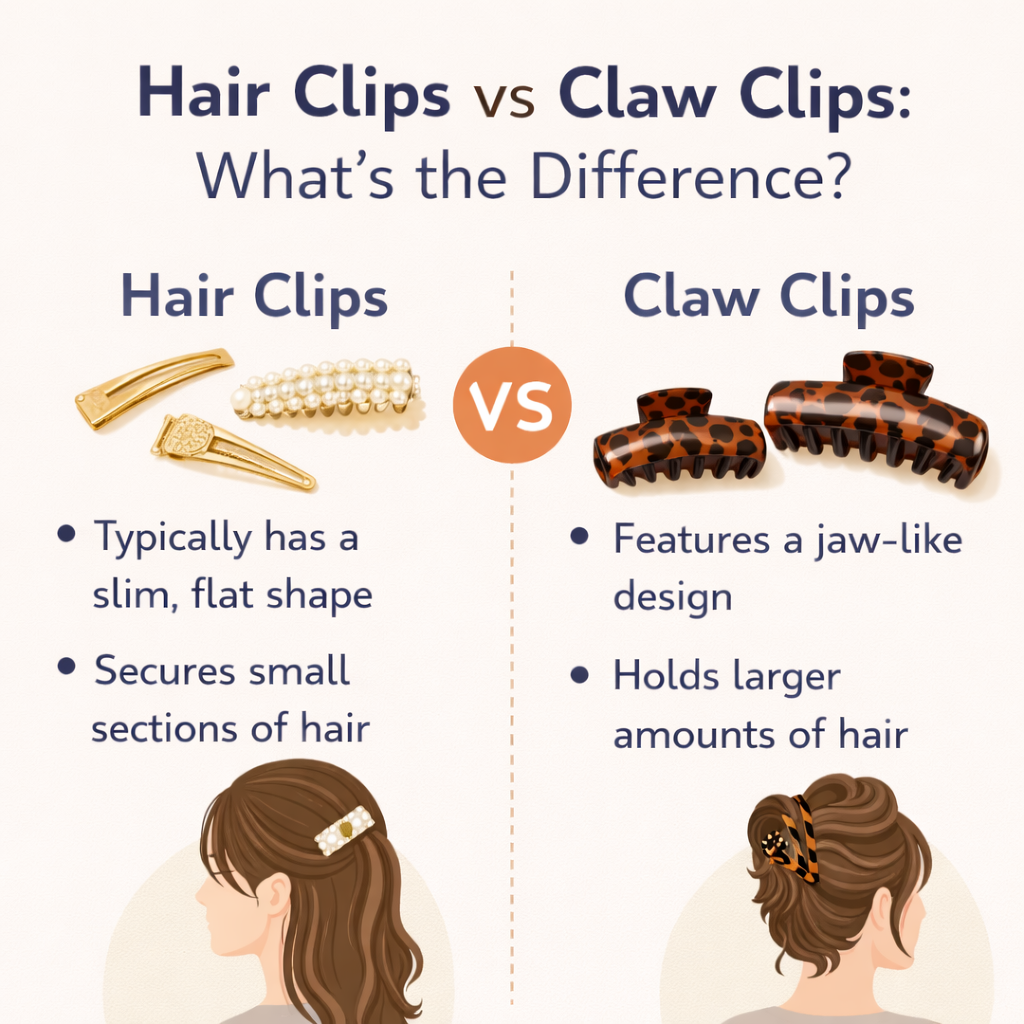
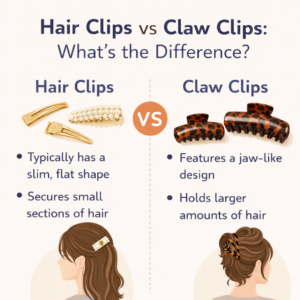
“Hair clips” is a broad category. It can include snap clips, barrettes, duckbill clips, alligator clips, decorative side clips, and fashion pins. In retail language, the phrase often refers to smaller pieces that secure a section of hair rather than the full head. That is why hair clips are commonly associated with styling detail, face-framing placement, children’s accessories, and trend-driven looks.
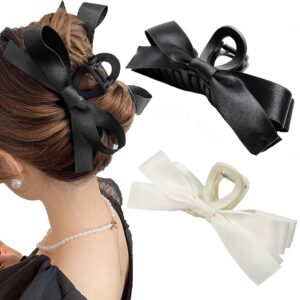
They also have wider aesthetic range. Some are basic and functional. Others are heavily decorative, using pearls, bows, rhinestones, acetate patterns, metallic finishes, or fabric wrapping. Allure’s 2026 barrette roundup reflects that breadth, ranging from simple snap clips to bow barrettes and statement pieces that elevate an outfit as much as they hold hair.[5]
What are claw clips?
Claw clips are usually larger, toothed accessories built to gather and hold more hair in one motion. Their structure is easy to recognize: two interlocking comb-like sides, connected by a spring hinge, designed to grip a twist, bun, or half-up section. They are especially popular for quick updos, everyday commuting, office styling, and low-effort routines.
Editorial testing reinforces that use case. Allure describes claw clips as everyday styling staples for uncomplicated hairstyles, half-up looks, and French twists, while ELLE’s 2026 roundup emphasizes comfort, grip, and design for work totes and daily rotation.[3][4]
Why people confuse the two
Consumers often use “hair clip” as a catch-all term, so the line between categories gets blurred. In practice, though, the distinction matters. Hair clips usually work at the micro level: small section, styling accent, decorative finish. Claw clips usually work at the macro level: larger section, faster hold, practical updo.
That is why the same customer may buy both categories for completely different jobs. One solves styling detail. The other solves hair management.
Materials and construction also separate them
Hair clips can be made from metal, plastic, acrylic, resin, fabric-wrapped bases, or acetate. Claw clips are also available in plastic, metal, and acetate, but their performance depends more heavily on hinge strength, tooth spacing, and tension. Good Housekeeping’s beauty experts specifically noted that French-made acetate clips can be stronger, lighter, and more flexible than regular plastic, which is highly relevant for quality-focused brands.[11]
| Feature | Hair Clips | Claw Clips |
|---|---|---|
| Main role | Sectioning, decorating, refining details | Holding larger sections quickly |
| Typical size | Small to medium | Medium to large |
| Best styling use | Side styling, half-up accents, fashion looks | Twists, buns, full or half-up hold |
| Buying trigger | Style, gifting, trend, detail | Convenience, comfort, speed, daily use |
Internal link suggestion: Link “claw clips” to your claw clip collection page and “hair clips” to your broader clips category.
External link suggestion: Add an external style/expert source here for barrette and claw clip definitions.
Hair Clips vs Claw Clips: Advantages
Advantages of hair clips
Hair clips are stronger style communicators. They are better at adding polish, sparkle, contrast, softness, or personality to a hairstyle. A barrette can make a simple ponytail look intentional. A pearl snap clip can shift a plain look toward event-ready. A bow clip can create a giftable, feminine, seasonal story almost instantly. Allure’s recent barrette coverage shows exactly why they stay relevant: they are small accessories that create visible fashion impact.[5]
They also work well for targeted consumer segments. Fine hair users, children, bridal customers, occasion dressing, and fashion-driven shoppers often respond better to decorative clips than to bulkier claw formats. Hairstylist Justine Marjan even recommends placing barrettes based on facial lines, which highlights how styling precision is part of the category’s appeal.[6]
Advantages of claw clips
Claw clips are built for practicality. They are fast, intuitive, and high-frequency. A good claw clip helps users get hair off the face in seconds without heat styling or a complex routine. That explains why editors continue to test and recommend them year after year. Allure focuses on their versatility and hold, especially for thick hair, while ELLE’s 2026 edit frames them as reliable everyday tools tested for comfort, grip, and design.[3][4]
For brands, that matters because high-frequency products often have stronger repeat-buy potential. A consumer may buy a decorative clip because it is pretty. They buy a claw clip because they expect to use it constantly.
Hair clips usually win on aesthetics; claw clips usually win on utility
This is the most useful simplification for buyers. Hair clips tend to overperform when the customer wants outfit coordination, gifting, trend layering, or visual storytelling. Claw clips tend to overperform when the customer wants daily function, quick styling, and less friction in the morning routine. Grand View Research’s note that the broader market is growing around products that combine utility and trend helps explain why both categories remain relevant.[1]
Assortment advantage: they work better together than apart
The strongest brands often use the categories together. A claw clip handles the core utility need. Hair clips and barrettes extend the style story. That combination serves more moments of use, more gift occasions, and more price points. It also makes collection-building easier because sizes, materials, and finishes can be layered across a broader visual system.
| Category Advantage | Hair Clips | Claw Clips |
|---|---|---|
| Decorative appeal | Excellent | Moderate to strong |
| Everyday speed | Moderate | Excellent |
| Giftability | Excellent | Good |
| Thick-hair performance | Limited to selected designs | Usually stronger |
| Trend flexibility | Excellent | Strong |
Internal link suggestion: Link “giftable sets” to your custom service or seasonal collection page.
External link suggestion: Add Allure or ELLE here as an editorial proof point.
Hair Clips vs Claw Clips: Disadvantages
Disadvantages of hair clips
Hair clips often struggle when the job shifts from decoration to real hold. Small clips can look beautiful but fail on thick hair, high-movement days, or larger sections. Some pieces are better described as ornaments than secure accessories. That can limit repeat purchase unless the design is distinctive enough to justify fashion-led buying.
Another weakness is scale. Small pieces are easier to lose, easier to damage in transit, and harder to merchandise cleanly unless the packaging is strong. For value-oriented channels, that can create pressure on perceived worth.
Disadvantages of claw clips
Claw clips have the opposite problem. They are often easier to use but harder to differentiate. The category has been crowded for several seasons, and commodity shapes can look interchangeable fast. A bulky claw clip also does not fit every bag, every head position, or every hairstyle. It may press against the scalp when sitting back, and it may feel oversized for very short hair or for highly edited evening looks.
Even editorial praise comes with an implicit warning: the best claw clips stand out because so many average ones fail on grip, comfort, or thick-hair performance.[3][4]
Material quality can make or break both categories
Construction matters more than trend. Weak springs, poor tooth alignment, rough edges, thin metal, and brittle low-grade plastic all damage user trust. This is especially risky in claw clips because failure is visible and immediate. The clip snaps, slides, or pinches. But hair clips are not immune. A decorative barrette that will not stay in place or arrives bent also undermines the product story.
That is why material selection matters. Acetate-like finishes, matte coatings, spring quality, hinge strength, plating consistency, and edge smoothness all affect comfort and performance. Good Housekeeping’s expert note on acetate being stronger, lighter, and more flexible than regular plastic is useful shorthand for why better material choices can command better reviews.[11]
Hair-health downside: tight styling is still a risk
No accessory category is completely risk-free if it is used with too much tension. The American Academy of Dermatology warns that hairstyles that constantly pull on the hair can damage hair health over time and lead to traction alopecia.[8] Mayo Clinic makes a similar point when discussing hair loss caused by repeated pulling or tight styling.[9] The lesson for buyers is practical: comfort is not a soft feature. It is a quality feature.
| Common Weakness | Hair Clips | Claw Clips |
|---|---|---|
| Hold on thick hair | Often limited | Usually better, but not guaranteed |
| Bag portability | Excellent | Often bulky |
| Breakage risk | Lower per piece, but still possible | Higher if spring or teeth are weak |
| Differentiation risk | Lower in fashion-led designs | Higher in basic commodity shapes |
Internal link suggestion: Link “material quality” to a page explaining your acetate, metal, or QC capabilities.
External link suggestion: Add AAD or Mayo Clinic here for the hair-health note.
Hair Clips vs Claw Clips: Opportunities
Hair clips have stronger fashion and gifting opportunities
If a brand wants to build seasonal drops, holiday gifting, kids’ assortments, bridal capsules, or fashion-led social content, hair clips are extremely flexible. Their smaller scale makes them ideal for novelty, color stories, pearl or bow details, and trend reaction. In 2026 trend coverage, Who What Wear highlighted oversize barrettes and jewelry-inspired hair accessories, showing how this side of the category is moving closer to adornment and statement styling.[7]
That creates room for higher storytelling value, especially when clips are grouped in twos, threes, or mixed-texture packs.
Claw clips have stronger everyday and commute-driven opportunities
Claw clips are better positioned for office use, low-effort beauty routines, thick-hair problem solving, and “throw-it-on-fast” purchasing behavior. ELLE’s 2026 roundup literally frames them as the kind of accessory people keep in a work tote, shoulder bag, or toiletry case.[4] That kind of language matters because it reveals how the product lives in real life, not just in flat-lay photography.
For brands, that means stronger potential in commuter sets, travel styling, minimal everyday colorways, and utility-first merchandising.
Material-led product development is still underused
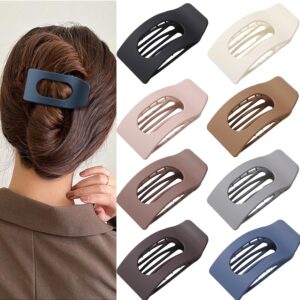
One of the biggest opportunities is not shape. It is finish. Matte, glossy, tortoiseshell, translucent, marbled acetate, soft-touch coatings, brushed metal, mixed media, and padded decorative clip toppers all create different retail stories. This matters because differentiation in mature categories rarely comes from saying “we also sell clips.” It comes from saying “we solved a performance or style problem in a way the market is not crowded with yet.”
Collection-building is where the biggest upside lives
The smartest strategy is usually not claw clip or hair clip. It is a coordinated collection. A basic large claw clip can anchor the everyday need. Smaller clips or barrettes can build up the fashion layer. Add scrunchies or headbands and the brand suddenly has a fuller accessory wardrobe. That is good for basket size, gifting, and merchandising clarity.
- Use claw clips as core utility SKUs.
- Use hair clips and barrettes as style-extension SKUs.
- Launch coordinated colors across both.
- Offer mixed packs for gifting and trial.
- Build size tiers for fine hair, thick hair, and kids.
Internal link suggestion: Link “coordinated collection” to your product category page and “custom service” to your OEM/ODM service page.
External link suggestion: Add a 2026 trend article here, such as Who What Wear or Pinterest Predicts.
Hair Clips vs Claw Clips: Risks
Hair clips risk: strong decoration, weak repurchase
Decorative clips can attract first-time buyers quickly, especially when the design is cute, giftable, or social-friendly. But if the item is mostly ornamental and rarely worn, repurchase can be weaker than expected. The product wins the visual test but fails the habit test. That is a real risk in trend-heavy channels.
There is also intense price competition in small clips and low-unit multipacks. Without brand value, superior finish, or strong presentation, the category can get squeezed.
Claw clips risk: heavy copycat pressure
Claw clips can generate higher daily-use value, but they are also easier to commoditize. Once a hero shape takes off, dozens of similar versions appear quickly. That creates margin pressure and makes quality even more important. If the spring is weak or the clip breaks in the user’s hand, the review damage can be immediate.
This is the key operational risk in the category: claw clips look simple, but consumer tolerance for failure is low because the product’s purpose is straightforward. It either holds well or it does not.
Quality risk becomes a brand risk very fast
In both categories, poor execution travels fast through ratings, comments, and return behavior. A rough edge that snags hair, a chipped coating, a broken spring, or poor plating turns a low-ticket accessory into a trust problem. And because accessories are often impulse buys, bad first impressions can stop a consumer from trying the rest of the collection.
Over-indexing on one winner can trap the assortment
When a single hero product performs well, brands sometimes overbuild around it and neglect the rest of the assortment. That can work in the short term, but it increases concentration risk. A smarter approach is to use hero claw clips to bring customers in, then use hair clips, barrettes, and related accessories to expand the collection and protect the business from one-trend dependence.
| Risk Area | Hair Clips | Claw Clips |
|---|---|---|
| Price competition | High | Moderate to high |
| Trend fatigue | Moderate | High in generic shapes |
| Quality complaint severity | Moderate | High |
| Repurchase reliability | Can be style-dependent | Often stronger if performance is good |
Internal link suggestion: Link “quality control” or “custom development” to your factory or service page.
External link suggestion: Add a case-study or market article here.
Case Study: What the Claw Clip Boom Teaches Brands
Case signal: Emi Jay shows how big claw clips can scale
A strong real-world signal comes from Emi Jay. According to WWD, the brand had sold one million claw clips by November 2025 and expanded further into tools and liquid products.[10] That is not just a nice headline. It shows that claw clips can grow beyond a trend item when the brand connects hold, aesthetics, celebrity visibility, and ongoing novelty.
Editorial validation helped reinforce the category
That growth story aligns with editorial behavior. Allure named Emi Jay’s Heartbreaker Claw Clip its best claw clip for thick hair in a tested roundup, with direct praise for hold and sturdiness.[3] ELLE’s 2026 list also placed an Emi Jay clip at the top of its spring roundup.[4] Together, those signals show how performance and desirability can reinforce one another.
The lesson for brands: function created the demand, branding multiplied it
This is the key takeaway. The claw clip category did not scale just because the product was pretty. It scaled because it solved a real use problem quickly. Then brands layered color, finish, gifting value, celebrity association, and scarcity on top of that utility. That is a much stronger flywheel than trend alone.
What hair clips can learn from this
Hair clips and barrettes can still win, but usually through a different route. Their edge is not “hold all your hair fast.” Their edge is precision, decoration, curation, and styling expression. That means brands should merchandise them as style solutions, occasion solutions, or collection add-ons rather than direct substitutes for heavy-duty claw clips.
Internal link suggestion: Link “launch your next bestseller collection” to your custom-service page.
External link suggestion: Link to a trade article or editorial roundup here.
Hair Clips vs Claw Clips: How to Choose Between Them
Choose hair clips first if your customer buys for style
If your target buyer shops fashion boutiques, gift stores, bridal channels, or trend-led e-commerce, hair clips and barrettes are usually the better lead category. They photograph well, layer easily into storytelling, and adapt quickly to seasons, colors, embellishments, and trends.
Choose claw clips first if your customer buys for daily use
If your customer values speed, practicality, comfort, office styling, and thick-hair performance, claw clips deserve priority. They fit mass daily-use behavior better and often make more sense as the core SKU in a new collection.
Choose both if you want a stronger assortment architecture
For most brands, the best answer is not binary. Start with claw clips as the hero practical item. Add hair clips as the styling extension. Then organize the collection by size, occasion, or material finish. This supports both entry-level buying and higher-value bundle buying.
Use this quick decision matrix
| If your priority is… | Choose… | Reason |
|---|---|---|
| Fashion styling and gifting | Hair clips | More decorative range and stronger visual storytelling |
| Everyday utility | Claw clips | Faster, easier, more habitual use |
| Thick-hair problem solving | Claw clips | Generally stronger hold and more capacity |
| Kids and fine-hair styling | Hair clips | Smaller formats are often more suitable |
| Seasonal capsule collection | Both | Combines utility and aesthetic range |
| Premium assortment | Both | Lets material, finish, and pack architecture do more work |
Internal link suggestion: Link “custom hair accessories” to https://qnbeauty.com/custom-service/ and “claw clips” to your relevant collection page.
External link suggestion: Add a buyer guide or trend report here.
FAQ
Are claw clips better than hair clips?
Not always. Claw clips are usually better for fast hold and everyday updos. Hair clips are usually better for decorative styling, smaller sections, and fashion-led looks.
Which is better for thick hair?
In most cases, claw clips are better for thick hair because they can gather and hold more volume. Editorial testing from Allure and ELLE repeatedly highlights grip and thick-hair performance as major evaluation criteria for claw clips.[3][4]
Which is better for fine hair?
Fine hair can work with both, but small barrettes, snap clips, and lighter formats are often easier to place and style. Some users may still prefer smaller claw clips for half-up looks.
Are claw clips safer for hair than tight elastics?
They can feel gentler for many users, but any accessory that creates repeated tension or discomfort can still be a problem. The safest choice is a comfortable fit, low tension, and avoiding styles that pull too tightly for long periods.[8][9]
What materials are best?
That depends on the target price and finish, but better acetate-like materials, smooth edges, reliable spring quality, and strong construction usually outperform brittle low-grade plastic. Material quality has a direct effect on comfort and longevity.[11]
Should brands launch both hair clips and claw clips?
Usually yes. If your customer base is broad enough, the two categories complement each other well. One covers style and gifting. The other covers utility and frequency of use.
Conclusion
Hair Clips vs Claw Clips is not a simple style debate. It is a category strategy decision. Hair clips are usually the better choice when the goal is decoration, detail, fashion layering, gifting, or trend storytelling. Claw clips are usually the better choice when the goal is speed, comfort, hold, and repeat daily use.
That is why the smartest brand strategy is often not choosing one over the other. It is building a collection where claw clips deliver the practical anchor and hair clips deliver the visual range. The wider market is rewarding accessories that combine function with aesthetics,[1] while 2026 trend coverage suggests that statement barrettes, jewelry-inspired pieces, and sculptural clips all still have room to grow.[7]
Looking ahead, the best opportunities are likely to come from better materials, clearer assortment architecture, and more deliberate collection-building. In other words: fewer random SKUs, more purposeful systems.
- Custom service: https://qnbeauty.com/custom-service/
- Homepage / collection overview: https://qnbeauty.com/
- Claw clip hairstyles guide: https://qnbeauty.com/claw-clip-hairstyles-for-thick-vs-thin-hair-18-easy-looks-pro-hold-tips/
- Hair accessory organization guide: https://qnbeauty.com/organize-hair-accessories-easy-storage-ideas-for-a-neat-space/
- Butterfly hair clips comparison page: https://qnbeauty.com/butterfly-hair-clips-2/