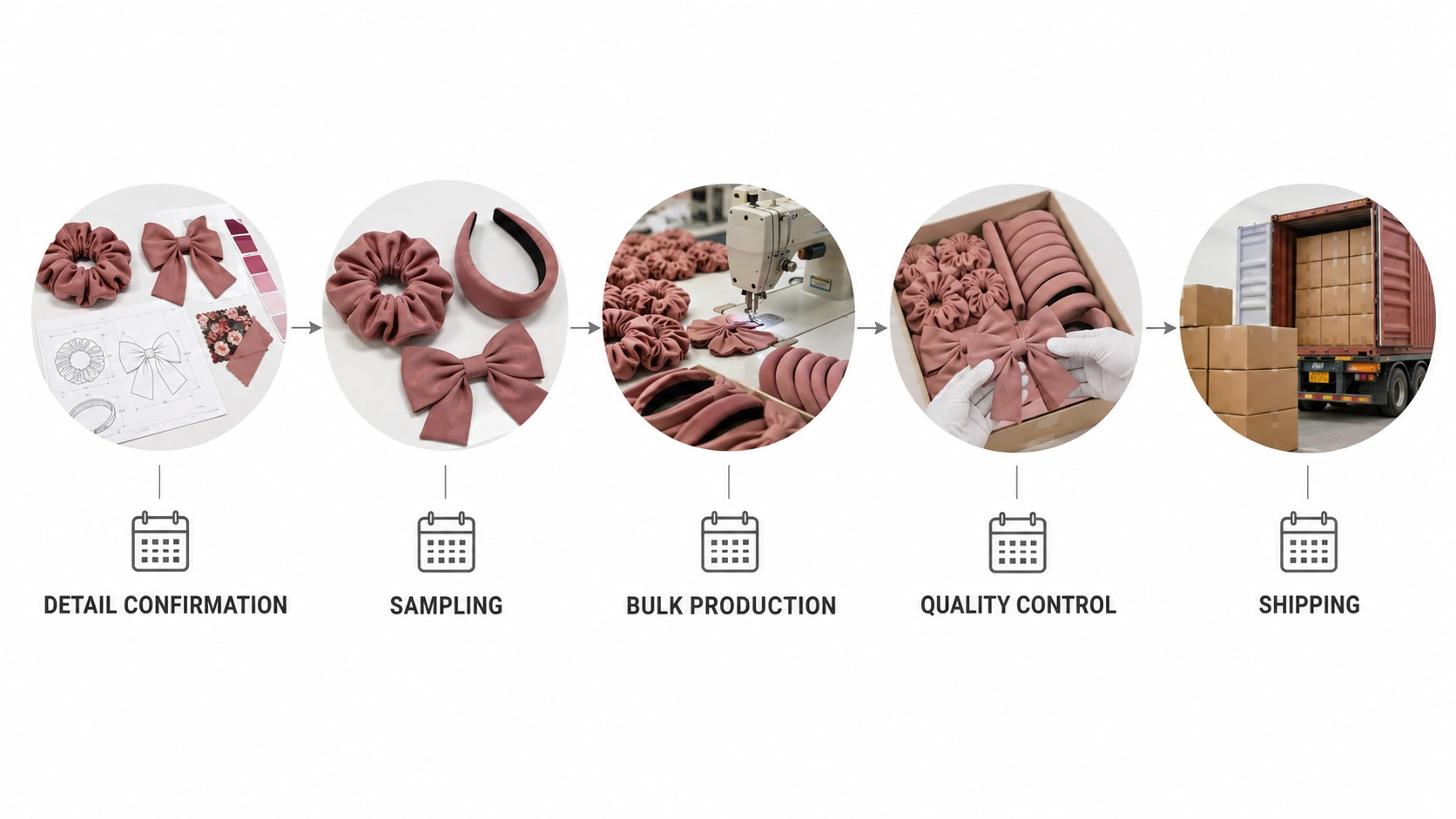
Custom hair accessory production time is not simply the number of days a factory spends sewing or assembling. A buyer must also account for specification review, material sourcing, sampling, revisions, testing, bulk production, inspection, packaging, freight, and customs clearance. If one dependency is omitted, a purchase order that looks safe on paper can miss a retailer delivery window, force expensive airfreight, or launch with unapproved quality.
This guide shows procurement and private label teams how to schedule scrunchies, hair bows, fabric clips, padded headbands, heatless curling sets, claw clips, and mixed collections. It explains the critical path, approval gates, and dates a manufacturer should confirm.
Planning a launch? Send QN Beauty your product type, target quantity, specifications, destination, and required in-warehouse date through the hair accessory project inquiry page. The team can review material and customization dependencies before a production commitment is made.
Custom Hair Accessory Production Time Starts with a Complete Project Brief
Why a Single Lead-Time Number Can Mislead Buyers
“Lead time” can describe different intervals. One supplier may count from deposit receipt; another may start after artwork, materials, and samples are approved. Neither definition necessarily includes freight or customs. Require the start event, finish event, assumptions, and exclusions.
The most useful schedule separates three clocks:
- Development time: design clarification, sourcing, samples, revisions, packaging prototypes, and approval.
- Manufacturing time: material release, cutting or molding, sewing, assembly, inspection, and packing.
- Delivery time: cargo booking, export handling, international transit, import clearance, and final-mile delivery.
Work Backward from the Required In-Warehouse Date
Start with the required stock-receipt date. Work backward through receiving, customs, freight, inspection, manufacturing, material procurement, sample approval, and design closure. Include your own team’s decision time at each gate.
Keep four dates distinct in the purchase order or production calendar: sample approval date, planned ex-factory date, estimated departure date, and required in-warehouse date. An ex-factory promise does not guarantee a vessel departure or warehouse receipt.
Information a Manufacturer Needs Before Confirming a Schedule
Prepare a reference photo, drawing, or tech pack with measurable requirements. For fabric accessories, specify composition, weight or swatch, dimensions, gathering ratio where relevant, elastic, padding, seams, and color standard. For clips, define dimensions, substrate, spring or hinge, plating, holding expectation, and decoration attachment.
Include artwork, Pantone references, logo details, quantity by SKU and color, packaging and labeling, destination, required date, target age, and market requirements. A picture without dimensions is inspiration, not a production specification.
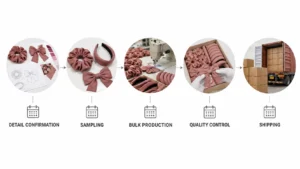
Product Type and Construction Change the Hair Accessory Lead Time
Sewn Fabric Accessories: Scrunchies, Hair Bows, and Headbands
Sewn products do not share one schedule. A basic scrunchie may require cutting, joining, elastic insertion, closing, inspection, and packing. A printed bow adds artwork, alignment, folding, clip attachment, and shape control. A padded headband adds insert sourcing, foam cutting, wrapping, end finishing, and wear evaluation.
Velvet, silk, satin, cotton, organza, chiffon, linen, nylon, and terry cloth cut and sew differently. Slippery, sheer, high-pile, or fraying fabrics may need special handling, and a material change can alter the approved silhouette.
Clips, Claw Clips, and Accessories with Metal or Plastic Components
Fabric-covered alligator clips or French barrettes combine fabric preparation, hardware, gluing, and decoration. A claw clip using an existing mold differs from a proprietary shape requiring tooling, color development, polishing, spring assembly, and surface inspection.
For metal or plastic components, schedule approval around clip dimensions, metal thickness, spring tension, hinge alignment, plating consistency, scratches, burrs, sharp edges, glue marks, and ornament attachment. A component that looks acceptable alone may still fail after assembly, so evaluate the finished product.
Stock Components Versus Fully Custom Development: Pros and Cons
| Development Route | Advantages | Limitations | Typical Schedule Impact | Quality Risk | Best Fit |
|---|---|---|---|---|---|
| Stock material and standard component | Fewer sourcing steps; easier replacement | Less exclusivity; availability can change | Usually shorter pre-production path | Lot variation or unreserved stock | Launch tests, repeatable basics |
| Stock base with custom color or logo | Balances differentiation and existing construction | Color or branding still needs approval | Adds artwork, color, and sample gates | Color mismatch or logo inconsistency | Private label collections |
| Custom print, component, or packaging | Stronger brand control | More suppliers and minimums may apply | Longer dependency chain | Print, fit, or packaging incompatibility | Signature seasonal programs |
| New mold or engineered structure | Highest product differentiation | Tooling approval and validation required | Longest and least flexible development path | Tooling revision or functional failure | Proprietary designs with planned volume |
Select the route that supports brand positioning, forecast confidence, and inventory risk. Confirm availability before ordering; a quoted material is not reserved unless the agreement says so.
Materials, Colors, Branding, and Packaging Create Pre-Production Dependencies
In-Stock Materials Versus Custom-Dyed or Custom-Made Inputs
“In stock” should mean the required grade, color, quantity, and lot of fabric or components can be reserved. Custom dyeing, special elastic, nonstandard hardware, new molds, or exclusive decorations add upstream schedules that may control the order.
Identify the longest-lead input in the bill of materials. Confirm the purchase gate, bulk-color approval, and backup-source policy. Require written approval for substitutions.
Pantone Matching, Printing, and Pattern Placement
Pantone references do not eliminate substrate, finish, lighting, or dye-lot differences. Approve color on production material using a defined reference. For prints, specify artwork resolution, repeat, scale, orientation, colors, and placement; a positioned motif may require a strike-off and finished-sample review.
Logo Methods, Decorations, and Retail Packaging
Woven labels, heat transfer, embroidery, metal plates, debossing, and printed cards have different setup and inspection needs. A plate may affect comfort; embroidery may distort light fabric; a large label can interrupt gathering. Approve branding on the finished accessory.
Packaging is often a separate production project. Cards, boxes, pouches, barcodes, warnings, multilingual copy, and retailer templates need approved artwork and physical fit. Late copy changes can hold otherwise finished goods.
How Long Does Hair Accessory Sampling Take?
From Design Review to the First Physical Sample
Hair accessory sampling time begins after the design is interpretable. The team may first need to source alternatives, clarify construction, create artwork, match color, or engineer an attachment. A substitute-material sample can confirm size or construction, but not final hand feel, color, recovery, or finish.
Sample Revisions and Buyer Approval Rounds
Consolidate design, merchandising, compliance, and packaging comments into one numbered document. Use annotated photos and measurements, and mark each point mandatory or preferred. Separate, conflicting messages create rework.
- Compare it with the latest tech pack.
- Measure critical dimensions by the agreed method.
- Check applicable function, comfort, and attachment security.
- Review color, print, logo, stitching, glue, plating, and finish.
- Issue one revision sheet with photos and tolerances.
How to Evaluate and Seal a Pre-Production Sample
| Approval Area | Evidence to Record | Approval Question | Delay Risk if Unclear | Preventive Action |
|---|---|---|---|---|
| Dimensions and structure | Measured sample and tolerance table | Does the sample match the intended fit and form? | Bulk rework or inconsistent silhouette | Define measurement points and tolerances |
| Material and color | Composition, swatch, lot reference | Is the final production material approved? | Shade or hand-feel dispute | Seal the actual swatch or bulk lot standard |
| Function | Elastic, clip, hinge, or wear observations | Does it perform for the intended use? | Late component replacement | Approve finished assembly after evaluation |
| Branding | Artwork version, size, location, method | Is branding readable and securely attached? | Logo remake or placement error | Sign dated artwork and physical sample |
| Packaging | Approved dieline and packed sample | Does it protect, present, and scan correctly? | Finished goods wait for repacking | Test fit, barcode, copy, and carton plan |
| Compliance | Market, age grade, test plan, reports | Are applicable requirements identified? | Testing after cargo is ready | Approve compliance plan before bulk release |
Give the sealed sample a version, date, and approval record; retain buyer and factory copies when practical. Derive bulk tolerances and workmanship criteria from it. Control later changes in writing.
Bulk Hair Accessory Production: Scheduling Each Manufacturing Stage
Purchase Order Confirmation and Material Booking
Define the bulk-release conditions: signed PO, payment milestone, approved pre-production sample, final bill of materials, artwork, packaging, shipping terms, and compliance plan. The factory should acknowledge the calendar when these inputs are complete.
If constrained materials are booked early, document quantity, ownership, variance, and responsibility if the design changes.
Cutting, Sewing, Assembly, Finishing, and Packaging
The route depends on the SKU. Fabric products may pass through incoming inspection, cutting, printing or embroidery, sewing, elastic or padding insertion, finishing, assembly, inspection, and packing. Clip products may require molding or cutting, polishing, plating, spring assembly, gluing, curing, functional checks, and protective packing.
Hand pleating, aligned prints, braiding, and decorations add labor. Do not compress required curing or stabilization.
Capacity Bottlenecks and Production-Line Sequencing
Total capacity can hide a bottleneck in printing, hand assembly, polishing, plating, or inspection. Mixed orders also require color, material, and packaging changeovers. Ask which step is constrained and whether the calendar assumes parallel lines or outside processing.
Final Inspection and Shipment Release
Allow time between assembly and cargo handover for counts, final inspection, corrections, packaging verification, carton marking, packed measurements, and release authorization.
For QN Beauty’s stated end-to-end OEM/ODM workflow and inspection approach, review its custom hair accessory manufacturing service. Buyers with a reference photo, drawing, or draft specification can submit it for a manufacturability and timeline review. The exact sampling, mass-production, and inspection calendar remains subject to project review.
Quality Control and Compliance Can Protect or Extend the Schedule
Build Inspection Hold Points into the Production Plan
Quality control is faster near the defect source. Incoming checks catch wrong materials before labor is added; a first-article check verifies construction; in-line inspection detects drift; final inspection verifies packed goods against the approved standard.
Checks may cover dimensions, seams, elastic recovery, print alignment, colorfastness, padding, clip function, sharp edges, glue, plating, decorations, and packaging. Agree methods and acceptance criteria before production.
Plan Market-Specific Safety and Chemical Compliance Early
Requirements depend on destination, user, age grade, materials, structure, claims, and classification. Do not assume CPSIA, REACH, Proposition 65, warnings, or certifications apply identically to every hair accessory.
For a U.S. children’s product subject to an applicable CPSC-enforced children’s product safety rule, the CPSC explains third-party testing and Children’s Product Certificate requirements. Buyers of children’s hair accessories should assess small parts, sharp points and edges, lead and other restricted substances, flammability where applicable, tracking labels where applicable, and required packaging warnings based on the actual product and age group.
For the EU, the European Commission’s GPSR overview describes product-safety and economic-operator responsibilities. Confirm chemical, traceability, risk-assessment, labeling, and documentation duties for the specific product.
Control Material Changes After Testing and Sample Approval
A material, coating, pigment, adhesive, metal component, print chemistry, or supplier change can affect appearance, function, and compliance evidence. The CPSC also distinguishes requirements for children’s and general-use products; applicable testing and certification must be determined for the actual item. Build retesting and documentation review into change control rather than discovering the need after shipment booking.
Since July 8, 2026, U.S. importers of products subject to CPSC certification requirements must eFile certificate data; the CPSC eFiling guidance explains applicability. This does not mean every hair accessory requires a CPC or GCC.
Packaging, Shipping, and Customs: Factory Completion Is Not Delivery
Packaging Approval, Carton Data, and Booking Readiness
Freight planning needs packed volume, weight, carton count, and pickup location. Confirm unit packs, carton quantity and dimensions, marks, barcodes, protection, and pallet requirements before the booking cutoff.
Express, Air, Ocean, and Multimodal Shipping Compared
| Shipping Route | Advantages | Limitations | Cost Impact | Schedule Risk | Recommended Use |
|---|---|---|---|---|---|
| Express courier | Door-to-door visibility; suitable for small cartons | High cost at larger weights; import process still applies | Highest relative cost | Capacity, remote-area, or clearance delay | Samples, urgent replacements, small launches |
| Air freight | Faster than ocean for commercial quantities | Airport handling and final delivery must be arranged | High | Space, routing, security, or customs delay | Deadline-sensitive, higher-value goods |
| Ocean freight | Efficient for higher-volume cargo | Longer transit and more handoffs | Usually lower per unit at suitable volume | Rollovers, port congestion, transshipment, customs | Planned replenishment and larger programs |
| Rail or multimodal | May balance time and cost on eligible lanes | Lane availability and handoffs vary | Route-dependent | Border transfers and schedule variability | Selected regional corridors |
Obtain a current forwarder quotation for the exact route, chargeable weight or volume, ready date, service, and commodity. Compare door-to-door time and responsibility, not line-haul duration alone.
Incoterms, Import Documents, and Customs Clearance
Agree the Incoterm and named place. Align the PO, invoice, packing list, transport document, origin information, and product description; inconsistent data can delay clearance.
The European Commission’s guide for importing goods outlines EU import preparation, including EORI registration, customs declarations, transport documents, and product requirements. U.S. buyers can consult U.S. Customs and Border Protection’s importing guidance and coordinate with their customs broker for shipment-specific requirements.
Add a Practical Buffer Before the Retail Launch
Assign buffer to identifiable risks: approvals, new materials, testing, peak periods, packaging artwork, freight space, border checks, and receiving. A risk-based buffer is easier to defend than one unexplained number.
For a fixed promotion, set a latest acceptable ex-factory date and a decision point for changing freight mode, splitting the shipment, reducing optional SKUs, or moving the launch. Make those options before delay occurs.
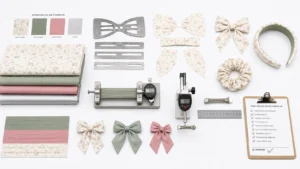
MOQ, Cost, Rush Orders, and Common Causes of Delay
Why a Lower MOQ Does Not Always Mean a Shorter Lead Time
MOQ and lead time are not interchangeable. A small order with custom dyeing, several Pantone colors, barcodes, and a rigid box may have more dependencies than a larger standard order. High volume, however, may need multiple material lots, lines, inspections, or split shipments.
Evaluate MOQ by component and process. Combining styles helps only when their materials and operations are genuinely compatible.
Rush Production Trade-Offs Buyers Should Challenge
A credible rush plan identifies the change: available materials, standard components, simpler packaging, parallel work, priority capacity, or faster freight. It should not remove necessary approval, curing, compliance, or quality checks.
Ask what risk and cost change. “We will try” is not a controlled commitment.
Illustrative Product Development Scenario: Finding the Critical Path
This is an illustrative scenario, not a customer case. A beauty brand plans a coordinated set containing a printed satin scrunchie, a padded headband, and a fabric-covered clip in a branded box. The factory can sew all three products in parallel, but the box dimensions depend on the approved headband profile, and the print strike-off must be approved before bulk fabric can be released.
The critical path runs through print approval, headband sample, packaging fit, bulk material, assembly, packed inspection, and freight. The buyer can freeze headband dimensions early and start box artwork sooner, while keeping final dieline approval contingent on a packed sample.
How to Evaluate a Manufacturer’s Production Timeline
Questions to Ask Before Issuing the Purchase Order
- What event starts the quoted lead time, and what event ends it?
- Which materials or processes are on the critical path?
- Does the schedule assume stock materials, one approved sample, or buyer feedback within a set window?
- Which operations are performed internally, and which depend on approved outside processors?
- When will bulk materials, first articles, and packaging be available for approval?
- What quality hold points and compliance tests are included?
- What is excluded from the ex-factory date?
- How will a failed inspection, material delay, or buyer revision change the calendar?
Review the supplier’s product range and development fit as well as its calendar. QN Beauty presents scrunchies, headbands, claw clips, bows, barrettes, and related categories in its custom hair accessory product portfolio. Buyers can also compare broader evaluation criteria in this guide to choosing a hair accessories manufacturer.
Milestone Reporting and Supplier Evaluation Checklist
| Evaluation Point | Evidence to Request | Strong Practice | Warning Sign | Buyer Action |
|---|---|---|---|---|
| Schedule definition | Dated milestone plan with assumptions | Start, finish, dependencies, and owners are clear | One unsupported completion date | Add milestones to PO record |
| Material readiness | BOM and reservation status | Longest-lead items identified | “Available” without quantity or lot check | Confirm reservation and substitution rules |
| Sample control | Versioned sample and feedback log | Approval scope is documented | Photos replace required physical review | Seal the pre-production standard |
| Production visibility | Milestone updates and exception report | Problems reported with recovery actions | Repeated “on schedule” without evidence | Set reporting frequency and escalation owner |
| Quality release | Inspection criteria and report | Hold points occur before defects multiply | Inspection planned after booking cutoff | Reserve correction time |
| Shipping readiness | Packing data and document checklist | Forwarder and customs inputs aligned early | Freight plan begins after production | Pre-book and verify documents |
Timeline Red Flags and Preventive Actions
Red flags include identical timing for every style, promises before specification review, no buyer-approval allowance, unsigned bulk standards, late packaging, inspection after the ship date, or freight estimates without route and Incoterm.
Use one controlled tech pack, a decision owner, dated approvals, a change log, critical-path milestones, and exception reporting. A useful update names the completed milestone, next dependency, owner, due date, and recovery action.
Buyer FAQ, Future Trends, Expert Summary, and Sourcing Action
Frequently Asked Questions About Hair Accessory Lead Time
How long does custom hair accessory production take?
No universal duration is reliable. Design readiness, materials, revisions, quantity, testing, packaging, inspection, freight, and customs determine it. Request milestones after specification review.
How long does a custom hair accessory sample take?
Timing depends on available materials and any custom dyeing, printing, tooling, logo hardware, or packaging. First define what the sample must validate.
Does lead time start when I request a quote?
Usually not. Define the contractual start event. It may be the date the PO, payment milestone, approved sample, artwork, packaging, and compliance requirements are complete.
Can bulk production begin before the final sample is approved?
Materials may be reserved with written authorization, but full release raises rework risk. Document what may proceed and who accepts the exposure.
Is air shipping always the best way to recover a delay?
No. Air cannot fix unresolved samples, testing, packaging, documents, or customs issues. Compare split shipment, simpler packaging, or partial SKU release.
How can buyers reduce sample revision time?
Use a measurable tech pack, final materials where possible, consolidated annotated feedback, tolerances, and one version-controlled decision log.
Should compliance testing happen before or after bulk production?
The plan depends on the product and applicable rules. Identify requirements before sampling, use suitable materials, and agree with a qualified lab or compliance specialist whether components, a finished sample, or production units are needed. Final timing is to be confirmed for the specific market and product.
Future Trends in Faster, More Visible Production Planning
Faster programs will depend on better information, not compressed workmanship. Digital tech packs, sample-version records, material libraries, traceability, and milestone dashboards reduce clarification. Modular designs using validated components can shorten repeat development while preserving customization.
Brands are likely to ask for earlier visibility into upstream materials and compliance documentation. That favors suppliers that can connect bills of materials, approved samples, inspection records, certificate data, and shipment documents. Digital evidence does not replace physical evaluation, but it makes decisions and exceptions easier to track.
Expert Summary: Build the Schedule Around Evidence, Not Assumptions
A dependable custom hair accessory production time is built from approved inputs and linked milestones. Define the product, identify the longest material or process dependency, approve a measurable sample, schedule quality and compliance hold points, confirm packed cargo data, and calculate delivery through customs to the receiving warehouse.
QN Beauty states more than 15 years of hair accessory OEM/ODM experience and supports material selection, product development, sampling, mass production, packaging, inspection, and shipment coordination. Buyers can review the company background on the QN Beauty manufacturing profile. Project-specific MOQ, sample timing, production lead time, testing, and shipping remain subject to specification review and sample evaluation.
Request a Sample Plan, Production Schedule, or Bulk Quotation
For a schedule that your procurement and merchandising teams can use, request a milestone-based review rather than a standalone number. QN Beauty can assess the manufacturability, material path, sampling gates, bulk process, quality controls, packaging dependencies, and delivery assumptions for your program.
Please provide:
- Product type
- Product dimensions
- Reference photos, design drawings, or tech pack
- Fabric and material requirements
- Pantone colors or print artwork
- Logo file and preferred branding method
- Target quantity by style and color
- Packaging requirements
- Delivery country
- Target delivery date
- Applicable market or compliance requirements
Next step: Submit your custom hair accessory specifications to request a sample plan, customization proposal, or bulk quotation. Any timing will be confirmed after the design, materials, quantity, packaging, testing scope, and shipping route have been reviewed.