For boutique owners, private label brand founders, and global procurement managers, sourcing hair accessories often comes with a hidden risk. While a product may look stunning on a wholesale catalog, the real test happens three hours after your end-consumer puts it on. If it pinches, squeezes, or causes discomfort, you are facing the dreaded “headband headache.”
As a seasoned B2B buyer, you know that physical discomfort for the user translates directly into a financial headache for your business. High return rates, negative reviews, and damaged brand reputation are the true costs of poorly manufactured headwear. To secure your profit margins and build customer loyalty, you need to look beyond the surface aesthetics and understand the factory-level engineering.
In this comprehensive guide, we will reveal the manufacturing secrets behind premium, pain-free headwear. From raw material selection to dimensional shipping strategies, you will learn how partnering with a genuine pain-free headbands manufacturer can transform your product line and safeguard your bottom line.
1. The Business Impact of “Headband Headaches” on B2B Retailers
1.1 High End-Consumer Return Rates and RMA Processing Costs
When you buy padded headbands wholesale, your primary concern is sell-through rate and margin retention. However, hair accessories engineered with cheap, rigid plastics invariably cause pressure behind the ears. This leads to immediate buyer’s remorse.
Processing Return Merchandise Authorizations (RMAs) eats directly into your net profit. You aren’t just losing the sale; you are absorbing reverse logistics costs, warehouse restocking fees, and the cost of unsellable inventory. A product with a 15% return rate due to fit issues is a liability, not an asset.
1.2 Negative E-Commerce Reviews and Brand Dilution
In today’s digital marketplace, a single one-star review citing “gave me a massive migraine” can tank a SKU’s conversion rate. Consumers read reviews meticulously for wearable accessories.
If your brand is associated with cheap, uncomfortable products, brand dilution happens rapidly. High-end boutiques and private labels must rely on structural integrity to justify premium retail prices. Quality engineering is your best marketing tool.
1.3 The Difference Between B2C Aesthetics and B2B Structural Integrity
End consumers buy based on color, fabric, and current trends. B2B buyers, however, must source based on consistency, durability, and ergonomic design. You are buying a supply chain solution.
You need a factory that understands the physical mechanics of the product, not just a trading company pushing the latest patterns. Real manufacturing expertise ensures that every batch of 10,000 pieces has the exact same tension and fit as the approved pre-production sample.
2. Deconstructing the “Pain-Free” Promise: Core Material Selection
[Insert Image: A side-by-side cross-section comparing a cheap plastic headband core with a premium Memory PC core covered in high-density EVA foam.]
2.1 Memory Polycarbonate (PC) vs. Cheap Recycled ABS Plastics
The skeleton of the headband dictates its comfort. Many budget suppliers use recycled Polystyrene (PS) or standard ABS plastics to keep the unit price artificially low. These materials are brittle and unforgiving.
A true pain-free experience relies on Memory Polycarbonate (PC). PC possesses excellent tensile strength and flexibility, allowing it to stretch over various head sizes without snapping or permanently losing its shape. This memory spring-back is the foundational secret to eliminating pressure points.
2.2 The Role of High-Density EVA Foam in Wholesale Padded Headbands
Thick, padded designs are trending, but the type of foam used inside makes all the difference. Low-grade sponges will flatten during overseas shipping or after a few weeks of wear.
We utilize High-Density EVA (Ethylene-Vinyl Acetate) foam. EVA provides superior cushioning, retains its plump volume even after compression, and distributes the weight of the headband evenly across the scalp. This creates a lightweight, cloud-like feel for the wearer.
2.3 Environmental Certifications and Skin-Safe Material Compliance
When importing custom fabric hair accessories into North America or the EU, chemical compliance is mandatory. Azo dyes and heavy metals in fabrics or plastics can lead to customs seizures or allergic reactions.
Professional source factories ensure that all textiles comply with global standards. We recommend ensuring your supplier’s fabrics align with OEKO-TEX® Standard 100, guaranteeing they are free from harmful substances and safe for prolonged skin contact.
3. Engineering the Perfect Arch: Flexibility and Tension Control
3.1 Understanding the Ergonomic Temporal Bone Gap
The human head is not a perfect oval. The area right behind the ears—the temporal bone—is highly sensitive to sustained pressure. Medical and ergonomic studies indicate that external compression in this area restricts blood flow, causing tension headaches.
Our molds are engineered with a specific 15-degree outward flare at the terminal ends. This subtle design modification prevents the inner core from digging into the mastoid process, allowing the headband to sit securely yet gently.
3.2 Tension Fatigue Testing in the Manufacturing Process
How do we guarantee the longevity of our flexibility? Through rigorous factory-level tension fatigue testing. We don’t just guess; we rely on data.
Illustrative Manufacturing Scenario: In our testing lab, sample headbands are mechanically stretched to a 150mm width up to 5,000 times. We measure the retention force before and after the test. If the band loses more than 5% of its original tension, the batch is rejected. This ensures your customers get a product that lasts for years, not days.
3.3 Adjustability Capabilities for Diverse Market Demographics
A one-size-fits-all approach is a sourcing trap. Different demographics require different fits. By utilizing premium PC cores, our headbands can be slightly manipulated by the end-user. Gently heating the band with a hairdryer allows for micro-adjustments, a selling point you can pass on to your B2C customers.
4. The Finishing Touch: Wrapping and End-Tip Manufacturing Secrets
[Insert Image: Close-up macro shot of a flawlessly hand-stitched headband end-tip wrapped in velvet, showcasing the absence of messy glue residue.]
4.1 Sourcing Custom Fabric Hair Accessories: Velvet, Silk, and Linen
The exterior fabric is the primary tactile touchpoint. Whether you are building a winter collection with plush velvet or a summer line with breathable linen, the fabric must be cut precisely.
We work directly with premium textile mills, allowing us to offer vast customization for your custom hair accessories line. We ensure bias-cut fabric wrapping, which allows the material to stretch smoothly over the curved foam without unsightly wrinkling or bunching.
4.2 Hand-Stitching vs. Industrial Glues (Avoiding Toxic Odors)
A common complaint with cheap wholesale headbands is a strong, toxic chemical smell upon unboxing. This is the result of factories rushing production using excessive amounts of cheap cyanoacrylate glues.
To eliminate odors and ensure durability, we employ artisanal hand-stitching techniques for securing the fabric over the padded core. Where adhesive is strictly necessary, we use eco-friendly, odorless hot-melt adhesives that cure instantly without off-gassing.
4.3 Fabric Wrapping at the End-Tips: The Ultimate Comfort Zone
The tips of the headband are where the most friction occurs against the skin and hair. Sharp, poorly finished tips will scratch the scalp and snag hair.
Our standard operating procedure dictates a double-wrap technique at the end-tips. We fold the fabric inward, securing it with soft grosgrain ribbon. This creates a padded bumper at the most critical contact point, completely encapsulating the plastic core.
5. Quality Control Protocols for Wholesale Hair Accessories
5.1 Raw Material Inspection Before Assembly
Quality control doesn’t start at the end of the line; it starts at the loading dock. Before a single piece is assembled, all incoming raw materials undergo strict inspection.
- Colorfastness tests: Ensuring fabrics won’t bleed dye onto blonde hair or skin when exposed to sweat.
- Density checks: Verifying the EVA foam meets the exact weight and bounce-back specifications.
- Core flexibility: Snapping a random sample of PC cores to test absolute breaking points.
5.2 In-Line Production Checking and Glue Residue Removal
During the wrapping phase, our in-line QA inspectors monitor the assembly stations. A major issue in B2B sourcing is receiving units with visible glue stains or uneven fabric seams.
We enforce a strict “clean wrap” policy. Any unit showing glue residue or asymmetrical padding is immediately pulled from the line and disassembled. You can learn more about our rigorous standards on our factory capabilities page.
5.3 Final Stress Testing and Colorfastness Verification
Aligning with international quality management principles, every completed batch goes through a final randomized stress test. We check for seam strength, packaging accuracy, and overall aesthetic perfection before authorizing shipment to your warehouse.
6. Smart Packaging Solutions: Reducing Dimensional Weight in Shipping
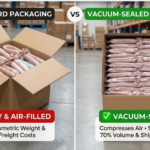
[Insert Image: A visual comparison of a standard shipping carton vs. an optimized vacuum-sealed carton, demonstrating the 40% volume reduction.]
6.1 The Dimensional Weight (DIM) Problem with Bulky Accessories
If you buy thick padded headbands, you know that you are essentially paying to ship air. Courier services and ocean freight forwarders calculate shipping costs based on dimensional weight (DIM weight) policies.
Because padded headbands take up significant volume relative to their actual physical weight, your freight costs can easily destroy your profit margins if the packaging is not optimized.
6.2 Vacuum Sealing Strategies: Compressing Volume Safely
As an experienced source factory, we have engineered a highly effective packing solution. For large wholesale orders, we offer specialized vacuum-sealing for padded headbands.
Because we use high-grade, resilient EVA foam, we can safely compress the headbands during transit. Upon arrival and unboxing at your fulfillment center, the foam fully expands back to its original plush shape within 24 hours. This strategy can reduce your shipping volume—and freight costs—by up to 40%.
6.3 Optimizing Master Cartons for Maximum Container Yield
Beyond vacuum sealing, we mathematically optimize our master carton dimensions to perfectly fit standard shipping pallets and 40HQ containers. We utilize reinforced corrugated cardboard to prevent structural crushing at the bottom of the stack, ensuring your products arrive in pristine retail condition.
7. Overcoming Common Traps When Sourcing Padded Headbands Wholesale
7.1 The “Too Good to Be True” Unit Price Illusion
When sourcing on B2B platforms, it is tempting to go with the lowest bidder. However, an impossibly low unit price always signals corners being cut. The supplier is likely using recycled brittle plastics, low-density foam, or toxic glues.
The few cents you save per unit will be eclipsed by the dollars you lose on customer returns, poor reviews, and high shipping volumes. Buy on value and structural integrity, not just the base price.
7.2 Bait and Switch Tactics with Inner Core Materials
A common nightmare for buyers is the “bait and switch.” The factory sends a beautiful, flexible PC core for the pre-production sample, but uses cheap PS plastic for the 10,000-unit bulk order.
Partnering with a reputable source factory with over 15 years of transparent OEM experience eliminates this risk. We provide detailed material spec sheets with every mass production contract, locking in your quality standards.
7.3 Hidden Costs in Minimum Order Quantities (MOQ)
Many factories demand an MOQ of 3,000 to 5,000 pieces per color, forcing buyers to tie up massive amounts of cash flow in unproven inventory. This restricts your ability to test new trends or seasonal colors.
We understand the modern retail landscape requires agility. That is why we support flexible custom manufacturing.
8. Partner with a Reliable Pain-Free Headbands Manufacturer Today
8.1 Why Our 15+ Years of Source Factory Expertise Matters
We are not a trading company; we are the direct source factory. With over 15 years of specialized experience in hair accessory manufacturing, we have perfected the balance between stunning aesthetics and ergonomic comfort.
By cutting out the middleman, you get direct access to our production line, transparent pricing, and rapid prototyping capabilities.
8.2 Exploring Our Flexible MOQ 500 Customization Program
To help our B2B partners scale safely, we proudly offer a low MOQ of just 500 pieces for custom OEM/ODM orders. Whether you want to use your own proprietary fabrics, add custom woven logo labels, or design a unique foam arch, our engineering team is ready to bring your vision to life without breaking your budget.
8.3 Request Your B2B Sample Box and OEM/ODM Catalog
Don’t let the headband headache ruin your brand’s reputation. Upgrade your product line with accessories engineered for all-day comfort and ultimate durability.
Ready to feel the difference a premium factory makes? Contact our OEM/ODM experts today to request our latest digital catalog, get a fast bulk quotation, or order a custom B2B sample box to test our pain-free structure for yourself.