Author perspective: This guide is written from a product-development, organization, and retail-readiness perspective for modern beauty consumers and brands serving Western markets.
In this guide, we will break the topic down by problem, reason, solution, and result. You will learn when a cosmetic bag works, when it fails, how to protect different accessory types, what kind of organizer pouch performs best, and why this everyday storage habit also points to a real product opportunity for beauty and accessory brands.
Suggested internal links:
Hair accessory organization guide |
Custom service |
Q&N Beauty homepage
External link prompt: Add a current market-data source here, such as Grand View Research on the hair accessories market and travel bag market.
Problem: Why Do People Ask This Question?
Hair accessories collections are getting bigger and more varied
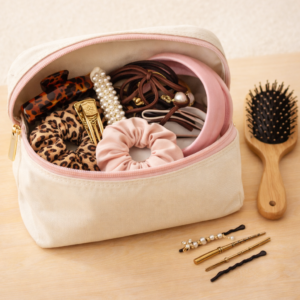
Hair accessories are no longer limited to a few basic elastics. Today’s consumer may own padded headbands, metal snap clips, acetate claw clips, satin scrunchies, oversized bows, spiral ties, French pins, and travel-friendly mini clips. The category is growing because accessories now sit at the intersection of beauty, fashion, and daily utility. For brands, that means more SKUs. For consumers, it means more clutter if storage does not evolve along with the collection.
That matters because not all accessories behave the same in storage. Small clips disappear easily. Elastics knot together. Headbands lose shape when compressed. Decorative pieces with pearls or metal trim can scratch or snag softer items. A bigger collection creates a bigger organizational problem.
The cosmetic bag is usually the most convenient thing people already own
Most consumers do not buy a dedicated hair accessory organizer first. They reuse what they already have. A cosmetic bag feels like the obvious answer because it is portable, familiar, and already associated with personal care. It fits into handbags, gym bags, carry-ons, and bathroom drawers. For many people, especially during travel, it becomes the default storage pouch for everything small enough to toss inside.
This is also why the search intent behind this question is strong. People are not asking from theory. They are asking because they are already doing it and want to know whether they are making life easier or creating hidden damage.
Space pressure makes “mixed storage” feel efficient
Desktop storage is limited. Bathroom cabinets are crowded. Travel packing is tighter than ever. That pressure pushes people toward consolidation. One pouch feels better than three. But mixed storage often creates a trade-off: the more categories you place in one bag, the more likely they are to contaminate, compress, or hide one another.
Organizing experts consistently recommend sorting by category and keeping frequently used items together, which is helpful here because hair accessories behave best when grouped by type rather than thrown in with unrelated products.
| Accessory Type | Common Storage Problem | What Usually Goes Wrong in a Basic Cosmetic Bag |
|---|---|---|
| Small hair clips | Easy to lose | Slip into corners and disappear under larger items |
| Scrunchies and elastics | Tangling and flattening | Get squeezed under bottles or tools |
| Claw clips | Bulk and breakage risk | Take up too much room and can crack under pressure |
| Headbands | Shape distortion | Bend when forced into a pouch that is too small |
| Decorative pieces | Surface damage | Metal or embellishments scratch other items |
Suggested internal link: Link the phrase hair accessories collection to the main Q&N Beauty collection page.
External link prompt: Add a supporting link to a professional organizing article about sorting by category.
Reason: Why a Cosmetic Bag Can Work — and Why It Sometimes Doesn’t
Why a cosmetic bag can work
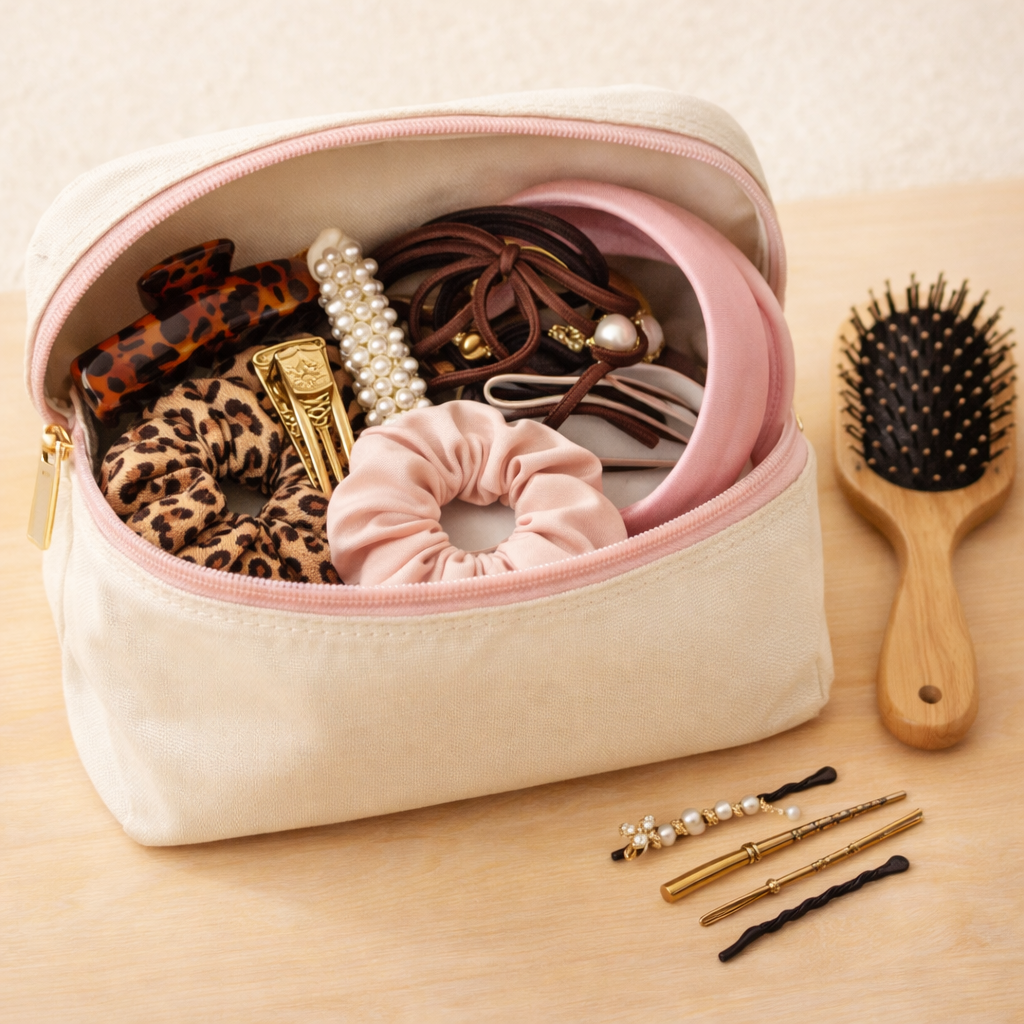
A cosmetic bag works well for hair accessories because it solves three real consumer needs at once: portability, containment, and speed. It keeps loose items together, makes grab-and-go routines easier, and reduces visual clutter. In a handbag, suitcase, or gym tote, it turns a scattered collection into one unit.
That is not a small advantage. The broader personal care and travel-storage markets are growing because consumers increasingly expect products to be portable and organized. In practice, that means people are not only buying beauty items. They are also buying better ways to carry, sort, and protect them.
Why it fails when the bag has no structure
The biggest weakness of a standard cosmetic pouch is that it is often just one open cavity. No divider. No mesh pocket. No elastic loops. No hard shell. That design is acceptable for a few lip products. It is much less effective for a mixed hair accessories collection.
Without internal structure, small pieces migrate, soft items get compressed, and rigid items collide with delicate ones. A claw clip can press against a headband. A metal clip can scratch a gloss cap. A leaked concealer can stain a fabric bow. The bag may still contain everything, but it does not protect everything equally.
Material interactions matter more than most people think
Soft-fabric accessories such as satin scrunchies, velvet bows, and fabric headbands benefit from clean, low-friction storage. If they share space with liquids, powders, or sticky beauty residues, they lose that advantage fast. Hard accessories have the opposite issue: they need enough room to avoid being forced, bent, or snapped.
This matters even more if you buy soft accessories because you want a gentler experience on the hair. Dermatology sources consistently warn that repeated tension and friction can contribute to damage, so it makes sense to protect low-friction accessories from rough handling and contamination during storage too.
Travel changes the answer
At home, you may get away with a basic pouch because you can empty it often. During travel, the demands rise immediately. Bags are zipped tighter. They are squeezed into luggage. They are opened in a hurry. If liquids and accessories share one space, the risk of mess and pressure goes up. This is why clear, compartmentalized, or structured cosmetic organizers outperform basic pouches in travel scenarios.
| Storage Option | Best For | Main Strength | Main Limitation |
|---|---|---|---|
| Basic cosmetic pouch | Minimal daily carry | Portable and simple | No internal separation |
| Compartment cosmetic bag | Mixed beauty + accessory use | Better organization and faster access | Usually bulkier |
| Structured organizer case | Travel and larger collections | Protects shape and surfaces | Takes more space |
| Dedicated hair accessory bag | Accessory-only users or brands | Purpose-built fit | Extra item to buy or develop |
Suggested internal link: Link soft-fabric accessories to Q&N custom service if you want to guide readers toward custom material options.
External link prompt: Insert a market-data source and a dermatology/expert source here.
Solution: How to Store Hair Accessories in a Cosmetic Bag Properly
Step 1: Sort by category before you pack
The simplest improvement is also the most effective: do not treat all accessories as one category. Separate mini clips, elastics, claw clips, headbands, and special occasion pieces before they ever enter the bag. Category sorting reduces search time, prevents tangles, and makes the pouch easier to reset after use.
For everyday users, this can be as simple as using one zip mini pouch for clips, one elastic band for scrunchies, and one open section for larger items. For brands, it suggests modular packaging logic: different compartments for different accessory behaviors.
Step 2: Keep soft items away from messy products
If you store hair accessories in a cosmetic bag, try not to store them directly against liquid makeup, foundation, cream blush, oil-based products, or loose powders. Fabric items absorb residue. Decorative items lose shine. Even if nothing leaks, dusty pigments and product buildup make accessories look older and feel less premium.
A better rule is this: if an item touches hair or fabric, keep it in the cleanest zone of the bag. If it is a liquid or breakable cosmetic, keep it in the wipe-clean zone.
Step 3: Give rigid items their own protected space
Claw clips, acetate barrettes, and embellished accessories need space around them. Do not wedge them under bottles or force them into a pouch that changes their shape. Use a structured corner, an internal mesh compartment, or a semi-rigid section that lets the accessory sit naturally.
This is especially important for larger claw clips because pressure points during travel can crack teeth, loosen springs, or create surface scratches that make the item look cheap fast.
Step 4: Choose visibility on purpose
Transparent panels, mesh pockets, and open-wide top openings are not just design details. They reduce rummaging. That means less pulling, less snagging, and fewer lost pieces. If your routine is fast-paced, a clear cosmetic bag or cosmetic organizer with visible sections is usually better than a deep pouch with dark lining.
- Empty the pouch and remove expired or broken beauty products.
- Group accessories into: clips, elastics, claw clips, headbands, decorative pieces.
- Add one mini pouch or divider for the smallest pieces.
- Keep liquids upright and separate from fabric accessories.
- Place rigid accessories on top or in a structured side section.
- Reset the bag weekly so the system does not collapse.
| Accessory | Best Way to Pack It in a Cosmetic Bag | Avoid |
|---|---|---|
| Bobby pins / mini clips | Small zip pocket or mini pouch | Loose at the bottom of a large bag |
| Scrunchies | Loose ring bundle or separate soft section | Compression under heavy products |
| Claw clips | Structured area with free space around teeth | Overstuffed pouch corners |
| Headbands | Larger curved compartment or separate bag | Folding or forcing into tight pouches |
| Metal / embellished clips | Protective pocket or soft wrap | Direct rubbing against cosmetics and hardware |
Suggested internal link: Link how to organize hair accessories to this Q&N Beauty article.
External link prompt: Add a supporting editorial review or expert-organization source about pouches, dividers, and category-based sorting.
Best Cosmetic Bag Types for Different Hair Accessories
For small clips and pins: choose compartment-first bags
If your main problem is losing mini clips, snap clips, or bobby pins, choose a cosmetic bag with interior zip pockets or detachable mini pouches. For this category, access matters more than volume. You do not need a big bag. You need a bag that prevents migration.
For scrunchies and soft hair ties: choose soft but clean storage
Scrunchies can live in a cosmetic pouch if the space is clean, dry, and not tightly packed. Satin and other soft-fabric accessories perform best when they keep their loft and surface smoothness. A wipe-clean lining plus a separate soft zone is often the best balance.
If your bag is crowded with liquids, brushes, or hard packaging, scrunchies deserve their own small insert pouch instead.
For claw clips and statement pieces: choose structure over softness
Large claw clips, acetate shapes, and embellished pieces need more than containment. They need protection. A clamshell case, a structured organizer pouch, or a cosmetic bag with firmer walls is better than a floppy pouch. The more expensive or decorative the piece, the more structure it needs.
For mixed collections: choose a beauty organizer, not a basic makeup bag
If you store several accessory types together, upgrade from a simple cosmetic pouch to a multi-section beauty organizer. Tested editorial roundups consistently favor bags with divider inserts, layered compartments, and wide openings because they reduce digging and improve visibility. In practical terms, those same features also make them better for mixed accessory storage.
| Bag Type | Best Use Case | Best For |
|---|---|---|
| Clear zip pouch | Travel and quick visibility | Mini clips, elastics, basic daily items |
| Flat-lay cosmetic bag | Fast access at home or hotel | Mixed medium-size accessories |
| Layered organizer bag | Beauty + accessory combination | Consumers with larger collections |
| Semi-rigid case | Protection during travel | Claw clips, decorative pieces, premium sets |
| Dedicated accessory pouch set | Retail-ready organization | Brands selling bundles or gift sets |
Suggested internal links:
Claw clip guide |
French hair pin guide
External link prompt: Add a link to a recent tested roundup of the best makeup bags or toiletry organizers.
Storage Plans for Daily Use, Travel, and Retail
Daily commute: keep it small and selective
For daily life, do not carry your entire hair accessories collection. Carry a working edit. One or two hair ties, one small clip, one emergency claw clip, and one low-profile headband are usually enough. A slim cosmetic pouch or mini accessory organizer works best here because it stays light and easy to reset.
Travel: separate accessories from liquids
Travel is where most people make storage mistakes. They combine everything into one bag because packing space feels scarce. But this is exactly when separation matters most. TSA rules still require many carry-on liquids to fit into a clear quart-size bag, so it often makes sense to keep liquids in that clear bag and accessories in a second pouch. That reduces mess, speeds access, and protects soft or decorative pieces.
Vanity or bathroom use: visibility beats volume
If the cosmetic bag lives at home, choose one that opens wide or lays flat. The goal is not maximum capacity. The goal is to see what you own. Hidden accessories become forgotten accessories. A flatter profile also helps prevent the “pile effect,” where heavier items sit on top of smaller ones and turn the bag into a mixed heap.
Retail product development: build a dedicated storage SKU
For brands, the consumer question creates a merchandising idea: if people are already storing accessories in cosmetic bags, why not design a dedicated accessory storage bag? That product can be sold alone, added to a gift set, or paired with a coordinated hair accessories collection. The value is not just storage. It is better presentation, perceived organization, and higher giftability.
| Scenario | Recommended Setup | Why It Works |
|---|---|---|
| Daily handbag | Mini pouch with 3–5 essentials | Lightweight and easy to maintain |
| Gym bag | Wipe-clean pouch plus small clip pocket | Handles moisture and quick changes |
| Carry-on travel | Separate clear liquids bag + accessory pouch | Reduces contamination and improves security access |
| Checked luggage | Structured organizer case | Better protection under pressure |
| Retail bundle | Custom organizer bag + curated accessory set | Adds value and supports premium positioning |
Suggested internal link: Link custom organizer bag or retail-ready bundle to Q&N Beauty custom service.
External link prompt: Add an official TSA source for liquids rules and one travel-organizer editorial source here.
Result: What Happens When Storage Is Done Right?
Your accessories last longer
The first result is physical protection. Scrunchies keep their volume. Headbands hold shape. Decorative clips stay cleaner. Claw clips are less likely to crack. Better storage does not make a cheap accessory premium, but it does preserve whatever quality you already paid for.
Your routine gets faster
When accessories are grouped by type and visible at a glance, getting ready becomes quicker. That sounds minor, but convenience is one of the biggest reasons consumers stick with a product system. A bag that saves even thirty seconds every morning feels useful. A bag that makes people dig for five minutes feels like clutter with a zipper.
Your collection looks more intentional
Organization changes perception. A small set stored well looks edited and premium. A large set stored badly looks messy and low-value. This is true for consumers at home and even more true for brands trying to sell coordinated collections. Packaging and storage do not just protect products. They shape how valuable those products feel.
You unlock cross-category product logic
Once storage is treated as part of the use experience, brands can think beyond individual clips or ties. They can build systems: hair accessory set plus pouch, travel set plus organizer, seasonal launch plus giftable case, cosmetic bag adapted for accessory use, or even a dual-purpose toiletry and accessory organizer. In other words, correct storage does not only improve the result for the user. It expands the result for the business.
Quick Result Snapshot
- Less loss of small clips and pins
- Less crushing of claw clips and headbands
- Cleaner fabric accessories
- Faster daily access
- Higher perceived value for bundled products
Suggested internal link: Link organized collection to Q&N Beauty’s organization article.
Case Study: Why This Simple Habit Signals a Bigger Product Opportunity
Case study signal #1: the market is rewarding organization, not just beauty
Recent market and editorial signals point in the same direction: consumers are buying portable organization, not merely containers. Travel accessory brands like BÉIS position items such as dopp kits and accessories as practical trip tools, while organizer-focused brands like Dagne Dover explicitly market pouches and toiletry organizers as multi-use solutions for travel bags, beauty, and personal accessories. That is important because it shows the customer does not think in rigid product silos. They think in use cases.
Case study signal #2: editorial testing keeps favoring compartments and visibility
Beauty and style editors repeatedly highlight dividers, layered sections, wide openings, and visibility as the features that make makeup bags more useful. Those same features solve the exact pain points of storing a mixed hair accessories collection. In other words, the best cosmetic bag features for beauty products also map well onto accessory storage.
Case study signal #3: accessory brands can turn storage into an add-on SKU
For a hair accessory brand, this opens a clear product pathway. Instead of selling only clips, headbands, or scrunchies, a brand can sell the use environment around them. That could mean a velvet-lined mini case for satin scrunchies, a structured travel pouch for claw clips, or a branded organizer included with a curated launch set. The product is not “just a bag.” It is a storage answer to a real consumer behavior pattern.
How a brand could apply this in practice
Imagine a spring launch built around claw clips, soft scrunchies, and a matching pouch. The pouch includes one mesh section for clips, one wipe-clean section for accessories near cosmetics, and one structured corner for larger pieces. That bundle increases perceived completeness, supports gifting, and creates a second reason to buy: not only style, but order. For OEM/ODM brands, this is a realistic extension because the bag and the accessory set can be developed as one coordinated merchandising story.
| Brand Opportunity | Consumer Benefit | Business Benefit |
|---|---|---|
| Accessory pouch sold separately | Cleaner, easier storage | New SKU and higher basket size |
| Gift set with organizer | Ready-to-use system | Higher perceived value |
| Travel bundle | Better portability | Cross-category upsell |
| Premium organizer materials | Better protection for delicate accessories | Supports premium pricing |
Suggested internal links:
Custom development |
About Q&N Beauty
External link prompt: Add links to a current travel-accessories market report and recent editorial reviews of organizer bags here.
Pros & Cons of Using a Cosmetic Bag for Hair Accessories
Pros
- Easy to carry in a handbag, gym bag, or suitcase
- Reduces visual clutter on vanity tops and in drawers
- Works well for small or edited daily collections
- Can double as a travel organizer pouch
- Creates product-development potential for brands
Cons
- Basic pouches often lack compartments
- Liquids or powders can soil fabric accessories
- Rigid accessories can be crushed in overfilled bags
- Headbands and statement pieces may not fit properly
- Mixed storage can slow access if visibility is poor
Best use cases
A cosmetic bag is best when your accessory needs are light, portable, and well sorted. It is less ideal when you have a large, high-value, or shape-sensitive collection. In that case, a dedicated organizer or purpose-built storage bag is usually better.
Bottom-line judgment
If you choose the right pouch style and separate items intelligently, a cosmetic bag is a practical solution. If you use the wrong size, wrong material, and no internal structure, it becomes a clutter trap.
| Question | Best Answer |
|---|---|
| Can a cosmetic bag hold hair accessories? | Yes, especially for small and medium daily-use items |
| Is it the best option for every accessory? | No, not for large or delicate pieces without structure |
| What makes it work? | Compartments, visibility, clean zones, and correct sizing |
| What makes it fail? | Overstuffing, mixed messy products, and no categorization |
FAQ
Can I store hair clips in a makeup bag?
Yes. Small hair clips store well in a makeup bag if they are placed in a zip pocket, mini pouch, or mesh section. Without separation, they are easy to lose.
Can I store scrunchies with cosmetics?
You can, but it is better to keep scrunchies away from liquid or powder makeup. Soft-fabric accessories stay cleaner and look better when stored in a separate section.
Will a cosmetic bag damage claw clips?
Not necessarily. Damage usually comes from pressure, overstuffing, and poor fit. A structured or semi-rigid organizer is much safer for claw clips than a floppy pouch.
Is a clear cosmetic bag better for travel?
Often yes. Clear bags improve visibility and help with quick security checks when used for liquids. For accessories, they reduce rummaging and make small items easier to find.
Should I store hair accessories and makeup in the same bag?
Only if the bag has enough separation. A dual-use bag works best when liquids, powders, and hair accessories each have their own zone.
What kind of bag is best for a hair accessories collection?
For small collections, a cosmetic pouch with internal pockets is enough. For larger or mixed collections, a layered organizer or dedicated accessory bag is better.
Can brands develop a special storage bag for hair accessories?
Absolutely. This is a strong product opportunity because consumers already use cosmetic bags for accessories. A purpose-built version solves a real problem and adds value to bundles and gift sets.
Conclusion and Next Step
The clear answer
Yes, you can use a cosmetic bag to store hair accessories. But not every cosmetic bag is right for every accessory. The best results come from three things: separation, structure, and scenario fit. If you classify items by type, keep soft accessories clean, and give rigid pieces enough protection, a cosmetic bag can become a very efficient organizer.
What this means for consumers
For consumers, the goal is simple: faster access, less mess, and longer-lasting accessories. A good organizer pouch helps you find what you need, protect what you own, and stop losing tiny pieces in the bottom of your bag.
What this means for brands
For brands, this question points to a bigger opportunity. Storage is no longer an afterthought. It is part of the product experience. A coordinated hair accessories collection paired with a branded cosmetic organizer, travel pouch, or dedicated accessory storage bag can increase perceived value, improve merchandising, and create a stronger customer offer.
2026 trend outlook and CTA
Looking ahead, the strongest product direction is clear: multifunctional, travel-friendly, category-aware organization. Consumers want products that do more than look pretty. They want products that solve friction in daily life. If you are building a beauty or accessory line, now is a smart time to develop storage-ready bundles, dual-purpose cosmetic pouches, and dedicated organizer concepts.
CTA: If you want to turn this consumer need into a sellable product, explore custom development options for pouches, organizer bags, and coordinated accessory sets with Q&N Beauty custom service.
Recommended internal links recap:
Homepage |
Custom Service |
How to Organize Hair Accessories |
Claw Clip Guide |
French Hair Pins Guide
Recommended external link placements:
- Intro: current hair accessories market report
- Reason section: dermatologist or hair-health expert source
- Solution section: professional organizer source
- Travel section: official TSA liquids rule
- Case study section: recent editorial reviews of makeup bags and organizer pouches