
Quick answer: Choose the outer diameter for appearance, the fabric width for fullness, and the elastic construction for hold. Mini, standard, and oversized are useful style descriptions, but they are not interchangeable measurement specifications across suppliers.
Scrunchie Size Guide: Standard Scrunchie Sizes Compared
Buyers searching for standard scrunchie dimensions should start with a measured product, not a size name alone. Published brand guides show why: Sew Cozy describes its Mini as approximately 2.5 inches in diameter, while Flirty Pineapple lists its Mini at 3–3.5 inches.
The following are actual examples from the brands’ own size guides. They illustrate naming differences; they do not establish an industry standard or describe Q&N’s fixed product specifications.
| Brand | Size name | Published diameter |
|---|---|---|
| Sew Cozy | Mini | About 2.5 in (6.4 cm, converted) |
| Sew Cozy | Classic | About 4.5–5 in (11.4–12.7 cm, converted) |
| Sew Cozy | XL | About 6 in (15.2 cm, converted) |
| Flirty Pineapple | Mini | 3–3.5 in; listed as 7.5–9 cm |
| Flirty Pineapple | Basic | 3.75–4.25 in; listed as 9.5–11 cm |
| Flirty Pineapple | Next Level | 4.75–5.5 in; listed as 12–14 cm |
| Flirty Pineapple | Extra XL / Jumbo | 6–7 in; listed as 15.5–17.5 cm |
Sources: Sew Cozy’s size guide and Flirty Pineapple’s size guide. Brand-listed metric values are rounded. Flirty Pineapple specifies measuring across the scrunchie while it lies flat.
Mini vs. Standard vs. Oversized Scrunchies
- Mini: A smaller visual profile to consider for small hair sections, half-up styles, and understated accessories. Verify the elastic fit separately.
- Standard or classic: An everyday styling option. Define your own finished measurements before applying this label to a collection.
- Oversized: More visible fabric for statement ponytails or buns. A larger fabric shell does not automatically mean a larger elastic loop or stronger hold.
When comparing scrunchie styles and materials, request both the relaxed measurements and a photo on a ruler. Product photography alone can make two different sizes appear similar.
How to Measure Scrunchie Width and Diameter
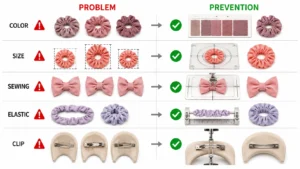
A scrunchie contains a gathered fabric tube around an elastic loop. Its outer diameter, fabric tube width, and elastic circumference describe different parts of that construction. A single “10 cm” measurement is incomplete unless it identifies which dimension is being measured.
- Measure the relaxed outer diameter. Lay the scrunchie flat without stretching the elastic. Arrange the gathers gently and measure from one outer fabric edge to the opposite outer edge. If the shape is uneven, record measurements in two perpendicular directions.
- Define finished fabric tube width. For a manufacturing specification, use the width of the sewn tube when flattened, excluding seam allowance. Ask for an ungathered tube swatch if the assembled gathers obscure this measurement.
- Record the center opening separately, if needed. The visible opening depends on how the fabric falls. It should not replace a specification for the internal elastic loop.
- Identify the measurement condition. State whether the product is relaxed, gently arranged, or stretched under an agreed load. Use the same method for the sample and production inspection.
Avoid a common mistake: The visible fabric band from the center opening to the outer edge is not necessarily equal to the flattened tube width. Gathers, folds, fabric thickness, and styling affect its appearance.
How to Choose Scrunchie Width
Start with the desired look and then approve the fabric width in the actual material. The same width can look soft and draped in satin, fuller in velvet, or more sculptural in organza.
For a focused sample comparison, you could request the following illustrative development targets. These are proposed test widths, not verified market averages or universal size categories:
- 2 cm finished tube width: A starting point for a narrow, restrained design.
- 4 cm finished tube width: A starting point for a fuller everyday design.
- 6 cm finished tube width: A starting point for a prominent fabric effect.
Hold the fabric type and elastic specification constant when comparing widths. Then adjust the shell length if you want more or fewer gathers. Width controls one aspect of fullness; the amount of fabric gathered around the loop controls another.
For a basic tube folded lengthwise and sewn along one long edge, the pattern starting point is: cut width = twice the finished tube width + twice the seam allowance. For example, a proposed 4 cm finished tube with 0.5 cm seam allowances starts with a 9 cm cut width. This is a construction calculation, not a finished outer-diameter formula; the sewn sample still needs checking.
Elastic Length and Stretch: What Determines Fit?
Two scrunchies can share the same outer diameter and feel very different in use. Elastic length, width, construction, resistance to stretching, and recovery all influence the result.
Cut Length Is Different From Finished Loop Circumference
The elastic cut length is measured before its ends are joined. The finished loop circumference is the length around the closed loop in its relaxed state. With an overlapped joint, the overlap reduces the finished circumference.
Illustrative manufacturing calculation: An elastic cut to 20 cm with a 1 cm overlap produces a nominal 19 cm loop before accounting for joining effects. This example explains the calculation; it is not a recommended elastic size for every customer.
Specify the joint method alongside the length. Do not calculate the internal loop circumference from the outer fabric diameter: the elastic runs inside the gathered shell, not around its outer edge.
Measure Usable Stretch and Recovery
A maximum hand-stretched measurement does not tell a buyer how the scrunchie will feel in hair. For comparative sample checks, agree on the applied load, holding time, recovery time, and number of stretch cycles.
- Working stretch: Can the scrunchie reach the intended styling position without excessive force?
- Hold: Does it stay in place during the intended activity?
- Recovery: After release and an agreed rest period, does the loop return close to its original size?
- Construction: Do the elastic joint and fabric closure remain secure?
If you report extension as a percentage, define the method: extension (%) = (stretched length − original length) ÷ original length × 100. Use the same measurement basis for both lengths. A loop circumference and a doubled, laid-flat loop length must not be mixed.
Avoid promising a fixed number of wraps for all wearers. Hair bundle size, hairstyle, and elastic resistance change the fit.
Scrunchie Sizes for Different Hair Types
Choose around the amount of hair being secured, not hair length alone. Fine strands can still form a dense ponytail, while a half-up style may contain only a small section of otherwise thick hair.
| Hair or styling need | Sample direction | What to check |
|---|---|---|
| Fine or low-density hair | Lightweight shell and a loop suited to a smaller hair bundle | Slippage, fabric weight, and comfortable wrapping |
| Medium-volume everyday ponytail | Moderate fabric fullness with an everyday elastic option | Hold during wear and easy removal |
| Thick or high-density hair | A loop with sufficient usable stretch and a secure joint | Ease of wrapping without excessive tension |
| Curly or coily hair | A smooth-contact fabric and fit matched to the chosen style | Snagging during removal and tension at the hairline |
| Short hair or half-up styles | A compact design for the section being secured | Whether the elastic fits the small section |
| Statement buns or ponytails | Oversized fabric shell with independently selected elastic | Visual balance, weight, and actual hold |
Comfort should remain part of the approval process. The American Academy of Dermatology explains that repeated pulling from tight hairstyles can cause traction alopecia. A hairstyle that hurts should be loosened. A soft fabric cover does not make excessive tension harmless.
Custom Scrunchie Size Options for Brands
For a coordinated collection, define each size through a specification sheet rather than simply ordering “small, medium, and large.” Q&N Beauty’s custom scrunchies development service supports OEM/ODM projects with fabric and size customization, branding, sampling, bulk production, and inspection.
Available material directions include satin, cotton, velvet, organza, and printed fabrics. Branding options include woven or printed labels, hang tags, and packaging cards. Approve logo placement on the gathered sample so folds do not hide the design.
Construction details deserve the same attention as color: confirm shell width, gathering, elastic specification, closing seam, and any bow or trim dimensions. Q&N’s sampling and production process provides a route from a reference design to an approved physical sample and bulk order.
Illustrative Manufacturing Scenario: One Look, Two Fits
This is a hypothetical development example, not a customer case study.
A beauty brand wants an oversized satin scrunchie for both smaller and larger ponytails. Instead of increasing every dimension, it keeps the desired fabric appearance and requests two internal elastic options.
Wear trials compare security, comfort, and removal. If one elastic option changes the gathered silhouette, the shell pattern is adjusted before approval. This separates the styling goal from the fit requirement while keeping the collection visually consistent.
What to Include in Your Sample Request
- Target wearer and hairstyle: Describe the hair section, intended activity, and preferred visual effect.
- Finished dimensions: State the relaxed outer diameter and flattened tube width, with a measurement photo or sketch.
- Fabric: Identify composition, texture, color, and print requirements.
- Elastic: Request confirmation of width, material or construction, cut length, finished circumference, and joint method.
- Fit and recovery checks: Agree on a repeatable evaluation method and acceptance criteria.
- Branding and packaging: Specify label position and test the packaged sample for unwanted stretching or flattening.
- Approval reference: Retain a signed-off sample and agree on dimensional tolerances before bulk production.
During inspection, compare measurements using the approved method and check stitching, elastic joints, recovery, label placement, color, and packaging. Numerical tolerances should be agreed for the selected material and construction rather than assumed from a generic chart.
Scrunchie Size Guide FAQs
What size is a standard scrunchie?
There is no single dimension you should assume from the word “standard.” Published brand guides use different size names and diameters. Ask for the relaxed outer diameter, finished fabric tube width, and internal elastic specification.
Does a wider scrunchie hold more hair?
Not necessarily. A wider fabric tube mainly changes appearance and fullness. Holding capacity depends on the elastic, the amount of hair, and how the accessory is wrapped.
Are oversized scrunchies only for thick hair?
No. An oversized shell can be developed with an elastic loop for a smaller hair section. Check the shell’s weight and the finished fit during sampling.
How long should scrunchie elastic be?
There is no single cut length suitable for every design. Start with the intended hair bundle and elastic properties, account for the joint, and approve the fit in a physical sample.
Can I use the same dimensions for every fabric?
You can use them as a comparison starting point, but the finished appearance may change. Fabric thickness, stiffness, and drape affect the gathers, so approve each material version separately.
Choose the Look, Then Validate the Fit
This scrunchie size guide gives buyers three separate decisions: outer diameter for scale, fabric width for fullness, and elastic construction for fit. Clear measurements and an approved sample make those decisions easier to reproduce in production.
Developing a new collection? Send Q&N Beauty your reference image and size requirements, along with the intended hairstyle, fabric, branding, and order quantity, to discuss sample development and a project-specific quotation.