This guide explains how to compare mini, medium, and large clips using dimensions, hair volume, teeth design, and shape. It also covers what to include in a sourcing brief so the approved sample matches the intended hairstyle.
Quick answer: Use mini clips for small sections and accents, medium clips for half-up styles or smaller twists, and large clips for fuller updos. Then check the usable space inside the jaws: overall length alone does not tell you how much hair a clip can hold.
Different Claw Clip Sizes: A Practical Comparison
Do not assume that “mini,” “medium,” and “large” mean the same dimensions across suppliers. Use the following approximate length bands as a starting framework for comparing samples—not as an industry standard or a guarantee of fit.
| Size group | Approximate overall length | Styles to try | Main fit check |
|---|---|---|---|
| Mini | 2–5 cm / about 0.8–2.0 in | Small sections, face-framing pieces, decorative accents | Can the teeth capture the section without sliding? |
| Small | Over 5–7 cm / about 2.0–2.8 in | Smaller half-up sections and compact twists | Does the jaw depth suit the gathered hair? |
| Medium | Over 7–10 cm / about 2.8–3.9 in | Half-up styles and moderate-volume twists | Does it hold securely without excess weight? |
| Large | Over 10–13 cm / about 3.9–5.1 in | Full twists and more voluminous updos | Is there enough internal capacity for the full section? |
| Extra-large or jumbo | Over 13 cm / over about 5.1 in | Longer, denser hair and larger gathered styles | Can the clip close around the hair comfortably? |
These bands are editorial selection guidance. Inch values are rounded. Supplier labels may overlap or fall outside these bands; confirm each product’s actual measurements.
Published manufacturer specifications provide useful reference points. France Luxe lists its Mini Couture Claw Clip at 1.75 inches long, approximately 4.45 cm. Kitsch’s claw clip size information identifies a 9 cm medium style and a 14 cm jumbo style. These are individual brand examples, not universal sizing rules.
When browsing the QN Beauty claw clip collection, compare the construction and intended hairstyle alongside the size label.
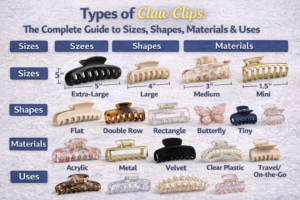
Mini, Medium, and Large Claw Clips: What Each Does Best
Mini claw clips for small sections
Mini claw clips are a useful starting point for holding back a small section near the face or adding several accents to a hairstyle. Their compact footprint also suits coordinated sets.
However, “mini” does not automatically mean suitable for all fine hair. A shallow clip may work for a few strands but lack room for a half-up section. Test it on the amount of hair the product is meant to hold.
Medium claw clips for everyday styling
Medium clips are worth sampling for half-up styles and smaller full twists. They can offer a balance between coverage and a discreet appearance, but the result depends on hair length, density, and the shape of the jaws.
For a retail assortment, describe the intended use precisely. “For half-up styling” is more helpful than an unsupported promise that one medium clip fits every hair type.
Large claw clips for fuller updos
Large claw clips provide more external coverage, but check whether that translates into usable holding space. Decorative wings, bows, or broad handles may increase the measured length without increasing capacity.
For a full twist, look for jaws that reach around the gathered hair and teeth that engage without forcing the hinge. Move to a roomier design if the clip stays excessively spread open or cannot secure the section.
How to Choose Claw Clip Sizes for Different Hair Types
Separate strand thickness from hair density. Fine strands can still form a substantial bundle when the hair is dense or long. The amount of hair in the finished style is more useful for fit selection than a single hair-type label.
- Fine or low-volume hair: Start with a smaller, lighter clip or a compact medium design. Check whether the teeth engage the section instead of leaving it loose inside the jaws.
- Short hair: Try mini or small clips for sections that reach the teeth. A longer clip cannot compensate for layers that do not reach the fastening area.
- Medium-volume hair: Compare a medium clip for half-up styling with a roomier option for a full twist.
- Thick or high-density hair: Sample larger, deeper designs and check the opening, internal space, and spring action together.
- Curly or coily hair: Assess the volume in the intended style. Check for smooth teeth and comfortable insertion and removal without forcing the hair into the jaws.
- Long hair: Test the completed twist, including folded lengths and ends. Even fine, long hair may need more capacity than expected.
What to look for in claw clips for thick hair
When selecting claw clips for thick hair, prioritize capacity before decorative size. Ask for a side view and an open-jaw view so you can assess depth, opening clearance, and the reach of the teeth.
A stronger spring alone cannot fix insufficient space. The sample should contain the intended section, stay stable during normal movement, and remain comfortable to open and wear.
How to Measure Claw Clip Dimensions
For sourcing, record more than one number. Agree on measurement directions with the supplier because width and height can be labeled differently on product listings.
- Measure the closed overall length: Record the longest end-to-end dimension, including any decoration, and state whether it extends beyond the functional jaw.
- Record width and height: Use a top view and side view to show exactly where each measurement is taken.
- Measure the usable jaw area: Note the internal length and depth available for hair, separate from handles or ornaments.
- Check opening clearance: Measure the usable opening without forcing the mechanism beyond its normal travel.
- Record weight: Compare samples in the intended hairstyle; similar dimensions do not necessarily feel equally comfortable.
Include annotated photos or a dimensioned drawing in the specification sheet. For production, agree on measurement tolerances rather than assuming every finished piece will be dimensionally identical.
Teeth Design and Grip: Why Length Is Only Part of the Answer
Two clips with the same overall length can behave differently because their teeth, curvature, spring, and internal space differ. Evaluate these features as a working assembly.
- Tooth spacing: Compare how well each design captures the intended section. Closer spacing is worth testing on fine sections, but it does not guarantee better hold.
- Tooth length and curvature: Check that the teeth reach around the hair and that the clip sits comfortably.
- Surface finish: Inspect tooth tips, edges, and seams for roughness that could catch hair.
- Jaw alignment: Open and close the clip to check that the teeth move without unwanted collisions.
- Spring and hinge: Assess smooth movement, secure assembly, and manageable opening resistance.
Do not treat a matte finish or a “non-slip” product name as proof of performance. Validate hold on the intended hair types and hairstyles before using broad claims in retail copy.
Popular Claw Clip Shapes and Their Fit Considerations
Shape names describe appearance more reliably than capacity. The following are useful design categories to compare, rather than a ranking by sales or popularity.
- Rectangle: An elongated profile to consider for twists. Check jaw depth as well as length.
- Oval or curved: A rounded silhouette that may suit compact updos; compare how the curve sits against the hairstyle.
- Rounded or octopus-style: A design that wraps around a gathered section. Evaluate its internal volume rather than comparing length alone.
- Hollow or open-frame: An airy appearance. Check frame rigidity and actual weight instead of assuming it is lighter.
- Flower, butterfly, or bow: A decorative silhouette. Separate ornament dimensions from the functional clip dimensions.
How Brands Choose Sizes for a Claw Clip Collection
Build an assortment around identifiable styling needs. A mini accent clip, a medium half-up clip, and a larger full-updo clip can serve distinct purposes if sample testing supports those uses.
- Define the customer and hairstyle: Specify whether each style is intended for small sections, half-up styling, or a full twist.
- Shortlist functional shapes: Compare internal capacity before choosing colors and decorative details.
- Test physical samples: Use the same hairstyle when comparing options and record slipping, pressure, opening effort, and removal.
- Approve clear specifications: Confirm dimensions, material, finish, teeth, hinge, logo location, and packaging.
- Write useful size information: Publish dimensions in centimeters and inches, plus an intended styling use and a clear scale photo.
Typical Buyer Example: A Three-Size Assortment
This is an illustrative planning example, not a customer case study or a confirmed QN Beauty product specification.
A beauty retailer could start sample development with a 4 cm accent clip, an 8 cm half-up clip, and a 12 cm full-updo clip. Testing might reveal that the 12 cm option needs deeper jaws rather than additional length. The retailer would revise the structure before approving the final assortment.
Turning a Size Brief Into an OEM/ODM Product
QN Beauty supports OEM/ODM development, including material sourcing, size and shape customization, sampling, mass production, quality control, and retail packaging. Its range includes acetate, plastic, and metal clip options. Review the custom hair accessories service to discuss which options suit your design.
For a size change, ask whether an existing construction can meet the brief or whether new tooling is needed. Changes to jaw depth, teeth, or hinge position should be reviewed as structural changes, not simply a scaled-up outline.
Branding should suit the surface. Discuss logo printing on a suitable clip area or branding on display cards and packaging; approve placement and finish on the sample. Embroidery and woven labels apply to compatible textile decorations or packaging, not directly to a rigid clip body.
Before bulk production, agree on checks for dimensions, tooth finish, jaw alignment, spring action, color, logo appearance, and packaging. Set any durability test method and acceptance criteria in writing. Learn more about QN Beauty’s manufacturing and design support.
Frequently Asked Questions
What size is a mini claw clip?
For initial selection, this guide uses approximately 2–5 cm in overall length. Brand definitions vary, so verify the actual dimensions and usable jaw space before ordering.
Is a 4-inch claw clip large?
Four inches equals 10.16 cm. It falls near the large end of this guide’s selection framework, but a supplier may use a different label. Its shape and capacity determine whether it suits a full updo.
Are large clips always better for thick hair?
No. A large decorative outline can conceal a shallow jaw. Look for enough internal space, suitable tooth reach, and a secure, comfortable mechanism.
Can a mini clip hold a full hairstyle?
It may hold a very small gathered section, but mini clips are a better starting point for accents and partial styles. Test the actual hair volume rather than relying on the label.
Choose by Fit, Then Finalize the Size
The most useful way to compare claw clip sizes is to start with the hairstyle, then assess overall dimensions, internal capacity, teeth, and spring action. Mini, medium, and large labels help organize a collection, but a physical sample establishes whether the design works for its intended use.
Developing a branded range? Send QN Beauty your reference images and size requirements, including the target hair types, intended hairstyles, material preferences, logo artwork, and packaging brief.