Choosing by label alone is risky. Long hair may need extra wrapping length without a larger diameter, while short or fine hair may struggle with the weight and broad curve of a thick XL rod. This guide separates length from diameter, compares real market specifications and shows consumers and private-label brands how to select dimensions based on measurable performance.
Editorial note: “Standard” and “XL” are commercial labels, not regulated dimensions. All size ranges below are product-development starting points. Check the finished rod measurements and validate them on the intended hair lengths, densities and curl goals.
What Are Standard Heatless Curlers?
Typical Standard Rod Length
A single-ribbon standard rod commonly falls around 80–95 cm (31.5–37.4 in) in total finished length. That usually provides enough usable space for shoulder-length to mid-back hair when the hair is divided evenly between both sides. End caps, ties or tapered tips should not be counted as usable wrapping length.
The size name alone is insufficient. A 90 cm rod with 8 cm of bulky finishing at each end offers only 74 cm of practical wrapping space. Brands should publish total and usable length separately; consumers can estimate usable length by measuring the smooth central area that accepts hair.
Typical Standard Rod Diameter
For fabric-covered curling ribbons, a practical standard diameter is about 20–32 mm (0.8–1.25 in). The smaller end produces more defined curls; the upper end creates a softer wave. Measure the finished outer diameter without compressing the filling. The internal foam dimension does not describe the curve hair actually follows.
Hair Types and Lengths It Suits Best
Standard rods offer the broadest fit for shoulder-length to chest-length hair, fine to medium density and users seeking visible curls rather than a very loose blowout. They also work for longer low-density hair if the wrapping sections are narrow enough to fit without stacking excessively.
| Attribute | Practical starting range | Performance purpose |
|---|---|---|
| Total length | 80–95 cm / 31.5–37.4 in | Fits common medium hair lengths |
| Finished diameter | 20–32 mm / 0.8–1.25 in | Defined curl to natural wave |
| Core | Low-mass, resilient foam or fiber | Balances shape with sleep comfort |
| Best starting fit | Shoulder to chest; fine to medium density | Broad mainstream use |
What Are XL Heatless Curlers?
Typical XL Rod Length
XL designs often begin around 100 cm (39.4 in) and can extend to 150 cm (59 in) or more. The most useful increase is not decorative overhang; it is additional smooth wrapping area. A long, high-density head of hair needs enough space for each section to travel down the rod without repeatedly covering earlier layers.
Typical XL Rod Diameter
Diameter varies widely. A long-and-slim XL rod may remain around 22–30 mm, preserving a standard curl size while adding capacity. A long-and-thick XL rod may measure 35–50 mm or more, creating broader waves. Therefore, XL should never be interpreted automatically as “looser curls.”
Hair Types and Lengths It Suits Best
XL length suits hair below mid-back, extra-long layers and high-density hair that runs out of room on a standard ribbon. XL thickness suits users seeking broad curls, movement or a blowout effect. Someone with waist-length fine hair may benefit from extra length but still prefer a slim diameter.
| XL design | What increases | Primary benefit | Expected curl change |
|---|---|---|---|
| Extra-long, standard diameter | Length only | More wrapping capacity | Similar curl radius |
| Extra-long and thicker | Length and diameter | Capacity plus broader shape | Looser curls or waves |
| Jumbo diameter, standard length | Diameter only | Volume and blowout effect | Much broader curve |
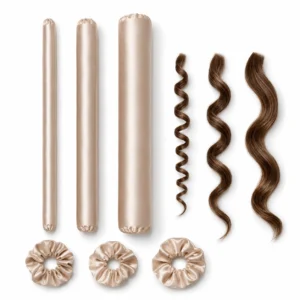
Standard vs XL Heatless Curlers: Key Differences
Length and Wrapping Capacity
Longer rods provide more linear space, reducing overlap between turns. Overlap is not always wrong, but thick layers dry more slowly and can create uneven bends. Hair length and density both affect capacity: many fine strands can consume more space than fewer coarse strands.
Diameter and Curl Size
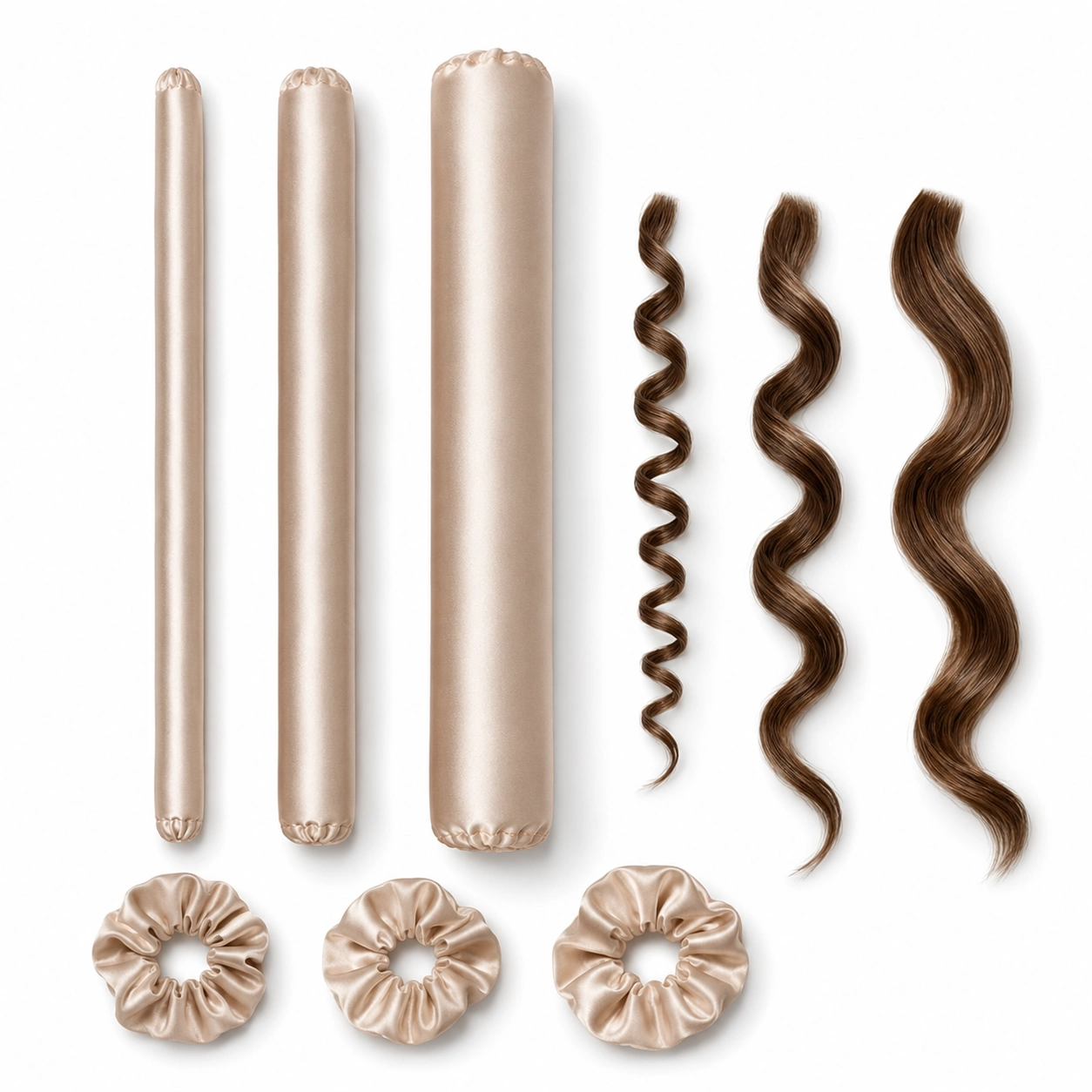
Diameter—not the letters XL—controls the basic curl radius. A larger circumference uses more hair per turn, so the strand completes fewer rotations. If a brand enlarges only length, the curl size should remain broadly similar when technique is constant.
Weight and Sleeping Comfort
Extra material and filling can increase weight. A long rod can remain comfortable if the core has low density and the added length lies beside the head. A thick, dense rod creates more leverage and may lift away from the crown. The American Academy of Dermatology advises loose styles and avoiding pulling or tugging; overnight curlers should follow the same principle. Review the AAD’s hair-damage prevention guidance.
Stability and Ease of Use
A standard rod is usually quicker for beginners to center and wrap. An XL rod provides capacity but introduces more fabric to control. Thick XL designs may shift when a side sleeper turns. Stability should come from balanced positioning, surface grip and even sections—not excessive root tension.
Finished Curl Results
A slim standard or slim XL rod produces more rotations and defined curls. A thick XL rod favors loose waves and volume. The released curl will expand beyond the rod as tension disappears, then relax further with gravity and humidity. Select for the result after several hours, not only the first release photo.
| Factor | Standard | XL |
|---|---|---|
| Typical total length | 80–95 cm | 100–150+ cm |
| Diameter | Often 20–32 mm | May remain slim or increase to 35–50+ mm |
| Capacity | Moderate | High when extra length is usable |
| Curl result | Defined to natural | Same as standard if slim; looser if thicker |
| Handling | Simple and balanced | More material to position |
| Sleep feel | Usually lower bulk | Depends strongly on core mass and diameter |
Who Should Choose a Standard Heatless Curling Rod?
Short to Medium-Length Hair
Hair from shoulder to chest length rarely needs extreme wrapping capacity. A standard rod keeps excess material away from the face and is easier to center. Chin-length hair may need an even shorter or smaller-diameter design.
Fine or Low-Density Hair
Fine or low-density hair generally needs less physical space. A lighter standard core can reduce root drag and maintain closer contact with the head. Fine but high-density hair is the exception: many small strands may still benefit from additional length.
Users Who Prefer Defined Curls
Standard diameters typically create more rotations than thick XL rods. This gives straight or curl-resistant hair extra definition before normal relaxation. If the final target is a compact curl, diameter matters more than capacity.
First-Time Heatless Curler Users
A standard rod has a shorter learning curve. It is easier to see whether slipping comes from placement, sectioning or material. Beginners can move to XL later if hair consistently reaches the rod ends or overlaps heavily.
Who Should Choose an XL Heatless Curling Rod?
Long or Extra-Long Hair
Hair below mid-back often benefits from more usable length. The extra space helps distribute the ends without creating a thick stack near the bottom. Choose a slim XL if you want to preserve definition.
Thick or High-Density Hair
High density increases the amount of hair wrapped on each side. A longer rod allows smaller sections and better surface contact. Coarse strands may also suit a larger diameter, but strand thickness and density are separate measurements.
Users Who Prefer Loose Waves
A thick XL rod creates broad curves and fewer rotations, supporting loose waves or an overnight blowout. Very straight fine hair may need lightweight mousse and complete drying because the open pattern has less visible definition to lose.
Users Who Need More Wrapping Space
Look at the set before removal. If the final third of the hair repeatedly covers previous wraps or hangs past the rod, capacity is insufficient. Extra length is the direct solution; extra diameter is optional.
| Observed problem or goal | Better starting choice | Reason |
|---|---|---|
| Hair reaches beyond the ends | Long, slim XL | Adds space without loosening the curl |
| Hair fits but curl is too tight | Thicker rod | Changes curl radius; added length is unnecessary |
| Rod feels heavy at the roots | Lightweight standard | Reduces mass and leverage |
| Long, dense hair overlaps heavily | Extra-long XL | Distributes more sections along the rod |
| Short hair forms only a bend | Smaller standard | Allows more complete rotations |
Does XL Always Mean a Larger Diameter?
Extra Length vs. Extra Thickness
No. Length increases capacity, while diameter increases curl radius. These dimensions solve different problems. Product pages should list both; buyers should reject an XL specification that contains only the word “oversized.”
Long and Slim XL Curling Rods
A long, slim rod is ideal for waist-length hair when the user wants defined curls. It adds room without changing the curve significantly. The longer core must still resist flattening along its center.
Long and Thick XL Curling Rods
This format targets long hair and loose waves together. It uses more cover fabric and filling, so finished weight becomes a critical specification. A lightweight low-density core can provide volume without unnecessary pull.
How Different XL Designs Affect the Curl
A real retail example makes the distinction clear. Target lists one Kitsch standard rod at 34 in long and 1.25 in in diameter, while its XL version is 39 in long and 1.5 in in diameter. In that product family, XL adds 5 in of length—about 14.7%—and increases diameter by 20%. It therefore changes both capacity and curl radius. View the standard dimensions and the XL dimensions.
| Specification | Standard | XL | Change |
|---|---|---|---|
| Length | 34 in / 86.4 cm | 39 in / 99.1 cm | +14.7% |
| Diameter | 1.25 in / 31.8 mm | 1.5 in / 38.1 mm | +20% |
| Intended result | Waves and bouncy curls | Voluminous waves and loose curls | Broader result |
This comparison describes one current product line, not a universal standard. Another supplier may use XL for length only.
How to Choose Between Standard and XL Sizes
Measure Your Hair Length
Measure from the crown or intended rod position to the ends, following the hair’s path. Do not match rod length to hair length one-to-one; hair travels around and down the form. A sample wrap is more reliable than a flat measurement.
Consider Hair Thickness and Density
Strand thickness describes each fiber; density describes how many strands you have. Density consumes wrapping capacity. Fine, high-density hair may need XL length, while coarse, low-density hair may fit a standard rod.
Choose the Desired Curl Pattern
Select diameter independently. Use roughly 20–30 mm for defined-to-natural curls and 35–50 mm for open waves or blowout movement. These are practical starting bands, not guaranteed results.
Consider Sleeping Position and Comfort
Back sleepers often tolerate a crown-centered rod. Side sleepers may prefer a flexible, low-profile standard rod or a long design whose ends can be moved behind the shoulders. Any style that causes pain, tingling or persistent pulling should be removed and repositioned.
- Check capacity: does your hair fit without heavy overlap?
- Select diameter: decide between definition and broad waves.
- Check total weight: compare the complete set, not only the core.
- Test your sleep position: lie down before completing the full wrap.
- Evaluate over time: photograph the result at release, two hours and eight hours.
Common Mistakes When Selecting a Curling Rod Size
Choosing XL Only Because Hair Is Long
Long hair needs capacity, not necessarily thickness. A thick XL rod may create weak bends when the buyer wanted defined curls. Choose an extra-long, standard-diameter version in that situation.
Ignoring Rod Diameter
Two rods of equal length can produce different curl patterns. Always compare the finished diameter and whether the core compresses substantially during wrapping.
Selecting a Rod That Is Too Heavy
Bulk is visible; weight is often hidden. Request grams for the rod and the complete kit. Heavy clips, decorative hardware and dense cores can create more pull than added fabric length.
Using the Same Size for Every Hair Type
A single SKU can serve a broad group, but it will not create identical results. Give shoppers decision criteria based on length, density and target curl instead of claiming one universal outcome.
| Mistake | Likely result | Correction |
|---|---|---|
| Long hair automatically gets thick XL | Wave is looser than expected | Add length first; preserve diameter |
| Buy by Standard/XL name | Unpredictable fit | Compare numeric dimensions |
| Ignore finished weight | Root drag or poor sleep | Specify complete-kit grams |
| Use very wet, dense sections | Hair remains unset inside | Start slightly damp and reduce sections |
Case Study: Standard Rod vs. Jumbo Real-World Tests
Two independent editorial tests illustrate the practical trade-off. WWD tested a 34 in standard satin rod for four months with one tester, varying moisture, product and wrapping method. Shop TODAY tested five heatless tools using slightly damp hair for at least eight hours when possible, including jumbo rods designed for volume. These were not controlled clinical trials and did not compare the same user or construction, so the results show use patterns rather than proof that one size is superior.
| Test | Format | Observed result | Practical lesson |
|---|---|---|---|
| WWD, four-month test | 34 in standard ribbon | Tight, bouncy ringlets; comfortable and stable with a crown clip | Standard capacity can support defined curls and reliable overnight placement |
| Shop TODAY, overnight ranking | Set of jumbo flexi rods | Volume 4.25/5; comfort 3.75/5; ease 2/5 | Jumbo size supported volume but required more technique |
The tests also expose why size cannot be isolated from design. One long ribbon distributes hair along two sides; four jumbo rods divide the head into separate sections and use individual closures. Brands should benchmark Standard and XL prototypes with the same cover, core and wrapping protocol whenever they want to claim a size-driven difference. Read the WWD test and Shop TODAY’s 2026 test.
Standard and XL Options for Heatless Curler Brands
Recommended Dimensions for Each Size
For a focused two-size collection, start Standard around 88–92 cm long and 24–30 mm in diameter. Develop XL according to the consumer problem: 105–120 cm with the same diameter for capacity, or 100–110 cm by 38–45 mm for loose waves. Avoid changing length, diameter, filling and cover at once during initial comparison testing.
Material and Filling Considerations
Satin offers glide; velvet adds grip. Core density controls weight, recovery and how much the diameter compresses. Specify finished weight, compression recovery and seam position. An XL core should not become dense merely to look substantial in packaging.
Size Identification and Packaging Design
Print length and diameter in centimeters and inches near the size name. Add a front-facing result cue: “Defined Curl,” “Extra Length” or “Blowout Wave.” On the back, show hair-length and density guidance plus a note that results depend on moisture and section size.
Developing Multi-Size Private Label Collections
Grand View Research estimates the global hair-accessories market at US$27.2 billion in 2026 and forecasts US$46.6 billion by 2033, an 8.0% CAGR from 2025 to 2033. Statista projects approximately US$99.91 billion in worldwide hair-care revenue for 2026. These adjacent-category figures do not measure heatless curlers specifically, but they support the commercial logic of measurable, segmented styling accessories. View Grand View Research’s outlook and Statista’s hair-care forecast.
| Field | Standard prototype | XL prototype |
|---|---|---|
| Total length | 88–92 cm | 105–120 cm |
| Finished diameter | 24–30 mm | Same for capacity; 38–45 mm for loose waves |
| Weight | Set target after comfort trial | Limit increase through low-mass filling |
| Core recovery | Measure after repeated compression cycles | |
| Label claim | Everyday curls | Extra length or blowout waves—state which |
| Wear testing | Same users, cover, moisture, section count and evaluation times | |
Q&N Beauty supports OEM/ODM development of heatless curling rods, scrunchies, clips, labels and retail packaging. Brands can customize length, finished diameter, filling, satin or velvet cover, color and logo application. Visit Q&N Beauty to develop a clearly differentiated Standard and XL collection.
Pros and Cons of Standard and XL Heatless Curlers
| Size | Pros | Cons |
|---|---|---|
| Standard | Lower bulk; easier positioning; defined curls; beginner-friendly | May run out of space for long or high-density hair |
| Long, slim XL | More capacity without changing curl radius | More fabric to control and store |
| Long, thick XL | More capacity plus loose waves and volume | Heavier, bulkier and less effective on short hair |
| Jumbo, standard length | Strong blowout effect without excessive length | Does not solve capacity for extra-long hair |
Frequently Asked Questions
What is the difference between standard and XL heatless curlers?
XL may add length, diameter or both. Added length increases wrapping capacity. Added diameter creates broader curls. Check numeric measurements rather than relying on the label.
Is an XL heatless curler better for long hair?
It is better when long hair runs out of wrapping space. Choose a long, slim XL for defined curls or a long, thick XL for loose waves. XL is unnecessary if the hair already fits comfortably.
Does XL always mean a thicker curling rod?
No. Some XL products are only longer. Others are longer and thicker. The finished diameter must be listed to predict the curl pattern.
Can fine hair use an XL rod?
Yes, especially if it is long or high-density. Select lightweight filling. If fine, straight hair loses waves quickly, use extra length with a smaller diameter rather than a thick XL form.
Are XL rods less comfortable to sleep in?
Not necessarily. Comfort depends on weight, core flexibility, diameter, end placement and sleeping position. A long, lightweight rod may be easier to move away from the face than a short, rigid jumbo rod.
How do I know if my standard rod is too short?
It is probably too short if the ends hang beyond the usable area, the final wraps repeatedly stack over earlier sections, or one side has much less space than the other despite even sectioning.
What dimensions should a brand print on the package?
Print total length, usable wrapping length and finished diameter in centimeters and inches. If possible, add finished rod weight and a hair-length/result guide.
Conclusion: Choose Heatless Curlers by Measurements
Standard and XL are useful shopping shortcuts only when the underlying dimensions are clear. Standard rods around 80–95 cm provide manageable capacity for common hair lengths. XL rods above roughly 100 cm add space for long or dense hair. Diameter remains a separate decision: slim rods favor definition, while thick rods create open waves and blowout volume.
The future of heatless curlers will move toward transparent specifications: usable length, finished diameter, weight, core recovery and result-led size names. Modular collections may offer the same diameter in two lengths, letting shoppers solve capacity without unintentionally changing their curl.
For beauty and haircare brands: decide whether your XL promise is extra capacity, a looser curl or both. Then contact Q&N Beauty to develop measured Standard and XL prototypes, coordinated accessories and retail-ready packaging.