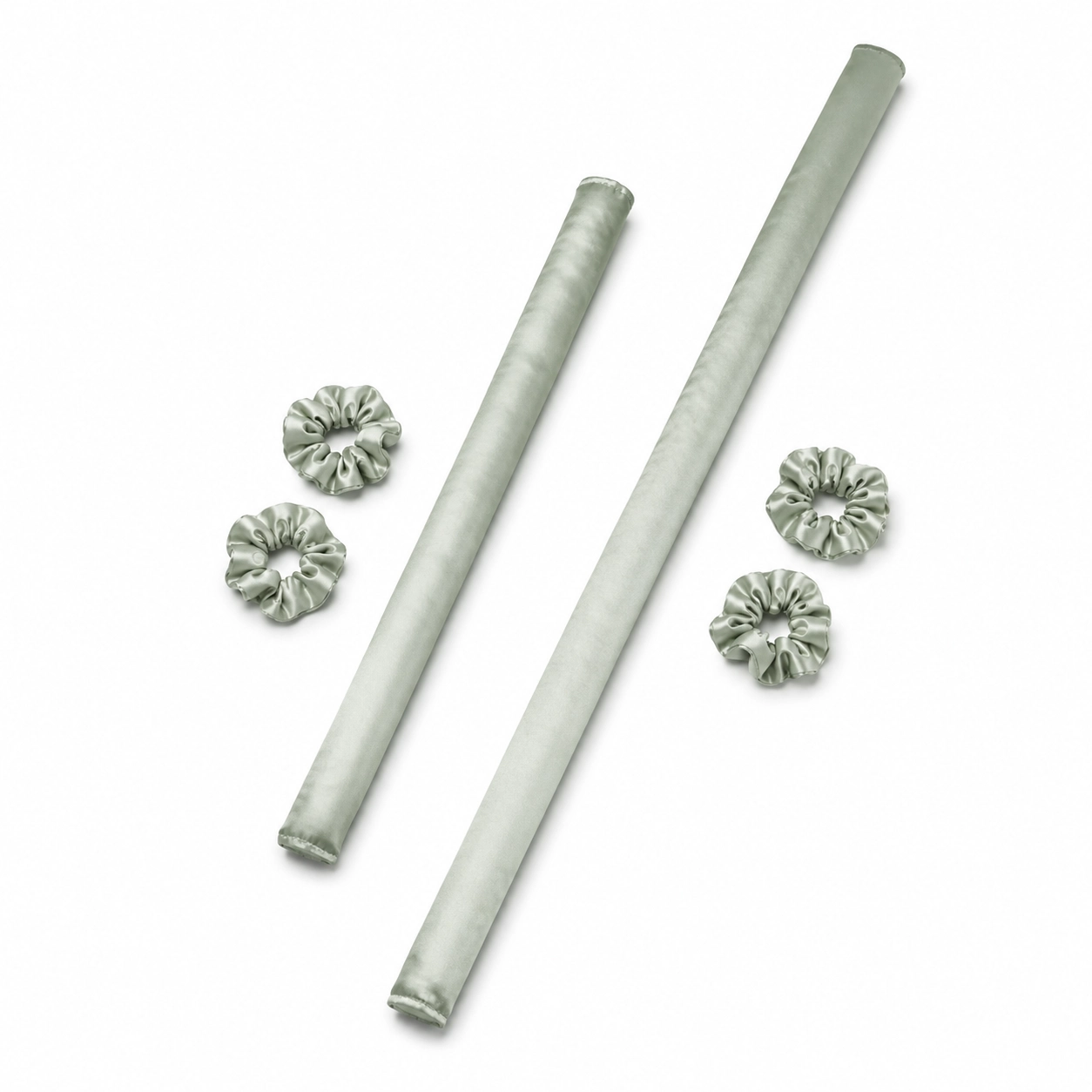
Satin gives hair more glide. Velvet gives the wrap more grip. The better material depends on which problem you need to solve.
Heatless curlers are often sold as if cover material were merely a color choice. It is not. Satin may be gentle to unwind yet difficult to center. Velvet can secure fine hair but may feel warmer and create more removal drag.
The cover interacts with diameter, filling, section size, moisture, closures, and sleep position. Material cannot rescue a short rod or loose wrap. This guide separates textile facts from claims and gives private label buyers an actionable specification.
Quick Verdict: Satin or Velvet Heatless Curlers?
| Your priority | Better starting choice | Why |
|---|---|---|
| Fine, straight hair that slips | Velvet | Pile supplies more mechanical grip |
| Dry, bleached, curly, or frizz-prone hair | Satin | Smoother contact and easier removal |
| Secure overnight wrapping | Velvet or hybrid | Less migration at equal tension |
| Loose waves or blowout finish | Satin | Hair glides around a larger rod easily |
| Defined curls with resistant hair | Velvet | Grip helps preserve wrapping tension |
| Warm climate or hot sleeper | Lightweight satin | Usually less plush and less insulating |
| Broad private label range | Offer both or use zoned fabric | One surface cannot optimize every hair type |
Short answer: choose satin for low-friction handling; choose velvet for non-slip control. Diameter, tension, moisture, and dry time still have a larger influence on the final curl than the cover alone.
Why Heatless Curler Material Matters
Material Impact on Hair Friction
Hair does not curl because satin or velvet chemically changes it. Slightly damp or product-supported hair is held in a new shape while it dries or sets. The cover controls the interface between the strand and the form.
A peer-reviewed review identifies abrasion and friction as contributors to surface wear and protein loss; conditioning can reduce friction. This supports low-friction handling, not a claim that satin prevents breakage. Seams, residue, tension, and removal still matter. Review the research.
Material Impact on Grip and Slipping
Grip preserves section tension and location. Satin’s long floats create a smooth face; velvet’s raised pile resists movement, making it a logical choice for glossy straight hair.
Grip is not automatically healthier. Painfully tightening satin or pulling out velvet can increase stress. Aim for control without tugging.
Material Impact on Comfort and Durability
Satin often feels cooler; velvet feels plush but can trap air and lint. Durability depends on fiber, weight, seams, colorfastness, abrasion, and cleaning.
| Performance factor | Satin tendency | Velvet tendency | Other variables |
|---|---|---|---|
| Surface drag | Lower | Higher | Fiber, finish, pile density |
| Overnight movement | More likely on slippery hair | Usually less likely | Clip, closure, rod position |
| Removal | Easy glide | Should be carefully unwound | Seams and tangled ends |
| Warmth | Usually lower | Usually higher | GSM, filling, room temperature |
| Visual effect | Glossy, sleek | Plush, matte-to-lustrous | Color and lighting |
What Is a Satin Heatless Curler?
Common Types of Satin Fabric
Satin is primarily a weave structure, not a synonym for silk. CottonWorks explains that long floats give satin its smooth, lustrous face, while those floats can also introduce snagging and seam-slippage risks. See the satin-weave construction guide.
Mass-market rods commonly use polyester satin for scale and color consistency. Premium sets may use silk satin or charmeuse. Recycled polyester supports certified recycled-content programs. Buyers should specify fiber, weight, finish, and performance—not merely “satin.”
| Fabric option | Positioning | Strength | Buyer check |
|---|---|---|---|
| Polyester satin | Accessible mass market | Color range and repeatability | Snagging, static, colorfastness |
| Recycled polyester satin | Eco-conscious collections | Familiar hand with recycled input | Certification and lot consistency |
| Silk satin/charmeuse | Premium or gift-led | Soft hand and luxury story | Fiber proof, care, cost, dye stability |
| Stretch satin | Flexible covers | Conforms around shaped filling | Elastane recovery and seam torque |
Key Features of Satin Curling Rods
A good satin rod has a smooth face, flat seam, even filling, protected ends, and correctly sized scrunchies. A flattened crown zone or temporary clip offsets low grip.
Advantages of Satin Heatless Curlers
- Smooth application and easy release with less pulling.
- Useful for dry, porous, processed, curly, and tangle-prone hair.
- Glossy appearance suited to premium beauty and gifting.
- Broad color and print possibilities in polyester constructions.
- Often cooler and less lint-prone than plush pile fabric.
Limitations of Satin Heatless Curlers
- Can migrate on fine, straight, heavily conditioned hair.
- Long floats may pick or snag on rough nails and hardware.
- Polyester satin may build static in dry conditions.
- “Satin” alone does not identify fiber or quality.
- May need a crown clip, textured underside, or stronger closure.
What Is a Velvet Heatless Curler?
Common Types of Velvet Fabric
True woven velvet is a cut-pile fabric: extra yarns form a three-dimensional surface and are cut to create upright pile. See the pile-fabric classification.
“Velvet” may also describe knit velour, stretch velvet, or short-pile plush. They are not interchangeable. Short, dense pile offers controlled grip; long pile can trap hairs and show pressure marks.
| Fabric option | Grip | Commercial fit | Risk to test |
|---|---|---|---|
| Short-pile polyester velvet | High | Core retail range | Pile shedding and direction |
| Knit velour | Medium-high | Soft, flexible sets | Stretch, curling, dimensional recovery |
| Stretch velvet | Medium-high | Contoured or bendable rods | Seam growth and elastane aging |
| Long-pile plush | Variable | Novelty/luxury appearance | Hair trapping, lint, heat, bulk |
Key Features of Velvet Curling Rods
Pile creates traction between turns, reducing dependence on root tension. Directional pile can behave differently on each tail, so brands should test both wrapping directions.
Advantages of Velvet Heatless Curlers
- Stronger hold on fine, straight, or slippery hair.
- More stable sections during application and overnight wear.
- May improve curl consistency by preserving even tension.
- Plush visual texture supports fall, winter, and gift collections.
- Can reduce the need to over-tighten the wrap.
Limitations of Velvet Heatless Curlers
- More drag during removal if users pull instead of unwind.
- Can feel warmer or bulkier for side sleepers.
- Pile may collect lint, dust, and styling-product residue.
- Embroidery and heat transfer can flatten or distort the surface.
- Fabric quality varies widely under the generic “velvet” label.
Satin vs Velvet Heatless Curlers: Key Differences
Smoothness and Hair Protection
Satin’s lower friction suits bleached, fragile, textured, dry, or tangle-prone hair. Velvet is not inherently damaging but requires deliberate unwinding. Neither supports an absolute “damage-free” claim.
Grip and Overnight Stability
Velvet wins for grip because pile resists rotation and migration. Satin can remain stable with correct placement, sectioning, ties, and clips. Hybrids can combine a low-pile crown with satin tails.
Curl Definition and Consistency
At equal diameter and technique, velvet may improve definition by limiting movement. This is a mechanical inference. Diameter, section size, moisture, set time, and hair response remain primary.
Sleeping Comfort
Filling density and closure placement determine pressure. Satin tends to feel cooler; velvet can feel cushioned but warmer. Side sleepers need a flexible, narrow form without hard parts under the ear.
Appearance and Product Positioning
Satin looks sleek and beauty-led; velvet looks plush and seasonal. Satin supports bridal or spa positioning, while velvet supports holiday and non-slip stories. Velvet shade approval must account for pile direction.
| Criterion | Satin | Velvet | Winner |
|---|---|---|---|
| Low-friction contact | Excellent | Moderate | Satin |
| Grip on slippery hair | Moderate to low | High | Velvet |
| Easy removal | Excellent | Good when unwound | Satin |
| Overnight stability | Technique-dependent | Generally strong | Velvet |
| Warm-weather comfort | Generally better | Can feel warm | Satin |
| Lint resistance | Better | Needs brushing/cleaning | Satin |
| Plush seasonal look | Sleek | Strong | Velvet |
| Print/finish flexibility | Broad | More process-sensitive | Satin |
Which Heatless Curlers Work for Different Hair Types?
Best Choice for Fine Hair
Fine hair may not hold a glossy rod. Choose short-pile velvet or a grippy hybrid, small sections, and mini scrunchies. For chemically fragile hair, use satin plus flat clips instead of extra tension.
Best Choice for Thick Hair
Thick hair works with either: velvet controls heavy sections; satin eases removal. Rod length and filling matter more. Use additional sections if hair overlaps heavily.
Best Choice for Straight or Slippery Hair
Velvet is the practical first choice because pile holds smooth strands. Start nearly dry, add light mousse if needed, and use a smaller diameter for weak retention.
Best Choice for Dry, Curly, or Frizz-Prone Hair
Satin is the better start because strands wrap and release easily. Detangle and avoid soaking-wet hair. If it migrates, use a crown clip, connected ends, or zoned rod.
| Hair profile | First choice | Adjustment |
|---|---|---|
| Fine + healthy + slippery | Velvet | Small sections; light product |
| Fine + bleached/fragile | Satin or hybrid | Flat clips; low tension |
| Thick + straight | Velvet | Longer rod; more sections |
| Thick + dry | Satin | Long rod; minimal overlap |
| Curly/coily + tangle-prone | Satin | Detangle; smooth end wrap |
| Very smooth, curl-resistant | Velvet | Smaller diameter; fully dry set |
Which Material Is Better for Different Curling Goals?
Defined and Long-Lasting Curls
Choose velvet when slipping is the failure point, then use a smaller-to-medium rod and consistent sections. The fabric helps retain placement; it does not replace adequate set time. Remove only when hair is dry.
Loose Waves and Blowout Styles
Choose satin with a larger, soft rod. Its glide makes broad sections easier to distribute and release. For root volume, position the rod at the crown without pulling the front hairline flat.
Overnight Curling Without Slipping
Velvet or a zoned hybrid has the edge. Active sleepers also need a flexible core and secure ends. InStyle’s 2026 test used 23 editors, 23 products, and 529 hours, showing that geometry and comfort vary even among smooth systems. See the methodology.
Reducing Frizz and Hair Breakage
Satin is the better first choice, but “reducing friction” is more defensible than “preventing breakage.” Inspect seams, avoid rough closures, keep tension comfortable, and unwind slowly. A dirty satin surface or exposed zipper can negate the material advantage.
| Goal | Material | Rod/technique partner |
|---|---|---|
| Tighter defined curls | Velvet | Smaller diameter; equal sections |
| Soft waves | Satin | Medium/large diameter; broad sections |
| Blowout volume | Satin | Large soft rod; elevated crown |
| Maximum overnight grip | Velvet/hybrid | Flat anchor; connected ends |
| Lowest removal drag | Satin | Low-profile seams; unwind gently |
How to Choose Between Satin and Velvet
Consider Hair Texture
If hair slides off other forms, choose velvet. If it tangles, catches, or frizzes during removal, choose satin. Mixed needs point to a zoned design.
Consider the Desired Curl Pattern
Material fine-tunes control; diameter defines the pattern. Smaller rods curl tighter and larger rods create loose texture. Velvet cannot make an extra-large rod produce ringlets.
Consider Sleeping Habits
Active sleepers benefit from velvet; hot sleepers may prefer satin. Side sleepers need a narrow, compressible rod. Move any closure pressing the ear.
Consider Climate and Season
Satin feels lighter in warm rooms; velvet supports cool-season comfort and merchandising. Test polyester satin for dry-weather static rather than relying on fiber name.
| Question | If yes | Choose |
|---|---|---|
| Does hair slide out before morning? | Grip is the priority | Velvet or hybrid |
| Does hair snag or frizz during removal? | Glide is the priority | Satin |
| Do you sleep hot? | Reduce plush bulk | Lightweight satin |
| Is hair fragile but also slippery? | Balance both risks | Satin tails + grippy crown zone |
How to Care for Satin and Velvet Heatless Curlers
Washing and Drying Satin Curlers
Follow the label because fiber, dye, adhesive, foam, and wire affect care. Hand wash removable polyester-satin covers in cool water when permitted; air dry. Avoid twisting, heat, bleach, and rough fasteners.
Washing and Drying Velvet Curlers
Brush off lint, clean with the pile, and avoid scrubbing. Air dry flat and lift fully dry pile gently. Do not machine wash a wired rod unless permitted.
Maintaining the Shape of the Curling Rod
Store flat or loosely curved. Do not sharply fold foam or leave wire bent. Dry the filling completely before storage.
Knowing When to Replace a Heatless Curler
Replace exposed cores, flat or lumpy filling, open seams, shedding velvet, sharply snagged satin, or failed closures. Washable covers cannot repair a failing core.
| Component | Routine care | Replace when |
|---|---|---|
| Satin cover | Cool gentle wash; air dry | Sharp pulls, split seam, permanent residue |
| Velvet cover | Brush lint; clean with pile | Heavy shedding, bald areas, hard buildup |
| Foam/fiber filling | Dry fully; store uncompressed | Flat, lumpy, or odorous |
| Flexible core | Use broad curves | Exposed, kinked, or internally displaced |
| Scrunchies/loops | Wash separately; rotate use | Elastic no longer recovers |
Satin and Velvet Heatless Curlers for Private Label Brands
Grand View Research values global hair accessories at US$23.4 billion in 2024, estimates US$27.2 billion in 2026, and projects US$46.6 billion by 2033. Elastics and ties held 32.6% in 2024, supporting coordinated rod-and-scrunchie systems. These are broad accessory figures, not heatless-curler sales. View the market summary.
Statista projects worldwide Hair Care revenue of US$99.91 billion in 2026 and a 2.79% CAGR from 2026 to 2031. This adjacent market indicates category scale but should not be presented as curling-set revenue. View the Statista outlook.
Fabric Quality and Color Selection
Specify composition, GSM, construction, stretch, finish, and color standard. Test shade, crocking, product transfer, seam slippage, snagging, shedding, static, and shrinkage. Approve velvet in its intended pile direction.
Filling and Rod Construction
Match cover and filling. Satin benefits from an oval crown or anchor; velvet can use softer filling. Validate compression, core migration, flex cycles, protected ends, and sleep comfort.
Logo and Branding Methods
Satin can accept print, transfer, embroidery, labels, and ribbon when compatible. Velvet is sensitive: embroidery compresses pile and transfers may look uneven. Side labels or branded pouches preserve texture. Keep metal logos outside pressure zones.
Matching Scrunchies and Packaging Options
Bundle the rod, sized scrunchies, crown clip, optional bonnet, instructions, and storage pouch. Packaging should state fiber, dimensions, moisture guidance, care, and contents. QR tutorials can show different hair and sleep types.
| Decision | Satin program | Velvet program | Validation |
|---|---|---|---|
| Surface | Low-friction face; flat seam | Short, dense, even pile | Snag, shedding, friction comparison |
| Structure | Oval anchor zone helpful | Soft-to-medium filling | Compression and sleep panel |
| Branding | Print, label, or light embroidery | Side label or pouch branding | Wash and abrasion durability |
| Accessories | Mini satin ties + flat clip | Matching velvet/satin ties | Elastic recovery and clip-edge check |
| Claims | “Smooth satin surface” | “Textured grip” | Verify final production construction |
QN Beauty supports fabric sourcing, Pantone color matching, structure sampling, logo development, coordinated accessories, and retail-ready packaging. The company profile reports 15+ years of manufacturing experience, 220+ skilled workers, and BSCI, ISO 9001, and SEDEX certification. Explore heatless curling rod options, review the custom service process, or visit QN Beauty to plan a private label curling set.
Claims guidance: “satin-covered,” “short-pile velvet,” “adjustable closure,” and exact dimensions can be verified. “Damage-free,” “prevents breakage,” “anti-frizz,” and “guaranteed overnight hold” need suitable substantiation and regional compliance review. Material selection supports performance; it does not guarantee a biological or styling outcome.
Frequently Asked Questions About Heatless Curlers
Are satin or velvet heatless curlers better?
Satin is better for smooth contact, low removal drag, and frizz-prone or fragile hair. Velvet is better for grip, stable tension, and slippery straight hair. Choose according to your main failure point.
Do velvet heatless curlers make curls last longer?
Velvet can improve overnight stability by reducing slip, which may produce more consistent curls. It does not change the basic setting process. Diameter, section size, moisture, product, set time, and hair texture still control longevity.
Is satin less damaging than velvet?
Satin usually creates less surface drag, so it is the gentler starting choice for vulnerable hair. However, no cover is automatically damage-free. Excessive tension, rough seams, tangled removal, and repeated pulling can stress hair with either material.
Which material is best for fine, straight hair?
Short-pile velvet usually works best because it grips smooth, low-density sections. For fine but bleached or fragile hair, consider satin with flat anchor clips or a satin-and-velvet hybrid.
Which material is best for curly or frizzy hair?
Satin is generally preferable because hair can wrap and unwind with less resistance. Detangle before setting and use comfortable tension. If the rod slips, improve its crown anchor instead of pulling tighter.
Can satin heatless curlers stay in place overnight?
Yes. Center the rod behind the hairline, clip it temporarily at the crown, add equal sections with even tension, secure both ends with small scrunchies, and connect the rod ends if the design allows.
Can satin and velvet curling rods be washed?
Many removable covers can be gently washed, but the care label controls. A complete rod with foam, adhesive, or wire may not be machine washable. Air dry fully before use or storage.
Expert Conclusion: Which Heatless Curlers Win?
Neither material wins every category. Satin wins for glide, easier removal, warm-weather comfort, and hair that is dry, processed, curly, or frizz-prone. Velvet wins for traction, controlled wrapping, and overnight stability on fine, straight, slippery, or curl-resistant hair. A well-built rod in the “wrong” material can still outperform a poorly built rod in the “right” one.
The strongest future trend is not satin replacing velvet or vice versa. It is zoned construction: a grippy crown area, smooth hair-contact tails, removable washable covers, interchangeable rod diameters, flatter sleep geometry, and evidence-backed product claims. Brands can also offer satin and velvet as clearly differentiated SKUs instead of treating them as cosmetic variants.
Developing a private label collection? Contact QN Beauty with the target hair type, rod length and diameter, fabric composition, filling firmness, closures, accessories, quantity, logo, and packaging brief. Approve performance only after comparing production-intent samples for grip, snagging, curl consistency, colorfastness, and overnight comfort.