Size affects visual scale, wrap count, hair-holding capacity, fabric use, print appearance, product photography, packaging, and cost. Grand View Research estimates the global hair-accessories market at USD 27.2 billion in 2026 and reports that hair elastics and ties represented 32.6% in 2024. Statista projects USD 758.14 billion for the much broader worldwide accessories market in 2026; that figure is spending context, not a scrunchie estimate.
Scrunchie size is often underestimated in product development. A buyer may request a “standard scrunchie,” approve a fabric, and receive a sample that is too flat, bulky, loose, or small. The cause is usually an incomplete measurement specification rather than sewing quality alone.
Why Scrunchie Size Matters in Product Development
Size and Visual Appearance
A scrunchie is both a functional elastic and a visible fabric accessory. Its visual scale depends on more than the finished outer diameter. The width of the fabric tube, the number of gathers, fabric stiffness, elastic tension, and seam placement all influence how large it appears.
Two products can measure 11 cm across yet look different. Light organza with dense gathers appears airy and oversized; thick velvet may look compact because it forms fewer, heavier folds. Review samples flat, from the side, on the wrist, and in a ponytail.
Size and Hair-Holding Capacity
Holding capacity depends on joined elastic circumference, stretch, recovery, and hair-bundle thickness. A large shell does not automatically hold more hair; a jumbo style with weak elastic may hold less securely than a classic style with a well-matched elastic.
Clinical guidance on traction alopecia warns against repeated high-tension hairstyles and recommends covered elastic ties instead of bare rubber bands. Buyers should balance retention with comfort rather than request maximum tension.
Size and Material Consumption
Fabric strip length and width directly affect unit cost. A jumbo style can use several times more fabric than a mini style, and printed or directional fabrics may create additional cutting loss. The table below shows a simplified theoretical example for 1,000 pieces using 150 cm-wide fabric. It excludes seam allowances, print matching, defects, end loss, inspection loss, and minimum cutting quantities.
| Example size | Example cut strip | Cut area for 1,000 pcs | Theoretical fabric length at 150 cm width | Approx. length with 12% allowance |
|---|---|---|---|---|
| Mini | 40 × 6 cm | 24 m² | 16.0 m | 17.9 m |
| Classic | 55 × 10 cm | 55 m² | 36.7 m | 41.1 m |
| Large | 70 × 13 cm | 91 m² | 60.7 m | 67.9 m |
| Jumbo | 95 × 17 cm | 161.5 m² | 107.7 m | 120.6 m |
Expert note: Never use theoretical area alone to confirm a quotation. Actual consumption depends on usable fabric width, shrinkage, fabric direction, pattern repeat, cutting method, and the factory’s marker plan.
The Main Scrunchie Size Measurements
Fabric Strip Length
The fabric strip length controls gathering density. A longer strip produces more folds around the same elastic circumference. It also increases cost and sewing time. Buyers should specify the cut length before sewing, including whether the measurement includes the joining seam allowance.
A useful development metric is the gather ratio:
Gather ratio = fabric strip length ÷ joined elastic circumference
A 60 cm strip around an 18 cm joined elastic gives a 3.33:1 ratio. About 2.5:1 produces a cleaner shape; above 4:1 creates denser folds but may be difficult to distribute in thick fabric.
Fabric Strip Width
Strip width controls ruffle depth. Increasing width without length creates broad but sparse folds; increasing both creates a fuller product and raises consumption quickly.
Finished Outer Diameter
Measure finished outer diameter with the scrunchie flat, relaxed, and evenly arranged. Measure across the widest point without stretching or compressing the folds.
Inner Opening and Elastic Length
The relaxed inner opening differs from the elastic cut length. Specify elastic material, width, cut length, joining method, joined circumference, maximum stretch, and recovery.
| Measurement | How to measure | Why buyers need it |
|---|---|---|
| Fabric strip length | Measure the cut panel before sewing. | Controls gathering density and material consumption. |
| Fabric strip width | Measure across the cut panel before sewing. | Controls ruffle depth and visual volume. |
| Finished outer diameter | Lay flat and measure outer edge to outer edge. | Controls visual scale, packaging, and size naming. |
| Relaxed inner opening | Arrange gathers evenly and measure the central opening. | Helps evaluate wrist fit and starting hair capacity. |
| Elastic cut length | Measure before joining. | Controls wrap count and tension. |
| Maximum stretch | Stretch to the approved test load, not to failure. | Helps confirm compatibility with target hair volume. |
Scrunchie Size Comparison Chart
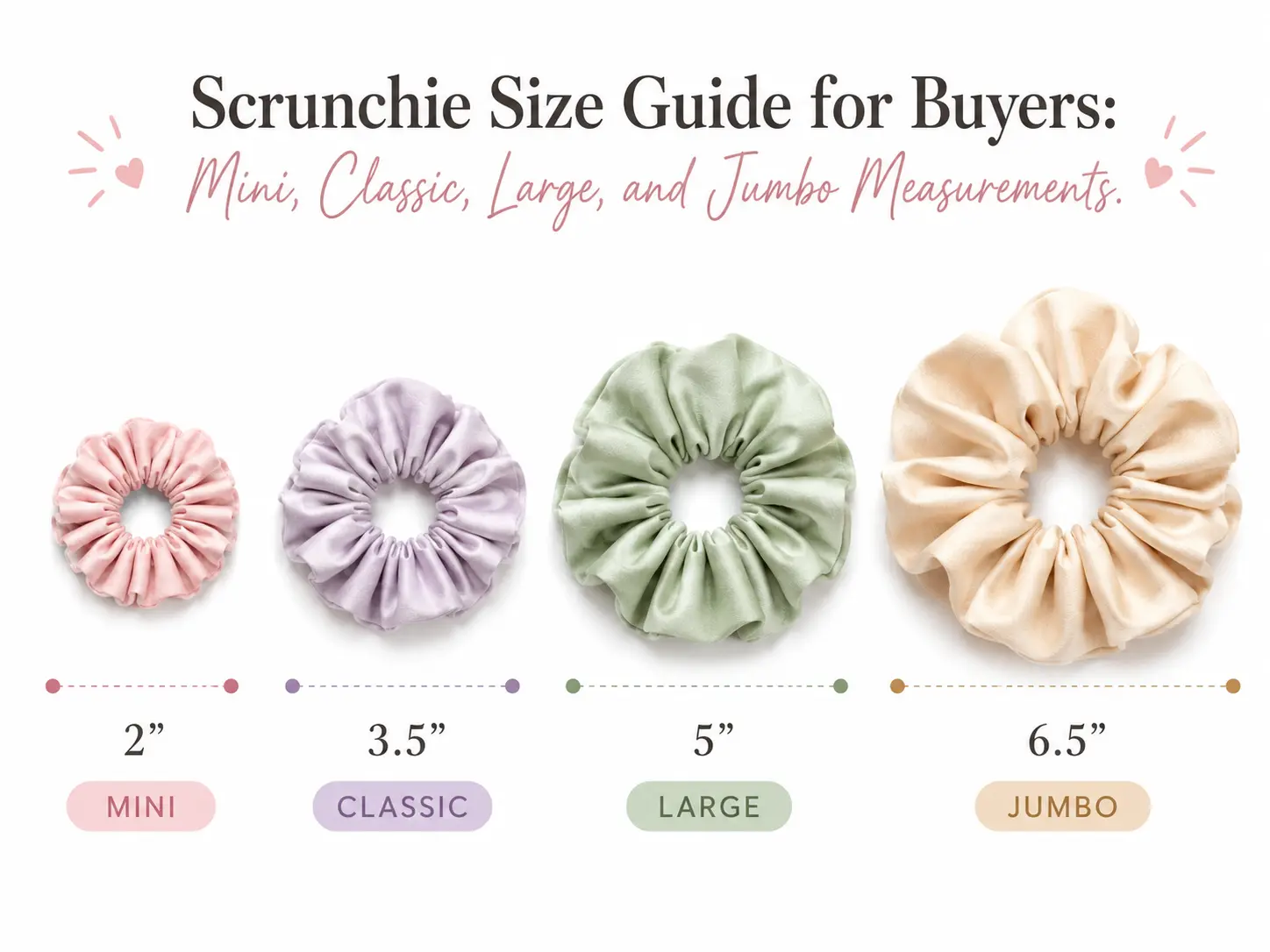
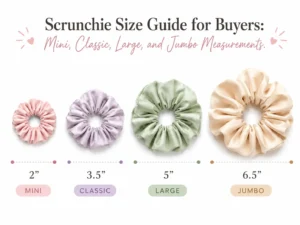
The following ranges are suitable as a buyer’s development starting point. They are intentionally broad because there is no universal standard for the words mini, classic, large, and jumbo. Published sewing guides demonstrate this variation: Seamwork suggests 18 × 3 inches for mini, 28 × 4 inches for classic, and 40 × 6 inches for jumbo, while another widely used sewing guide uses shorter regular patterns and a 35 × 5-inch jumbo strip.
| Category | Suggested fabric strip | Suggested elastic cut length | Typical finished outer diameter | Common positioning |
|---|---|---|---|---|
| Mini | 35–50 × 5–7 cm | 12–17 cm | 6–9 cm | Fine hair, short hair, children’s sets, discreet styling |
| Classic | 45–70 × 8–11 cm | 15–22 cm | 9–12 cm | Everyday ponytails, broad consumer collections |
| Large | 60–85 × 11–15 cm | 18–27 cm | 12–16 cm | Thick hair, visible bows, fashion-led collections |
| Jumbo | 85–110 × 14–20 cm | 28–40 cm | 16–22 cm | Statement styling, gifting, editorial and festival looks |
Do not copy these ranges directly into a purchase order. The same pattern produces different results in organza, satin, cotton, and velvet.
Mini Scrunchie Size Measurements and Uses
Typical Mini Scrunchie Dimensions
A mini scrunchie usually has a finished outer diameter of approximately 6–9 cm. A practical starting strip is 35–50 cm long and 5–7 cm wide, with 12–17 cm of elastic before joining. Small changes are highly visible at this scale. An extra centimeter of strip width can change the product from slim to puffy.
Best Hair Types and Hairstyles
Mini scrunchies suit fine hair, short ponytails, half-up styles, braid ends, children’s hairstyles, and multi-pack merchandising. They are also suitable for consumers who want the softness of a covered elastic without a large decorative effect.
For thick hair, a mini shell can use a longer elastic, but the fabric may visually disappear in the hairstyle. Treat visual size and holding capacity as separate specifications.
Recommended Fabrics
Light satin, silk, lightweight cotton poplin, fine jersey, organza, and thin recycled polyester are suitable. Heavy velvet or padded fabric can overwhelm the small structure and reduce the inner opening.
Classic Scrunchie Size Measurements and Uses
Typical Classic Scrunchie Dimensions
The classic category usually measures 9–12 cm across when relaxed. A common development range is 45–70 cm in strip length, 8–11 cm in strip width, and 15–22 cm in elastic cut length. This is the most flexible category because small adjustments can shift it toward a slim basic or a fuller fashion piece.
Best Hair Types and Hairstyles
Classic scrunchies work for everyday ponytails, low buns, casual half-up styles, sleep collections, beauty gift sets, and coordinated hair-accessory lines. They can serve fine, medium, or thick hair by changing the elastic rather than dramatically changing the outer shell.
Recommended Fabrics
Satin, silk, cotton, gingham, linen blends, lightweight velvet, ribbed jersey, and soft polyester all work well. Prints are easier to read than on mini sizes, but small motifs still perform better than large, placement-dependent graphics.
| Classic-style option | Construction direction | Best commercial use |
|---|---|---|
| Slim classic | Narrower strip, moderate gather ratio | Basics, office styling, fine-hair packs |
| Full classic | Wider strip, higher gather ratio | Fashion colors, satin collections, gifting |
| Strong-hold classic | Standard shell with longer or firmer elastic | Thick-hair and active-use collections |
| Soft sleep classic | Smooth fabric with moderate elastic tension | Night routines and beauty bundles |
Large Scrunchie Size Measurements and Uses
Typical Large Scrunchie Dimensions
A large scrunchie commonly measures 12–16 cm across. Buyers can begin with a 60–85 cm-long strip, an 11–15 cm width, and 18–27 cm of elastic. The specification should define whether “large” refers to outer volume, hair capacity, or both.
Best Hair Types and Hairstyles
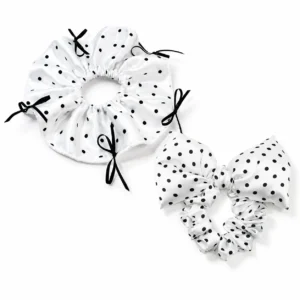
Large scrunchies work well for long hair, thick ponytails, curly hair, prominent half-up styles, bridal parties, seasonal drops, and social-media-focused collections. They create enough visual area for contrast piping, embroidered labels, bow tails, color blocking, and larger prints.
On short or low-density hair, heavy decorations may rotate or pull downward even when the elastic holds.
Recommended Fabrics
Satin, silk, cotton, linen blends, velvet, corduroy, washed fabrics, tulle, and organza are common. Structured fabrics can create a sculptural result, while soft fabrics create relaxed folds. For velvet and corduroy, buyers should lower the gather ratio or enlarge the inner opening to compensate for bulk.
Jumbo Scrunchie Size Measurements and Uses
Typical Jumbo Scrunchie Dimensions
A jumbo scrunchie generally measures 16–22 cm across. Start with an 85–110 cm strip, 14–20 cm width, and 28–40 cm elastic, then adjust for fabric and target wrap count.
Best Hair Types and Hairstyles
Jumbo scrunchies are designed for visual impact. They suit thick or long hair, oversized buns, editorial styling, festival collections, gifting, coordinated apparel launches, and wrist-as-accessory merchandising. They can also be worn over a separate internal hair tie when the brand prioritizes appearance over primary hold.
Recommended Fabrics
Organza is ideal for high volume with low weight. Satin and silk create a dramatic fluid shape. Cotton can support bold prints, while lightweight taffeta produces a sculptural finish. Thick velvet can become heavy and expensive at jumbo dimensions, so the pattern may need less length or a narrower strip.
Plan packaging early. Compression can flatten organza, crease satin, and distort the first impression; consider wider cards, shallow boxes, pouches, or low-compression cartons.
| Jumbo design goal | Recommended adjustment | Main risk to control |
|---|---|---|
| Maximum visual volume | Use light organza or tulle with a high gather ratio. | Uneven gathers and crushed packaging. |
| Luxury drape | Use silk or quality satin with moderate fullness. | Snags, seam puckering, and high fabric cost. |
| Bold printed statement | Use cotton or polyester with a controlled repeat. | Print disappearing inside folds. |
| Strong hold for thick hair | Specify elastic performance separately from shell size. | Assuming a larger shell automatically gives stronger hold. |
How Fabric Type Changes the Finished Scrunchie Size
Lightweight Fabrics Versus Thick Fabrics
Lightweight fabrics can accept more gathering before the seam becomes bulky. Organza, silk, and thin polyester create many small folds and often appear larger than their weight suggests. Thick velvet, fleece, terry, and quilted fabric require more space inside the tube and may reduce the relaxed inner opening.
Changing from satin to velvet usually requires revised strip width, elastic length, gather ratio, or a new sample.
Structured Fabrics Versus Soft Fabrics
Structured fabrics hold ruffles away from the elastic; soft fabrics collapse closer to the hair. Taffeta may appear dramatic with less width, while rayon may need more.
How Gathering Density Affects Volume
Gathering density is driven by fabric length relative to joined elastic circumference. Too little looks flat; too much causes uneven folds, seam twisting, and avoidable cost.
| Fabric type | Typical behavior | Development response |
|---|---|---|
| Silk or light satin | Fluid, compressible, smooth folds | Use moderate-to-high gathering; test seam puckering. |
| Organza or tulle | High visual volume with low weight | Control raw edges and packaging compression. |
| Cotton poplin | Defined folds and strong print visibility | Choose a print scale that remains readable after gathering. |
| Velvet or corduroy | Bulky, rich texture, reduced inner space | Reduce gathering or increase tube and elastic dimensions. |
| Jersey or stretch fabric | Soft, variable shape, possible seam growth | Control stretch direction and stabilize production measurements. |
How Buyers Should Select the Right Scrunchie Size
Define the Target Customer and Hair Type
Start with the intended hairstyle and hair volume. A buyer should state whether the product is designed for fine hair, children, medium everyday ponytails, thick curls, long hair, sleep use, active use, or decorative use over another elastic.
Age and positioning also matter. Children’s sets may require market-specific compliance planning, while adult jumbo styles are often decorative statement products.
Match the Size to the Collection Positioning
Basic multipacks favor mini and classic sizes. Premium silk ranges can offer a size ladder, while festival and holiday launches often use large or jumbo dimensions.
Review Samples Before Confirming Measurements
Review a sample in the final fabric, color, elastic, and logo method. Evaluate it flat, on the wrist, around the target ponytail, and inside final packaging.
Ask the manufacturer to record the sample’s cut dimensions before sewing. Once the finished product is approved, retain both the physical golden sample and the written measurement sheet.
How to Specify Scrunchie Size to a Manufacturer
Providing Finished Measurements
A useful specification includes more than “10 cm diameter.” Provide the relaxed outer diameter, inner opening, product weight if relevant, expected wrap count on a defined hair bundle, elastic width, elastic cut length, maximum stretch, and permitted tolerance.
Providing Reference Samples or Images
Reference samples are more reliable than images. State which details must be copied; when using photos, provide multiple angles and a ruler or known object for scale.
Setting Acceptable Size Tolerances
Soft products need realistic tolerances. A starting point may be ±0.5 cm for mini diameter and ±1.0 cm for larger sizes, subject to fabric and measurement method.
Elastic also needs tolerances, especially in mini styles where a 1 cm difference is significant. Inspection must use the same conditioning and measurement method as approval.
| Specification field | Example entry | Why it prevents disputes |
|---|---|---|
| Finished category | Classic scrunchie | Provides commercial context but is not the only measurement. |
| Fabric cut size | 55 × 10 cm, including seam allowance | Controls fullness and repeatability. |
| Elastic | 6 mm braided elastic, 18 cm cut length | Defines the functional core. |
| Finished diameter | 10.5 cm relaxed, ±0.8 cm | Controls visible size and packaging fit. |
| Stretch requirement | Fit approved test mandrel without seam or elastic failure | Creates a reproducible functional test. |
| Gather distribution | Even around full circumference | Prevents flat sections and seam concentration. |
| Reference | Approved sample code QS-01 | Links the written sheet to a physical standard. |
Brands can review custom materials, private-label options, and product-development support at Q&N Beauty and the company’s hair accessories wholesale and manufacturing page.
Case Study: Scrunchie Size Architecture at Slip and GIMME Beauty
Slip: Using Size as a Premium Assortment Ladder
Slip’s official collection includes Skinny, Large, and Jumbo categories within one silk-led brand world, turning size into an assortment and price architecture.
Skinny products support subtle daily styling, Large products create visible luxury, and Jumbo products act as statement accessories. One fabric story can therefore support several use cases and price points.
GIMME Beauty: Using Hair Type to Clarify the Size Decision
GIMME Beauty organizes satin scrunchies for fine or thinner hair, most hair types, and thick or curly hair, translating construction into an understandable benefit.
A strong private-label range can combine both approaches: clear size names for visual merchandising and hair-type guidance on packaging.
Case-study takeaway: Size names sell the silhouette, while hair-type guidance sells confidence. A manufacturer still needs exact measurements behind both claims.
Pros and Cons of Mini, Classic, Large, and Jumbo Scrunchies
| Size | Advantages | Limitations |
|---|---|---|
| Mini | Low material use, discreet look, easy multipacks, suitable for fine hair and braid ends | Limited visual impact and less room for large prints or labels |
| Classic | Broadest consumer appeal, flexible fabric choice, easy packaging, reliable everyday positioning | Highly competitive and difficult to differentiate through size alone |
| Large | Stronger visual presence, more branding area, suitable for thick hair and premium collections | Higher cost and possible rotation on low-density hair |
| Jumbo | High social-media impact, giftable, supports statement pricing and seasonal launches | High fabric use, packaging volume, and greater risk of weight or crushed presentation |
Expert Buyer Checklist
- Define the wearer. State hair density, hair length, age group, and primary hairstyle.
- Separate appearance from function. Specify outer shell size and elastic capacity independently.
- Choose the final fabric early. Thickness and stiffness can change the result even when the pattern stays identical.
- Set a gather ratio. Record fabric length and joined elastic circumference rather than approving fullness by eye alone.
- Control the elastic. Specify width, material, cut length, overlap, stretch, and recovery.
- Approve physical samples. Test the product on the intended hair type and inside final packaging.
- Set realistic tolerances. Define the measurement method and conditioning conditions.
- Retain a golden sample. Use it with the written specification during production inspection.
Frequently Asked Questions
What is the standard scrunchie size?
There is no universal standard. A classic often measures about 9–12 cm across, but brands use different patterns, elastic, and naming systems. Confirm a physical sample.
How long should the fabric strip be for a scrunchie?
Typical ranges are 35–50 cm for mini, 45–70 cm for classic, 60–85 cm for large, and 85–110 cm for jumbo, adjusted for fabric and gathering.
How long should scrunchie elastic be?
Typical elastic ranges are 12–17 cm for mini, 15–22 cm for classic, 18–27 cm for large, and 28–40 cm for jumbo.
What scrunchie size is best for thick hair?
Large and jumbo shells suit thick hair visually, but elastic strength, stretch, length, and recovery determine actual holding capacity.
What scrunchie size is best for fine hair?
Mini and classic sizes usually suit fine hair when wrap count and tension are tested for secure but comfortable hold.
How is finished scrunchie diameter measured?
Lay it flat and relaxed, distribute gathers evenly, and measure outer edge to outer edge without stretching or compression.
Why did my scrunchie sample look different in another fabric?
Fabric weight, thickness, stiffness, stretch, and finish change fold formation and inner space, often requiring a new sample.
Conclusion: Choose Scrunchie Size With Measurements, Not Names
The right scrunchie size is defined by fabric strip length and width, joined elastic circumference, finished diameter, inner opening, material behavior, and target hairstyle—not by the size name alone.
Mini supports fine hair and multipacks; classic offers broad flexibility; large improves visibility; jumbo creates statement value but requires tighter control of weight, consumption, and packaging.
Future collections will increasingly combine visual size with clearer hair-type guidance, measurable elastic performance, recycled fabrics, modular size ladders, and packaging designed to preserve volume. Brands that publish meaningful dimensions and validate fit on real users will reduce returns and create stronger product trust.
Ready to develop a custom scrunchie collection? Visit Q&N Beauty to discuss mini, classic, large, and jumbo patterns, fabric options, custom colors, logos, packaging, samples, and production quotations.
Sources and External Link Placements
- Grand View Research: Hair Accessories Market
- Statista: Worldwide Accessories Market
- Google Search Central: People-First Content
- Google Search Central: AI Search Optimization Guide
- Preventing Traction Alopecia
- Seamwork Scrunchie Size Examples
- AppleGreen Cottage Size Examples
- Slip Scrunchie Collection
- GIMME Beauty Scrunchies by Hair Type