Anti-Slip Fabric Hair Clips for Fine Hair
Many fabric hair clips look attractive on a display card but fail the moment they are worn on fine, smooth, or low-density hair. The clip slides toward the ear, rotates under the weight of a bow, or falls out after a few minutes of walking. Consumers often describe this as a “weak clip,” yet the real cause is usually a system-level design problem involving spring pressure, contact area, surface friction, decoration weight, and the way the fabric is attached.
This matters commercially. Grand View Research valued the global clips-and-pins segment at USD 5.66 billion in 2025 and forecasts 8.1% annual growth through 2033. Its broader hair-accessories report estimates the category at USD 27.2 billion in 2026. Statista projects USD 758.14 billion for the much broader worldwide accessories category in 2026; that figure is useful only as spending context, not as a hair-clip market size.
For brands, the opportunity is not simply to add silicone to an existing clip. A reliable anti-slip product must create enough retention to stay in place while avoiding concentrated pressure, snagging, cuticle abrasion, and scalp discomfort. This guide explains the engineering principles, component choices, production controls, test methods, and market-specific recommendations needed to develop fabric-covered clips that work for fine hair.
This article follows Google Search Central’s people-first, expert-led content guidance.
Why Fabric Hair Clips Need a Fine-Hair Design
Common Reasons Hair Clips Slide Out
A clip stays in position when the forces resisting movement are greater than the forces pulling it downward or rotating it. Fine hair often presents a smaller bundle of fibers inside the clip. If the base was designed for a thicker section, the spring may close before the jaws establish useful contact. The clip appears closed but is barely loading the hair.
The Relationship Between Hair Density and Clip Pressure
Hair density describes the number of fibers in an area, while fiber diameter describes the width of each strand. A consumer can have many fine strands or relatively few coarse strands. Both variables affect the thickness and compressibility of the captured section.
For a fine-hair clip, the spring must generate useful closing force at a smaller jaw gap. Yet excessive pressure concentrated at one point can feel painful or crease the hair. A better design distributes moderate pressure over a longer contact zone. Curved bases, multiple teeth, lined inner surfaces, and balanced decorations can improve hold without turning the clip into a clamp.
| Failure mode | Likely cause | Better engineering response |
|---|---|---|
| Clip slides downward | Low friction or insufficient closing force | Add controlled texture, improve spring preload, or increase contact length. |
| Clip rotates sideways | Bow or ornament is too heavy or off-center | Reduce mass, center the decoration, and widen the stabilizing contact zone. |
| Clip closes but holds nothing | Jaw geometry is designed for a thicker hair section | Reduce the closed gap or use an insert that remains compressible. |
| Clip holds but hurts | Pressure is concentrated at teeth or metal edges | Round contact points and distribute load over a larger area. |
| Clip pulls hair during removal | Exposed adhesive, burrs, seams, or sharp tooth transitions | Improve edge finishing and keep glue away from functional surfaces. |
Expert view: The best fine-hair clip is not necessarily the tightest clip. It is the clip that reaches a stable closed position, maintains friction under movement, and releases without dragging individual fibers across rough edges.
What Makes Fabric Hair Clips Anti-Slip?
Grip Strength
Grip strength combines spring force, jaw geometry, surface friction, and the amount of hair captured. Spring force alone is an incomplete specification. Two clips with the same measured opening force can perform differently if one has a short contact zone and the other has a long, curved inner surface.
For development, measure opening force at a defined opening distance and compare samples from the beginning, middle, and end of a production run. The target should be a range, not a single number, because metal thickness, heat treatment, hinge assembly, and plating can create variation.
Contact Surface Area
A larger effective contact area lets the clip distribute pressure and resist rotation. “Effective” is important: a wide clip does not help if only two raised points touch the hair. Curved snap clips and barrettes can follow the head shape, while serrated alligator clips create multiple points of engagement.
Clip Weight and Balance
Fabric bows, padded knots, pearls, metal charms, and layered tails add mass. Weight alone does not predict failure. The distance between the decoration and the hinge or contact zone also matters. A heavy bow positioned far above the base produces greater rotational leverage than a flatter decoration placed close to the clip.
Fabric Texture and Friction
Velvet, grosgrain ribbon, brushed polyester, and some cotton weaves create more tactile friction than smooth satin. However, placing rough fabric directly against hair can increase drag during removal. Research on hair tribology shows that surface roughness, chemistry, treatment, and environmental conditions influence friction. The practical objective is controlled traction during wear and low snag risk during removal.
| Design variable | Too low | Balanced target | Too high |
|---|---|---|---|
| Spring pressure | Sliding and rotation | Secure hold with comfortable wear | Scalp pressure, creasing, difficult opening |
| Surface friction | Clip migrates on smooth hair | Stable grip with clean release | Snagging and cuticle abrasion risk |
| Decoration weight | May look insubstantial | Visual impact matched to base capacity | Rotation, sagging, hinge fatigue |
| Contact area | Point loading and unstable hold | Distributed pressure across the hair section | Oversized base or reduced styling flexibility |
Clip Base Designs That Improve Grip
Alligator Clips With Teeth
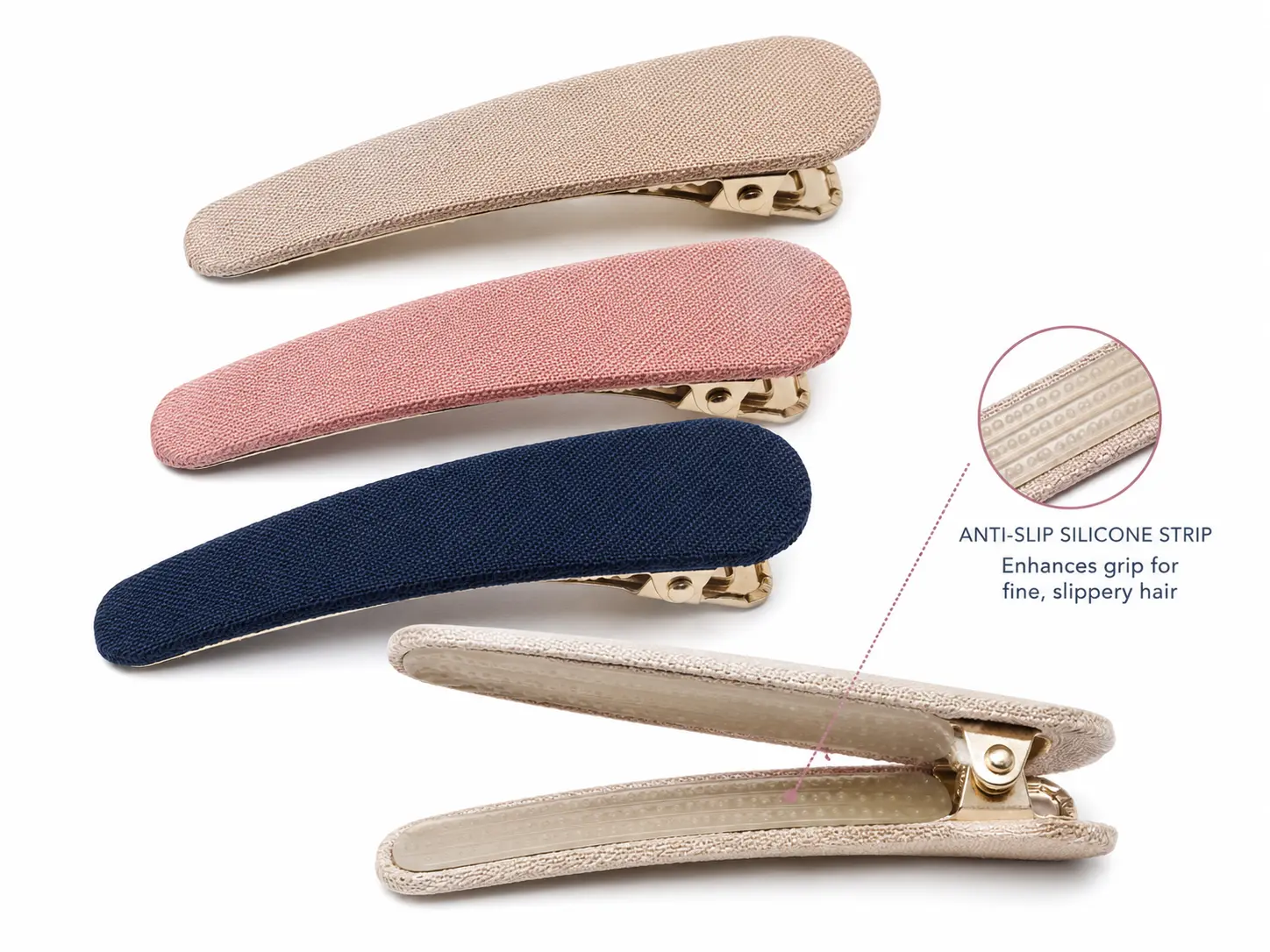
Alligator clips are strong candidates for anti-slip bow clips because their long jaws and teeth can engage a small section of hair. Fine-hair versions usually benefit from closely spaced teeth, a controlled closed gap, rounded tooth tips, and a narrow silicone or textured ribbon insert on one inner jaw.
Snap Clips With Curved Bases
Snap clips are low-profile, familiar, and suitable for mini fabric styles. A curved base follows the head and creates distributed contact when correctly sized. Fine-hair performance depends on the spring action of the metal shell and the gap between the upper and lower sections after snapping closed.
Barrettes With Adjustable Tension
French-style barrettes offer a broad platform for bows and statement fabrics. Some mechanisms provide more than one tension position or include a removable center bar. This helps brands serve different hair volumes with one silhouette. For fine hair, the barrette should close on a thin section without requiring a bulky ponytail.
Duckbill Clips With Added Grip Features
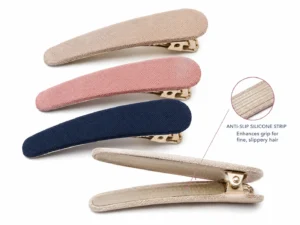
Duckbill clips have a long, smooth profile and work well for side placement, sectioning-inspired fashion, and elongated bows. Standard duckbill clips may slide on fine hair because the jaws are relatively smooth. A short silicone strip, micro-serrated insert, or textured ribbon placed away from exposed edges can improve performance.
| Clip base | Fine-hair grip potential | Best use | Main limitation |
|---|---|---|---|
| Toothed alligator | High | Bow clips, side clips, children’s styles | Teeth may snag if sharp or poorly finished. |
| Curved snap clip | Medium to high | Mini clips, pairs, lightweight fabric covers | Tension can weaken after repeated flexing. |
| Adjustable barrette | Medium to high | Statement bows, half-up styles, gift collections | Heavy decoration can rotate the mechanism. |
| Duckbill clip | Medium with added grip | Long bows, sleek side clips, styling-inspired products | Smooth jaws often need a secondary grip feature. |
Anti-Slip Materials and Components
Silicone Grip Strips
Silicone strips can provide reliable traction with relatively little thickness. They work best when narrow, flexible, securely bonded, and positioned inside the contact zone. A wide strip may make the clip difficult to close or create a visible ridge. Poor bonding can produce lifted corners that catch hair.
Soft Rubber Coatings
Rubberized or thermoplastic elastomer coatings can create a softer touch and increase friction. They may suit sport-inspired collections and modern matte finishes. The limitations are potential tackiness, dust attraction, coating wear, and chemical compatibility with hair oils or styling products.
Textured Ribbons and Fabric Linings
Grosgrain ribbon is frequently used because its ribs provide texture, it is easy to color-coordinate, and it can be cut to fit a clip. Velvet ribbon offers higher tactile friction and a premium appearance. The lining should stop before hinge and tooth zones, and cut edges should be sealed without creating a hard ridge.
Foam and Felt Grip Inserts
Thin foam or felt can reduce the closed gap and help a clip engage less hair. They are economical and easy to prototype, but may compress permanently or absorb oils and moisture. Control thickness carefully and reserve them for products whose wear and cleaning conditions are clearly defined.
| Grip component | Pros | Cons | Best-fit collection |
|---|---|---|---|
| Silicone strip | High traction, thin profile, repeatable shape | Bonding and edge-lift risks | Premium fine-hair, active, and travel lines |
| Soft rubber/TPE coating | Integrated feel, modern finish, broad contact | Wear, tackiness, and compatibility concerns | Sport and minimalist collections |
| Grosgrain lining | Color-matchable, familiar, economical | Lower traction than silicone; edge finishing needed | Bow clips and coordinated fabric sets |
| Velvet lining | Soft, premium, higher tactile friction | Bulk and lint attraction | Fashion and holiday collections |
| Foam/felt insert | Low cost, easy gap adjustment | Compression set and moisture absorption | Lightweight seasonal or children’s styles |
How Fabric Construction Affects Performance
Preventing Excess Fabric From Reducing Clip Pressure
Fabric thickness changes closure geometry. A padded bow tail trapped between the jaws may reduce spring travel, while a tightly wrapped shell may prevent a snap clip from reaching its stable closed position. Before approving the decoration, compare the bare mechanism with the finished sample. If opening force, closed gap, or alignment changes substantially, the covering method is interfering with function.
Controlling Bow and Decoration Weight
Lightweight construction can still look full. Brands can use hollow loops, organza, light polyester, engineered pleats, or a small internal support rather than dense layers of fabric and adhesive. Metal charms should be positioned near the clip center instead of at the end of a long bow tail.
Securing Fabric Without Covering Functional Areas
Adhesive should remain on the outer spine or designated bonding plate. It should not flow into the hinge, spring, teeth, or inner gripping surface. Stitching can improve durability, but thread tails and knots must be isolated from the hair-contact area. Heat-sealed synthetic ribbon edges should be smooth rather than sharp or glass-like.
| Construction control | Inspection question | Reject condition |
|---|---|---|
| Closed gap | Does the decorated clip close to the approved gauge? | Gap increases enough to lose grip on the fine-hair tress. |
| Hinge clearance | Can the base open fully without fabric interference? | Fabric or glue restricts movement or causes uneven closing. |
| Decoration alignment | Is the center of mass aligned with the base? | Bow visibly twists or pulls the clip sideways. |
| Inner surface | Are teeth, pads, and grip zones unobstructed? | Fabric covers functional areas or adhesive is exposed. |
| Edge finish | Can the clip be inserted and removed without catching? | Burrs, hard glue, sharp heat seals, or loose wire are present. |
For more information on custom materials, logo methods, and private-label development, brands can review Q&N Beauty and its custom hair accessories manufacturing capabilities.
How to Test Fabric Hair Clips for Fine Hair
Slip Resistance Tests
Mount a standardized hair tress vertically or at a repeatable angle. Apply the clip to a marked position with a defined amount of hair. Record displacement after a fixed period and after controlled movement. Test at room conditions and, when relevant, after exposure to humidity, synthetic sebum, conditioner, or light styling product.
Opening and Closing Cycle Tests
Cycle the mechanism, then remeasure opening force, alignment, closed gap, and grip. A development screen may begin at 500 cycles, while a premium program may require more. Treat the cycle count as a brand specification, not a universal legal threshold.
Wear Comfort and Hair Damage Tests
Human wear trials should record pressure points, headache or tenderness, pulling during movement, snagging during removal, visible creasing, and broken fibers. Research on hair care consistently connects mechanical friction and grooming stress with cuticle wear and breakage risk. A clip should therefore be assessed both for retention and for the quality of release.
Real-Use Testing on Different Hair Types
Include untreated fine straight hair, conditioned fine straight hair, fine wavy hair, and low-density hair where possible. If the product is sold as suitable for chemically treated or children’s hair, include those intended users under an ethically and legally appropriate test plan.
| Test | Suggested method | Record | Example acceptance logic |
|---|---|---|---|
| Static slip | Vertical tress, fixed hair mass, 60 minutes | Movement in mm | No release and displacement below the brand’s validated limit. |
| Dynamic wear | Controlled head-motion or movement fixture | Rotation, displacement, release | No release; limited rotation; repeatable result across samples. |
| Cycle durability | Repeated opening and closing | Force loss, deformation, hinge failure | Force and gap remain within the approved tolerance. |
| Snag assessment | Insert and remove from test tress repeatedly | Snag events and broken fibers | No sharp snag and no exposed adhesive contact. |
| Decoration security | Pull/torque test based on component type | Detachment force and failure mode | No separation below the approved product specification. |
| Corrosion/sweat screen | Artificial perspiration or relevant accelerated exposure | Rust, plating change, staining | No corrosion that affects safety, appearance, or function. |
Compliance note for children’s clips: In the United States, a product designed or intended primarily for children aged 12 or younger may be classified as a children’s product. CPSC guidance states that children’s products subject to applicable rules require third-party testing and a Children’s Product Certificate. CPSC also lists barrettes among grooming products excluded from the federal small-parts ban, so brands should not assume that every small-parts rule applies in the same way. Internal small-component retention and sharp-edge inspections remain prudent, and other applicable lead, coating, labeling, tracking, or market-specific requirements may still apply.
In the European Union, the General Product Safety Regulation has applied since December 13, 2024. It reinforces safety, traceability, and online-sale responsibilities. Obtain a product-specific assessment rather than treating a generic checklist as legal advice.
Design Recommendations for Fabric Hair Clips
Anti-Slip Bow Clips
Use a toothed alligator base or a curved barrette with a narrow grip insert. Keep the bow’s center close to the base. For fine hair, reduce dense knot layers and use lightweight fabric to create volume. Leave the inner teeth and hinge clear.
Anti-Slip Fabric Barrettes
Select a barrette that closes securely on a thin section. A multi-position or adjustable center bar can broaden fit. Use a flat bonding plate for the fabric decoration and test the product in half-up styles, not only on a thick ponytail.
Anti-Slip Mini Clips
Mini clips require precision because there is little area available for grip features. Closely spaced teeth, a slim silicone dot pattern, or a textured ribbon insert can help. Decorations should remain extremely light. Sell pairs or coordinated sets to increase styling value without enlarging each clip.
Anti-Slip Children’s Hair Clips
Favor rounded edges, secure decoration attachment, limited metal exposure, and age-appropriate sizing. Avoid loose gems, protruding wire, sharp heat-sealed ribbon, and adhesive squeeze-out. Packaging, imagery, colors, and product scale may affect whether the product is treated as a children’s product under U.S. guidance, so compliance planning should begin before artwork approval.
| Product style | Recommended base | Preferred grip feature | Decoration rule |
|---|---|---|---|
| Classic bow clip | Toothed alligator | Teeth plus narrow silicone or grosgrain insert | Center bow over outer spine; keep hinge open. |
| Premium fabric barrette | Curved or adjustable barrette | Textured inner bar or low-profile silicone | Control ornament height and total torque. |
| Mini side clip | Snap or mini alligator | Micro texture or thin lining | Use one lightweight layer; avoid bulky knots. |
| Sport-inspired clip | Duckbill or flexible alligator | Matte TPE or silicone contact zone | Use washable, low-absorption fabric. |
| Children’s pair | Rounded snap or finished alligator | Soft ribbon or secure low-profile pad | Prioritize attachment security and edge safety. |
Case Study: Translating Grip Claims Into Product Design
Kitsch: Secure Hold Without a Crease
Kitsch markets its creaseless clips for hair ranging from fine to thick and states that the smooth, rounded grip holds securely without tugging or snagging. The useful design lesson is not that every fabric clip should copy a creaseless styling clip. It is that retention and hair appearance are presented as a paired benefit: the product must hold while limiting dents and damage.
Goody: Building a Recognizable Grip Platform
Goody uses “SlideProof Grip” and “No-Slip Grip” across several accessory forms, including barrettes, bobby pins, claw clips, headbands, and elastics. This demonstrates the value of treating grip as a platform rather than a one-product feature. A brand can apply a consistent performance promise across bow clips, fabric barrettes, and mini sets while adapting the mechanism to each silhouette.
Case-study takeaway: Successful performance positioning connects a clear consumer problem, a visible or explainable feature, and a repeatable test. Fabric alone creates the style identity. The base and contact system create credibility.
Pros and Cons of Anti-Slip Fabric Hair Clips
| Advantages | Trade-offs |
|---|---|
| Better retention on smooth, fine, or low-density hair | Extra components increase material and assembly cost. |
| Clear functional differentiation from decorative-only clips | Higher friction can increase snag risk when poorly designed. |
| Supports premium claims and hair-type-specific merchandising | Added pads or coatings may complicate color matching and aging tests. |
| Reduces consumer frustration and repeated restyling | Excess spring force can create discomfort or creasing. |
| Can extend into sport, children’s, bridal, and everyday collections | One design may not perform equally on all densities, treatments, and textures. |
The trade-offs are manageable when the product is engineered as a complete system. Most problems arise when a grip material is added late, after the bow size, base, adhesive, and packaging have already been approved.
Expert Development Checklist
- Define the use case. Specify hairstyle, target hair density, expected wear time, user age, and activity level.
- Select the mechanism before decoration approval. Match base length, spring behavior, curvature, and teeth to the intended hair section.
- Set measurable tolerances. Document opening force, closed gap, decoration weight, alignment, and grip insert position.
- Test finished products. A bare clip result is not valid after fabric, glue, padding, labels, and ornaments are added.
- Evaluate removal. Record snagging, pulling, creasing, and broken fibers, not only holding time.
- Complete market-specific compliance review. Confirm age classification, chemical restrictions, labeling, traceability, and documentation before production.
Brands developing private-label fabric hair clips can contact Q&N Beauty to discuss clip bases, fabrics, logo methods, grip components, packaging, prototyping, and production testing.
Frequently Asked Questions
How do you keep hair clips from slipping out of fine hair?
Use a clip that closes on a small section and combines moderate spring pressure with teeth, curvature, a longer contact zone, or a controlled grip insert. Avoid heavy decorations.
What type of hair clip is best for fine hair?
A toothed alligator clip, curved snap clip, or adjustable barrette can work well. The best choice depends on the hairstyle, closing geometry, contact area, and decoration weight.
Are alligator clips good for fine hair?
Yes, when the teeth are closely spaced, smoothly finished, and able to engage a thin section without being covered by fabric.
Do silicone grip strips damage hair?
Properly designed silicone strips can improve traction, but lifted edges, excessive tack, sharp transitions, or excess pressure may pull hair.
Is velvet better than satin for an anti-slip clip?
Velvet usually provides more texture than satin, but the clip base and grip insert normally affect retention more than the decorative fabric.
How should anti-slip hair clips be tested?
Measure static and dynamic displacement on standardized tresses, then complete cycle, decoration-security, corrosion, snag, and wear tests.
Are children’s fabric hair clips subject to special rules?
Potentially. Requirements depend on intended age, design, packaging, marketing, and destination market. Obtain a product-specific compliance review.
Conclusion: Better Fabric Hair Clips Start With Grip
A reliable fabric hair clip for fine hair is a balance of retention, comfort, weight, and clean removal. The clip base must close on a small hair section. The contact surfaces must generate enough friction without snagging. The decoration must stay light and centered. Fabric, glue, padding, and labels must not obstruct the hinge, teeth, or gripping zone.
Future development will favor hair-type-specific sizing, lighter statement bows, molded grip inserts, recycled fabrics, lower-profile mechanisms, and claims supported by measured displacement rather than vague “strong hold” language.
Ready to develop a custom anti-slip collection? Visit Q&N Beauty to request material options, clip-base recommendations, prototype support, packaging ideas, and a production quotation for custom fabric hair clips.
Sources and External Link Placements
- Grand View Research: Clips & Pins
- Grand View Research: Hair Accessories
- Statista: Accessories Forecast
- Human Hair Friction Review
- Hair Friction Dynamics Study
- Hair Cosmetics Review
- Kitsch Product Case
- Goody Product Case
- CPSC: Children’s Products
- CPSC: Small Parts Guidance
- EU General Product Safety Regulation
- Google People-First Content Guidance