Asking for “strong elastic” is not enough. Performance depends on width, cut length, construction, thickness, working extension, recovery, joining method, fabric weight, and the amount of hair captured.
The commercial opportunity is substantial. Grand View Research estimates that the global hair-accessories market will reach USD 27.2 billion in 2026 and reports that hair elastics and ties represented 32.6% of the market in 2024. In the United States, elastics and ties represented about 40.3% of the hair-accessories market in 2025. Statista projects USD 758.14 billion in 2026 revenue for the much broader worldwide accessories market; that number provides consumer-spending context but should not be described as the size of the scrunchie market.
Why Elastic Selection Is Important for Custom Scrunchie Quality
Elastic and Holding Strength
A scrunchie holds when the stretched elastic produces enough inward force and the fabric creates useful friction. Excess force makes wrapping difficult; insufficient force allows the ponytail to loosen.
Elastic and Wearing Comfort
Comfort depends on force distribution. Wider elastic spreads pressure but can add bulk. Narrow elastic fits mini products but may create concentrated tension when too firm.
Medical literature on traction alopecia shows that prolonged or repetitive pulling can damage the hair shaft and follicle. Scrunchie development should not attempt to make every product as tight as possible. The objective is the lowest reliable tension that maintains the intended hairstyle during normal use.
Elastic and Product Lifespan
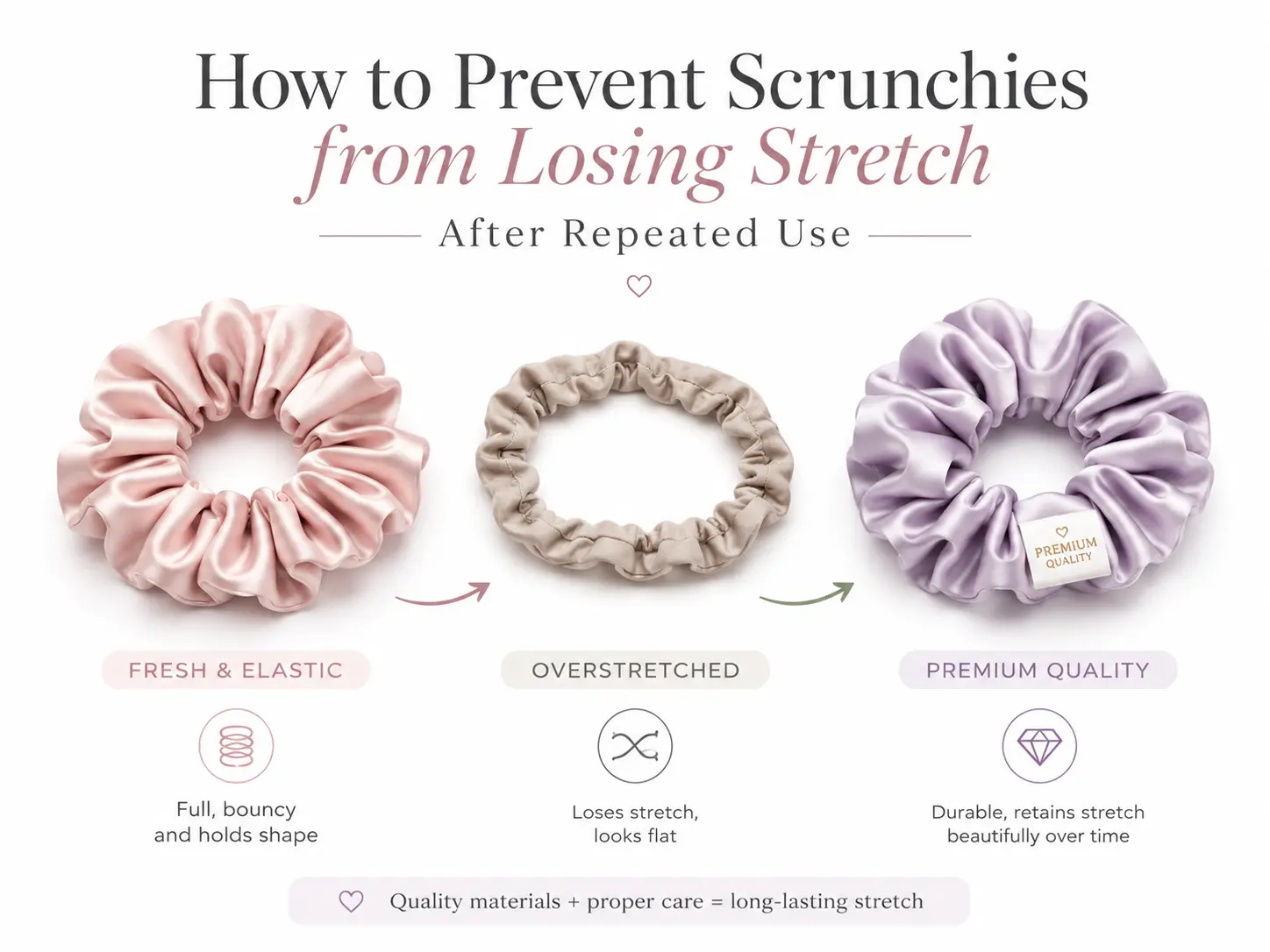
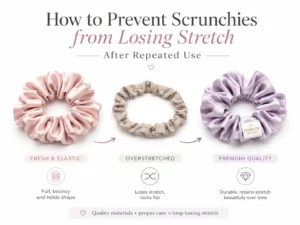
Elastic lifespan depends on elastomer quality, textile covering, working extension, cycling, heat, oils, ultraviolet light, moisture, and detergent. Repeatedly stretching near the material limit accelerates fatigue.
| Quality objective | Elastic variable | Buyer evaluation |
|---|---|---|
| Secure hold | Tension at working extension | Does the scrunchie maintain the target hairstyle for the required time? |
| Comfort | Width, force distribution, wrap count | Can users wear it without pain, pulling, or excessive creasing? |
| Long lifespan | Recovery, fatigue resistance, joining strength | Does performance remain within tolerance after repeated use? |
| Stable appearance | Width, twisting resistance, seam bulk | Does the elastic remain flat and evenly distributed inside the shell? |
Expert principle: Evaluate the finished scrunchie as a system. Elastic that performs well in a laboratory strip test can behave differently after it is joined, enclosed in heavy fabric, and wrapped around real hair.
Understanding Elastic Specifications for Custom Scrunchies
Elastic Width
Elastic width is measured across the relaxed band. Scrunchie development commonly starts between 3 and 12 mm. Narrow bands are discreet; wider bands resist rolling and distribute force but need more tube space.
Width alone does not indicate strength. A soft 10 mm knitted elastic can exert less force than a firm 6 mm braided elastic at the same extension. Every width decision should be linked to a tension or fit test.
Elastic Length
Buyers must distinguish among three lengths:
- Cut length: the elastic length before joining
- Overlap allowance: the section used for stitching or another joining method
- Joined circumference: the functional loop length after the overlap is deducted
Thickness and Stretch Ratio
Thickness affects force and twisting resistance. Stretch can be reported as a multiple of relaxed length or as percentage elongation:
Elongation (%) = (stretched length − original length) ÷ original length × 100
An elastic that extends from 20 to 40 cm has 100% elongation. Define the calculation because “200% stretch” is often used ambiguously.
Recovery Strength
Recovery describes how closely the elastic returns to its original dimensions after extension. Force recovery is also important: a band may return to its original length while producing less holding tension after cycling.
ASTM D4964 addresses tension and elongation of elastic fabrics, ASTM D5278/D5278M-26 covers narrow elastic under static load, and ISO 20932-3 covers elasticity of narrow fabrics. Buyers and laboratories must still agree on relevant loads, extensions, conditioning, and acceptance criteria.
| Specification | Example | Incomplete wording to avoid |
|---|---|---|
| Width | 6 mm ± 0.5 mm | “Standard elastic” |
| Cut length | 19 cm before joining | “About 19 cm” |
| Overlap | 1.5 cm, box stitch | “Sew ends together” |
| Working extension | Test at 150% of original loop circumference | “Very stretchy” |
| Recovery | Maximum permanent growth after agreed cycles | “Good recovery” |
| Functional fit | Two wraps on the approved ponytail mandrel | “Fits all hair” |
How to Choose Elastic Width for Custom Scrunchies
Narrow Elastic for Mini Scrunchies
Mini and skinny scrunchies commonly begin with 3–5 mm elastic. This range keeps the inner construction discreet and allows the fabric tube to remain narrow. It is suitable for fine hair, children’s styles, braid ends, slim silk scrunchies, and multipacks.
The main risk is rolling. Compare a firmer braided option with a softer knitted option, then inspect twisting, comfort, and recovery in the finished mini scrunchie.
Standard Elastic for Classic Scrunchies
A 5–8 mm width is a practical starting range for classic custom scrunchies. It provides enough surface area for stable joining while fitting inside most satin, cotton, polyester, and light velvet tubes. This range can be adjusted for fine, medium, or thick hair through material choice and loop length.
Wider Elastic for Large and Jumbo Scrunchies
Large and jumbo products may use 8–12 mm elastic when the shell is heavy or the target is thick hair. Wider bands resist twisting and distribute the load from velvet, terry, or dense fabric.
| Scrunchie category | Development width range | Suitable use | Main risk |
|---|---|---|---|
| Mini or skinny | 3–5 mm | Fine hair, braid ends, slim silk styles | Rolling, concentrated tension, weak join area |
| Classic | 5–8 mm | Daily ponytails, general collections, gift sets | Assuming one tension suits every hair type |
| Large | 7–10 mm | Long or thick hair, fuller fabrics | Bulk visible through lightweight satin |
| Jumbo or heavy fabric | 8–12 mm | Statement products, velvet, terry, dense shells | Excess stiffness and difficult wrapping |
These are prototype ranges rather than fixed standards. The best width is the narrowest band that remains stable, meets the hold requirement, and survives the agreed durability test without rolling or excessive force loss.
How to Determine Elastic Length for Custom Scrunchies
Matching Elastic Length to Finished Size
Elastic length controls the inner opening, gathering density, and wrap count. A shorter loop creates denser gathers and higher starting tension; a longer loop creates more opening and may need another wrap.
| Category | Suggested cut-length starting range | Typical development goal |
|---|---|---|
| Mini | 12–17 cm | Two or three wraps on fine hair or small sections |
| Classic | 15–22 cm | Two wraps on a medium ponytail; adjustable by hair target |
| Large | 18–27 cm | Two wraps on medium-to-thick hair |
| Jumbo | 25–40 cm | One or two wraps on thick hair or decorative wear over another tie |
Adjusting for Different Hair Thicknesses
Fine hair generally needs a smaller joined circumference or lower-force elastic that can complete more wraps without discomfort. Thick, curly, or long hair often requires a larger circumference and stable recovery at higher extension.
Use standardized ponytail bundles representing target users. Record bundle circumference, wrap count, installation effort, slippage, and comfort so hair-type claims become measurable.
Accounting for Elastic Joining and Sewing Allowance
Elastic ends are commonly overlapped and stitched. Include the 1–2 cm overlap in cut length and require the join to remain flat and intact during repeated extension.
| Joining method | Advantages | Limitations | Recommended use |
|---|---|---|---|
| Flat overlap with box or zigzag stitch | Strong, repeatable, easy to inspect | Adds local thickness | Most commercial scrunchies |
| Multi-line straight stitch overlap | Simple equipment and fast production | Can perforate or cut some elastic constructions | Approved after pull and cycle testing |
| Butt join with reinforcement | Low profile | More complex and method-dependent | Very slim premium styles |
| Knot | Fast for prototypes | Bulky, inconsistent, difficult to control | Development samples only |
How Fabric Weight Affects Elastic Selection
Lightweight Satin and Organza
Lightweight satin and organza add little mass, so they do not automatically require stronger elastic. Satin reveals lumps and twists, making flat joining and consistent elastic width particularly important. Organza can create a large visual shell around a relatively light band.
For sleep positioning, prioritize moderate tension and recovery. Slip cites a consumer perception study of more than 85 women who switched from an ordinary elastic or coil tie to its silk skinny scrunchie for at least eight hours. This is brand-specific evidence, not proof for every silk scrunchie.
Cotton and Polyester Fabrics
Cotton poplin and standard polyester offer predictable construction and can use a wide range of elastic types. Medium-weight cotton may need slightly more stable tension than light satin because the gathered shell creates more resistance during wrapping.
Velvet, Terry Cloth, and Heavy Fabrics
Velvet, terry, corduroy, fleece, and quilted shells add bulk. They often need wider elastic, more tube space, and enough loop length to avoid an overly tight result.
| Fabric group | Elastic direction | Construction adjustment |
|---|---|---|
| Silk/light satin | Narrow-to-standard, moderate force | Use a flat join and prevent twisting or visible lumps. |
| Organza/tulle | Choose by hair target, not visual volume | Control sharp edges and avoid unnecessary elastic stiffness. |
| Cotton/polyester | Standard width with hair-specific length | Test fabric shrinkage and gather resistance. |
| Velvet/corduroy | Standard-to-wide with stable recovery | Increase tube room and reduce excessive gathering. |
| Terry/quilted fabric | Wider band for anti-twist stability | Test weight, moisture exposure, and joining strength. |
Common Elastic Problems in Custom Scrunchies
Scrunchies That Feel Too Tight
Likely causes are a short loop, high working force, firm construction, or bulky fabric that reduces usable opening. Adjust length only after identifying whether the problem is force or geometry.
Scrunchies That Do Not Hold Hair Securely
Weak hold may come from excessive loop length, low tension, poor recovery, slippery fabric, or too few wraps. A shorter loop or higher-friction shell may work better than simply increasing force.
Elastic That Twists Inside the Fabric Tube
Twisting is linked to narrow elastic, uneven insertion, an oversized tube, unstable construction, or a bulky join. Add an anti-twist inspection before closing the fabric opening.
Elastic That Loses Recovery Quickly
Early relaxation can indicate poor elastomer quality, overextension, heat exposure, chemical incompatibility, or a weak covering. Compare cycled samples with unused controls.
| Problem | Likely cause | Corrective action |
|---|---|---|
| Too tight after two wraps | Loop too short or working force too high | Increase joined circumference or select lower-tension elastic. |
| Slides after movement | Loop too long, weak recovery, or low fabric friction | Shorten loop, improve recovery, or revise shell material. |
| One hard lump | Bulky knot or overlap | Use a controlled flat join and position it inside dense gathers. |
| Elastic turns sideways | Narrow band, oversized tube, or poor assembly | Increase width, reduce tube space, and add an anti-twist inspection. |
| Becomes loose after limited use | Fatigue, heat damage, or overextension | Upgrade material and validate the real working extension. |
| Elastic breaks at seam | Stitch perforation or insufficient overlap | Revise needle, stitch pattern, overlap, and pull-test requirement. |
How to Test Elastic for Custom Scrunchies
Stretch and Recovery Testing
Condition samples, record original circumference, extend to agreed percentages, hold, release, and measure immediate and delayed recovery. Record force at useful working extensions, not only maximum stretch.
ASTM D4964, ASTM D5278/D5278M-26, and ISO 20932-3 can inform laboratory methods for elastic fabrics. The brand must still define the test points and acceptance criteria. A scrunchie rarely needs to reach the elastic’s breaking extension during normal use.
Repeated Use Testing
Cycle finished scrunchies between relaxed size and validated working extension. Then measure permanent growth, force loss, join damage, seam distortion, and twisting across multiple samples.
Hair-Holding Performance Testing
Test on standardized bundles and target users. Record wrap count, installation force, slippage after movement, comfort, removal, and visible creasing.
Washing and Aging Tests
ISO 6330:2021 provides domestic washing and drying procedures for textile testing. Use an agreed procedure—or the claimed hand-wash method—to compare recovery, shrinkage, seam integrity, color, and appearance.
| Test | What to record | Example acceptance approach |
|---|---|---|
| Working-force test | Force at agreed extensions | Results remain within the approved range across samples. |
| Recovery test | Permanent growth after load and rest | Growth stays below the brand’s validated limit. |
| Cycle test | Force loss, breakage, twist, seam change | No functional failure and controlled performance loss. |
| Hair-holding test | Wrap count, displacement, rotation, comfort | Meets the stated hairstyle and wear-time claim. |
| Join pull test | Failure force and failure location | Join exceeds normal-use force with an agreed safety margin. |
| Wash/aging test | Elastic recovery, shrinkage, color, appearance | Product remains functional and visually acceptable after claimed care. |
Information Buyers Should Provide for Custom Scrunchies
Target Scrunchie Size
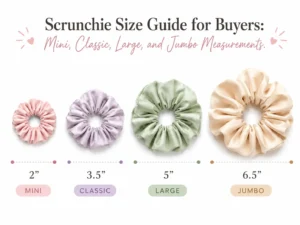
Provide fabric strip length and width, finished outer diameter, relaxed inner opening, and acceptable tolerances. Terms such as mini, classic, large, and jumbo are useful for merchandising but do not replace dimensions.
Target Hair Type and Use Scenario
State whether the product targets extra-fine, fine, average, thick, long, curly, coily, or children’s hair. Explain whether it is intended for daily ponytails, sleep, exercise, buns, decorative wrist wear, or use over another hair tie.
Required Tightness and Stretch Performance
Define the target wrap count and the ponytail bundle or mandrel used for approval. Provide a preferred tension description—gentle, balanced, or firm—but connect it to a sample and measurable working-force range.
| Purchase specification | Example buyer entry |
|---|---|
| Product | Classic satin custom scrunchie |
| Target user | Fine-to-medium adult hair; daily ponytail |
| Elastic construction | Knitted or braided option to be compared during sampling |
| Elastic width | 6 mm ± 0.5 mm |
| Elastic cut length | 18.5 cm before joining |
| Join | 1.5 cm flat overlap with approved stitch |
| Target use | Two wraps on approved medium test bundle |
| Durability | Pass approved cycle and recovery protocol |
| Reference | Golden sample CS-E02 and signed specification sheet |
Brands can review custom fabrics, elastic options, logo processes, packaging, sampling, and private-label production at Q&N Beauty and the custom hair accessories manufacturing page.
Case Study: Elastic Strategy at Slip and GIMME Beauty
Slip: Validate the Complete Wearing Experience
Slip offers skinny, large, and jumbo silk formats. Its product pages reference a study of more than 85 women aged 18–45 who switched from elastic or coil ties to a Slip silk skinny scrunchie for at least eight hours.
The lesson is to validate the finished combination of shell, elastic, size, and wear conditions rather than assuming silk alone guarantees performance.
GIMME Beauty: Match Construction to Hair Type
GIMME Beauty organizes products for fine or thinner hair, most hair types, and thick or curly hair, showing why one internal elastic specification should not be forced across an entire collection.
Brands can use coordinated colors while changing circumference, working tension, width, and shell volume by hair profile. Packaging should identify the intended user clearly.
Pros and Cons of Common Scrunchie Elastic Options
| Elastic option | Advantages | Limitations |
|---|---|---|
| Narrow braided elastic | Compact, firm response, suitable for mini styles | May narrow under stretch, roll, or feel concentrated |
| Knitted elastic | Soft hand, flexible, generally comfortable | Quality and recovery vary widely by construction |
| Woven elastic | Stable width, strong, resistant to rolling | Can be too stiff or bulky for slim scrunchies |
| Wide soft elastic | Distributes pressure and supports heavy shells | Requires a larger tube and may be visible through satin |
| Natural-rubber or latex-containing elastic | Strong extension and recovery when well made | Requires accurate material declarations and risk review for target markets |
| Latex-free synthetic elastic | Useful for latex-free positioning when verified | Performance depends on polymer and textile construction; claims need documentation |
Supplier names such as “premium elastic” or “high-strength elastic” are not technical specifications. Request composition information, construction type, width, thickness, working-force data, recovery results, and consistency records.
Expert Product-Development Checklist
- Define the hairstyle first. State hair type, ponytail size, activity, wear time, and intended number of wraps.
- Select width and length together. A wider band may need a different loop circumference to deliver the same comfort.
- Compare at least two elastic constructions. Prototype different tensions rather than selecting by appearance or price.
- Use the final fabric. Satin, cotton, velvet, organza, and terry cloth change the working geometry.
- Specify the join. Record overlap, stitch pattern, needle, and finished circumference.
- Measure working force and recovery. Do not rely only on maximum stretch.
- Test completed scrunchies. Include cycling, holding, comfort, twisting, washing, and aging where relevant.
- Approve a golden sample. Link the physical sample to a signed specification and inspection method.
Frequently Asked Questions
What elastic width is best for custom scrunchies?
Mini scrunchies often begin at 3–5 mm, classic styles at 5–8 mm, and large or heavy styles at 7–12 mm. The final width should be validated for holding force, comfort, twisting, and fabric bulk.
How long should elastic be for a scrunchie?
Development ranges are approximately 12–17 cm for mini, 15–22 cm for classic, 18–27 cm for large, and 25–40 cm for jumbo styles. Specify whether the number is cut length or finished joined circumference.
Is braided or knitted elastic better for scrunchies?
Braided elastic can provide a firm response in narrow widths, while knitted elastic often feels softer and more flexible. Neither is universally better. Compare recovery, working force, rolling, and comfort in the finished product.
Why does scrunchie elastic become loose?
Common causes include poor elastomer quality, repeated overextension, heat or chemical exposure, weak textile covering, permanent growth, and failure at the stitched overlap.
How much should scrunchie elastic stretch?
There is no universal percentage. The elastic must reach the target hair bundle for the intended wrap count while staying within a working range that preserves comfort and recovery. Record force at the chosen extension.
How do manufacturers test scrunchie elastic?
They can measure tension, elongation, recovery, cycle fatigue, joining strength, hair-holding performance, twisting, and wash or aging effects. ASTM D4964, ASTM D5278/D5278M, ISO 20932-3, and ISO 6330 can inform agreed procedures.
Does heavy fabric need stronger elastic?
Often it needs a wider or more stable elastic, but not always greater tension. The goal is to control shell bulk and twisting while maintaining comfortable hold. Lightweight jumbo organza may need less support than a smaller terry scrunchie.
Conclusion: Build Better Custom Scrunchies From the Inside
High-quality custom scrunchies begin with an elastic specification that connects width, cut length, joined circumference, stretch, working force, recovery, joining method, fabric weight, hair type, and wrap count.
Narrow elastic suits mini and skinny products when rolling and concentrated tension are controlled. Standard widths offer flexibility for classic collections. Wider elastic supports heavy fabrics and large shells, but may create unnecessary stiffness when selected only because the product looks oversized.
Future development will move toward hair-type-specific internal constructions, more transparent performance claims, documented latex-free options, recycled textile coverings, automated force measurement, and durability targets linked to real wearing scenarios. Brands that test completed products rather than approving elastic by hand feel will create more consistent comfort and longer-lasting hold.
Ready to develop your own scrunchie collection? Visit Q&N Beauty to discuss elastic samples, mini-to-jumbo sizing, custom fabrics, colors, logos, packaging, performance testing, and production quotations.
Sources and External Link Placements
- Grand View Research: Hair Accessories Market
- Grand View Research: U.S. Hair Accessories
- Statista: Worldwide Accessories Forecast
- Google: People-First Content Guidance
- Google: AI Search Optimization Guide
- ASTM D4964: Tension and Elongation
- ASTM D5278/D5278M-26
- ISO 20932-3: Narrow Fabric Elasticity
- ISO 6330:2021 Washing Procedures
- Traction Alopecia Review
- Slip Skinny Scrunchie Study Details
- GIMME Beauty Scrunchie Segmentation
- FTC Textile Labeling Guidance