The category is commercially important. Grand View Research estimates the global hair-accessories market at USD 27.2 billion in 2026, with hair elastics and ties accounting for 32.6% of the market in 2024. In the United States, elastics and ties represented 40.29% of the hair-accessories market in 2025. Statista projects USD 758.14 billion in 2026 revenue for the much broader worldwide accessories market; that figure is useful only as general consumer-spending context, not as a scrunchie market estimate.
This guide explains the main causes of stretch loss, compares elastic materials and constructions, shows how manufacturing decisions affect fatigue, and provides a practical testing and care framework. The suggested cycle counts and acceptance limits are development examples rather than universal legal standards. Buyers should validate them against product price, use scenario, hair type, and market claims.
Why Scrunchies Lose Their Stretch
Low-Quality Elastic Materials
Elastic fatigue begins at the material level. Inconsistent rubber or spandex content, weak textile covering, poor stabilization, or uneven yarn tension can create a band that feels acceptable when new but relaxes quickly under cycling.
Elastic textiles are viscoelastic. They show an immediate elastic response and a delayed response often described as creep or stress relaxation. This means a band may become longer while held under tension, even without breaking. When the polymer or fabric structure is poorly controlled, part of that deformation becomes permanent.
Excessive Stretch During Use
Consumers often stretch a scrunchie well beyond the extension used during product development. This happens when one specification is marketed for fine, medium, and very thick hair, or when a small scrunchie is expected to wrap around a large bun. Repeated extension near the material limit accelerates loss of force and permanent growth.
A durable design should operate within a validated working range. Maximum extension is a safety boundary, not the recommended daily-use position. If a loop reaches the target ponytail only when stretched close to failure, increasing the joined circumference or changing the elastic is more appropriate than accepting the risk.
Heat, Moisture, and Chemical Exposure
Textile aging research identifies heat, moisture, ultraviolet exposure, chemicals, and mechanical stress as degradation routes. Detergent, bleach, hair products, oils, chlorine, sweat, hot water, and tumble drying can affect the elastic, covering yarn, color, or joining seam.
Poor Sewing and Assembly
Assembly can damage good elastic. Needles may cut elastomer filaments. Excessive presser-foot pressure can crush the band. Operators may pre-stretch the elastic to speed insertion, creating uneven residual tension. A bulky knot or weak overlap may become the first failure point.
| Failure symptom | Probable cause | Corrective direction |
|---|---|---|
| Loop remains visibly enlarged | Permanent set, overextension, heat damage, or low recovery | Upgrade elastic and reduce working extension. |
| Scrunchie returns in size but feels weak | Force loss after cycling | Measure force recovery, not dimensions alone. |
| Elastic breaks near one point | Needle damage, poor join, or local abrasion | Inspect stitch, needle, overlap, and internal tube surface. |
| One side becomes longer | Uneven tension during insertion or twisted elastic | Standardize assembly and add an anti-twist checkpoint. |
| Failure after washing | Heat, detergent, shrinkage, or seam incompatibility | Validate the claimed care method on finished goods. |
Expert view: A scrunchie that has “not broken” can still have failed. Buyers should define failure as excessive permanent growth, unacceptable force loss, insecure hair hold, exposed elastic, damaged seams, or poor appearance.
How Materials Prevent Scrunchies from Losing Stretch
Rubber Elastic
Natural or synthetic rubber strands can deliver strong extension and recovery when protected by textile yarns. Performance depends on rubber quality, strand count, covering yarn, storage, and exposure to heat, oxidation, oils, and chemicals. Verify composition and any latex-free claim.
Spandex and Polyester Elastic
Spandex, or elastane, is a polyurethane-based elastic fiber capable of high reversible extension. It is commonly combined with polyester or nylon covering yarns that protect the core, influence hand feel, and help control the force-extension curve.
Braided, Woven, and Knitted Elastic
Braided elastic often becomes narrower when stretched. It is economical and useful in slim scrunchies, but can roll or concentrate pressure. Knitted elastic is generally soft and flexible, making it suitable for everyday and sleep-oriented products. Woven elastic tends to maintain its width and resist rolling, but may be too stiff or bulky for mini satin styles.
| Elastic construction | Long-term advantages | Durability risks | Best starting use |
|---|---|---|---|
| Braided | Compact, responsive, cost-effective | Narrows under stretch, may roll, quality varies | Mini and classic products after anti-twist testing |
| Knitted | Soft, flexible, comfortable over repeated wear | Low-grade versions may relax quickly | Classic, sleep, and fine-hair scrunchies |
| Woven | Stable width, strong, resistant to rolling | Can feel stiff and create visible bulk | Large, jumbo, terry, and heavy-fabric designs |
| Multi-yarn composite | Force can be distributed across many elastic elements | Complex construction needs supplier consistency | Performance-led and hair-type-specific collections |
ASTM D4964 covers tension and elongation testing of elastic fabrics with a constant-rate-of-extension machine. ASTM D5278/D5278M-26 covers narrow elastic fabrics under static loading. ISO 20932-3 provides methods for narrow-fabric elasticity. These standards help laboratories generate repeatable data, but the brand must still define the load, extension, conditioning, and acceptable change relevant to its finished scrunchie.
How to Choose the Correct Elastic Specification
Selecting the Right Stretch Ratio
Stretch ratio should be evaluated at the working position, not only at maximum extension. A useful calculation is:
Working extension (%) = (worn circumference − relaxed circumference) ÷ relaxed circumference × 100
If a joined elastic loop measures 18 cm and reaches 36 cm during a two-wrap application, it is operating at 100% extension. The development team should measure the force at that position and compare it before and after cycling.
Matching Elastic Width to Scrunchie Size
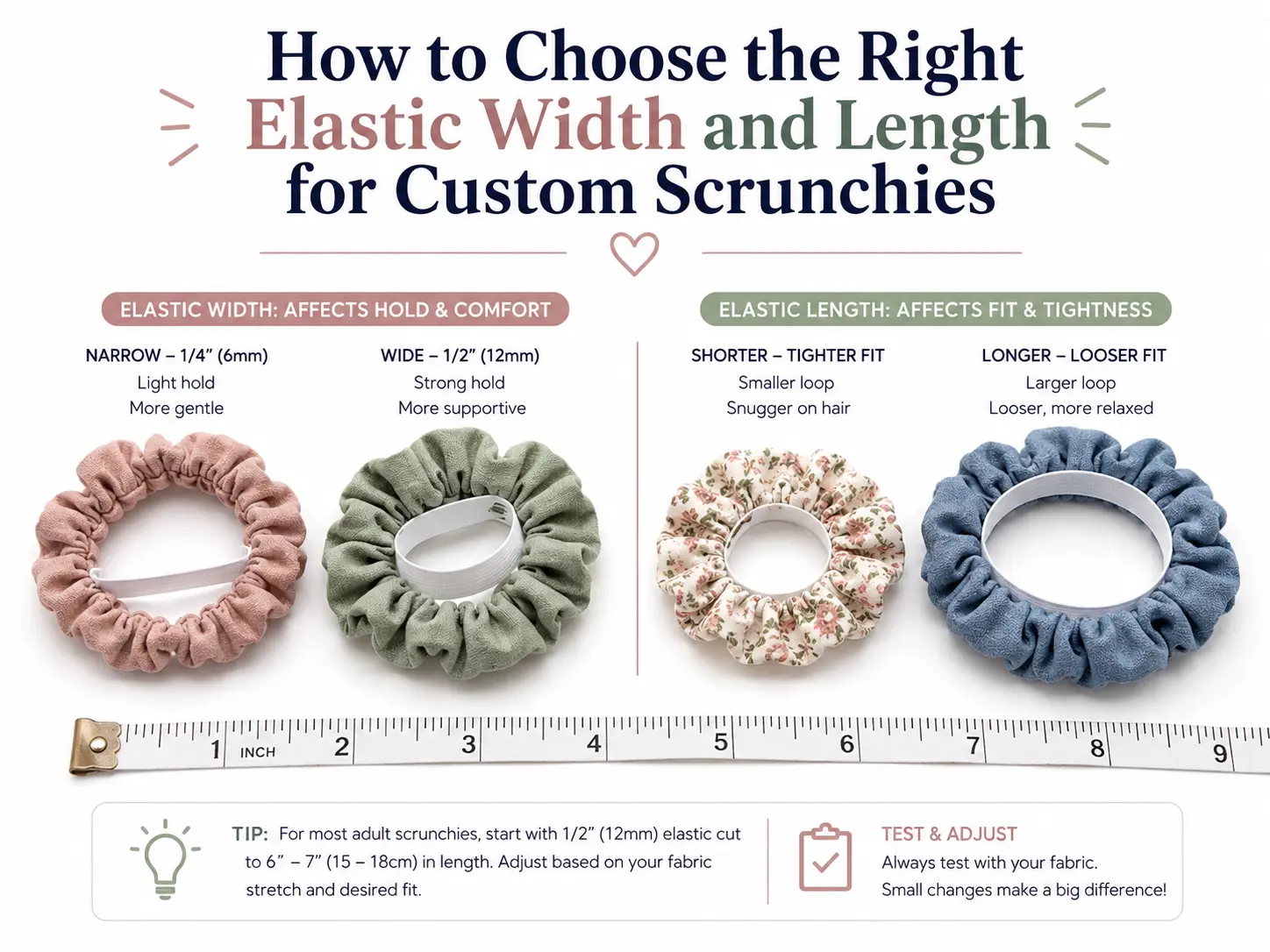
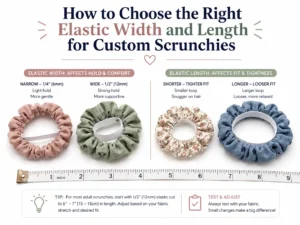
Mini styles often begin with 3–5 mm elastic. Classic scrunchies commonly use 5–8 mm. Large and jumbo styles may use 7–12 mm, especially when the shell is heavy. Width improves force distribution and twisting resistance, but an overly wide band can create stiffness and visible lumps.
Avoiding Elastic That Is Too Thin or Too Soft
Very thin elastic can cut into the hair bundle, twist inside the tube, or require high tension to hold. Very soft elastic can feel comfortable but need extra wraps, causing consumers to stretch it farther than intended. The best specification is the narrowest and softest option that still meets holding, recovery, and cycle requirements.
| Scrunchie type | Width starting range | Elastic design priority | Durability warning |
|---|---|---|---|
| Mini or skinny | 3–5 mm | Low bulk and controlled tension | Avoid repeated extreme extension on thick hair. |
| Classic | 5–8 mm | Balanced hold, comfort, and recovery | Do not use one loop length for every hair type. |
| Large | 7–10 mm | Stable force and reduced twisting | Account for heavier fabric and larger opening. |
| Jumbo/heavy fabric | 8–12 mm | Load distribution and join strength | Do not confuse visible size with required tension. |
Manufacturing Methods That Prevent Stretch Loss
Controlling Elastic Tension During Assembly
Elastic should be inserted in a relaxed, controlled state unless the approved process requires defined pre-tension. Use cut templates, automatic cutters, or length marks instead of hand-pulling different amounts during feeding.
Using Secure Elastic Joining Methods
A flat overlap with an approved zigzag, box, or multi-line stitch is repeatable and easy to inspect. It must resist pullout without creating excessive bulk. Knots are best limited to prototypes.
Preventing Needle Damage to the Elastic
Needle size, point type, stitch density, and thread tension can damage narrow elastic. Too many punctures in one small area may act like a perforation line. Conduct a join pull test and inspect failed samples to determine whether the elastic, thread, or stitch line failed first.
Allowing Enough Space Inside the Fabric Tube
| Production control | Inspection method | Reject condition |
|---|---|---|
| Elastic cut length | Measure before joining with no tension | Outside approved tolerance |
| Overlap and stitch | Use gauge and visual standard | Short overlap, skipped stitch, frayed edge, or excessive perforation |
| Twist check | Run fingers around the complete loop before closure | Band rotates or folds inside the tube |
| Tube clearance | Compare to approved golden sample | Elastic is trapped, compressed, or excessively loose |
| Finished recovery | Stretch to the approved fixture and release | Uneven gathers or permanent local extension |
Brands can review private-label materials, elastic options, sampling, packaging, and production support at Q&N Beauty and its custom hair accessories manufacturing page.
How Fabric Choice Influences Elastic Durability
Heavy Fabrics and Increased Elastic Load
Velvet, terry cloth, corduroy, fleece, and quilted fabrics add mass and compression resistance. A consumer must open the loop farther to wrap a bulky shell around the same ponytail. This increases the working extension and loading on the join.
Heavy designs may need a wider elastic, longer loop, lower gather ratio, or larger fabric tube. Strengthening the band without changing geometry can make the product uncomfortable while leaving the original overextension problem unresolved.
Rough Fabrics and Internal Friction
Raw seams, coarse fabric backs, exposed metallic yarn, and hardened adhesive can rub against the elastic during every stretch. Over time, the textile covering may abrade and expose the elastic core. Use clean seam finishes and keep glue away from the elastic path.
Fabric Shrinkage After Washing
If the shell shrinks but the elastic does not, the fabric may compress the loop and restrict movement. If the elastic loses force while the shell remains stable, the scrunchie may look normal but fail functionally. Pretest fabric shrinkage before approving the final elastic length.
ISO 6330:2021 specifies domestic washing and drying procedures, while ISO 5077 measures dimensional change. Test the care method intended for the product rather than an unrelated severe condition.
| Fabric | Effect on elastic system | Recommended response |
|---|---|---|
| Silk/light satin | Low load but reveals twists and lumps | Use flat joins and controlled tube width. |
| Organza/tulle | Large visual volume with low mass | Select elastic by hair type, not appearance. |
| Cotton/polyester | Moderate load; possible wash shrinkage | Prewash or test dimensional change. |
| Velvet/corduroy | High bulk and internal resistance | Increase clearance and validate working extension. |
| Terry/quilted fabric | High mass and moisture retention | Use stable width and test wet and dry recovery. |
Quality Tests to Prevent Scrunchies Losing Stretch
Repeated Stretch Cycle Testing
Cycle the finished scrunchie between its relaxed and defined working circumferences. Development checkpoints may include 100, 500, and 1,000 cycles, depending on price and expected life. Record breakage, growth, force loss, twisting, join damage, exposed elastic, and seam changes.
Record breakage, permanent growth, force loss, twisting, join damage, exposed elastic, seam opening, and changes in hair-holding performance. Cycle counts are internal targets unless a product specification or contract makes them mandatory.
Elastic Recovery Measurement
Measure the relaxed loop before testing, immediately after cycling, and after a defined recovery period. Also compare force at the approved working extension; a loop may regain its dimensions while losing holding force.
Permanent growth (%) = (post-test circumference − original circumference) ÷ original circumference × 100
Also measure force at the approved working extension before and after testing. Dimensional recovery without force recovery can create a scrunchie that looks normal on the table but slides in use.
Washing and Heat Exposure Testing
Test the care instruction the brand intends to publish. Compare hand wash, machine wash, line dry, flat dry, or tumble dry only when commercially relevant. ISO 6330 supports controlled laboratory comparisons.
Long-Term Wear Simulation
Hold the scrunchie on a standardized ponytail mandrel, release it, and evaluate recovery. Add movement, moisture, or perspiration when relevant. Human panels should record security, comfort, pulling, and removal.
| Test | Key measurement | Example brand acceptance logic |
|---|---|---|
| Cycle fatigue | Permanent growth and force loss | No breakage; changes remain within approved limits. |
| Static hold | Growth after extended time on a fixture | Product recovers after the defined rest period. |
| Hair-holding test | Slippage, wrap count, and comfort | Maintains the stated hairstyle for the claim duration. |
| Wash test | Recovery, shrinkage, seam and appearance | Passes the published care method. |
| Heat/humidity aging | Force and dimension change | No unacceptable deterioration under relevant conditions. |
| Join pull test | Failure force and failure location | Join survives normal-use loading with an approved margin. |
Common Production Mistakes to Avoid
Using One Elastic Specification for Every Scrunchie Size
A mini satin scrunchie and a jumbo terry scrunchie do not create the same working extension, fabric load, or consumer expectation. Reusing one elastic specification can make the mini painfully tight and the jumbo too loose.
Overstretching Elastic During Sewing
Pre-stretching changes the residual force and can create uneven gathers. It also makes the cut-length specification meaningless because operator technique becomes the real control. Feed elastic without tension unless a validated process requires a defined pre-extension.
Skipping Pre-Production Performance Tests
Color approval and appearance approval do not prove durability. Test pilot samples in the final fabric, elastic lot, stitch, and joining method before mass production. Retain an untested control and an approved golden sample.
| Mistake | Immediate appearance | Likely long-term result |
|---|---|---|
| One elastic for all sizes | Samples may look coordinated | Inconsistent comfort and recovery by size |
| Hand-pulled assembly | Uneven but sometimes hidden gathers | Variable loop circumference and early relaxation |
| No join test | Product appears complete | Breakage at overlap during repeated wear |
| Substitute fabric in testing | Fast sample approval | Unexpected bulk, friction, or shrinkage in production |
| No aged control comparison | Pass/fail based on hand feel | Force loss cannot be quantified |
Care Instructions That Help Extend Scrunchie Life
Washing Recommendations
Care must match the fabric and construction. Delicate satin, silk, velvet, or embellished scrunchies often need cool hand washing with mild detergent. Machine-wash claims should be validated in the labeled cycle.
Drying and Storage Recommendations
Air dry away from direct heat, reshape the gathers, and store the product fully dry and relaxed rather than stretched around containers or packaging inserts.
Avoiding Excessive Heat and Chemicals
Avoid hot dryers, radiators, styling tools, bleach, strong solvents, chlorine, dye, and concentrated hair chemicals unless the product has been tested for that exposure.
| Consumer action | Why it helps |
|---|---|
| Use the correct size for the hair bundle | Reduces routine overextension. |
| Rotate several scrunchies | Allows recovery time between wears. |
| Wash according to the labeled method | Limits avoidable heat and chemical damage. |
| Air dry in a relaxed shape | Avoids prolonged tension and high dryer temperatures. |
| Store away from direct sunlight and heat | Reduces unnecessary polymer and color aging. |
Case Study: Performance Positioning at Slip and GIMME Beauty
Slip: Define the Wearing Conditions Behind a Claim
Slip’s official pages cite a consumer perception study of more than 85 women aged 18–45 who switched from elastic or spiral ties to a Slip silk skinny scrunchie for at least eight hours. This is a brand-specific finished-product study, not a universal conclusion about silk.
The development lesson is to state the population, comparison product, wear duration, and tested claim. A statement such as “retained approved hold after 500 laboratory cycles” is more credible than “never stretches out.”
GIMME Beauty: Segment Elasticity by Hair Type
GIMME Beauty markets Bounce Back ties for fine, medium, thick, extra-fine, and long or curly hair. It describes a nylon, polyester, rubber-elastic, and spandex blend and acknowledges that ties change after repeated wear, supporting realistic hair-type segmentation rather than one universal construction.
Case-study takeaway: Long-term credibility comes from realistic claims, defined testing conditions, and product segmentation. Consumers are more likely to trust “designed and tested for fine hair” than an absolute promise that no elastic product will ever change.
Pros and Cons of Elastic Construction Options
| Option | Pros | Cons |
|---|---|---|
| Firm braided elastic | Compact, responsive, economical | Can roll, narrow under stretch, or create concentrated pressure |
| Soft knitted elastic | Comfortable, flexible, suitable for sleep and fine hair | Poor grades may lose force more quickly |
| Stable woven elastic | Resists rolling and supports heavy shells | Bulky or stiff in slim designs |
| Shorter loop | Dense gathers and stronger initial hold | Greater working extension and fatigue risk |
| Longer loop | Better for thick hair and lower extension per wrap | May require extra wraps and feel loose on fine hair |
| Higher-cost validated elastic | Better consistency and evidence for quality claims | Raises unit cost and requires supplier documentation |
Expert Buyer Checklist
- Define the target user. State hair density, ponytail circumference, hairstyle, activity, and wear time.
- Specify elastic construction. Record material declaration, width, thickness, cut length, overlap, and joined circumference.
- Set the working extension. Measure the real product during the intended number of wraps.
- Use final materials. Test the approved fabric, elastic lot, thread, stitch, and join together.
- Test care claims. Validate hand washing, machine washing, drying, heat, or moisture exposure before printing instructions.
- Retain standards. Keep a signed specification, golden sample, untested control, and laboratory report.
Frequently Asked Questions
Why do scrunchies lose their stretch?
Common causes include low-quality elastic, repeated overextension, heat, moisture, chemicals, poor recovery, needle damage, weak joining, fabric shrinkage, and internal abrasion.
Can a stretched-out scrunchie recover?
Some temporary growth may recover after rest or approved washing, but permanent polymer fatigue cannot be reliably reversed. Product-specific care should be tested before recommending heat or machine drying.
Which elastic lasts longest in scrunchies?
No construction is universally best. High-quality knitted, braided, woven, rubber, or spandex-based elastics can perform well when used within a suitable working range and protected by correct assembly.
How many stretch cycles should a scrunchie pass?
There is no universal requirement. Brands may use 500 or 1,000 cycles as development targets, but the correct number depends on price, expected life, use scenario, and contractual claims.
Does washing damage scrunchie elastic?
It can. Hot water, tumble drying, detergent, bleach, fabric shrinkage, and mechanical agitation may affect recovery or seams. Test the exact care method stated on the label.
Does thick fabric make a scrunchie wear out faster?
It can increase working extension, friction, and load. The risk can be reduced with a wider or longer elastic, lower gathering density, more tube clearance, and stronger joining.
How should manufacturers measure elastic recovery?
Record original circumference and force, cycle the finished product to a defined extension, then remeasure immediately and after a recovery period. Report both permanent growth and force loss.
Conclusion: Prevent Stretch Loss Through Better Engineering
To prevent scrunchies from losing stretch after repeated use, brands must control the complete elastic system. Material quality matters, but so do working extension, width, loop length, joining, needle selection, fabric weight, tube clearance, washing, and consumer use.
Braided elastic can be effective in compact designs. Knitted elastic can deliver a softer hand. Woven elastic can support heavy shells. None will perform consistently when stretched beyond its intended range or damaged during assembly.
Future products will use more hair-type-specific constructions, instrumented force testing, better supplier traceability, realistic durability claims, recycled covering yarns, and care instructions based on validated wash and aging programs. Brands that measure both dimensional recovery and holding-force recovery will produce scrunchies that feel reliable long after the first wear.
Ready to improve your scrunchie durability? Visit Q&N Beauty to discuss elastic options, mini-to-jumbo sizes, fabrics, custom colors, logos, packaging, performance testing, samples, and production quotations.