The commercial opportunity is substantial. Grand View Research reports that global clips and pins generated USD 5.66 billion in 2025 and could reach USD 10.50 billion by 2033, an 8.1% CAGR from 2026 to 2033. Statista’s USD 758.14 billion 2026 forecast covers the much broader accessories market and is included only as spending context.
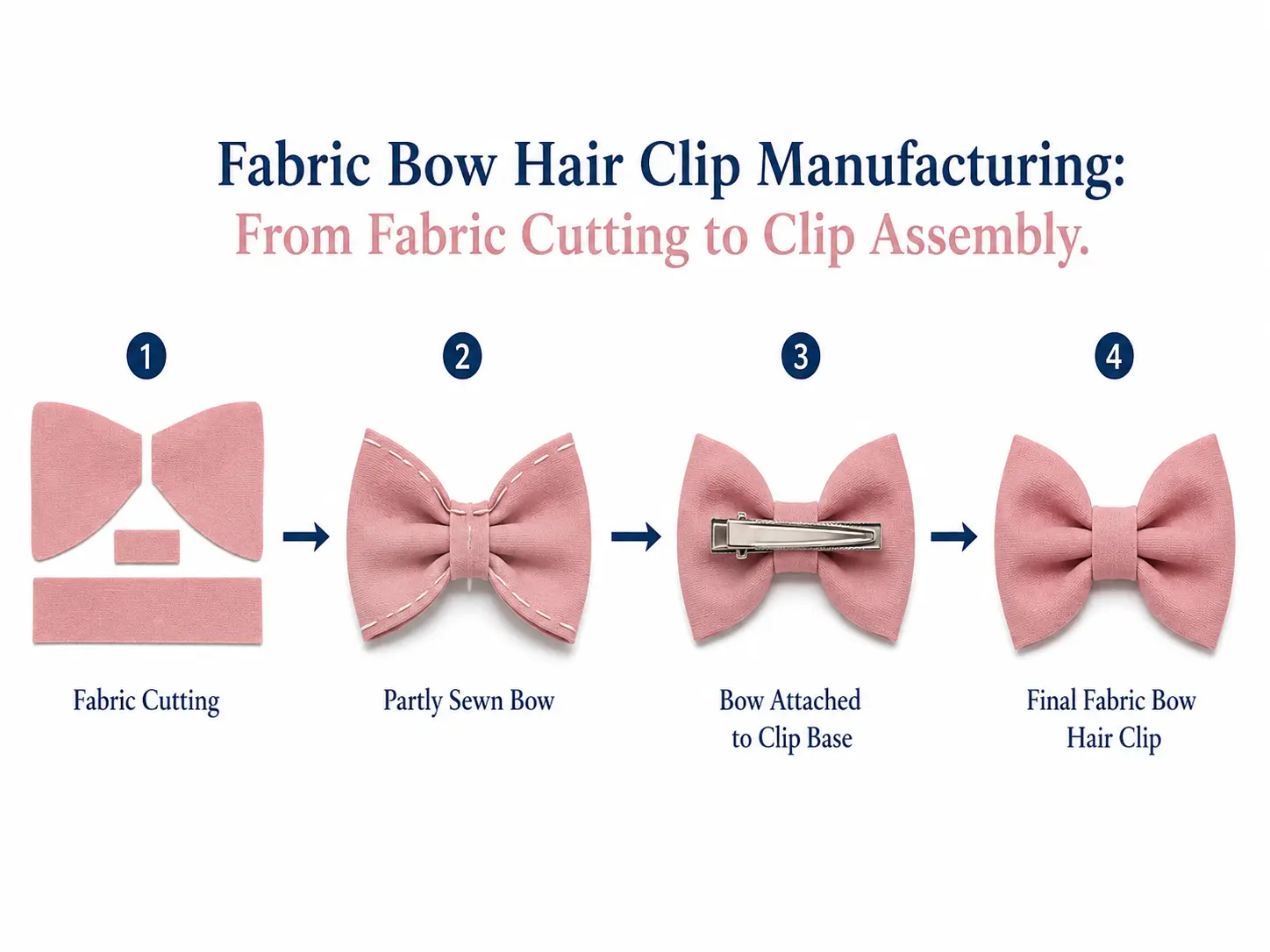
This guide explains the complete production route from product specification and fabric cutting patterns to sewing, shaping, clip preparation, attachment, inspection, and hair clip packaging. It also covers common failures, quality testing, safety considerations for children’s products, real brand examples, and the information buyers should confirm before placing a production order.
What Is a Fabric Bow Hair Clip?
Main Product Components
A fabric bow hair clip normally contains four functional groups: the bow body, the center wrap or knot, the clip mechanism, and the attachment system. Optional components include interfacing, padding, anti-slip strips, logo charms, embroidery, beads, sequins, labels, edge binding, and packaging cards.
Common Bow Shapes and Structures
Common structures include classic two-loop bows, sailor bows with tails, pinwheel bows, layered bows, knotted fabric bows, long-tail bridal bows, padded bows, and flat folded bows. Some are made from one continuous fabric panel. Others use separate loop, tail, and center pieces.
| Bow structure | Typical construction | Best clip base | Main control point |
|---|---|---|---|
| Classic two-loop bow | One sewn loop compressed at center | Alligator clip or barrette | Equal loop width and centered pleats |
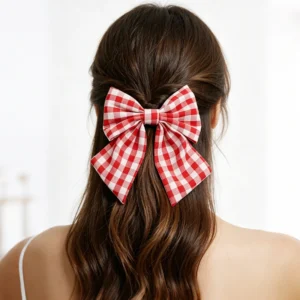
| Sailor bow | Loop body plus separate tail panel | Alligator clip or snap clip | Tail angle, length, and directional fabric |
| Layered bow | Two or more bow bodies stacked | Barrette or longer alligator base | Total weight and attachment depth |
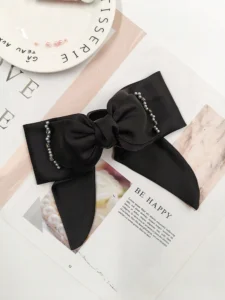
| Long-tail statement bow | Compact center with extended tails | Non-slip barrette | Balance, drape, and packaging protection |
| Padded bow | Fabric shell with foam or filling | Wide barrette or strong alligator clip | Consistent fill weight and clip capacity |
Expert principle: Select the clip base after defining the finished bow weight and hairstyle. A base that works for a small cotton bow may rotate or open under an oversized velvet design.
Step 1: Confirming Fabric Bow Hair Clip Specifications
Selecting the Bow Size and Shape
The specification should include finished width, finished height, tail length, center-band width, bow thickness, and acceptable tolerances. A drawing should mark the front, back, grain direction, fold lines, stitch lines, turning openings, and attachment position.
Choosing the Fabric and Clip Base
Fabric weight, drape, stretch, fraying, print scale, and heat sensitivity must match the structure. Satin reveals puckering and glue; cotton is stable and printable; velvet adds bulk; organza creates volume with low weight; padded fabrics need a stronger base.
Common bases include toothed alligator clip bases, snap clips, duckbill clips, and French-style barrettes. Define clip length, width, metal thickness, spring force, tooth shape, plating color, and whether the product needs an anti-slip hair clip feature.
Confirming Logo and Decoration Methods
Logo options include woven labels, printed labels, embroidery, foil printing, metal charms, engraved metal plates, rubber labels, and branded packaging cards. Decorations must not block the hinge, expose sharp edges, or create a detachable component without an appropriate retention test.
| Specification field | Example buyer instruction | Reason |
|---|---|---|
| Finished bow size | 120 × 90 mm, ±5 mm | Controls appearance and packaging fit. |
| Fabric | Poly satin, 95–110 gsm, approved color standard | Prevents substitution with a different drape or shine. |
| Clip | 60 mm toothed alligator clip, rounded tips | Defines holding function and safety finish. |
| Attachment position | Bow center aligned within 2 mm of clip center | Controls balance and symmetry. |
| Logo | 8 mm metal charm on center band | Controls placement and component scale. |
| Reference | Approved sample code FB-01 | Links written specifications to a physical standard. |
Step 2: Creating Patterns and Cutting Fabric
Developing the Cutting Pattern
The pattern maker converts finished dimensions into cut dimensions by adding seam allowances, turning allowances, fold depth, pleat consumption, and fabric-thickness compensation. Separate pattern pieces may be required for the loop, tails, center band, lining, interfacing, and clip cover.
Controlling Fabric Direction and Print Placement
Grain direction affects drape and distortion. Bias satin is harder to control, velvet requires nap direction, and stripes, checks, florals, or logos need a placement plan so both loops look intentional.
Cutting Fabric Manually or With Machines
Manual cutting suits samples and complex prints. Straight-knife cutting improves stacked-fabric productivity, die cutting gives repeatable small parts, and automated cutting supports large programs with stable digital patterns.
| Cutting method | Advantages | Limitations | Best application |
|---|---|---|---|
| Hand scissors or rotary cutter | Flexible and low setup cost | Operator variation and slower output | Samples, custom prints, small orders |
| Straight-knife cutting | Efficient for multiple layers | Layer shifting and edge distortion | Medium-to-large woven-fabric orders |
| Die cutting | Fast and highly repeatable | Tooling cost and limited design flexibility | Mini bows, center bands, repeated shapes |
| Automated cutting | Digital accuracy and marker efficiency | Higher setup and equipment requirements | Large programs with stable patterns |
Step 3: Sewing and Shaping the Bow
Sewing the Bow Body
Bow bodies are usually sewn inside out with a controlled turning opening. Needle, stitch length, thread, and seam allowance must suit the fabric. Fine satin needs a small needle; loose cotton may need edge finishing; stretch fabrics may need stabilization.
Turning and Pressing the Fabric
Creating Pleats, Knots, or Center Bands
Maintaining Consistent Bow Shape
Operators should compare each piece with a template before attachment. Control loop width, tail angle, center position, and height. A measurable bow symmetry inspection is more reliable than visual judgment alone.
| Sewing checkpoint | Inspection method | Common reject condition |
|---|---|---|
| Seam allowance | Gauge or marked machine guide | Variable width changes final bow dimensions. |
| Turning opening | Approved location and length | Opening is visible or difficult to close neatly. |
| Loop symmetry | Place on transparent template | Left and right endpoints exceed tolerance. |
| Pleat position | Folding jig or center marks | Bow leans, twists, or has unequal volume. |
| Pressing | Approved temperature and time | Shine marks, flattened pile, scorching, or distortion. |
ISO 13935-2:2026 provides a laboratory method for determining maximum force to seam rupture using a grab method. It is not a bow-clip-specific mandatory test, but it can inform seam-strength evaluation when a sewn bow structure or attachment carries load.
Step 4: Preparing the Hair Clip Base
Selecting the Correct Clip Size
The clip should support the bow without extending visibly. Small bows may use 30–50 mm bases, medium bows 50–80 mm, while heavy or oversized bows may need a long barrette or wider bonding plate. These are sampling ranges, not universal standards.
Check opening width, closing force, tooth alignment, plating consistency, edge smoothness, and hinge operation. The clip must remain functional after fabric covering and bow attachment.
Adding Ribbon or Fabric Covering
Ribbon or fabric covering can improve appearance and provide a bonding surface. Keep teeth, springs, and moving hinge zones clear unless the approved design specifically allows coverage.
Applying Anti-Slip Components
Fine-hair products may use silicone strips, textured ribbon, soft rubber coating, felt inserts, or closely spaced teeth. Grip components should improve retention without creating sharp transitions or lifted corners that catch hair.
| Clip base | Best feature | Main manufacturing risk | Recommended bow type |
|---|---|---|---|
| Toothed alligator clip | Strong grip and long contact zone | Fabric or glue blocking teeth and hinge | Classic, sailor, and children’s bows |
| Snap clip | Low profile and simple use | Covering fabric can restrict snap action | Mini and lightweight bows |
| French barrette | Wide platform and strong closure | Decoration weight can cause rotation | Statement, bridal, and layered bows |
| Duckbill clip | Long, sleek silhouette | Smooth jaws may require added grip | Long-tail and styling-inspired bows |
Step 5: Attaching the Bow to the Clip
Sewing Attachment Methods
Hand stitching or machine-assisted stitching can secure the bow around a covered clip or through designated holes in a base plate. Sewing provides visible mechanical retention and can perform well under heat. It requires enough accessible structure and must not interfere with the spring.
Adhesive Attachment Methods
Adhesive is fast and low-profile, but performance depends on fabric backing, metal finish, chemistry, surface preparation, application weight, pressure, and full cure.
Combining Sewing and Adhesive for Extra Strength
Hybrid attachment uses adhesive for positioning and stitching or a center wrap for secondary retention. It suits heavier, children’s, and premium products that need redundant security.
| Attachment method | Pros | Cons | Control test |
|---|---|---|---|
| Sewing | Mechanical security, heat resistance, visible construction | Slower and limited by clip design | Stitch inspection and attachment pull test |
| Adhesive | Fast, low profile, suitable for many shapes | Heat, aging, contamination, and cure risks | Cured pull/peel test and heat-aging screen |
| Center-band wrap | Conceals attachment and distributes load | Can restrict hinge if positioned poorly | Opening-cycle test and alignment inspection |
| Hybrid sewing plus adhesive | Redundant retention and controlled positioning | Higher labor and more process controls | Pull, cycle, and aging tests on finished pieces |
Step 6: Finishing and Quality Inspection
Trimming Threads and Removing Glue Marks
Trim threads without damaging seams. Remove glue strings, chalk, oil, and fingerprints only with a fabric-approved method because solvents may discolor fabric or weaken adhesive.
Checking Bow Symmetry and Position
Testing Clip Opening and Holding Strength
Cycle the finished clip to confirm that the bow, center band, ribbon, and adhesive do not restrict movement. Test closing force and slip resistance after decoration, not on the bare base alone.
Inspecting Sharp Edges and Loose Parts
Inspect burrs, exposed wire, sharp sealed edges, loose charms, rhinestones, and lifted grip strips. U.S. children’s-product classification determines applicable CPSC testing and CPC duties. CPSC excludes barrettes and certain grooming clips from the federal small-parts ban, but other safety, lead, coating, tracking, and labeling duties may still apply.
For the European Union, the General Product Safety Regulation has applied since December 13, 2024 and strengthens general safety, traceability, and online-sale responsibilities. Obtain a product-specific compliance assessment rather than relying on a generic checklist.
| Final QC item | Suggested check | Reject example |
|---|---|---|
| Dimensions | Measure against approved tolerance | Bow width, tail length, or center position outside specification |
| Appearance | Visual inspection under defined lighting | Stain, visible glue, shade mismatch, fraying, or severe wrinkles |
| Clip function | Open-close cycle and hair-hold test | Blocked hinge, weak spring, misaligned teeth, or sliding |
| Attachment | Product-specific pull and torque test | Bow loosens, rotates, or detaches |
| Safety finish | Hand and visual edge inspection | Burr, sharp point, loose wire, or exposed adhesive ridge |
| Packaging fit | Pack and transport simulation | Bow crushes, clip opens, card tears, or decoration rubs |
Common Fabric Bow Hair Clip Manufacturing Problems
Uneven Bow Shapes
Uneven shapes usually come from inaccurate cutting, shifting fabric layers, inconsistent seam allowance, unmarked pleats, variable center-band tension, or off-center clip attachment. Use hard patterns, not a finished sample alone, and add fold marks or jigs.
Visible Glue and Stains
Excess adhesive, incorrect nozzle size, rushed curing, dirty work surfaces, and rework create visible marks. Control adhesive by weight or dispensing time, separate clean and glue stations, and use protective trays for light-colored satin.
Loose Bow Attachments
Loose attachments may result from incompatible adhesive, insufficient bonding area, contaminated plating, inadequate cure, weak stitches, or a bow that is too heavy for the base. Increase bonding quality before simply adding more glue.
Fabric Fraying and Deformation
Fraying occurs when seam allowances are too narrow, fabric is loosely woven, heat sealing is inconsistent, or raw edges remain exposed. Deformation can result from high pressing temperature, incorrect storage, packaging pressure, or moisture.
| Problem | Root cause | Production solution |
|---|---|---|
| One loop larger | Cut or pleat variation | Use paired cut bundles and center-fold fixtures. |
| Bow rotates on clip | Off-center load or narrow attachment zone | Center the weight and increase stable contact area. |
| Glue visible at center | Over-application or pressure before skin formation | Calibrate dispenser and define assembly timing. |
| Satin puckers | Needle, thread tension, or pressing problem | Use finer needle, balanced tension, and lower heat. |
| Edges fray after wear | Unfinished raw edge or insufficient seam allowance | Enclose, bind, overlock, or safely seal the edge. |
| Clip stops opening fully | Center band or adhesive enters hinge zone | Mark a no-bond clearance area on the assembly jig. |
Packaging Fabric Bow Hair Clips for Shipment
Attaching Clips to Display Cards
Display cards support branding and retail presentation, but the slot design must match the clip. A card that is too thick can overstretch a snap clip. A narrow slot can scratch plating. A large bow may need two slots or a secondary tie to prevent rotation.
Protecting Bow Shape During Packing
Bows should be packed in their natural shape. Avoid stacking heavy cartons directly on soft loops. Use tissue support, shallow trays, dividers, individual pouches, or formed inserts when necessary. Conduct a packed-drop and vibration simulation before shipment.
Choosing Retail and Gift Packaging
Options include display cards, paper sleeves, reusable pouches, window boxes, gift boxes, and multi-clip trays. Packaging must protect the shape and carry required traceability, warning, age, material, and care information where applicable.
| Packaging type | Advantages | Limitations | Best use |
|---|---|---|---|
| Display card and bag | Economical, visible, easy to hang | Limited crush protection | Mini and classic retail clips |
| Shallow paper box | Better shape protection and premium feel | Higher cost and shipping volume | Large bows, gifting, bridal products |
| Reusable pouch | Travel-friendly and value-adding | May compress structured bows | Soft bows and premium collections |
| Compartment tray | Prevents movement in multi-piece sets | Requires accurate tooling or die lines | Children’s sets and coordinated collections |
Case Study: Two Bow Hair Clip Market Strategies
Lele Sadoughi: Premium Scale, Non-Slip Function, and Protective Storage
Lele Sadoughi’s official pages show a size ladder from 5 by 5.5-inch classic bows to a 15 by 8-inch poly-satin bow. Products use non-slip barrette closures, logo charms, spot-clean care, and, for some styles, a resealable pouch.
Mimi & Lula: Mini Fabric-Covered Clips and Clear Age Positioning
Mimi & Lula sells sets using 3 cm fabric-covered alligator clips, warns that selected products are unsuitable for children under 36 months, and recommends 4–5 cm alligator clips when stronger hold is needed.
Case-study takeaway: Premium adult bows compete through scale, material, non-slip function, and presentation. Children’s sets compete through repeatability, secure small-component assembly, age-appropriate communication, and pack value. Both require exact engineering behind the visual design.
Pros and Cons of Fabric Bow Clip Manufacturing Methods
| Method | Pros | Cons |
|---|---|---|
| Fully sewn bow body | Clean edges, durable structure, premium appearance | More labor and turning time |
| Folded and bonded bow | Fast production and simple tooling | Visible glue, heat sensitivity, and weaker long-term structure |
| Hand pleating | Flexible for complex shapes and small orders | Higher variation without jigs |
| Machine or fixture-assisted pleating | Better symmetry and scale | Setup cost and less flexibility |
| Adhesive-only attachment | Fast and low profile | Bond aging and cure-control risk |
| Hybrid sewn-and-bonded attachment | High security and positioning accuracy | Higher labor and more inspection steps |
Expert Buyer Checklist
- Define the wearer and hairstyle. State age group, hair density, hairstyle, wear duration, and required grip.
- Provide complete dimensions. Include bow width, height, tails, center band, clip size, and tolerances.
- Approve final materials. Confirm fabric weight, drape, print, interfacing, clip plating, anti-slip component, and adhesive.
- Define the attachment system. Specify sewing, adhesive, hybrid construction, cure conditions, and no-bond hinge zones.
- Set measurable QC criteria. Include symmetry, dimensions, clip cycles, hair hold, attachment strength, sharp-edge inspection, and appearance.
- Complete market-specific compliance review. Confirm intended-age classification, testing, certification, labeling, traceability, and chemical requirements.
- Retain a golden sample. Link the approved physical product to the signed technical specification and inspection report.
Brands can review materials, clip bases, logo methods, private-label development, sampling, packaging, and production support at Q&N Beauty and its custom hair accessories manufacturing page.
Frequently Asked Questions
How are fabric bow hair clips manufactured?
The process includes design confirmation, pattern development, fabric cutting, sewing, turning, pleating, center-band construction, clip preparation, bow attachment, finishing, functional testing, and protective packaging.
What is the best clip base for a fabric bow?
Toothed alligator clips work well for small and medium bows. Snap clips suit lightweight mini designs. French barrettes provide a wider platform for large or statement bows. The best base depends on bow weight, hairstyle, and grip requirement.
How are bows attached securely to hair clips?
Manufacturers use stitching, adhesive, center-band wrapping, or a hybrid method. Heavy or children’s products often benefit from redundant attachment, followed by product-specific pull, cycle, and aging tests.
Which fabrics are best for bow hair clips?
Satin creates fluid luxury bows, cotton provides stability and print clarity, velvet adds texture, and organza creates volume with low weight. The structure and clip strength must be adjusted for each fabric.
How do manufacturers keep fabric bows symmetrical?
They use accurate paired patterns, grain and print marks, fixed seam allowances, pleating jigs, center lines, shape templates, and measurable left-to-right tolerances.
How should bow hair clips be tested?
Finished clips should be checked for dimensions, symmetry, attachment security, opening cycles, holding performance, sharp edges, loose components, fabric damage, adhesive aging, and packaging deformation.
Are children’s bow hair clips subject to special safety requirements?
Potentially. Requirements depend on intended age, design, components, marketing, and destination. In the United States, children’s products subject to applicable CPSC rules may require third-party testing and a Children’s Product Certificate. EU products are also subject to general product-safety and traceability obligations.
Conclusion: Build Fabric Bow Hair Clips as Systems
Reliable fabric bow hair clip manufacturing requires control from the first drawing to the final shipping carton. The bow body, center band, clip base, anti-slip component, attachment method, finishing process, and packaging must be designed as one system.
Accurate patterns create consistent loops. Controlled sewing and pressing preserve shape. The correct clip supports the bow without excessive weight or blocked movement. A validated attachment method prevents rotation and separation. Objective inspection catches symmetry, glue, edge, holding, and packaging failures before shipment.
Future collections will use more automated cutting, digital pattern grading, lightweight statement structures, recycled and certified fabrics, measured grip performance, lower-visibility attachment systems, and packaging designed through transport simulation. Brands that publish real dimensions, materials, care, and safety information will also build stronger trust in both traditional and AI-supported search experiences.
Ready to develop a custom bow-clip collection? Visit Q&N Beauty to discuss bow patterns, fabrics, alligator clips, barrettes, anti-slip options, custom logos, samples, testing, packaging, and production quotations.