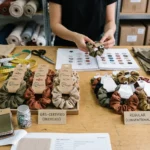
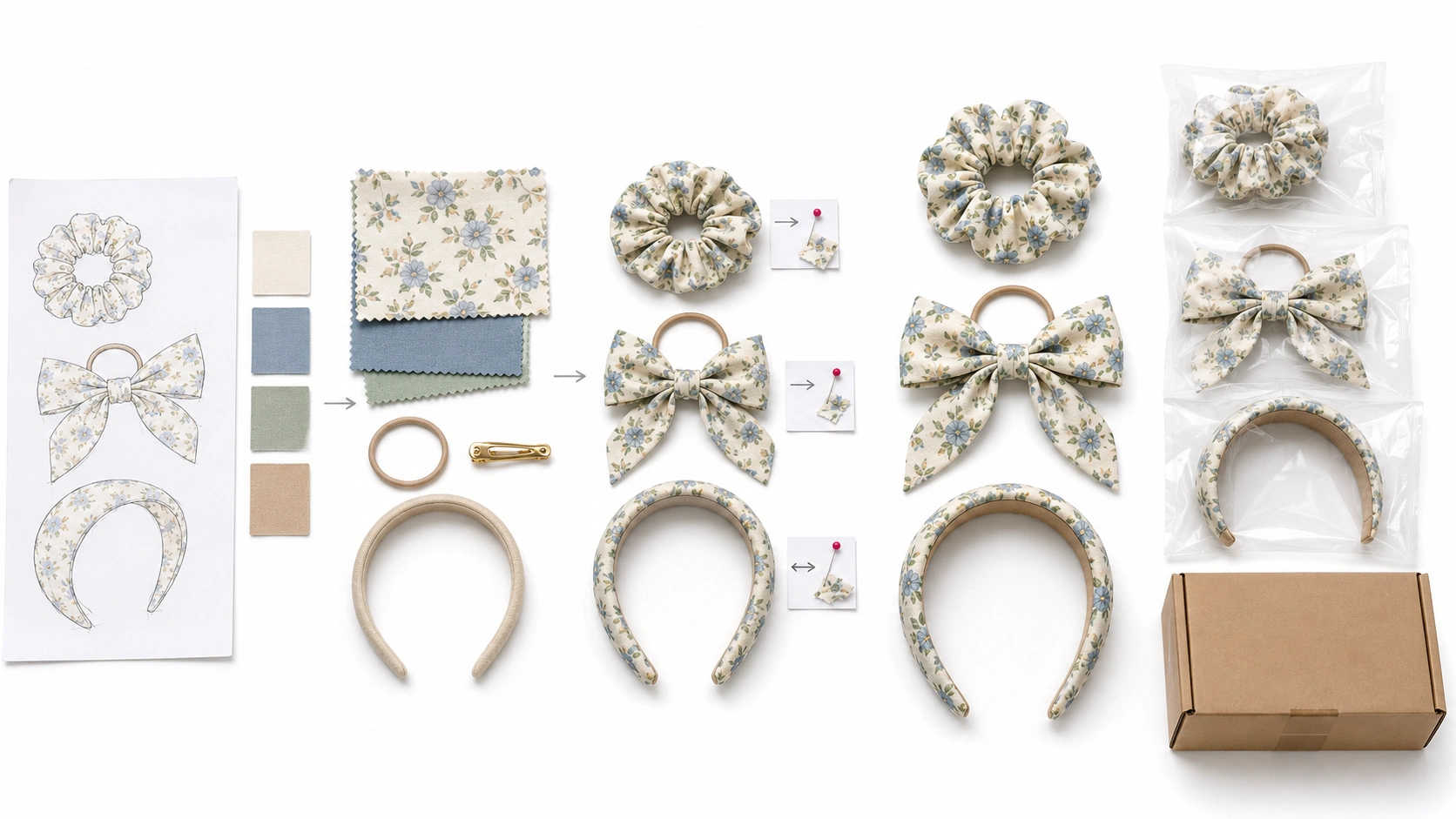
MOQ for custom hair accessories is rarely one simple factory rule. A supplier may be able to sew a limited quantity of scrunchies, yet the selected fabric mill may require more custom-dyed material. A logo label, plated clip, printed card, or gift box can have a different production minimum. If buyers compare only the headline MOQ, they may face unused materials, fragmented SKUs, higher unit costs, delayed packaging, or inventory that sells unevenly.
This guide explains where minimums come from, how they change, and how brands can negotiate realistic orders without weakening quality.
Before fixing your assortment, review Q&N Beauty’s custom hair accessories development process or submit your proposed products, colors, and quantities for an initial manufacturability and MOQ review.
How MOQ for Custom Hair Accessories Is Really Calculated
Finished-Product MOQ, Material MOQ, Process MOQ, and Packaging MOQ
Minimum order quantity is the smallest commercially workable quantity under a defined specification. It can originate at several supply-chain stages, so buyers should ask which minimum controls the quotation.
| MOQ layer | What creates it | Hair accessory example | Main buyer risk | Possible response |
|---|---|---|---|---|
| Finished product | Line setup and efficient production | One scrunchie construction per color | Too many small production runs | Consolidate colors or repeat one base |
| Material | Mill, dye house, or stockist minimum | Custom velvet or printed satin | Unused fabric or surcharge | Use stock color or share fabric across SKUs |
| Component | Hardware or trim supplier batch | Custom spring, barrette, pearl, or insert | Excess parts and cash tied up | Choose an existing approved component |
| Process | Printing, dyeing, plating, or tooling setup | Pantone plating or placement print | Setup cost concentrated in few units | Use a standard finish or repeat artwork |
| Packaging | Print conversion and packing efficiency | Custom card, pouch, or gift box | Packaging minimum exceeds product quantity | Standardize packaging across the collection |
Why One Project Can Have Several Minimum Order Requirements
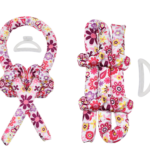
In a heatless curling set, the fabric tube, internal core, scrunchies, label, instructions, pouch, and box may use different processes. Final assembly is only one minimum.
Request the MOQ per finished SKU, color, custom material, logo, and packaging item. Document whether excess materials must be purchased, stored for a defined period, used later, or charged to the current project.
MOQ, Minimum Order Value, and Packing Multiples Are Not the Same
MOQ measures units, minimum order value sets a monetary threshold, and packing multiples control inner-pack or carton quantities. A premium item may support a lower unit quantity, while a low-value basic may require more. Carton multiples are logistical, not manufacturing minimums.
Identify all three before negotiating so the final quantity is not unexpectedly rounded for packing or commercial reasons.
Plan the Market, Collection, and SKU Structure Before Requesting MOQ
Match the First Order to the Sales Channel and Demand Evidence
A first order should reflect the channel. A gift-with-purchase program may use one color and fixed campaign volume; a retailer may forecast several colors by store; a direct-to-consumer brand carries its own inventory risk.
Estimate demand from sales, wait lists, retailer commitments, comparable products, or preorders. Do not order solely to unlock a lower unit price; consider sell-through, storage, markdowns, and cash exposure.
Calculate Quantity Per Style and Color, Not Only the Total Order
Factories plan by SKU or by groups sharing construction and materials. An order of 1,200 pieces divided among four products, three colors, and two logo versions becomes 24 small SKUs, each needing separate handling and control.
Build a matrix of style, color, material, logo, packaging, and quantity. Ask which combinations can run together and which retain independent minimums.
Build a Focused Launch Assortment Without Losing Commercial Variety
Variety does not require different engineering. One scrunchie pattern, headband base, or clip body can support coordinated fabrics, colors, or decorations while reducing changeovers.
Start with a hero product, limited supporting products, and a disciplined palette. Expand after sales evidence rather than spreading the first budget across unproven combinations.
How Product Type Changes Custom Hair Accessories MOQ
Scrunchies, Hair Bows, Fabric Clips, and Heatless Curling Sets
Sewn-product minimums reflect fabric availability, cutting yield, line setup, branding, and packaging. Scrunchies add elastic and gathering variables; bows add layered cutting, folding, center wrapping, and clip attachment.
For heatless curling sets, confirm whether MOQ applies to complete sets or every included piece. Multiple fabrics or colors may each retain a material minimum.
Padded Headbands, Barrettes, and Claw Clips
Padded headbands combine a base, padding, fabric, wrapping, and end finishing. Existing profiles require less development; pleating, knots, braids, motif placement, and hand decoration make small runs less efficient.
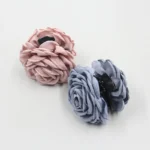
Existing barrette or claw-clip bodies need fewer development steps. A unique claw clip may require a mold, material trial, color setup, hinge validation, polishing, and inspection, making tooling and component batches the controlling minimum.
Pros and Cons of Stock Platforms, Modified Designs, and Fully Custom Products
| Development route | Customization level | Advantages | Limitations | MOQ impact | Recommended use |
|---|---|---|---|---|---|
| Stock platform | Existing shape, selected colors, simple branding | Faster evaluation and fewer setup variables | Lower exclusivity | Often the most flexible route | Market tests and basic collections |
| Modified platform | Existing base with new fabric, trim, or decoration | Balances identity and manufacturing stability | Some material or process minimums remain | Moderate and specification dependent | Private label collections |
| Fully custom sewn item | New pattern, dimensions, materials, and branding | Greater design control | More sampling and line setup | Driven by fabric and production efficiency | Distinctive brand products |
| Custom-molded item | New claw-clip or component geometry | Strongest structural differentiation | Tooling, validation, and higher commitment | Driven by mold and component batch | Proven programs with repeat potential |
Buyers can browse the customizable hair accessory categories to compare which product platforms may support a focused first collection.
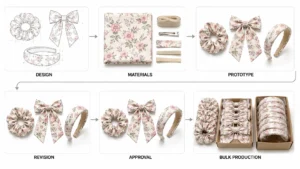
Material and Component Minimums Buyers Must Confirm
Silk, Satin, Velvet, Cotton, Organza, Nylon, and Terry Cloth
Fabric MOQ changes between available stock, reserved colors, custom dyeing, and printing. Composition, width, weight, finish, and cutting yield determine consumption.
Silk requires shade, handling, and yield control; polyester satin varies by weight and finish. Velvet has directional pile, organza and chiffon need edge control, cotton and linen may vary in shrinkage, and terry or nylon introduces different bulk and stretch.
Approve composition, relevant weight or thickness, color, hand feel, and a physical swatch. The source affects MOQ and repeat-order consistency.
Elastic Bands, Clips, Inserts, Padding, Springs, and Decorations
Components can control the order. Specify scrunchie elastic and recovery; headband base, pressure, padding, and profile; and clip dimensions, relevant metal thickness, spring tension, alignment, holding strength, teeth, plating, and edge control.
Pearls, rhinestones, wires, logo plates, and centers may be stock or custom. Custom pieces can add mold, plating, color, or attachment minimums. Confirm unused-component charges and tooling ownership.
Custom Dyeing, Pantone Colors, Printing, and Dye-Lot Control
A Pantone number is a target, not an identical result across fabric, plastic, metal, paper, and screens. Dyeing adds lab dips and batch control; printing adds artwork, strike-offs, repeat dimensions, direction, and placement rules.
If exact color is essential, plan several products around one custom material; otherwise compare stock colors. Approve a physical production-substrate standard and a dye-lot review method.
How Branding and Packaging Affect Private Label Hair Accessories MOQ
Compare Woven Labels, Embroidery, Heat Transfer, and Metal Logos
Branding has its own setup. Woven labels require weaving and cutting; embroidery depends on conversion, stitch count, backing, and stability; heat transfer needs suitable film, surface, adhesion, and curing; metal plates add tooling, plating, and attachment.
For a lower-risk first order, a standardized woven label or branded retail card may be more flexible than a custom metal part. The decision should follow durability, appearance, target price, intended age, and branding priority—not MOQ alone.
Retail Cards, Printed Bags, Gift Boxes, Barcodes, and Warning Labels
Packaging converters often work with printed sheets, molds, or production batches. A printed retail card may have a different minimum from a rigid gift box or reusable pouch. Finishes such as foil, embossing, windows, inserts, and specialty papers can add setup and waste. Barcode labels may be digitally produced in smaller batches, but each SKU still requires accurate data and line control.
Confirm individual packaging, retail display method, pack quantity, carton configuration, labeling, barcodes, country-of-origin information, and warnings before placing the order. Packaging should also protect the product: claw clips need scratch and tooth protection, while padded headbands should not be compressed out of shape.
When Shared Branding Elements Can Consolidate Minimums
One label design, card size, pouch, or carton format can sometimes serve several coordinated products. This can improve purchasing efficiency and reduce packaging leftovers. However, colors or styles cannot be combined automatically if they use different materials, print runs, product constructions, or legal information.
Ask the supplier for a consolidation map showing which components can be shared. A claim such as “mixed colors accepted” should specify the minimum per color, the total minimum, available materials, and whether the unit price changes.
Sampling and Mass Production: Lock the Specification Before Ordering
Prepare Reference Photos, Design Drawings, Artwork, and a Tech Pack
A reference photo starts the conversation but does not define an MOQ. Prepare front, back, side, and open views where relevant, finished dimensions, bill of materials, construction, fabric details, elastic or clip specifications, padding profile, Pantone colors, artwork, logo size and position, packaging, intended market, and quantity per SKU.
Ask the manufacturer to mark every assumption. If the fabric source, clip body, logo process, or box construction is still unknown, the initial MOQ should be described as preliminary and subject to specification review.
Evaluate the Sample and Approve a Sealed Bulk Standard
- Measure the finished sample using agreed measurement points.
- Confirm material, shade, print placement, hand feel, and construction.
- Test elastic recovery, headband comfort, clip tension, holding strength, hinge action, or set function as relevant.
- Inspect stitching, edges, glue, scratches, plating, and decoration attachment.
- Fit the product into the proposed retail and shipping packaging.
- Record revisions and approve a sealed sample or signed specification for bulk.
Mid-project CTA: Send your design drawing, reference images, preliminary tech pack, and SKU quantity matrix through the Q&N Beauty project inquiry page. The team can identify which minimum comes from the product, material, branding, or packaging before sampling begins.
Understand How Late Changes Reset MOQ, Cost, and Lead Time
Changing the fabric after the lab dip, adding a new logo color, replacing a stock clip with custom plating, or resizing the retail card can create a new supplier minimum. It may also require another sample or compliance review. Freeze the bill of materials, artwork versions, dimensions, packaging, and quality criteria before bulk material booking.
Require written change control. Every proposed substitution should identify the reason, visual or functional effect, price effect, revised MOQ, testing implications, and delivery impact.
Quality Control and Compliance Do Not Disappear at a Lower MOQ
Define Product-Specific Inspection Standards and Common Defects
| Product area | Critical checks | Common risks | Preventive document |
|---|---|---|---|
| Scrunchies and fabric items | Dimensions, seams, gathering, elastic recovery | Open seams, loose threads, weak recovery | Measurement and sewing standard |
| Headbands | Profile, padding, symmetry, pressure, end finish | Uneven shape, excessive pressure, exposed base | Approved profile and sealed sample |
| Clips and barrettes | Alignment, tension, holding function, edges | Burrs, weak spring, scratches, tooth damage | Component and functional standard |
| Decoration | Position, attachment, glue, plating | Loose parts, glue marks, discoloration | Placement and attachment criteria |
| Packaging | SKU, barcode, quantity, pack protection | Mix-ups, crushed cards, missing labels | Approved pack sample and packing list |
A lower production quantity may reduce the number of pieces inspected, but it does not reduce the need for clear standards. Agree incoming-material checks, first-piece approval, in-line controls, final inspection, and how critical defects are handled. Inspection scope should match the product risk and buyer requirements.
Plan REACH, CPSIA, Prop 65, UK Product Safety, and Market Documentation
Compliance is determined by product classification, intended age, construction, materials, market, and sales claims—not by order size. For the United States, the CPSC guidance on children’s products explains how products primarily intended for children 12 or younger are distinguished from general-use products and when third-party testing and a Children’s Product Certificate may apply.
For EU programs, the European Commission states that the General Product Safety Regulation has applied since December 13, 2024. Buyers should establish product-safety, risk-assessment, traceability, responsible-economic-operator, labeling, and online-offer requirements for the specific route. ECHA also explains that REACH restrictions may apply to substances in articles, including relevant materials, coatings, plastics, adhesives, and finishes.
For California, Proposition 65 is an exposure-warning framework, not a universal certificate. The official OEHHA business guidance should be used to assess relevant listed chemicals and exposure. UK buyers should specify Great Britain or Northern Ireland so the applicable product-safety route can be reviewed. Final test scope is to be confirmed after sample evaluation with a qualified laboratory or compliance specialist.
Assess Small Parts, Sharp Edges, Coatings, and Children’s Product Risks
Children’s bows and clips may include small ornaments, metal components, rhinestones, pearls, or decorative centers. Intended age, attachment strength, foreseeable use, and whether parts can detach must be evaluated. CPSC’s small-parts guidance explains the U.S. ban for covered products intended for children under three and related choking-hazard provisions.
Also review sharp points and edges, accessible lead and restricted substances, coatings, metal finishes, flammability where applicable, tracking labels where applicable, and required packaging warnings. Do not apply toy rules automatically to every hair accessory, but do not assume a small order or an age label removes legal obligations.
Negotiate MOQ Through Cost, Lead-Time, and Inventory Planning
Why Higher Volume May Reduce Unit Cost but Increase Business Risk
More units can spread pattern work, tooling, material setup, line changeovers, and packaging development. That can lower unit cost. It does not guarantee a better commercial outcome. Unsold colors, storage, insurance, handling, markdowns, damage, and obsolete packaging can erase the saving.
Evaluate contribution margin and cash exposure by SKU. A higher MOQ is sensible when demand is supported and the item has repeat potential. It is dangerous when the main reason for ordering is a visually attractive price tier.
Practical Ways to Request a Lower MOQ Without Lowering Quality
| Strategy | How it helps | Tradeoff | Best application | Question to ask |
|---|---|---|---|---|
| Use stock materials | Avoids custom mill or dye batch | Less exact color control | Market tests | Which approved colors are available? |
| Share one material | Combines consumption across products | Collection uses a narrower palette | Coordinated sets | Can these SKUs use one fabric lot? |
| Use existing components | Avoids molds or special hardware | Less structural exclusivity | Clips and headbands | Which bases are production-ready? |
| Simplify branding | Reduces logo setup | Branding may be less prominent | First private label run | Can one label serve all SKUs? |
| Standardize packaging | Combines print and pack quantities | Less product-specific presentation | Multi-SKU launches | Can one card format use variable stickers? |
| Pay a small-run surcharge | Covers inefficient setup transparently | Higher unit cost | Demand validation | What cost is the lower MOQ covering? |
Do not reduce quality specifications merely to reach a smaller run. Weak elastic, thin clips, poor attachment, or inadequate packaging can make a test order produce misleading customer feedback. Keep the customer experience stable and simplify variety or customization first.
Compare Landed Cost, Inventory Exposure, and Reorder Flexibility
Compare more than the EXW or FOB unit price. Include tooling, sampling, packaging, testing, inspection, freight basis, duties and taxes where known, destination handling, storage, and likely markdowns. Confirm carton size and gross weight after the pack-out is approved.
Ask about repeat-order rules. Can leftover custom fabric or labels be stored? For how long and under what conditions? Will a repeat order use the same price and MOQ? Can the supplier reproduce the original color and component? A practical reorder path may be more valuable than the lowest opening quote.
Illustrative Product Development Scenario: Simplifying a Multi-SKU Launch
Illustrative Product Development Scenario: A new brand plans three accessory types in four colors, creating twelve SKUs. Each uses different fabric and packaging. Rather than forcing the factory to treat the total as one MOQ, the buyer selects two hero colors, applies the same satin to the scrunchie and bow, uses one woven label, and standardizes the card size. The other colors move to a second release after sell-through data is available.
This is not a customer case. It demonstrates how design and SKU decisions can reduce separate minimums while preserving a coherent collection.
Frequently Asked Questions About Custom Hair Accessories MOQ
What Is a Typical MOQ for Custom Hair Accessories?
There is no reliable universal MOQ. It varies by product, material source, color, construction, logo method, packaging, factory setup, and quantity per SKU. Ask for the minimum at each layer and request a quotation based on your complete specification.
Can a Hair Accessories Manufacturer Negotiate MOQ?
Often, but negotiation must solve the cost or supply constraint. Options may include stock materials, existing components, fewer colors, shared packaging, a small-run surcharge, or purchasing excess custom material. A supplier cannot always negotiate away a mill, mold, or packaging-converter minimum.
Does a Higher MOQ Always Mean a Lower Unit Price?
No. Volume can spread setup, but fabric consumption, hand assembly, required testing, complex packing, and freight remain. The lowest unit price may also create more inventory risk. Compare total landed cost and expected sell-through.
Can Different Colors or Styles Be Combined to Meet MOQ?
Only when the factory and upstream suppliers can run them efficiently. Styles may combine if they share fabric, components, logo, or packaging, but each color or construction can still have a minimum. Require the allowed mix and any price effect in writing.
How Much Should a New Hair Accessory Brand Order First?
Order against evidence such as retailer commitments, preorders, comparable sales, or a defined test plan. Start with focused SKUs and enough stock to measure demand without creating harmful cash or storage exposure. The exact quantity is a commercial decision, not a universal manufacturing formula.
Evaluate the Manufacturer, Prepare for Future Sourcing, and Take Action
Supplier Questions That Reveal the Real Source of MOQ
- Is the quoted MOQ per order, product, construction, color, logo, or packaging design?
- Which minimum comes from the factory and which comes from an upstream supplier?
- Can approved stock materials or existing components lower the minimum?
- Can several SKUs share fabric, labels, cards, or cartons?
- Is a lower quantity possible with a transparent surcharge?
- Who purchases, owns, and stores excess custom materials or components?
- What changes would cause a new sample, MOQ, or lead time?
- How will the sealed sample, tolerances, testing, and inspection plan be controlled?
- What are the repeat-order MOQ and material-reproduction conditions?
Compare Quotations on the Same MOQ and Specification Basis
Normalize every quote before selecting a supplier. Confirm product dimensions, bill of materials, elastic or clip details, colors, logo method, packaging, quantity per SKU, quality criteria, test scope, delivery term, and schedule. Separate product price, tooling, samples, packaging, testing, inspection, and freight.
A low MOQ quote may rely on a different fabric, thinner component, stock packaging, or reduced customization. A higher MOQ quote may include materials the first supplier excluded. Comparable documents expose these differences before sampling and payment.
Q&N Beauty’s hair accessories manufacturing profile describes 15+ years of OEM/ODM experience, 200+ skilled workers, a design team, and BSCI-certified production. Published capabilities include scrunchies, fabric clips, bows, padded headbands, heatless curling sets, material and component sourcing, custom colors, printing, labels, packaging, sampling, bulk production, inspection, and pre-shipment quality control. The exact MOQ remains subject to each project’s specification.
Future Trends in Modular Development, SKU Consolidation, and Traceability
More buyers are building collections around proven product platforms: one headband base, clip component, or scrunchie pattern supports seasonal materials and colors. Modular development reduces repeated engineering and makes quality history more useful across reorders.
SKU data and traceability are also becoming more important. Clear bills of materials, controlled artwork versions, material lot records, standardized packaging, and reorder references help brands scale without recreating every decision. These systems do not remove supplier minimums, but they reduce errors, obsolete packaging, and uncontrolled variation.
Expert Summary and B2B Inquiry Checklist
The right way to manage MOQ for custom hair accessories is to find the constraint behind the number. Establish demand and SKU priorities first. Then confirm the minimums for the finished product, materials, components, logo process, and packaging. Approve a measurable sample, define compliance and quality requirements, and compare the landed risk of each order structure.
To request a sample plan, custom solution, or bulk quotation, provide:
- Product type and finished dimensions;
- Reference photos, design drawings, or tech pack;
- Fabric and material requirements;
- Pantone colors or print artwork;
- Logo file and preferred branding method;
- Target quantity by product, style, and color;
- Individual, retail, and carton packaging requirements;
- Delivery country and target delivery date;
- Intended age group, sales market, and known compliance requirements.
Explore Q&N Beauty’s custom scrunchie manufacturing options and share your proposed assortment with the OEM/ODM team. A specification-based review can show which minimums may be consolidated, which require supplier commitments, and which should be confirmed after sample evaluation.