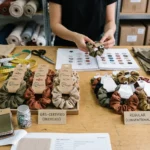
Choosing a hair accessories manufacturer from a catalog, quotation, or polished sample leaves major sourcing risks untested. A factory may make an attractive prototype yet struggle with dye-lot consistency, elastic recovery, clip tension, assembly defects, retail labeling, or peak-season capacity. Those gaps often appear only after a deposit has been paid and production has started.
A reliable evaluation therefore needs evidence at three levels: the supplier’s business and manufacturing capability, the product-specific controls demonstrated during sampling, and the commercial safeguards written into the purchase order. This guide provides a practical framework for assessing suppliers of scrunchies, hair bows, fabric clips, padded headbands, heatless curling sets, claw clips, and related private-label accessories before committing to volume.
If you are still defining the collection, review Q&N Beauty’s customizable hair accessories range and prepare a short sourcing brief before requesting quotations. A clear brief makes supplier comparisons far more meaningful than asking several vendors to quote from a photo alone.
Define the Bulk Order Before You Evaluate Suppliers
Match the Manufacturer to the Product and Sales Channel
“Hair accessories” is not one manufacturing discipline. A supplier experienced in sewn scrunchies may not control injection-molded claw clips, plated metal barrettes, padded headbands, or hand-applied crystal bows equally well. Begin by separating your assortment into construction families and identifying which processes are critical.
- Sewn fabric products: fabric inspection, cutting, printing or dyeing, stitching, elastic joining, turning, pressing, and label attachment.
- Structured fabric products: base or padding consistency, symmetry, edge wrapping, adhesive control, wearer comfort, and shape recovery.
- Plastic, resin, or acetate-style clips: material identification, molding or cutting, polishing, color consistency, spring assembly, hinge alignment, and tooth strength.
- Metal and decorated products: base-metal specification, plating, edge finishing, soldering or assembly, adhesive performance, and ornament security.
Your sales channel changes the standard. A boutique bow may require tight symmetry and hand-finishing; a mass retailer may prioritize barcode placement, case-pack accuracy, carton controls, and social-compliance documents. A children’s collection requires age grading and product-specific safety review.
Create a Comparable RFQ and Technical Brief
Issue the same RFQ to each candidate. Include product type, dimensions, drawings, materials, color reference, logo, hardware, packaging, quantity per SKU, destination, delivery date, and intended market. State whether substitutions are allowed and identify critical quality features.
A useful specification should define measurable requirements rather than subjective phrases. Replace “strong elastic” with an approved elastic construction plus a test method and acceptance limit established during sampling. Replace “gold clip” with an approved plating color sample, surface finish, and base material. Replace “premium satin” with composition, weight or supplier reference, appearance, hand feel, and approved color standard.
Decide Between OEM, ODM, and Existing-Style Customization
OEM gives greater design control but requires a complete specification and more development. ODM or customization of an existing construction can reduce engineering risk and lead time, although exclusivity is lower unless meaningful features are changed.
For a first order, an existing construction with custom fabric, branding, and packaging can validate the supplier. Proprietary shapes or new molds offer differentiation, but tooling ownership, revision cost, minimum quantities, and exclusivity need written terms.
How to Verify a Hair Accessories Manufacturer and Its Production Capability
Direct Factory, Trading Company, or Coordinated Supply Network
Supplier type is not a quality ranking. A direct factory may offer stronger visibility for its core process, while a capable trading or manufacturing group may coordinate specialized processes effectively. The real risk is an undisclosed role.
| Supplier Model | Advantages | Limitations | Evidence to Request |
|---|---|---|---|
| Direct specialist factory | Strong control over a defined process; easier production visibility | May outsource unfamiliar categories or special finishes | Business license, workshop video, machinery list, process flow, production records |
| Multi-category manufacturer | Can coordinate matching collections and packaging | Not every process is necessarily in-house | In-house versus subcontracted process map and named production locations |
| Trading or sourcing company | Broad supplier access and flexible category management | Less direct control if vendor management is weak | Approved-vendor system, inspection ownership, escalation process, factory disclosure |
| Hybrid network | Combines core in-house production with specialist partners | Traceability and accountability can become complex | Responsibility matrix, subcontractor controls, lot traceability, final QC location |
Ask where sampling and bulk production occur, which operations are subcontracted, and whether inspection rights cover the actual production site. The answer should remain consistent through sales, sampling, and ordering.
Audit Capacity with Records, Not Headcount Alone
Headcount and factory area do not prove available capacity. Request normal output for your product family, current loading, peak-season constraints, trained operators for critical steps, and the proposed production calendar. Ask how rework affects shipment.
Useful evidence includes anonymized production schedules, in-process inspection forms, maintenance logs, and packing-area photos. During a video audit, follow the flow from material storage through production, inspection, packing, and finished-goods storage.
Check Business Identity, Certifications, and Scope
Match the legal company name across the business license, quotation, pro forma invoice, bank beneficiary, audit reports, and certificates. If names differ, request a written explanation of the relationship. Check certificate validity, address, activity scope, issue date, expiration date, and issuing body rather than accepting a logo on a website.
Management and social-audit documents answer different questions: ISO 9001 concerns quality systems, while BSCI and Sedex-related audits focus on social compliance. None proves that a specific product meets market rules.
Q&N Beauty’s company and factory profile states that Bling Accessory was established in 2008, has more than 200 workers and a 10-member design team, and maintains BSCI, Sedex, ISO 9001, and GRS-related credentials. Buyers should still request current copies and verify the entity, site, process, and order scope.
Evaluate Materials, Components, and Product Engineering
Fabric and Elastic Controls for Sewn Accessories
For sewn accessories, approve more than the fabric name. “Satin” may describe a weave or appearance rather than one fiber composition, and fabrics with the same general name can differ in weight, luster, drape, print behavior, and colorfastness.
Request a material specification or supplier reference, then retain an approved swatch. Confirm whether production fabric will come from the same mill and dye lot. For printed products, review scale, repeat, direction, placement rules, color tolerance, and acceptable distortion around gathered or curved areas.
Evaluate elastic in the finished product. Specify width, construction, joining method, stretch, recovery after repeated extension, and expected fit on the target hair volume. Elastic length alone is not a functional standard.
Clip, Base, Spring, and Decorative Component Controls
For bows mounted on alligator clips or French barrettes, confirm clip dimensions, base metal, surface finish, edge condition, opening alignment, and attachment method. For claw clips, approve resin or plastic type, finished weight, tooth geometry, hinge alignment, spring behavior, surface polish, and color.
Do not use “same as sample” as the only definition. Code approved components, record key measurements, and prohibit unauthorized substitutions. Trims, padding, and adhesives can fail even when the main fabric is correct.
Ask for Material Traceability and Substitution Control
The supplier should record material source, lot information where available, incoming status, and related production lots. The system must support investigation of color, odor, breakage, or compliance complaints after shipment.
Add a no-substitution clause to the approved specification. If a material becomes unavailable, the factory should submit the replacement swatch or component, explain the effect on appearance, function, compliance, cost, and lead time, and wait for written approval before use.
Test Customization and Sampling Performance
Judge the Quality of Questions Before the Quality of the Sample
A capable supplier identifies missing information before quoting. Expect questions about size, fabric direction, elastic or clip performance, padding, branding, packaging, intended age group, market, and inspection standard. Assumption-based quotes move unresolved costs into later stages.
Confirm whether prices include labels, logo application, packaging, barcodes, cartons, molds, testing, and inspection. State the Incoterm and named place; separate shipping, duties, and taxes unless their basis is clear.
Approve a Golden Sample and Controlled Specification
A sample is a development tool, not automatically a production standard. Record revisions, issue a final specification, and have both parties retain an identical dated or sealed “golden sample” referenced by the purchase order.
- Review dimensions, materials, color, construction, function, branding, and packaging separately.
- List deviations instead of giving broad feedback such as “make it better.”
- Confirm which comments require a revised physical sample and which can be closed by documented evidence.
- Freeze the bill of materials, artwork versions, packaging dielines, and approved sample before production.
- Define the process for approving any change discovered during bulk manufacturing.
Compare Existing Components with Custom Tooling: Pros and Cons
Existing components usually reduce development time, minimum commitments, and technical uncertainty, but competitors may access similar constructions.
Custom tooling can improve exclusivity but adds cost, validation time, minimum quantities, and engineering risk. Define ownership, storage, service life, maintenance, exclusivity, and end-of-relationship rights before payment.
Q&N Beauty describes its hair accessories OEM/ODM process as covering inquiry, sampling, production, inspection, packaging, and delivery coordination. Use that process—or an equivalent documented workflow from another supplier—as the starting point for a project-specific approval schedule.
Audit Quality Control Before the Bulk Order
Require Controls at Incoming, In-Process, and Final Stages
Final inspection cannot efficiently correct a wrong dye lot, weak elastic, inaccurate cutting die, or defective spring used throughout an order. The pre-production control plan should define each check, method, frequency, acceptance criteria, owner, and corrective action.
- Incoming inspection: fabric shade and defects, component identity, dimensions, plating appearance, packaging print, and supporting material records.
- Pre-production confirmation: approved sample, bill of materials, artwork, color standards, process instructions, and operator briefing.
- In-process inspection: first-piece approval, cutting accuracy, stitch and seam condition, symmetry, assembly alignment, adhesive control, and functional checks.
- Final inspection: workmanship, dimensions, function, assortment, labeling, packing, carton markings, quantity, and agreed shipment tests.
Use a Product-Specific Hair Accessory Inspection Checklist
| Product Area | Inspection Points | Typical Risk | Acceptance Basis |
|---|---|---|---|
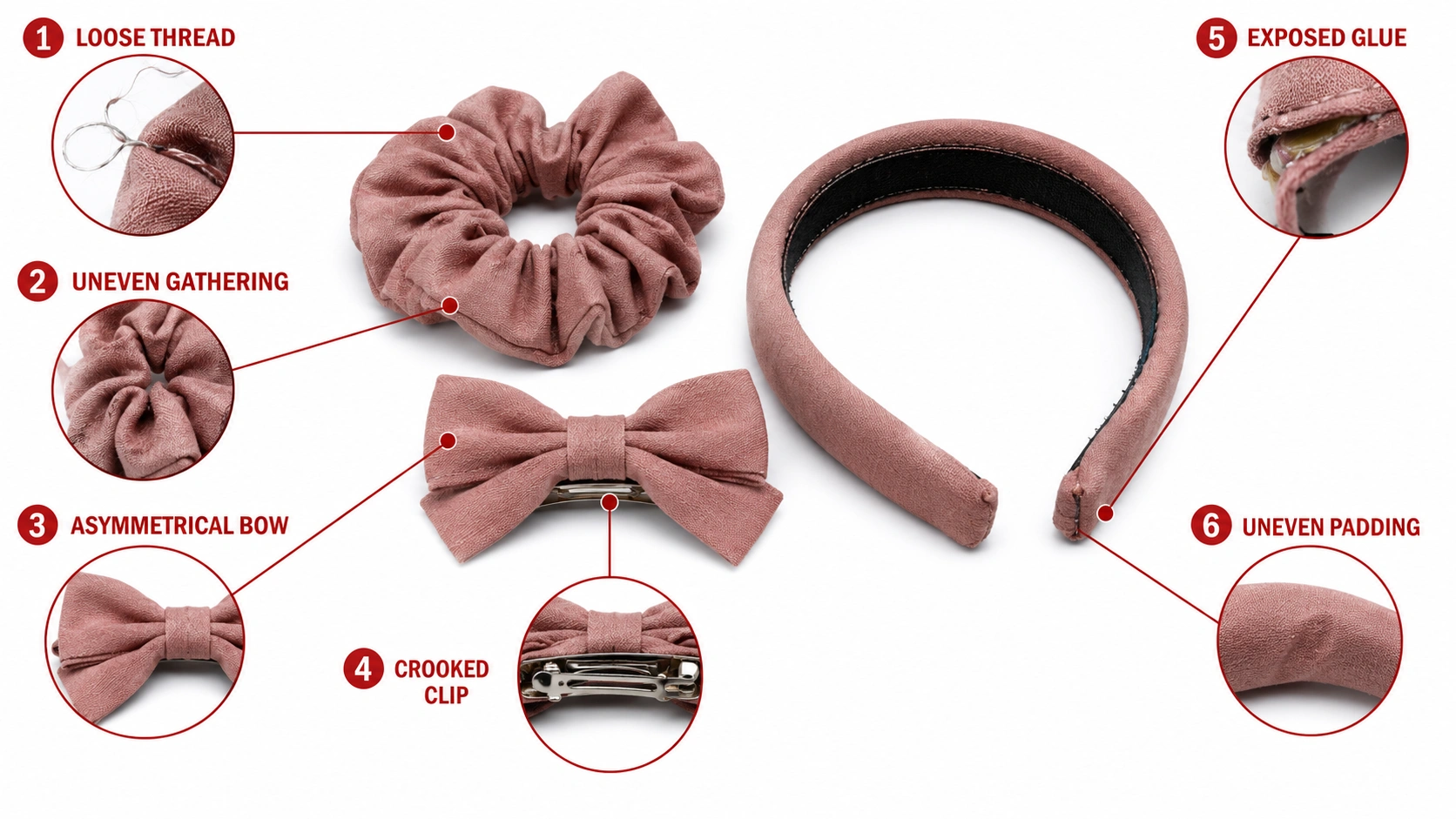
| All fabric accessories | Material, shade, odor, stains, dimensions, stitching, loose threads, logo | Dye-lot variation, fabric substitution, inconsistent finish | Approved swatch, specification, and golden sample |
| Scrunchies and hair ties | Elastic join, stretch, recovery, gathering, seam closure | Early loss of tension, broken join, uneven fullness | Buyer-approved functional method and limits |
| Padded headbands | Width, padding, symmetry, end finish, pressure and comfort | Twisting, exposed base, uneven shape, discomfort | Approved dimensions, fit assessment, and sample |
| Bows and fabric clips | Bow symmetry, pattern direction, clip orientation, attachment security | Crooked bows, reversed clips, loose ornaments | Approved orientation photos and pull method |
| Claw and metal clips | Teeth, hinge, spring action, surface, edges, plating, holding function | Breakage, weak grip, scratches, burrs, discoloration | Component specification and approved functional test |
| Retail packaging | Artwork, barcode, warnings, count, orientation, seal, carton marks | Warehouse rejection, scanning failure, transit damage | Approved packaging sample and packing instruction |
Define critical, major, and minor defects before inspection. The purchase order should state the agreed sampling plan, acceptance criteria, and what happens after a failed inspection. Do not copy an acceptance-quality limit from another product without considering safety, function, order size, retailer rules, and commercial risk.
Recognize Quality and Process Red Flags
Red flags include an undisclosed production site, unknown material sources, unexplained changes, mismatched certificate names, pressure to approve functional details from photos, missing revision records, or a plan described only as “100% inspection.”
Full visual checking still misses systematic defects without defined criteria. Review completed records and confirm rejected goods are segregated and rework is reinspected.
Assess Compliance and Documentation for the Target Market
United States: Intended Age and Product Classification Come First
Do not request a generic “CPSIA certificate” for every item. Determine whether it is a general-use product or primarily intended for children age 12 or younger, then map applicable rules to the design and materials. The U.S. Consumer Product Safety Commission explains that covered children’s products generally require third-party testing and a Children’s Product Certificate. Its business guidance also addresses lead, coatings, tracking information, and certificates.
Small-part analysis is classification-specific. The CPSC’s small-parts guidance identifies covered products and exclusions, including certain grooming items. Obtain a written assessment rather than automatically applying a toy warning—or assuming no rule applies.
European Union: GPSR, Traceability, and Chemical Restrictions
For products within scope, the EU General Product Safety Regulation (EU) 2023/988 has applied since December 13, 2024. Manufacturers must address safety, perform internal risk analysis, and prepare technical documentation. Map traceability, labeling, distance-sales, and incident duties to the supply chain.
REACH restrictions may affect textile, plastic, adhesive, and metal components. Testing depends on material and exposure; examples include certain azo colorants in skin-contact textiles or nickel release for qualifying metal contact. Use the current REACH regulation and Annex XVII with professional advice, not an old generic report.
An ordinary hair accessory does not receive CE marking merely because it is sold in Europe. CE marking is required only where applicable EU harmonization legislation calls for it. If the product is marketed or designed in a way that may classify it as a toy, obtain a separate classification assessment.
United Kingdom and Buyer-Specific Requirements
Great Britain and Northern Ireland differ. UK government guidance states that the 2005 general safety regulations apply in Great Britain, while EU Regulation 2023/988 applies in Northern Ireland from December 13, 2024. Confirm destination and importer duties before approving labels.
Retailers may add restricted-substance lists, performance tests, packaging specifications, social audits, and traceability rules beyond baseline law. Give the supplier the latest manual before quotation. Test reports should match the product, materials, colors, components, manufacturing site, and current order closely enough to support the buyer’s compliance assessment.
Compare MOQ, Pricing, Lead Time, and Commercial Terms
Normalize Quotations Before Comparing Unit Prices
A low unit price is misleading if it excludes labels, plating, packaging, barcodes, testing, molds, or inspection. Compare landed cost using identical assumptions for SKU quantity, packaging, Incoterm, fees, freight, duty, testing, tooling, and quality risk.
Ask whether the MOQ applies per style, color, size, print, or order. Separate the product MOQ from minimum material, dyeing, printing, plating, mold, and packaging quantities. Excess custom material may need to be purchased, stored, or consumed in a repeat order, so ownership and storage period should be written down.
Stress-Test the Production and Delivery Schedule
Break lead time into material approval, production, inspection, rework allowance, packaging, booking, transit, customs, and delivery buffer. Define whether the clock starts at deposit, sample approval, or final artwork.
Confirm whether the quote was prepared using normal or peak-season capacity. A realistic later date is safer than an unsupported promise. If the launch cannot move, define milestone dates and an escalation path, then reserve time for sample revisions and failed inspection. Airfreight should be a planned option with a cost owner, not the automatic cure for production delay.
Put Change Control and Remedies in Writing
The purchase order should identify the specification version, golden sample, quantities, price, currency, payment terms, Incoterm, shipment window, inspection right, defect categories, acceptance criteria, packaging, compliance deliverables, and approved subcontracting. It should also address late changes, failed inspections, shortages, rework, replacement, chargebacks where agreed, and disposition of defective goods.
Protect intellectual property through appropriate contracts, artwork controls, mold ownership terms, and confidentiality provisions. Legal terms should be reviewed for the jurisdictions and transaction involved; a supplier checklist is not a substitute for legal advice.
Hair Accessories Manufacturer Evaluation Scorecard
Score Evidence Instead of Sales Presentation
Rate shortlisted suppliers from 1 to 5 in each area, apply the weight, and record supporting evidence. Fix weights before final quotes arrive.
| Evaluation Area | Suggested Weight | Evidence | Automatic Concern |
|---|---|---|---|
| Product and process fit | 20% | Relevant production, engineering answers, process map | Core processes or bulk site undisclosed |
| Sample accuracy and function | 20% | Measured sample, revision response, repeatability evidence | Unapproved substitutions or unresolved functional failure |
| Quality-control system | 15% | Control plan, inspection records, defect handling | No defined criteria or corrective-action process |
| Compliance capability | 15% | Market-specific assessment, matching reports, traceability | False, expired, or unrelated documentation |
| Commercial transparency | 10% | Comparable quotation, clear inclusions and MOQ basis | Material price changes without specification change |
| Capacity and lead-time control | 10% | Production schedule, loading, contingency plan | Promise unsupported by capacity or material plan |
| Communication and change control | 5% | Written recap, version discipline, response quality | Conflicting answers or undocumented approvals |
| Business and social verification | 5% | Legal identity, current audits, bank-name match | Unexplained entity or payment mismatch |
A high total score should not override a critical failure. Unsafe construction, falsified documents, unresolved legal classification, unauthorized substitution, or inability to identify the production site should remain gate conditions.
Validate with a Controlled Trial or Pre-Production Run
Where feasible, use a trial order, pilot lot, or early-production inspection to test whether approved materials, processes, inspection methods, and packaging remain repeatable under production conditions.
For a large launch, consider independent inspection at risk-based stages. The buyer should appoint the inspector and define the checklist; inspection provides evidence but does not transfer compliance responsibility.
Common Buyer Mistakes to Avoid
- Comparing quotations based on different materials, packaging, quantities, or Incoterms.
- Approving color from a screen image without a physical standard.
- Testing the sample’s appearance but not elastic recovery, clip function, attachment, or packaging.
- Assuming an audit certificate proves product compliance.
- Starting bulk production before the specification, artwork, and golden sample are frozen.
- Ignoring minimum quantities for custom fabric, plating, printing, molds, or packaging.
- Leaving defect definitions, inspection rights, and remedies out of the purchase order.
If you want a manufacturability review before sampling, send your reference images, dimensions, materials, branding, packaging, target quantity, and destination through the Q&N Beauty project inquiry page. Ask for all assumptions and items requiring physical confirmation to be identified in the response.
Frequently Asked Questions About Hair Accessory Suppliers
How Do I Find a Reliable Hair Accessories Manufacturer?
Shortlist suppliers with relevant construction experience, then verify legal identity, production location, sample accuracy, material controls, QC records, capacity, compliance capability, and commercial terms. Use a weighted scorecard and evidence rather than choosing from catalogs or price alone.
What Should I Ask a Hair Accessory Supplier Before Ordering?
Ask which processes are in-house, where bulk goods will be produced, how materials are controlled, what the MOQ applies to, how samples are approved, which inspections occur, how substitutions are managed, what compliance documents are available, and what is included in the quoted price and lead time.
Should I Choose a Factory or a Trading Company?
Choose the model that provides the best control for your product mix. A specialist factory can offer direct process visibility; a capable trading or hybrid supplier can manage several specialized categories. Require transparency about production sites, subcontracting, inspection ownership, and accountability in either case.
How Can I Verify Bulk Quality Will Match the Sample?
Freeze a bill of materials, approved color standards, artwork, packaging files, measurable specifications, and a golden sample. Require incoming and in-process checks, approve the first production pieces, prohibit unapproved substitutions, and conduct a risk-based pre-shipment inspection.
Which Certificates Should a Hair Accessories Manufacturer Provide?
There is no universal certificate package. Request current business and factory audit documents relevant to your procurement policy, plus product-specific test reports and compliance records mapped to the intended age group, materials, design, and destination market. Verify names, addresses, dates, scope, and report-to-product traceability.
Expert Summary, Future Trends, and Your Next Sourcing Action
Expert Summary: Select for Repeatability, Not Just Sample Appearance
The best hair accessories manufacturer for a bulk order is the supplier that can repeat an approved product under controlled conditions. The evaluation should connect design intent to a fixed bill of materials, measurable specifications, a golden sample, a production control plan, market-specific compliance documents, transparent pricing, and a realistic schedule.
A sample is only one part of the decision. Risk falls when the supplier shows where production occurs, how critical components and changes are controlled, how defects are classified, and which records remain after shipment.
Future Trends in Hair Accessories Supplier Evaluation
Buyer expectations are moving toward component traceability, digital version control, disciplined sampling, product-level support for sustainability claims, and packaging designed for retail and logistics. Suppliers must connect creative development with documented risk assessment and repeat-order consistency.
Claims involving recycled materials, preferred fibers, or responsible sourcing will also face closer documentation review. Buyers should expect evidence linked to the actual material and transaction rather than relying only on a factory-level badge. At the same time, shorter trend cycles will reward manufacturers that maintain approved material libraries and modular constructions without bypassing sample or compliance controls.
What to Send for a Meaningful Sample and Bulk Quotation
To receive a comparable proposal, provide:
- Product type and intended user or age group
- Finished dimensions and critical tolerances
- Reference photos, design drawings, or a tech pack
- Fabric, elastic, clip, base, padding, trim, and other material requirements
- Pantone colors, print artwork, and pattern-placement instructions
- Logo file, size, position, and preferred branding method
- Target quantity by design, color, and size
- Retail packaging, barcode, labeling, and carton requirements
- Delivery country, destination, and preferred trade term
- Target delivery date and launch constraints
- Applicable market, retailer, testing, and compliance requirements
Share these details with Q&N Beauty to request a specification review, custom sample, or bulk quotation. The right first response should identify what can be quoted immediately, what remains subject to specification review, and what must be confirmed after sample evaluation.