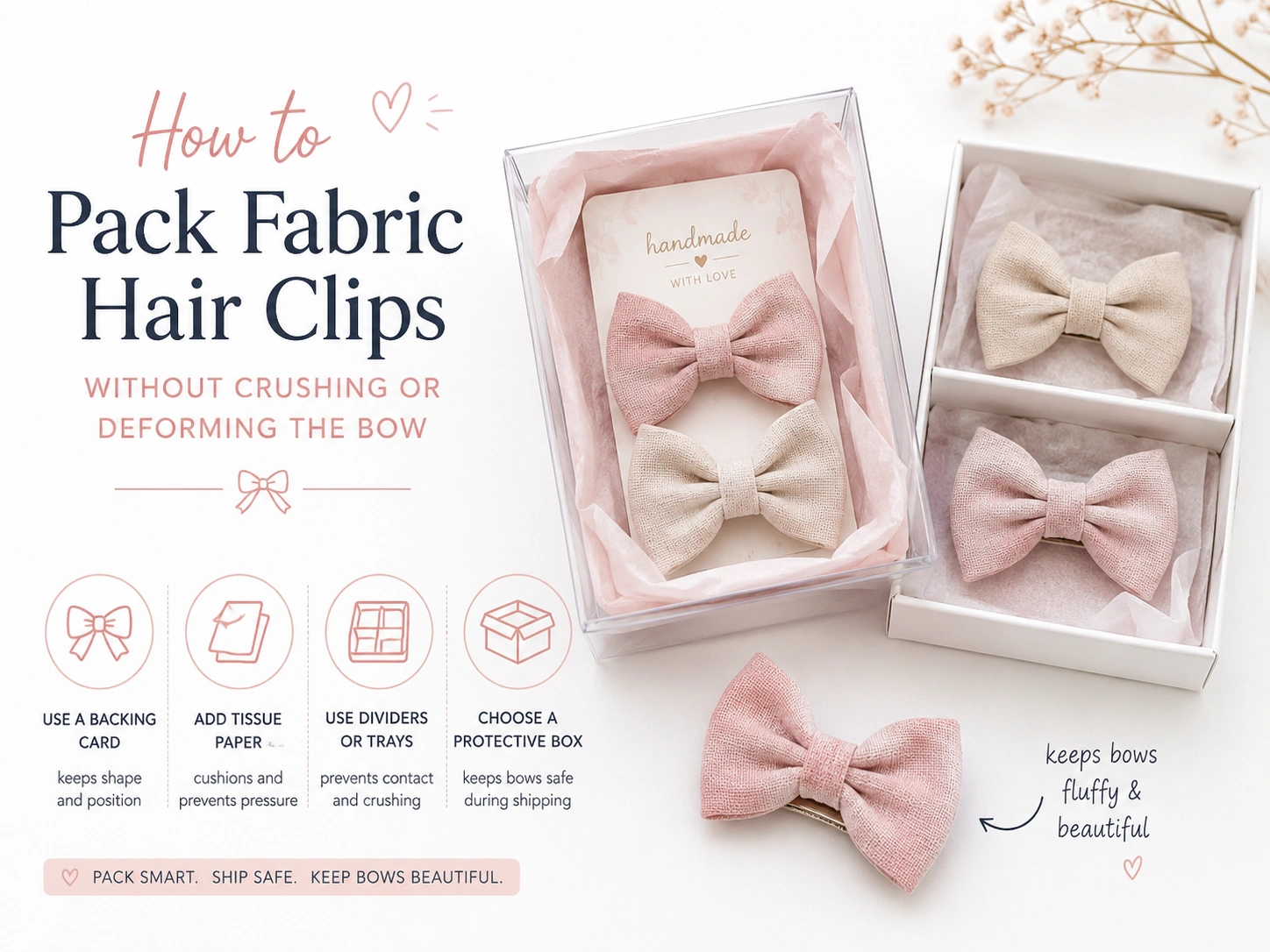
Grand View Research reports that the global clips-and-pins segment generated about USD 5.66 billion in 2025 and is forecast to grow 8.1% annually through 2033. It also estimates the protective-packaging market at USD 41.5 billion in 2026, with e-commerce as a major driver.
This guide explains how to prepare, card, support, box, carton, and test fabric bow clips for retail, e-commerce, gifting, and wholesale shipment.
Why Fabric Hair Clips Become Crushed
Insufficient Internal Space
The most common mistake is choosing packaging from flat width and height while ignoring bow depth. Padded knots, velvet loops, gathered centers, and layered tails need headroom above the highest point.
Excessive Stacking Pressure
A suitable unit box can still fail when too many layers are stacked above it. Long storage periods increase the risk because textiles can deform under continuous pressure.
Weak or Flexible Outer Packaging
Thin polybags protect against dust but not crushing. Folding cartons may bow inward, and corrugated cartons lose strength through humidity, poor stacking, weak board, or excessive void space.
Incorrect Clip Positioning
A clip attached too high can push the bow into the pack edge. An open clip can puncture bags, while an off-center base can twist the bow.
| Damage pattern | Likely packaging cause | Corrective action |
|---|---|---|
| Flat bow center | Top pressure or tight bag | Add depth clearance or a support that carries load around the bow. |
| One loop folded inward | Off-center card position or carton movement | Center the clip and secure lateral movement. |
| Long tails permanently creased | Tails folded to fit a short pack | Increase pack length or use a controlled gentle curve with tissue support. |
| Velvet shows light patches | Pile crushed during stacking | Use no-contact clearance and reduce layer pressure. |
| Clip scratched or opened | Metal-to-metal contact or loose packing | Close the clip and isolate each mechanism. |
Expert principle: Packaging should carry stacking loads through cards, trays, inserts, or box walls—not through the bow itself.
How Bow Structure Affects Packaging Requirements
Flat Fabric Bows
Flat grosgrain, cotton, felt, or lightly interfaced bows are easiest to pack. They usually need a stable display card and roomy bag or shallow carton.
Padded and Structured Bows
Padded bows contain foam, batting, layered seams, or a structured knot. They need greater depth and protection from point pressure.
Use a perimeter insert, shallow tray, raised card, or rigid box so the lid loads the support structure rather than the decoration. Test the foam or fill for recovery after 24 hours under the expected packed condition.
Layered and Oversized Bows
Layered bows create several height levels and can snag when packs slide. Oversized designs also twist more easily because of their longer leverage.
Bows With Long Tails
Long-tail bows need enough pack length to avoid hard folds. Where curving is unavoidable, use a broad radius supported by tissue or a shaped insert.
| Bow structure | Minimum packaging concept | Preferred protection | Main risk |
|---|---|---|---|
| Flat ribbon bow | Display card and roomy bag | Shallow carton for e-commerce | Card bending and surface abrasion |
| Padded bow | Rigid depth clearance | Perimeter insert or molded tray | Permanent compression set |
| Layered bow | Individual separation | Compartment tray | Snagging and loop distortion |
| Oversized bow | Large card or individual box | Support around center and tails | Rotation, sagging, and carton crush |
| Long-tail bow | Extended pack length | Tissue-supported broad curves | Hard creases and print damage |
Step 1: Prepare Fabric Hair Clips Before Packing
Shape and Steam the Bow
Before packing, restore the approved silhouette, align tails, distribute loops, brush velvet pile, and remove temporary folds. Steam only after validating the fabric and adhesive system.
Satin can develop water marks or shine changes. Velvet can flatten under direct pressing. Organza can distort with excessive heat. Use a fabric-specific temperature, distance, time, and cooling period, then allow the product to dry fully before enclosure.
Remove Loose Threads and Glue Residue
Trim loose threads without cutting structural stitches. Remove glue, chalk, lint, and oil only with approved cleaning methods.
Confirm the Clip Is Fully Closed
Close alligator, snap, barrette, or duckbill mechanisms unless the package was engineered to hold them open. Closing reduces space, puncture risk, and snagging.
| Pre-packing checkpoint | Inspection method | Reject condition |
|---|---|---|
| Bow shape | Compare with front and side golden-sample photos | Uneven loops, twisted center, or misaligned tails |
| Surface | Inspect under defined lighting | Glue, stain, lint, scorch, water mark, or crushed pile |
| Clip mechanism | Open once, then close completely | Blocked hinge, weak closure, or fabric trapped in jaws |
| Moisture | Allow complete cooling and drying | Warm or damp product sealed into packaging |
Step 2: Secure Fabric Hair Clips to a Display Card
Choosing the Correct Card Size
The card should support the clip and branding without flattening the bow. As a prototype starting point, allow roughly 5–10 mm side clearance, then confirm the physical sample.
Positioning the Clip Without Compressing the Bow
Position the metal base flat against the card while the bow projects naturally. Keep the knot clear of card edges, bag seals, and hanging holes.
Using Slots, Ties, or Protective Bands
| Card-retention method | Advantages | Limitations | Best use |
|---|---|---|---|
| Die-cut slots | Fast, clean, low material use | Incorrect slot width can scratch or loosen the clip | Mini and classic alligator clips |
| Paper locking tabs | Plastic-reduction potential and good stability | Requires accurate dieline and assembly | Retail sets and barrettes |
| String or soft tie | Flexible for irregular bases | Slower and may shift if tied loosely | Premium or handmade-style products |
| Elastic/protective band | Fast secondary retention | Can deform the bow if placed incorrectly | Around the card and clip base only |
Step 3: Add Internal Protection
Tissue Paper and Soft Wrapping
Cardboard Supports and Bow Inserts
Blister Trays and Molded Holders
Individual Boxes for Premium Styles
| Internal protection | Crush protection | Cost level | Best-fit style |
|---|---|---|---|
| Tissue only | Low | Low | Flat bows inside a strong outer pack |
| Paperboard perimeter insert | Medium to high | Low to medium | Padded and structured bows |
| Molded pulp tray | High | Medium | Gift sets and sustainability-led packs |
| Thermoformed tray | High and precise | Medium to high | Embellished clips and retail visibility |
| Individual rigid box | High | High | Luxury, bridal, and oversized styles |
How to Set Packaging Dimensions and Tolerances
Packaging dimensions should be based on the largest approved production condition, not only the most compact development sample. Measure at least five finished bows after they have fully relaxed. Record maximum width, height, depth, tail spread, card thickness, and the projection created by the closed clip.
Add clearance according to the damage mechanism. Side clearance prevents loops from folding inward. Top clearance protects padded centers and velvet pile. Tail clearance prevents sharp bends. Manufacturing allowance covers normal variation in bow forming, card cutting, box folding, insert placement, and fabric thickness.
Do not make every space excessively large. Oversized packaging increases movement, freight volume, and material use. The objective is controlled clearance: enough room to avoid contact, with inserts or void control that keep the product from accelerating into the box wall.
| Dimension | How to establish it | What the tolerance protects |
|---|---|---|
| Internal width | Maximum relaxed bow width plus side clearance | Loop edges and symmetry |
| Internal height | Card, hanging area, and full tail length | Tails, branding, and seals |
| Internal depth | Highest bow point plus no-contact allowance | Padded centers, pile, and embellishments |
| Insert position | Measured from fixed box or card datums | Clip alignment and repeatable presentation |
| Carton pack count | Validated by compression and transit testing | Stacking strength and shape recovery |
Buyer recommendation: Approve a packaging drawing with internal dimensions and tolerances, then link it to a golden packed sample. A box described only by its external size does not control the usable space around the bow.
Step 4: Select the Right Outer Packaging
Polybags With Enough Space
Polybags protect against dust and light moisture but not crush. Choose a size that does not pull the loops inward and keep the seal away from the bow.
Rigid Retail Boxes
Rigid or well-engineered folding boxes provide better compression protection and should include realistic allowance for cards, inserts, tissue, and production variation.
Compartment Trays for Multi-Piece Sets
Multi-piece sets need fixed positions so one clip cannot rest on another. Cavities should match each decoration height and support assortment accuracy.
Shipping Cartons With Crush Resistance
| Outer pack | Advantages | Limitations | Recommended channel |
|---|---|---|---|
| Roomy polybag | Low cost and low weight | No structural crush protection | Wholesale inside strong inner cartons |
| Folding paper box | Printable, recyclable potential, moderate protection | Can bow inward if board is weak | Retail and standard e-commerce |
| Rigid gift box | Strong presentation and protection | High cost and shipping volume | Premium and gifting |
| Compartment tray plus sleeve | Stable multi-piece arrangement | More components and setup | Sets and seasonal collections |
How to Arrange Fabric Hair Clips Inside Cartons
Controlling Layer Height
Set carton layer count through compression and storage testing, not by forcing in the maximum possible quantity.
Avoiding Direct Pressure on Bow Centers
Using Dividers and Protective Top Sheets
Filling Empty Space to Prevent Movement
| Carton control | Good practice | Failure to avoid |
|---|---|---|
| Layer count | Validated through compression and storage testing | Adding one more layer to reduce freight volume |
| Orientation | Keep bows in approved front/side position | Random rotation that bends tails or pile |
| Void fill | Immobilize packs without squeezing them | Overfilled paper pressing on bow centers |
| Top clearance | Allow flaps to close without contact | Carton bulging before tape is applied |
| Carton size | Fit inner packs with controlled clearance | Excessive voids that allow impacts and shifting |
Packaging Tests for Fabric Hair Clips
Carton Compression Testing
ASTM D642 covers compression testing of shipping containers. For bow clips, pass criteria should include both carton integrity and product shape.
Drop and Vibration Testing
ASTM D5276 evaluates free-fall shock, while ASTM D999 covers vibration of filled shipping containers. Inspect for opening, scratches, movement, detachment, flattening, and tail creases.
Storage and Stacking Tests
Post-Transit Shape Recovery Inspection
ISTA 3L simulates e-commerce hazards including vibration, shock, compression, temperature, and humidity, making it relevant to direct-to-consumer fulfillment.
| Test | Primary risk | Hair-clip acceptance checks |
|---|---|---|
| ASTM D642 compression | Stacking and external load | No carton collapse, bow contact, or permanent flattening |
| ASTM D5276 drop | Free-fall shock | No clip release, detachment, puncture, or severe displacement |
| ASTM D999 vibration | Transport movement | No abrasion, card migration, or product-to-product contact |
| Storage stack | Long-duration pressure and humidity | Stable carton and acceptable shape recovery |
| ISTA 3L or channel protocol | E-commerce fulfillment hazards | Finished package survives the defined distribution cycle |
Testing rule: Do not evaluate only the outer carton. The pass/fail decision must include the bow silhouette and the clip mechanism.
Packaging Recommendations for Different Sales Channels
E-Commerce Packaging
Retail Display Packaging
Gift Set Packaging
Bulk Wholesale Packaging
| Channel | Recommended format | Priority |
|---|---|---|
| E-commerce | Rigid unit pack plus tested shipping container | Shock, vibration, and compression protection |
| Retail | Display card plus sleeve, bag, or shallow box | Presentation, barcode, and hanging durability |
| Gift | Compartment tray or individual cavities in a premium box | Unboxing and bow separation |
| Wholesale | Efficient inner packs with dividers and master-carton validation | Cost control without deformation |
Case Study: Premium and Multi-Piece Bow Packaging
Lele Sadoughi: Storage as Part of a Premium Bow Product
Lele Sadoughi lists a 5 by 5.5-inch raffia Bardot bow barrette and instructs customers to store it in a custom resealable striped plastic pouch.
The pouch supports storage and surface protection, but shipment still requires structural clearance to stop loads from reaching a bow of this scale.
Mimi & Lula: Managing Different Bow Sizes in One Pack
Mimi & Lula’s red bow pack contains one large grosgrain bow on a 4.5 cm alligator clip and two smaller velvet bows, creating a height-management challenge within one set.
A suitable layout fixes each clip base separately and prevents the large bow from pressing on the velvet pieces.
Case-study takeaway: Premium single bows benefit from reusable storage plus structural transit protection. Multi-piece sets need fixed positions and height management. The sales format should determine the packaging architecture.
Pros and Cons of Bow Packaging Options
| Option | Advantages | Limitations |
|---|---|---|
| Display card and polybag | Low cost, lightweight, strong retail visibility | Minimal crush resistance |
| Card with paperboard insert | Good structure with limited extra volume | Requires a precise dieline and assembly control |
| Molded tray | Repeatable shape protection and set organization | Tooling, material, and recycling considerations |
| Individual folding box | Good protection and branding area | Higher unit and freight cost |
| Rigid gift box | Premium presentation and strong protection | Highest cost and shipping volume |
| Bulk layered carton | Efficient for wholesale quantities | High deformation risk without dividers and validated layer limits |
Expert Buyer Checklist
- Classify the bow structure. Record whether it is flat, padded, layered, oversized, embellished, velvet, or long-tailed.
- Measure three dimensions. Provide relaxed bow width, height, and maximum depth—not only the flat outline.
- Approve the packed sample. Confirm the clip, display card, insert, unit pack, inner carton, and master carton together.
- Protect functional areas. Keep card slots, ties, and inserts clear of hinges, jaws, springs, and clasps.
- Control contact points. Mark areas where packaging may touch and areas that require no-contact clearance.
- Set carton layer limits. Base them on compression and storage testing rather than freight optimization alone.
- Match the distribution channel. Use stronger protection for e-commerce and more display efficiency for retail.
- Define recovery criteria. Measure shape immediately after transit testing and after a documented rest period.
- Retain a golden packed sample. Use it for production packing, final inspection, and damage investigations.
Brands can review custom bow clips, display cards, reusable pouches, paper boxes, compartment trays, samples, testing, and private-label production at Q&N Beauty and its custom hair accessories manufacturing page.
Frequently Asked Questions
How do you pack fabric hair clips without crushing the bow?
Close the clip, secure its base to a correctly sized card, leave clearance around the bow, add tissue or a structural insert, use a rigid outer pack when needed, and validate the complete carton through transit testing.
What is the best packaging for bow hair clips?
Flat bows can use cards and roomy bags inside strong cartons. Padded, velvet, layered, or oversized bows perform better in folding boxes, molded trays, or individual rigid packs with no-contact clearance.
Should hair clips be closed before packing?
Yes, unless the package was specifically designed to hold them open. Closed clips use less space, reduce puncture risk, protect the spring, and prevent snagging.
Can tissue paper prevent a bow from being crushed?
Tissue supports tails and reduces abrasion, but it is not a structural crush barrier. The card, insert, box walls, and carton must carry stacking loads.
How do manufacturers test hair clip packaging?
They can use carton compression, drop, vibration, storage-stack, humidity, and e-commerce distribution tests, then inspect the bow’s shape, clip function, attachment, card position, and recovery.
How much space should a bow have inside a box?
There is no universal value. The bow should retain its relaxed width, height, and depth without continuous pressure. Padded and velvet bows generally need more headroom than flat ribbon bows.
What packaging is best for e-commerce hair clips?
Use a rigid unit pack or structural insert inside a tested parcel container. The system should resist shock, vibration, compression, and movement through the intended fulfillment network.
Conclusion: Protect Fabric Hair Clips From Pressure
Successful packaging for fabric hair clips starts by treating the bow as a three-dimensional textile structure rather than a flat accessory. The package must protect volume, pile, pleats, tails, embellishments, clip alignment, and attachment strength.
Flat bows may need only a stable card and roomy protective bag. Padded and structured bows need depth clearance. Layered sets need compartments. Long tails need extended packs or broad supported curves. Oversized premium products need individual structural protection.
The strongest program combines careful pre-packing preparation, correctly sized display cards, load-bearing inserts, channel-specific outer packaging, controlled carton layouts, and compression, drop, vibration, storage, and shape-recovery tests.
Future packaging will use more molded-paper cavities, recyclable mono-material structures, digitally optimized carton layouts, scan-linked packing instructions, automated bow-height measurement, and e-commerce tests based on real distribution data. The goal is not maximum packaging. It is the minimum material system that reliably delivers the approved bow shape.
Ready to develop protective packaging for your collection? Visit Q&N Beauty to discuss fabric hair clips, bow structures, display cards, trays, boxes, master cartons, testing, samples, and production quotations.