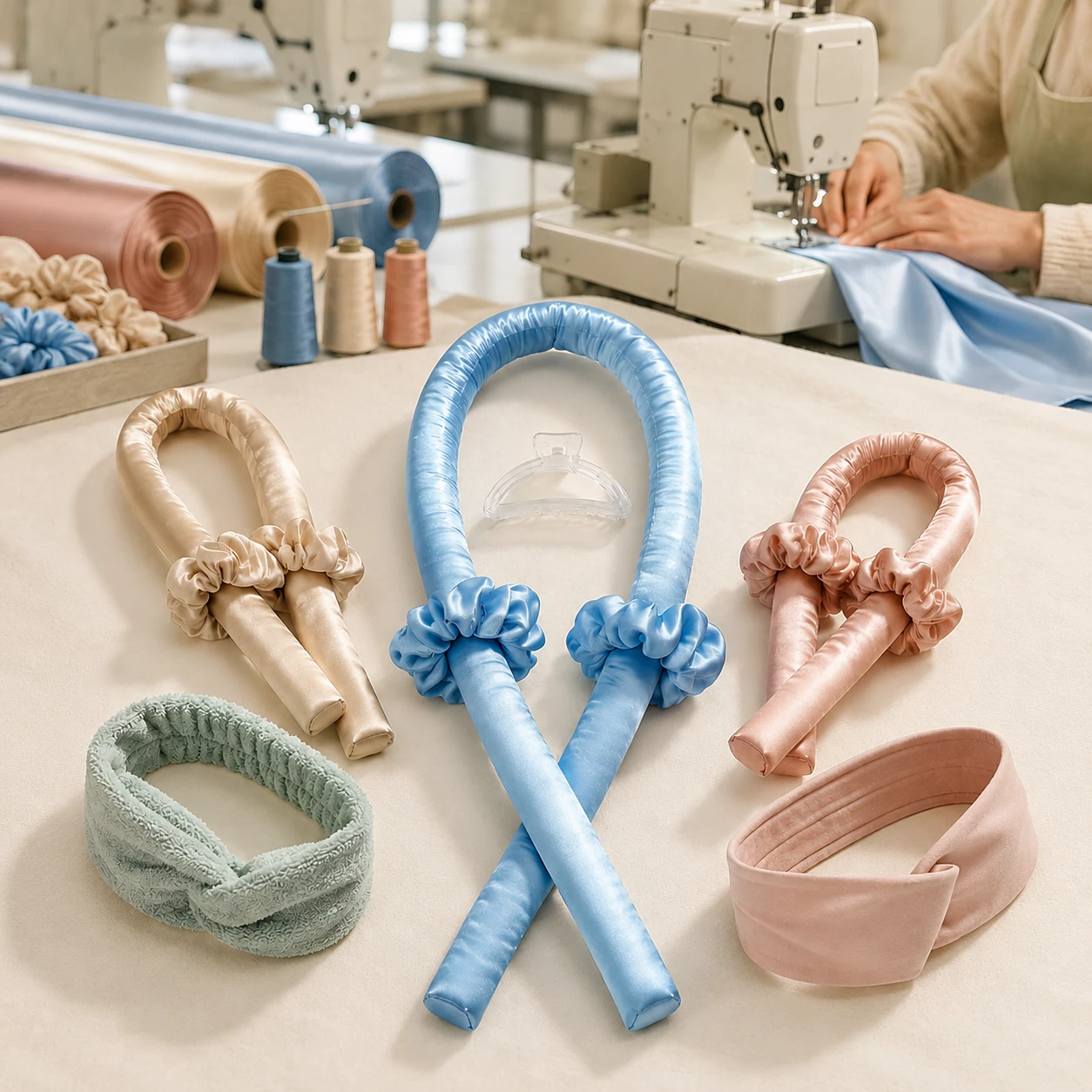
Can You Use Heatless Curlers on Short Hair?
Yes. A heatless curling rod works by holding hair in a curved position while temporary bonds within the fiber reset. Water can disrupt hydrogen bonding in keratin; as hair dries in a new shape, those temporary interactions reform. A peer-reviewed review in Cosmetics describes hydrogen bonds as abundant in hair and easily affected by water. This is why slightly damp hair often sets more strongly than completely dry hair—and why humidity can relax the result later.
The key limitation is geometry. Hair must be long enough to wrap around the chosen diameter and remain anchored. The circumference of a rod equals π × diameter. One complete turn around a 2.5 cm rod uses roughly 7.9 cm of hair before allowing for the distance from scalp to rod. A 3.5 cm rod needs about 11 cm for the same turn. On a short bob, that difference can decide whether the end locks in or springs out.
Minimum Hair Length for Heatless Curls
There is no single minimum for every design. Commercial headband-style rods become practical around chin length. RobeCurls, for example, gives chin length as its best-use threshold. That is a manufacturer-specific recommendation, not an industry rule, but it fits single-rod geometry.
Below the chin, use smaller tools. A 7–10 cm section can turn around a mini rod when the end is clipped. A very short pixie may not form ringlets, but pin curls or 1.2–1.8 cm bendable rods can add lift and texture.
How Short Hair Reacts to Heatless Curling
Short hair has less weight pulling curls down and often dries faster, but fewer turns produce a less complete spiral. Layers add another variable: the perimeter may wrap securely while crown pieces escape. Fine, straight hair may need light mousse and a smaller diameter. Coarse or wavy hair may need less product but more drying time. Handle lightened or high-porosity hair gently.
Common Challenges When Curling Short Hair
| Challenge | Why it happens | Best correction |
|---|---|---|
| Ends pop out | Too little hair completes the wrap | Use a smaller rod and clip the final 2–3 cm |
| Only one bend forms | Rod is too thick for the length | Reduce diameter or use mini rods |
| Back stays straight | Sections are missed or layered unevenly | Use a mirror and divide the back into two rows |
| Rod slides backward | Satin surface, heavy rod, or weak top anchor | Add two no-crease clips in a crossed position |
| Curls dry inconsistently | Sections overlap too thickly | Use smaller, evenly tensioned sections |
Expert view: On short hair, secure contact is more important than rod length. A compact curler with controlled flexibility and multiple anchor points usually outperforms an extra-long, heavily padded rod.
What Size Heatless Curlers Work Best for Short Hair?
Recommended Curling Rod Length
For a single headband rod, 60–75 cm (24–30 in) is a useful starting range for a chin bob. A lob may suit 75–90 cm (30–35 in). For ear-length cuts, four to eight rods around 15–25 cm (6–10 in) are easier to position. Excess length adds weight and leverage, so unsupported tails can pull the rod out during sleep.
Choosing the Right Rod Diameter
For most short bobs, 2.0–2.5 cm (0.8–1.0 in) balances security with a modern curl. Choose 1.5–2.0 cm for tighter definition or short layers; choose 2.5–3.0 cm for a longer bob and soft movement. Above roughly 3.2 cm, expect volume or a C-shaped bend on chin-length hair.
Small vs. Large Curling Rods for Short Hair
| Feature | Small rod | Large rod |
|---|---|---|
| Typical diameter | 1.5–2.0 cm / 0.6–0.8 in | 2.8–3.5 cm / 1.1–1.4 in |
| Wraps from limited length | More | Fewer |
| Finish | Defined, springy | Loose, voluminous |
| Short layers | Easier to capture | More likely to escape |
| Drying | Can slow if wraps overlap | Faster with thin, broad sections |
| Best user | Ear-to-chin cuts; straight hair | Long bobs; naturally wavy hair |
A strong retail offer may include two diameters instead of claiming one universal size.
Best Heatless Curler Designs for Short Hair
Short Flexible Curling Rods
A flexible rod follows the head, improves comfort, and reduces leverage that causes slipping. It should bend without a hard kink and recover after compression. Filling that is too soft collapses; filling that is too firm is uncomfortable.
Mini Heatless Curling Sets
Mini sets divide the head into controlled zones, helping graduated bobs, dense hair, and short nape layers. Setup takes longer, but each rod carries less hair for better direction and drying.
Adjustable and Bendable Curling Rods
A shape-retaining core can curve around the crown and fold the ends upward. It needs capped ends, sufficient padding, and clear washing instructions.
Heatless Curling Rods with Secure Ends
Short hair needs more than two large scrunchies. Include mini scrunchies, two flat no-crease clips and, where appropriate, covered end loops. Keep gripping elements away from loose hair.
Pros and Cons by Design
| Design | Pros | Cons | Best for |
|---|---|---|---|
| Single satin rod | Fast, giftable, low friction | Can slide; often too long | Chin-length bob to lob |
| Velvet-touch rod | More grip; secure wrapping | More surface friction; warmer | Fine or slippery hair |
| Mini foam rods | Precise, inexpensive, many curl patterns | Longer setup; more pieces | Ear-length and layered cuts |
| Wire-core headband | Adjustable; ends can fold away | Core quality and safety are critical | Active sleepers and travel |
| Pin-curl set | Works on the shortest usable lengths | Technique-dependent | Pixies and crops |
How Curling Rod Diameter Changes the Result
Diameter controls curvature, while section thickness, tension, angle, moisture, and time modify it. A small rod with a thick section can look softer than expected; a medium rod with thin, flat sections can look more defined.
Small Diameter for Defined Curls
Use 1.5–2.0 cm (0.6–0.8 in) for ear-to-chin, layered, very straight hair. Wrap small, flat sections. Let an initially tight result relax before finger-separating.
Medium Diameter for Soft Waves
A 2.0–2.8 cm (0.8–1.1 in) rod is versatile for a chin bob. Use smaller sections at the front and slightly larger ones at the back.
Large Diameter for Volume and Loose Texture
A 2.8–3.5 cm (1.1–1.4 in) rod adds lift to a long bob. On shorter cuts, expect a bend rather than a ringlet.
| Desired result | Diameter | Section width | Wrap tension | Release method |
|---|---|---|---|---|
| Defined curl | 1.5–2.0 cm | 1–2 cm | Firm, never painful | Finger-separate only |
| Soft curl | 2.0–2.5 cm | 2–3 cm | Even and moderate | Wide-tooth comb after cooling/drying |
| Loose wave | 2.5–3.0 cm | 3–4 cm | Moderate | Finger-comb with serum |
| Volume/bend | 3.0–3.5 cm | 4–5 cm | Light to moderate | Brush lightly at the ends |
How to Use Heatless Curlers on Short Hair
1. Prepare Short Hair Before Curling
Start with detangled, mostly dry hair. Lightly mist dry hair, or allow washed hair to reach roughly 80–90% dry. Lightweight mousse can improve hold; heavy cream may weigh down a short cut.
Water helps temporary setting, but prolonged wetness is not automatically gentler. In a controlled study, surface damage increased at higher temperatures, while the naturally dried group showed cell membrane complex damage that researchers associated with staying wet for more than two hours. Avoid wrapping dripping-wet hair so densely that it stays wet all night.
2. Divide Hair into Small Sections
Create the final part before wrapping. Clip the rod at the crown and use 1–3 cm sections. For a layered back, work in two horizontal rows. Consistent sections create consistent curls.
3. Wrap Short Layers Around the Rod
Wrap the first face-framing section away from the face, adding a little hair with each turn. Keep it flat and close to the scalp; rope-twisting creates a more irregular wave. Mirror the second side.
4. Secure the Ends Without Slipping
Stop when only 2–3 cm of the ends remain. Hold them against the rod and place a small scrunchie over both hair and rod. If the end is too short for a scrunchie, use a no-crease clip parallel to the rod. Never use an uncovered rubber band on damp ends.
5. Let the Hair Dry Completely
Set time depends on moisture, density, porosity, product, and humidity. Two to four hours may work for lightly misted fine hair; others prefer overnight. Release only when fully dry, then separate with dry fingers.
- Detangle and bring hair to mostly dry.
- Apply a small amount of lightweight styling product if needed.
- Anchor the rod at the crown with two crossed clips.
- Wrap 1–3 cm sections away from the face.
- Capture short ends with mini scrunchies or flat clips.
- Wait until every section is dry.
- Unwrap gently, separate, and finish with light hold.
How to Keep Heatless Curlers in Place on Short Hair
Choose the Right Scrunchie Size
A full-size scrunchie may not tighten enough around a small rod and a thin short section. Use compact scrunchies with stable elastic recovery. The loop should secure the wrap in one or two turns without crushing the foam or pulling the hair. Test the set on different hair densities before production or purchase.
Use Clips to Secure Short Layers
At the crown, position two no-crease clips in an X so the rod cannot rotate. Add slim clips at the nape or above the ears where layers usually escape. The clip’s contact surfaces should be smooth, with no molding flash or exposed spring that can catch hair.
Adjust the Rod Position for Sleeping
Place the central rod slightly behind the highest point of the head, then bend or tie the tails upward. Side sleepers should keep bulky knots away from the temples. Back sleepers may prefer mini side rods or a soft U-shaped design. If there is scalp pain, headache, numbness, or persistent pulling, remove and rewrap more loosely.
| Slipping point | Fast fix | Product-design fix |
|---|---|---|
| Crown | Cross two clips over the center | Add a flatter center zone or removable anchor loop |
| Face-framing layer | Reduce section size | Use a slightly grippier cover |
| Ends | Switch to mini scrunchies | Include two elastic sizes |
| Whole rod overnight | Fold tails upward | Shorten rod and use shape-retaining ends |
Common Mistakes with Heatless Curlers on Short Hair
Choosing a Rod That Is Too Long or Thick
A long rod is inconvenient; a thick rod changes the result. If hair completes less than one meaningful turn, expect a bend. Select size from the shortest layers that must be captured, not only from the overall haircut length.
Wrapping Sections That Are Too Large
Large bundles hide short layers inside the section, produce uneven tension, and slow drying. Make the first few sections small, particularly around the face. Increase section size only where the hair is longer and denser.
Curling Hair That Is Too Wet
Wet sections swell, feel fragile, and may remain damp beneath overlapping wraps. That leads to weak setting, frizz, and uncomfortable sleep. Mist the lengths lightly and keep roots close to dry.
Removing the Curler Too Early
If the inner layers are cool and damp, the shape has not stabilized. Give the set more time, use thinner sections next time, or reduce product. Do not “finish” a still-wet set with high heat while it is compressed around a foam rod.
Assuming Heatless Means Zero Damage
No-heat curls avoid direct iron temperatures, but friction and traction still matter. A satin surface can reduce rubbing, while a secure—but not tight—wrap limits movement. Replace accessories with rough seams, exposed wire, degraded foam, or stretched elastic.
How Brands Can Develop Heatless Curlers for Short Hair
Grand View Research valued global hair accessories at USD 23.4 billion in 2024 and projects USD 46.6 billion by 2033, an 8.0% CAGR; elastics and ties represented 32.6% in 2024. Statista projects the worldwide hair-care market at USD 99.91 billion in 2026. These are adjacent-market figures—not heatless-curler sales—but show the scale of hair-related spending.
Brands can create a clearer proposition by specifying the haircut and outcome: “defined curls for ear-to-chin hair” is more useful than “one size fits all.”
Recommended Product Dimensions
| Component | Short-hair starting specification | Development check |
|---|---|---|
| Single rod | 60–75 cm long; 2.0–2.5 cm diameter | Test on chin bob, fine bob, dense bob |
| Mini rod | 15–25 cm long; 1.5–2.2 cm diameter | Test nape and crown capture |
| Center zone | Flatter or lightly reinforced | Check rotation and crown comfort |
| Mini scrunchie | Small loop with soft cover | Check elastic recovery after repeated use |
| No-crease clips | Two or four per set | Check edges, spring, and hair snagging |
Validate specifications with samples. Tolerances for diameter, filling weight, straightness, stitching, and core position help bulk production match approval.
Material and Filling Options
Satin polyester offers a smooth surface, color range, printability, and accessible price positioning. Silk supports a premium story but needs fiber-content verification and more demanding care. Velvet or brushed fabric improves grip but increases friction and heat retention. A hybrid design—smooth contact surface with discreet grip zones—can balance both needs.
For filling, low-density foam feels soft but may flatten. Higher-resilience foam holds a consistent diameter. Fiberfill is light and washable but can migrate unless internally stabilized. A wire core adds adjustability but requires end caps, centered placement, fatigue testing, and clear washing instructions.
Essential Accessories for Short-Hair Sets
- Two mini scrunchies for thin end sections
- Two to four smooth no-crease clips for crown and layers
- A fine-mist bottle as an optional bundle component
- A storage pouch that keeps clips from pressing into the rod
- Illustrated instructions for bob, layered bob, and lob techniques
Custom Packaging and Private Label Options
A useful pack should state rod length and diameter in both centimeters and inches, recommended hair-length range, included pieces, fiber composition, care instructions, country of origin, and safety warnings. Show realistic outcomes by hair length instead of one long-hair image. QR-linked tutorials can reduce returns caused by technique errors.
Private-label options include Pantone color matching, all-over print, woven labels, embroidery, branded scrunchies, FSC-certified paper sleeves, retail boxes, barcode labels, and multilingual inserts. Brands can review custom heatless curling rod options and the Q&N Beauty OEM/ODM process before preparing a specification sheet.
Frequently Asked Questions About Heatless Curlers
Can heatless curlers work on a short bob?
Yes. Chin-length bobs are usually long enough for a 2.0–2.5 cm rod, provided the hair is wrapped in small sections and the short ends are clipped. Ear-length bobs often work better with several mini rods.
How long does hair need to be for a heatless curling rod?
A single headband-style rod is generally easiest from chin length. Shorter hair can still curl with pin curls or mini bendable rods. The usable minimum depends on diameter: a smaller rod requires less hair to complete a turn.
What diameter is best for short hair?
Start around 2.0–2.5 cm (0.8–1.0 in) for a chin bob. Choose 1.5–2.0 cm for tighter curls or shorter layers, and 2.5–3.0 cm for soft waves on a longer bob.
Should hair be wet or dry for heatless curls?
Mostly dry with a light, even mist is the safest practical starting point. Dripping-wet hair may remain damp too long and is more vulnerable to friction. Completely dry, resistant hair may need mousse or a small amount of moisture to hold.
How long should heatless curlers stay in?
Keep them in until the hair is fully dry. Lightly misted fine hair may set in two to four hours; dense or resistant hair may need longer or overnight. Moisture level matters more than a fixed timer.
How do I stop short layers from falling out?
Use smaller sections, a smaller rod, and flat no-crease clips at the crown, sides, and nape. Secure the last 2–3 cm with a mini scrunchie or clip instead of trying to stretch the hair to a large elastic.
Can heatless curlers damage hair?
They avoid direct curling-iron heat, but overly tight wrapping, rough fabric, exposed hardware, and friction on wet hair can still contribute to breakage. Use smooth materials, moderate tension, dry release, and well-finished accessories.
Conclusion: Better Heatless Curlers Start with Fit
The best heatless curlers for short hair are not simply smaller versions of long-hair products. They combine an appropriate diameter, shorter usable length, stable anchoring, soft but resilient filling, and accessories that capture layers without excessive tension. For most chin-length bobs, a 60–75 cm rod with a 2.0–2.5 cm diameter is a strong starting point. Ear-length cuts benefit from mini rods; long bobs can move up in diameter for softer waves.
The next generation of products will likely be more modular: multiple diameters, removable cores, hybrid grip surfaces, verified recycled textiles, size-specific tutorials, and packaging that shows realistic results across diverse hair textures and short cuts. That is a better direction than another one-size-fits-all tube.
For brands: build the specification around a target haircut, desired curl, and real use test. Contact Q&N Beauty to develop a custom heatless curling set with size, material, color, logo, accessories, and retail packaging matched to your market.
Sources and Methodology
This guide separates peer-reviewed hair-fiber evidence from practical product recommendations. Dimension ranges are development starting points and should be verified through user testing.
- Annals of Dermatology: Hair Shaft Damage from Heat and Drying Time of Hair Dryer
- Cosmetics: Human Hair and the Impact of Cosmetic Procedures
- Grand View Research: Hair Accessories Market
- Statista: Worldwide Hair Care Market Forecast
- Byrdie: Professional Stylist Tests Six Heatless Curling Methods
- Go-To Skincare: Two-User Heatless Curl Trial
- RobeCurls: Short-Hair Length and Wrapping Guidance
Editorial note: Product-development guidance was prepared from a hair-accessory manufacturing perspective. This article does not provide medical diagnosis or treatment advice.