The solution is not simply “buy the longest rod.” Length, diameter, filling density, surface grip, hair thickness, and desired curl must work together. This evidence-led guide explains the geometry behind Standard and XL curling rods, uses published long-hair tests and market benchmarks, and provides practical specifications for users, beauty brands, wholesalers, and private-label buyers.
You will learn how to match rod length to hair length, select a diameter for tight curls or blowout-style volume, wrap without excessive overlap, correct common failures, and develop a retail-ready long-hair heatless curling set.
Why Long Hair Needs Different Heatless Curlers
Heatless setting relies on holding hair in a new shape long enough for temporary interactions within the fiber to reset. Peer-reviewed hair research explains that water readily disrupts hydrogen bonds in keratin. As slightly damp hair dries around a rod, temporary bonding reforms around that curved geometry. This is also why moisture and humidity can later relax the style.
More Hair Requires More Wrapping Space
Long hair needs usable rod surface, not merely a long decorative tail. When the lower lengths repeatedly overlap the upper wrap, the outside dries first while inner layers remain damp. The diameter also grows with every layer, so ends form a looser curve than roots.
A useful capacity check is simple: wrap one side as intended and look at the final 10–15 cm. The ends should still sit on the rod in a thin layer. If they must stack three or four layers deep, move to an XL rod, reduce section size with a second rod, or use a multi-rod set.
Hair Weight Affects Curl Formation
Longer fiber has more mass, and gravity stretches the finished curl after release. This does not mean long hair cannot hold a curl. It means the starting curl may need slightly more definition than the final target. Fine waist-length hair may respond well to a medium diameter, while thick hair may need more rods to distribute weight and moisture.
Long Hair Is More Likely to Slip Overnight
Two heavy wrapped sections pull on the crown anchor as the sleeper turns. Smooth satin reduces friction but also reduces grip. A stable center clip, evenly balanced left and right sections, secure end scrunchies, and flexible tails that fold away make a measurable difference in comfort and position.
| Long-hair variable | Likely effect | Design response |
|---|---|---|
| Extra length | Rod runs out of surface | XL length or two rods |
| High density | Slow drying and thick overlap | Multi-rod system and smaller sections |
| Heavy finished curl | Faster drop | Start with medium or smaller diameter |
| Smooth, straight hair | Wrap slips | Velvet-touch grip or stronger anchors |
| Many layers | Ends escape at different points | Extra clips and staggered sectioning |
Expert view: Rod capacity should be judged by the thickest half of the user’s hair. Total hair length alone cannot predict whether one rod will dry evenly.
What Length Heatless Curlers Are Best for Long Hair?
Standard Rod Lengths Explained
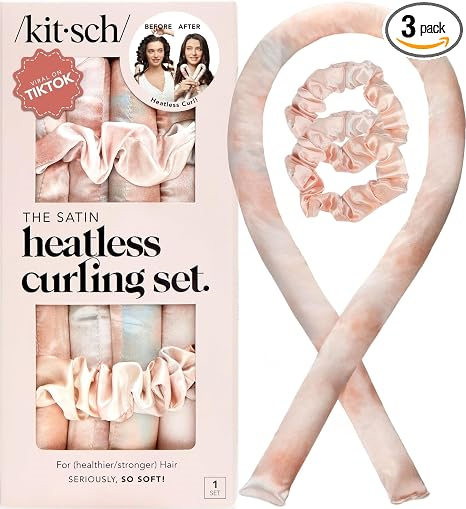
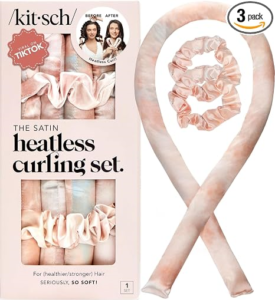
Commercial “standard” is not a regulated size. One useful current benchmark is Kitsch’s standard satin rod at 34 inches long and 1.25 inches in diameter. It offers enough space for many below-shoulder and some mid-back styles, especially when hair is fine or wrapped with little overlap.
For product development, 80–90 cm (31–35 in) is a practical Standard range. Measure the padded usable length rather than including empty seams, bows, or straps.
When to Choose an XL Curling Rod
Choose XL when the Standard rod leaves more than 10–15 cm of hair stacked at the bottom, when hair is waist-length, or when dense hair cannot dry between layers. An official XL market benchmark is 39 inches long and 1.5 inches in diameter. That design provides both extra surface and a larger curve, so it favors loose waves rather than tight spirals.
Longer and larger are separate decisions. A user may need XL length but still prefer a 2.5–3.0 cm diameter. Brands should avoid tying “extra-long” automatically to “extra-large diameter.”
Recommended Lengths for Mid-Back and Waist-Length Hair
| Hair length | Fine/medium density | Thick density | When to change system |
|---|---|---|---|
| Below shoulder | 80–90 cm | 85–95 cm | Use two rods if overlap stays damp |
| Bra-strap to mid-back | 90–100 cm | Two 80–95 cm rods | Split into four wrapping zones |
| Waist-length | 100–110 cm | Double-rod or 4–8 flexi rods | Prioritize drying over one-piece convenience |
| Hip-length or longer | 110 cm+ or multi-rod | Multi-rod set | Prototype on actual target users |
Standard vs. XL: Practical Pros and Cons
| Option | Pros | Cons | Best use |
|---|---|---|---|
| Standard rod | Lighter, easier to anchor, compact packaging | Limited capacity for dense or waist-length hair | Below-shoulder to mid-back, fine/medium hair |
| XL rod | More surface and fewer stacked layers | Heavier, bulkier, may create overly loose curls | Mid-back to waist-length hair |
| Two standard rods | Better density control and drying | Longer setup and more components | Long thick or layered hair |
How to Choose Heatless Curler Rod Diameter
Diameter determines the base curvature; length determines capacity. Section thickness, wrapping angle, moisture, tension, and set time then modify the result. Because long hair relaxes under its own weight, choose the curl you want after two hours—not only the curl visible at release.
Small Diameter for Tighter Curls
A 2.0–2.5 cm (0.8–1.0 in) rod creates stronger curvature and more turns. It suits long, straight hair that drops quickly or users seeking defined curls. On dense hair, use multiple small rods; forcing half the head around one narrow rod creates thick layers and slow drying.
Medium Diameter for Defined Waves
A 2.5–3.2 cm (1.0–1.25 in) diameter is the most versatile range for mid-back hair. It offers visible definition without making the ends look tightly coiled. For many retail collections, this is the strongest Standard option.
Large Diameter for Loose Curls
A 3.2–4.0 cm (1.25–1.6 in) rod creates broad, soft curls. It works well for long hair that naturally holds shape. Fine, resistant hair may release into a wave sooner, so use smaller sections and lightweight mousse.
Extra-Large Diameter for Blowout-Style Results
Diameters above 4.0 cm (1.6 in) emphasize volume, polished bends, and rounded ends. They are not ideal when the target is a ringlet. For a convincing blowout effect, combine the large rod with crown lift from rollers or a top section wrapped away from the natural part.
| Target result | Rod diameter | Section size | Long-hair note |
|---|---|---|---|
| Defined curl | 2.0–2.5 cm | Small | Use more rods on thick hair |
| Defined wave | 2.5–3.2 cm | Small to medium | Best all-round range |
| Loose curl | 3.2–4.0 cm | Medium | Allow for post-release drop |
| Blowout bend | 4.0–5.0 cm | Medium to large | Add separate root-volume rollers |
Best Heatless Curler Designs for Long Hair
Extra-Long Single-Rod Curlers
The one-piece XL rod is quick, recognizable, and easy to merchandise. It works best for fine to medium-density long hair. The center must resist rotation, while the tails should remain flexible enough to fold upward for sleep.
Double-Rod Heatless Curling Systems
Two rods divide the hair into four zones, reduce overlap, and improve curl consistency from crown to ends. The trade-off is a longer learning curve. Clear diagrams and numbered rods make the system easier to use.
Flexible Curling Rods with Secure Ends
A shape-retaining core lets users bend long tails away from the shoulders. It must be centered, fully padded, fatigue-resistant, and capped at both ends. Removable cores simplify washing but add parts that must be explained and controlled.
Multi-Rod Sets for Thick Long Hair
Four to eight rods distribute dense hair and provide the best drying control. They also let users vary diameter at the crown and ends. More pieces raise cost and packaging volume, but they answer a real performance need rather than relying on an oversized single tube.
| Design | Capacity | Sleep comfort | Setup speed | Best buyer segment |
|---|---|---|---|---|
| XL single rod | High | Medium to high | Fast | Waist-length, fine/medium hair |
| Double rod | High | Medium | Medium | Long layered or thick hair |
| Bendable ribbon | Medium to high | High when well padded | Fast | Active sleepers and travel |
| 4–8 flexi rods | Very high | Position-dependent | Slow | Very thick or resistant hair |
How Hair Length and Thickness Affect Your Choice
Long Fine Hair
Fine hair needs less capacity but may lose shape quickly. Choose a medium rather than extra-large diameter, use modest tension, and apply lightweight mousse. Avoid heavy oil before setting; it can reduce volume and hold.
Long Thick Hair
Density is a drying challenge. Two rods or a multi-rod set usually performs better than one huge rod. Begin with mostly dry hair, keep layers thin, and confirm that the inner wrap is dry before release.
Long Layered Hair
Layers end at different positions, so a single bottom scrunchie cannot capture every tip. Add hair gradually, use small clips where face-framing pieces finish, and avoid pulling shorter layers merely to reach the tie.
Long Straight or Resistant Hair
Use smaller sections, a 2.0–3.0 cm diameter, light hold product, and a full dry set. The initial curl should be slightly tighter than the intended finish. High humidity may still soften temporary styling.
| Hair profile | Length priority | Diameter priority | Surface/anchor priority |
|---|---|---|---|
| Fine + very long | XL single rod | Medium | Satin with strong crown clip |
| Thick + mid-back | Two rods | Medium | Grip zones and mini clips |
| Layered + long | Standard/XL by longest layer | Medium | Multiple no-crease clips |
| Straight + resistant | Enough for thin overlap | Small to medium | Velvet-touch or hybrid grip |
How to Use Heatless Curlers on Long Hair
Prepare Hair for Better Curl Retention
Detangle from ends upward and begin with dry or mostly dry hair. A fine mist or small amount of mousse is often enough. Water supports temporary setting, but dense wet wraps may remain damp all night. Avoid soaking the lengths.
The advantage over an iron is avoiding direct high temperature. A 2025 hair-damage paper cites curling-iron exposure at 180°C for 15 seconds in repeated cycles as an experimental damage model. Heatless setting removes that direct thermal contact, although rough fabric, wet friction, and excessive tension can still damage hair mechanically.
Divide Long Hair into Even Sections
Create the final part first. Anchor the rod at the crown and divide hair equally by density, not merely by a straight line. For thick hair, use four zones or two rods. Unequal weight makes one side loosen overnight.
Wrap Without Overlapping Too Much
Start near the face and add a similar amount with each turn. Spread hair flat across the rod. Move downward after every wrap rather than circling repeatedly in one spot. By the last quarter of the rod, the remaining ends should form one or two thin layers.
Secure the Ends for Overnight Wear
Hold the final 5–8 cm flat against the rod and secure with a soft scrunchie. Do not fold ends sharply under a tight elastic. Bend long rod tails upward or cross them behind the head only if the design permits. Rewrap if the scalp feels painful or numb.
- Detangle and bring hair to dry or 80–90% dry.
- Apply lightweight hold product if needed.
- Balance sections by density.
- Anchor the rod with one or two smooth clips.
- Add hair evenly and travel down the rod.
- Secure ends without sharp folds.
- Leave until fully dry, usually several hours or overnight.
- Unwrap gently and finger-separate before brushing.
Common Problems When Curling Long Hair
Running Out of Space on the Rod
Do not pile the final third into a thick knot. Move to XL length, tighten the downward spacing slightly, or divide the hair across two rods. If the diameter is already correct, solve capacity with length rather than a thicker rod.
Uneven Curls from Roots to Ends
Thick overlap enlarges the effective diameter toward the ends. Keep sections flat and advance along the rod. For very long hair, a tapered rod can compensate, but taper angle must be tested carefully.
Loose Ends and Overnight Slipping
Use scrunchies sized to the rod, not oversized decorative ties. Add flat clips where layers finish. Cross two clips at the crown if a satin rod rotates.
Flat Roots and Overly Tight Ends
Begin the first wrap closer to the scalp without pulling. Keep tension consistent instead of tightening as the section becomes thinner. For root volume, lift the top section with one or two large rollers.
| Symptom | Most likely cause | Next-test adjustment |
|---|---|---|
| Ends still wet | Too much overlap | XL length or extra rods |
| Curl drops quickly | Diameter too large or hair not dry | Reduce diameter; extend dry set |
| Rod falls backward | Unbalanced sections or weak anchor | Rebalance and cross crown clips |
| Ends kink | Scrunchie too tight or sharp fold | Lay ends flat; use wider soft tie |
| Frizzy surface | Rough wrap, damp friction, or rushed removal | Smooth sections and unwrap gently |
How Brands Can Customize Heatless Curlers
The commercial category sits at the intersection of hair care, accessories, sleep beauty, and social-led styling. Grand View Research values the global hair accessories market at USD 27.2 billion in 2026 and projects USD 46.6 billion by 2033, an 8.0% CAGR. Statista projects worldwide hair-care revenue of USD 99.91 billion in 2026. These are adjacent-market figures, not heatless-curler sales, but they demonstrate the size of the surrounding demand.
Selecting Standard or XL Dimensions
A commercial range should state usable length and finished diameter in both centimeters and inches. Consider a Standard 85–90 cm SKU for defined waves and an XL 100–105 cm SKU for extra-long hair. If possible, offer XL length in two diameters so users do not have to accept loose curls simply to gain capacity.
Choosing Filling Density and Flexibility
Low-density foam feels soft but may flatten, changing curl diameter. High-resilience foam holds shape but can feel bulky. Fiberfill is lightweight but requires internal stabilization. Wire or shape-retaining cores need capped ends, centered placement, adequate padding, flex-cycle testing, and clear washing instructions.
Adding Scrunchies, Clips, and Storage Bags
A long-hair set should include two stable scrunchies, one or two smooth crown clips, and optional mini clips for layers. A washable storage bag improves gift value and keeps hardware from compressing the rod. For thick-hair kits, number or color-code multiple rods.
Private Label and Custom Packaging Options
Brand options include Pantone color matching, printed satin, woven labels, embroidery, branded scrunchies, FSC-certified paper sleeves, retail boxes, barcode labels, multilingual inserts, QR tutorials, and gift-ready storage pouches. Packaging should show the target hair length, curl result, dimensions, contents, fiber composition, care, warnings, and country of origin.
| Commercial specification | Standard option | XL/long-hair option | QC checkpoint |
|---|---|---|---|
| Usable rod length | 85–90 cm | 100–105 cm | Measure seam-to-seam |
| Diameter | 2.8–3.2 cm | 3.2–3.8 cm or custom | Check before/after recovery |
| Core | Foam or fiberfill | High-resilience foam/bendable core | Center position and hard-point check |
| Accessories | 2 scrunchies + clip | 2 scrunchies + 2–4 clips + bag | Elastic recovery and snag test |
| Packaging | Paper sleeve or box | Gift box or reusable pouch set | Barcode, insert, carton drop protection |
Frequently Asked Questions About Heatless Curlers
How long should a heatless curler be for long hair?
Below-shoulder hair often suits 80–90 cm. Mid-back hair commonly needs 90–100 cm, while waist-length hair may need 100–110 cm or multiple rods. Density can increase the required capacity.
What diameter is best for long hair?
Use 2.0–2.5 cm for defined curls, 2.5–3.2 cm for defined waves, 3.2–4.0 cm for loose curls, and 4.0 cm or more for blowout-style bends.
Do heatless curlers work on long thick hair?
Yes, but a double- or multi-rod system usually dries more evenly than one oversized rod. Keep sections thin and release only when the inner layers are fully dry.
Should long hair be wet or dry?
Dry or 80–90% dry is a reliable starting point. Add a fine mist or lightweight mousse if needed. Soaking long hair can leave overlapping inner layers damp for hours.
How long should I leave heatless curlers in?
Leave them until the hair is fully dry. Many users set for four to eight hours or overnight, but density, moisture, product, and humidity matter more than a fixed timer.
How do I stop an XL rod from slipping?
Balance left and right sections by density, cross two flat clips at the crown, use properly sized scrunchies, and fold flexible rod tails away from the shoulders.
Can heatless curlers damage long hair?
They avoid direct iron heat, but rough seams, exposed wire, wet friction, tight elastics, and excessive tension can still contribute to breakage. Use smooth materials and remove gently.
Conclusion: Match Heatless Curlers to Capacity
The best heatless curlers for long hair provide enough surface for thin, even wrapping and use a diameter matched to the intended result. Mid-back hair often suits 90–100 cm; waist-length or dense hair may require 100–110 cm, two rods, or a multi-rod system. Medium diameters create the most versatile waves, while large diameters trade definition for blowout-style volume.
Future products will move beyond a single “XL” label. Expect length and diameter to be sold independently, modular multi-rod kits, hybrid satin-and-grip surfaces, removable washable cores, recycled or traceable textiles, inclusive tutorials, and hair-profile-specific packaging.
For brands and retailers: define the target hair length, density, curl pattern, overnight comfort, and price point before sampling. Then validate the physical sample on real users. Start your custom long-hair heatless curler project with Q&N Beauty.
Sources and Methodology
Research evidence, published product dimensions, editorial tests, and practical product-development principles were kept separate. Recommended dimensions are starting specifications that require sample and user validation.
- InStyle: 23 Heatless Curlers Tested for 529 Hours
- Kitsch: Standard Satin Rod Dimensions
- Kitsch: XL Satin Rod Dimensions
- Grand View Research: Global Hair Accessories Market
- Statista: Worldwide Hair Care Market Forecast
- Cosmetics: Human Hair and Cosmetic Procedures
- Journal of Cosmetic Dermatology: Establishment of a Heat-Damaged Hair Model
Editorial note: Product recommendations are not medical advice. Stop use if a wrap causes pain, numbness, scalp irritation, or persistent pulling.