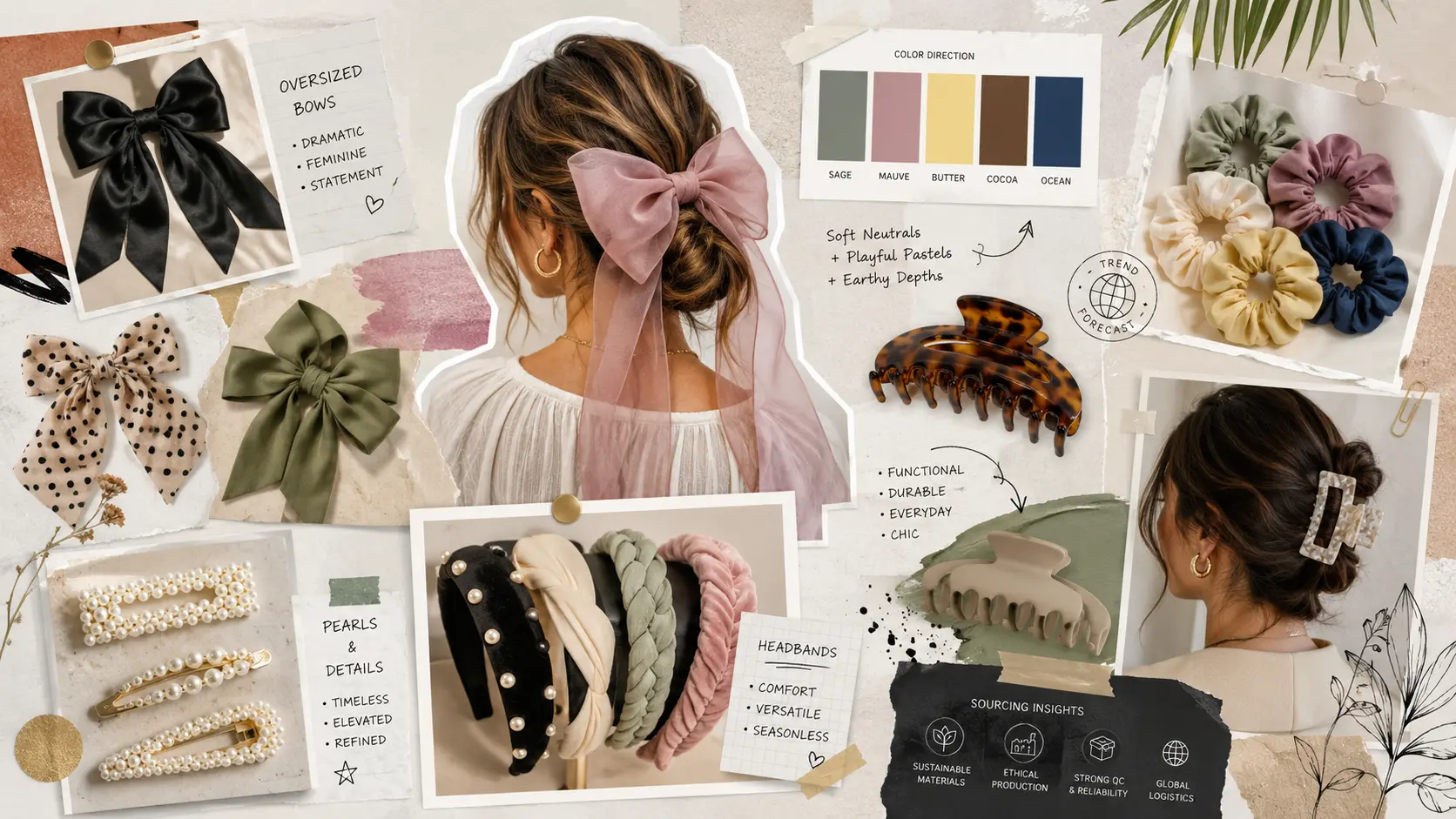
This guide explains how to specify custom fabric hair bows—from silhouette and material to attachments, logos, packaging, and sample approval. It also shows which details to settle before moving from a design concept to a bulk order.
What to Define Before Choosing a Custom Hair Bows Manufacturer
Start with the wearer, hairstyle, and retail format. A small accent bow, a long-tail ponytail bow, and an oversized statement clip need different structures even when they share the same color palette.
A useful brief answers five questions:
- Who will wear it? Define the intended customer and relevant hair types.
- How will it be worn? Specify side styling, a half-up look, a ponytail, or a headband.
- What should it look and feel like? Describe the silhouette, drape, texture, and level of structure.
- How will it be sold? Identify singles, pairs, coordinated sets, or gift packaging.
- What needs customization? List the fabric, dimensions, attachment, color, logo, and packaging requirements.
QN Beauty supports OEM/ODM hair accessory development, including size and construction customization, material sourcing, sampling, production, and packaging. Its custom hair accessories service provides a starting point for discussing which options suit your brief.
Different Types of Custom Hair Bows
Choose the silhouette before finalizing dimensions. The relationship between loop width, center-wrap size, and tail length often matters more than the total width alone.
- Classic loop bows: A balanced shape with two main loops and a defined center, suitable for a coordinated everyday assortment.
- Long-tail bows: Extended tails add movement and a more visible silhouette. Check how the tails hang when the bow is attached.
- Layered bows: Multiple loops or stacked components create volume. Review the added thickness and weight around the center.
- Flat or tailored bows: A restrained shape with controlled folds for a neat appearance.
- Oversized bows: A larger visual statement that needs an appropriately supported attachment.
- Mini bows and pairs: Smaller accents that require consistent proportions, especially when sold as matching sets.
Patterned fabric can change the character of the same shape. For example, QN Beauty’s gingham fabric bow hair clip offers a reference for a checked bow design. Use an existing style to communicate a direction, then confirm the specifications for your own version.
Satin, Velvet, Cotton, and Other Fabric Options
Fabric selection should account for both appearance and construction. A material that creates attractive flowing tails may need a different pattern or internal support to produce upright loops.
Specify fiber composition separately from appearance. Satin is a weave, and velvet describes a pile fabric; neither term alone confirms the fiber content. Request the actual composition when approving materials or writing product descriptions.
| Option | Design direction | What to check on the sample |
|---|---|---|
| Satin | A smooth, lustrous surface for flowing tails or polished folded shapes | Drape, seam puckering, visible needle marks, and whether the loops need support |
| Velvet | A plush surface for textured collections | Pile direction, bulk at the center, shade appearance, and pressure marks |
| Cotton fabrics | Printed or solid styles with a fabric-focused appearance | Hand feel, fraying, shape retention, and response to the intended care method |
| Grosgrain ribbon | A ribbed appearance for defined folds | Ribbon width, edge finish, stiffness, and center-wrap bulk |
| Organza | A sheer, airy look for layered designs | Transparency, visible seams, edge finishing, and snagging |
| Lace or textured fabrics | Decorative surface detail | Motif placement, backing visibility, and attachment security |
These are design considerations rather than guarantees about every fabric in a category. Confirm the available material and finish for the specific project, and review swatches before approving the finished sample.
For delicate fabrics, sewing settings also matter. Coats’ technical guidance on seam puckering identifies fabric structure, seam construction, needle and thread size, tension, and feeding as contributing factors. A trial seam helps evaluate the selected combination.
Hair Bow Sizes and Construction
“Small,” “medium,” and “large” are not enough to define a custom bow. Supply a dimensioned drawing or annotated reference photo so the manufacturer can distinguish the decorative dimensions from the attachment dimensions.
- Overall bow width: The distance across the outermost points of the finished loops.
- Overall height: The top-to-bottom measurement, stating whether hanging tails are included.
- Tail dimensions: The length and width of each tail, plus the required tip shape.
- Center wrap: Its visible width, thickness, and position.
- Attachment: The clip, elastic, or headband dimensions and its position behind the bow.
- Finished weight: A useful comparison when reviewing large or layered samples.
Agree on how the bow is arranged when measured and define acceptable tolerances. Compressing the loops or stretching the tails can change a measurement without changing the underlying pattern.
Construction Details That Affect the Finished Shape
Custom fabric hair bows may use sewn and turned components, folded ribbon, or layered fabric sections. Internal support can help some shapes hold their form, but it also changes thickness and feel. Approve reinforcement on the sample rather than treating it as an invisible substitution.
Review the back as carefully as the front. Check seam closures, center-wrap fastening, exposed edges, and the connection between the bow and its base. Edge treatment should match the material; heat sealing is not suitable for every fiber or finish.
Clips, Elastics, and Headband Attachments
The attachment determines how the bow is worn. A larger decorative bow does not automatically provide a stronger grip, and one clip type will not suit every hairstyle.
| Attachment | Use to evaluate | Sample checks |
|---|---|---|
| Alligator clip | Side sections, accent placement, or some half-up styles | Opening effort, edge finish, grip on the intended section, and concealed mounting |
| Barrette | A defined section held behind the bow | Closure clearance, opening action, and stability with the bow attached |
| Claw clip | A bow combined with a jaw-style hair fastener | Usable jaw space, spring action, and whether fabric obstructs the mechanism |
| Elastic or scrunchie base | Ponytail styling | Stretch, recovery, joining security, and bow rotation during use |
| Headband base | A bow positioned as part of a headband | Fit, underside finish, bow position, and attachment stability |
QN Beauty’s satin ribbon bow claw clip is one example of combining a fabric bow with a functional clip base. For custom bow hair clips, confirm both the bow construction and the fastening mechanism.
Test the assembled product on its intended hairstyle. If the bow rotates, tilts, or blocks access to the clip, changing the mounting position may be more useful than increasing spring strength.
Custom Colors and Logo Options
Approving Colors Across Different Materials
Provide a physical color reference or a clearly identified color standard. Screen images can communicate a direction, but they are not a reliable final color approval.
Compare the actual fabric, thread, center wrap, and any printed branding together. Satin sheen, velvet pile, and matte cotton can make a coordinated color appear different across materials. For a mixed-fabric collection, agree whether the goal is a close match or a deliberately tonal combination.
Branding Private Label Hair Bows
Private label hair bows can carry branding on the product, the packaging, or both. Choose a method that keeps the bow’s shape and wearing comfort intact.
- Woven labels: A small label can be incorporated into an appropriate seam or attachment area; confirm that it does not interfere with the clip.
- Printed logos: Suitable placement may include a tail or another relatively flat section, subject to fabric compatibility.
- Embroidery: Review detail, backing, and stiffness before using it on a lightweight bow.
- Branded cards and tags: A practical option when the fabric bow itself should remain visually clean.
Approve artwork size, orientation, placement, and color on the assembled sample. A logo that looks centered on a flat fabric panel may become partly hidden after folding.
Retail Packaging Options for Wholesale Hair Bows
Packaging should explain the product and protect its shape. Buyers sourcing wholesale hair bows should define the retail unit before confirming the packing specification: one bow, a mirrored pair, or a multi-piece assortment.
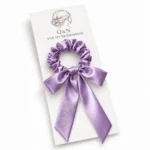
- Display cards: Confirm card size, attachment points, artwork, and whether the bow stays upright.
- Header cards and protective bags: Review fit and whether the packaging compresses the loops or tails.
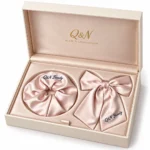
- Gift boxes: Check internal clearance and support so the bow does not arrive flattened.
- Pouches: Consider whether the material and closure protect delicate surface details.
- Set packaging: Specify color order, piece count, and positioning to keep the presentation consistent.
QN Beauty lists custom cards, gift boxes, labeling, and barcode packing among its options. Approve the actual packing sample, including the way the attachment is secured. A suitable empty box can still damage the product if the internal arrangement is too tight.
Sampling and Bulk Production With a Custom Hair Bows Manufacturer
The sample should resolve construction and fit questions before production quantities are committed. Use written specifications alongside the physical reference so details are not left to interpretation.
- Submit the brief: Include reference images, dimensions, fabric preferences, attachment type, intended use, colors, branding, and packaging.
- Confirm feasibility and commercial details: Review available materials and components, sampling scope, order quantities, pricing, and timing for the actual project.
- Develop the sample: Evaluate the chosen fabric, bow proportions, mounting position, and branding together.
- Review and revise: Record changes to shape, dimensions, attachment, finish, or packaging in one clear revision list.
- Approve the production reference: Retain the approved sample and final specification, identifying any agreed differences.
- Produce and inspect: Check materials and workmanship against the approved reference and agreed acceptance criteria.
- Pack and prepare shipment: Verify assortments, labeling, quantities, and carton contents before dispatch.
QN Beauty’s OEM services support buyer-supplied designs, while ODM development can start with an existing style and adapt it to the brand. The company and manufacturing overview provides background on its design and production support.
Quality Checks to Agree Before Production
Ask for product-specific checks rather than relying on a broad “premium quality” description. Useful checkpoints include:
- Fabric and shade consistency against the approved reference.
- Bow proportions, tail length, and center-wrap alignment.
- Closed seams, clean edges, and absence of visible adhesive residue.
- Secure attachment and unobstructed clip operation.
- Elastic function or headband fit where applicable.
- Correct logo, labels, set quantities, and packing presentation.
Define functional test methods and acceptance criteria with the manufacturer. A visual check can identify appearance defects but does not establish attachment durability on its own.
What to Include in a Hair Bow Quote Request
A complete inquiry makes quotations easier to compare. Send the following information, marking any undecided details as options for review:
- Design reference and intended hairstyle.
- Bow width, height, tail dimensions, and preferred attachment.
- Fabric composition or a swatch to match.
- Colors and estimated quantity per style and color.
- Logo artwork and preferred application method.
- Retail packaging, set composition, and labeling needs.
- Delivery destination and requested schedule.
Ask for sampling, product, branding, packaging, and shipping costs to be identified clearly. Minimum quantities and production schedules should be confirmed for the selected construction and material rather than assumed to apply across every bow style.
Frequently Asked Questions
Which fabric is best for custom hair bows?
Choose according to the intended silhouette. Satin is worth sampling for a lustrous look, velvet for texture, cotton for fabric-focused prints and solids, and grosgrain for defined folds. The actual weight, finish, and construction determine the result.
Can the same bow design use different attachments?
It may be possible, but each version needs review. A bow mounted on an elastic can behave differently from the same bow on a barrette or headband. Confirm mounting position, balance, and usability on each sample.
Can private label hair bows use packaging branding only?
Yes. Branded cards, tags, or boxes can provide the brand presentation while leaving the bow unmarked. Specify which packaging elements need artwork and approve the finished set.
Can a reference photo be used to develop custom fabric hair bows?
A reference photo is a useful starting point, but it may not show the back, internal support, or attachment method. Add dimensions, fabric preferences, and rear-view details where available.
What should be checked before ordering wholesale hair bows?
Review a physical sample, confirm the written specification, test the intended attachment and hairstyle, and approve packaging. Confirm the project’s quantities, costs, schedule, and quality requirements before bulk production.
Build a Bow Collection Around Clear Specifications
The right custom hair bows manufacturer should help turn a visual concept into a wearable, repeatable product. Fabric, proportions, attachment, branding, and packaging need to work together, with the final sample serving as the production reference.
Developing custom bow hair clips or a private label collection? Send QN Beauty your hair bow brief to discuss material options, construction, sampling, and bulk production requirements.