Beautiful hair accessories can completely change a hairstyle, but only when they are applied the right way. Many people buy claw clips, barrettes, scrunchies, bobby pins, headbands, or hair combs expecting an instant polished look, then end up with slipping, pulling, awkward volume, or styles that simply do not feel secure. In most cases, the accessory is not the real problem. The method is.
From an SEO and content quality perspective, that kind of real user need matters. Google’s own Search Central guidance says helpful, reliable, people-first content should be created to benefit readers first, not search engines. This article follows that principle by focusing on actual styling problems and real application logic rather than generic beauty fluff.
In this guide, you will learn why correct placement changes both hold and comfort, how to prepare your hair before styling, how to apply the most common accessory types, how to make them stay in place, and how to style them naturally for everyday wear, work, events, and special occasions. You will also see practical comparisons, expert-backed insights, and a realistic case study that shows why the same accessory can succeed on one hair type and fail on another.
Why Applying Hair Accessories Correctly Matters
Why correct placement affects both hold and comfort
Hair accessories are supposed to do two jobs at the same time: secure the hair and keep the style comfortable. When an accessory is clipped too close to the scalp, overloaded with too much hair, or forced into the wrong angle, it often creates pressure, imbalance, or slipping. That is why some styles feel fine for five minutes and then suddenly become annoying. Good application distributes tension more evenly and lets the accessory work with the hairstyle rather than against it.
This is especially important with claw clips. Expert-backed beauty coverage has noted that claw clips can be gentler than very tight elastics, but they can still contribute to breakage or discomfort when worn too tightly or repeatedly in the same spot. The takeaway is not that claw clips are bad. It is that fit, edge quality, and placement matter more than trend alone.
Why the same accessory performs differently on different hair types
A midi claw clip that works beautifully on thick shoulder-length hair may slide straight out of fine, freshly washed hair. A polished barrette that looks elegant on medium-density hair may pop open on dense curls if too much hair is loaded into it. Hair type changes friction, volume, tension, and how much grip an accessory can realistically achieve.
That is one reason everyday functional pieces remain so commercially important. The market data showing strong demand for elastics and ties reflects a very practical reality: consumers want accessories that match real hair behavior, not just fashion images.
Why many hair accessories only look awkward because they are applied wrong
People often decide an accessory “doesn’t suit them” when the real issue is scale or placement. A headband shoved straight back can flatten the crown and make the face feel exposed. A barrette placed too low can drag down the shape of the haircut. A bow clipped to a section that is too large can look bulky instead of elegant. Correct positioning changes the entire look.
The styling principle is simple: the accessory should feel integrated into the hairstyle. It should not look like an object that was randomly attached at the end.
Quick comparison: what usually goes wrong
| Common problem | Most likely cause | What to do instead |
|---|---|---|
| Clip slides down after 10 minutes | Section is too large or hair is too smooth | Use less hair, add light texture, or switch to a smaller clip |
| Accessory feels tight and uncomfortable | Too much tension at the roots | Loosen the twist or pony base before securing |
| Style looks bulky or awkward | Accessory is too big for the hairstyle | Choose a smaller size or place it higher and more deliberately |
| Hair dents or feels stressed | Repeated pressure in the same spot | Rotate placement and reduce tension |
How to Prepare Your Hair First
Why you should define the hairstyle before adding the accessory
One of the biggest mistakes people make is treating the accessory as the hairstyle. In reality, most accessories work best when the hair already has direction. That means deciding on the part, smoothing or shaping the section, and knowing whether the piece is meant to hold the style, decorate it, or do both.
Even a very simple style looks more polished when the shape is clear first. For example, a half-up section should already sit where you want it before a barrette closes over it. A low twist should already be twisted before the claw clip clamps it in place. Accessories are finishing tools, not magic shortcuts.
How prep changes based on fine, thick, curly, or short hair
Fine or silky hair usually needs more grip. That may mean dry shampoo, light texturizing spray, or gentle backcombing at the anchor point. Thick or dense hair usually needs better sectioning rather than more product. Curly or textured hair often benefits from hand-shaping, controlled tension, and accessories with more capacity. Short hair typically needs smaller or mid-size accessories because oversized pieces can overwhelm the haircut.
Styling coverage focused on short hair has made this point clearly: accessories can absolutely work on shorter lengths, but the scale must match the hair. Mid-size clips, slim barrettes, and narrow headbands often perform better than oversized statement pieces when the hair is shorter or finer.
Which products help and which ones create slipping
The best prep products depend on the goal. If the accessory is sliding, the hair usually needs a little controlled friction. Dry shampoo at the roots, light texturizing mist, or a small amount of styling powder can help. If the accessory is decorative rather than structural, you may only need a smooth, lightly brushed section.
What should you avoid? Too much serum, oil, or leave-in product around the anchor area. Shine products are helpful on lengths and ends, but they often make clips and pins slide when used near the root area.
A simple 60-second prep routine that improves almost every accessory
- Brush or finger-detangle the hair.
- Create the part and choose where the accessory will sit.
- Add grip only where needed, not all over the head.
- Take a slightly smaller section than you think you need.
- Secure the hair, then loosen it gently for softness and balance.
| Hair type | Best prep method | What to avoid |
|---|---|---|
| Fine / silky | Texture spray, dry shampoo, smaller sections | Heavy conditioner or serum near roots |
| Thick / dense | Strong sectioning, larger accessories, hidden anchor if needed | Trying to force all the hair into one small clip |
| Curly / textured | Hand placement, shape control, gentle tension | Flattening curls to suit the accessory |
| Short hair | Mini clips, slim barrettes, narrow headbands | Oversized statement pieces with no visual balance |
Internal link placement: This is a strong place to link to your brand homepage or educational category page, such as QN Beauty.
How to Apply Different Hair Accessories
How to wear claw clips, barrettes, and bobby pins
Claw clips: Gather the section, twist it lightly, then clip the twist so the teeth catch both the twisted hair and some of the anchor area near the scalp. Thick hair generally needs a wider clip and stronger spring. Fine hair often works better with a smaller clip and a tighter twist. Expert styling commentary has continued to recommend claw clips for their versatility and lower-tension feel, but only when the size is appropriate for the hair amount.
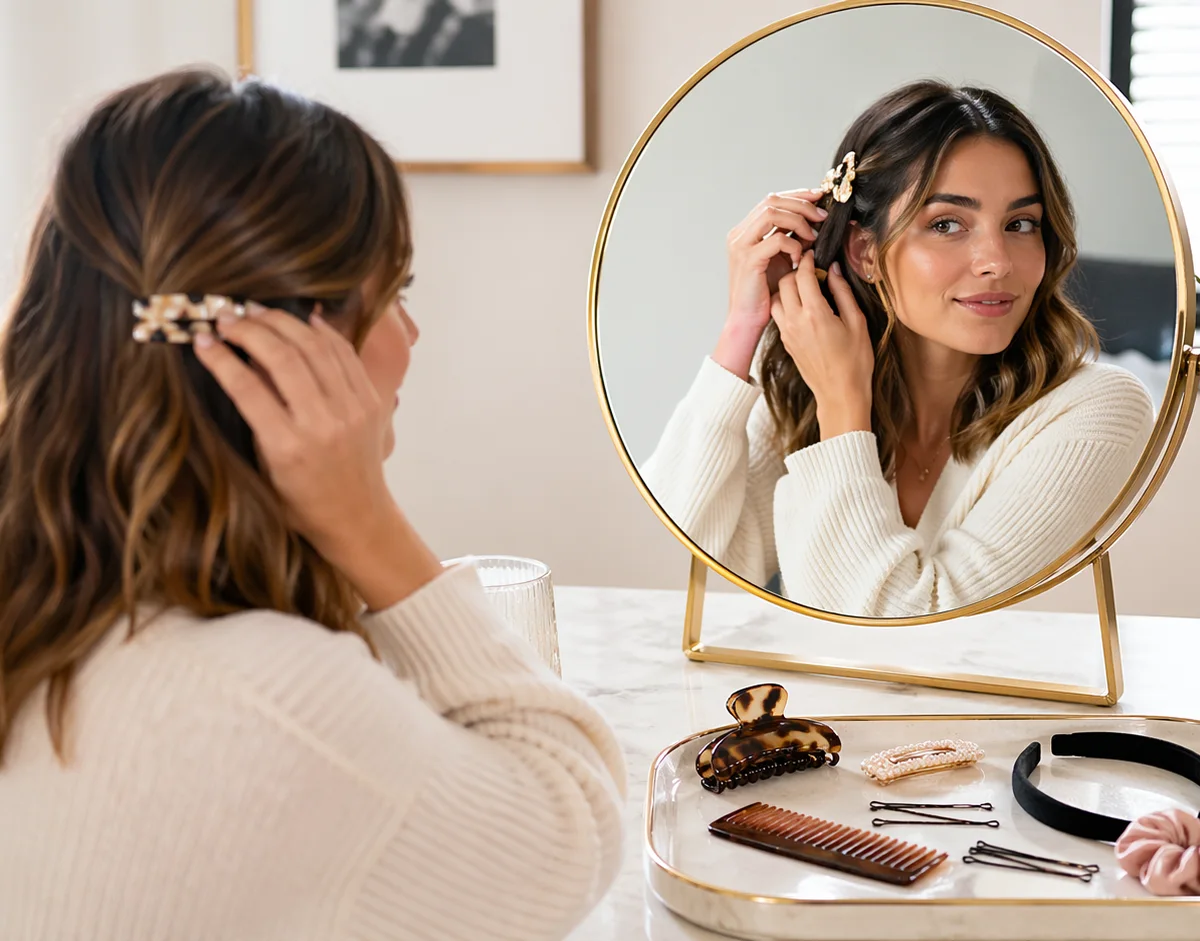
Barrettes: Barrettes work best on controlled, smoothed sections. Use them on half-up hair, side sections, or to hold back face-framing pieces. They usually look best when they do not have to carry the full weight of the hairstyle.
Bobby pins: Insert them with the wavy side toward the scalp for better grip. Cross two pins into an X shape when you need stronger hold. Bobby pins are often the hidden support system behind hairstyles that look effortless.
How to use headbands, scrunchies, and hair combs
Headbands: Instead of dragging a headband straight back from the forehead, place it slightly behind the hairline and then lift a bit of volume at the crown. This keeps the style softer and avoids the flat, overly severe look that many people dislike.
Scrunchies: Use a scrunchie over a ponytail or bun base. They are ideal when you want lower tension and softer styling. A scrunchie is not just decorative; it can also reduce harsh pressure compared with tighter uncovered elastics.
Hair combs: Decorative combs usually stay in place better when inserted against the direction of the hair first and then turned back into position. This reverse-and-lock motion helps the teeth catch the hair more securely. Editorial trend coverage has also highlighted French combs as a more refined alternative to casual clips for modern polished styling.
How to tell whether an accessory should hold or decorate
Some accessories are built mainly for structure. Others are built mainly for appearance. Problems happen when decorative pieces are expected to do heavy-duty holding. A slim pearl clip may beautifully finish a half-up style, but it may not be the best primary support for thick hair. A claw clip may be excellent for hold, but it can look too casual for some formal looks unless the finish is elevated.
| Accessory type | Best for hold | Best for decoration | Best use case |
|---|---|---|---|
| Claw clip | High | Medium | Twists, buns, half-up styles |
| Barrette | Medium | High | Side styling, polished half-up looks |
| Bobby pins | High | Low | Hidden support, anchoring sections |
| Headband | Low to medium | High | Face framing, finishing the look |
| Scrunchie | Medium | Medium | Ponytails, buns, relaxed styling |
| Hair comb | Medium | High | Formal styles, low twists, event hair |
Case study: why one half-up style failed on fine hair but worked on thick hair
Case A: Fine, straight hair. A large claw clip used on a half-up style kept sliding down within minutes. The initial instinct was to tighten the twist, but that only made the style uncomfortable. The fix was to take less hair, add light texture at the roots, and switch to a smaller clip.
Case B: Thick, wavy hair. The same style held better in terms of friction, but the small decorative clip used first could not handle the weight. The fix was to secure a hidden elastic base, then place a decorative barrette over it for appearance.
The lesson: The most successful application method is rarely “pull tighter.” It is usually better scaling, smarter sectioning, and using the accessory for the job it was actually designed to do.
Internal link placement: Link the phrase “different hair accessories” to https://qnbeauty.com/wholesale-hair-accessories/.
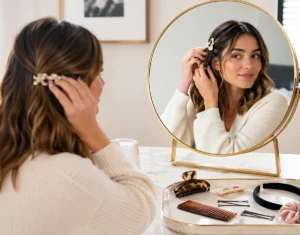
How to Make Hair Accessories Stay in Place
How to choose the right size for your hair volume
The accessory should fit the hairstyle without strain. If a clip barely closes, it is too small. If a barrette sits loose and wide over a tiny section, it is too large. A properly sized accessory closes comfortably while still gripping enough hair to feel stable. This is one of the simplest changes that solves repeated slipping.
How to improve hold based on hair texture
Fine hair usually needs grip. Thick hair usually needs capacity. Curly hair usually needs shape-aware placement rather than flattening. Oily roots often need a matte prep product. Very silky hair may hold better when you lightly tease or texture the anchor point first. The goal is not stiffness. The goal is controlled friction.
How to avoid styles that are too loose, too tight, or too smooth
Too loose causes collapse. Too tight causes discomfort and can stress the hair. Too smooth causes slipping. The sweet spot is gentle tension with strong anchoring. Beauty editors and stylists have also pointed out that accessories such as claw clips can become less hair-friendly when worn too tightly or in the same position every day, so hold should never come from pressure alone.
A practical no-slip workflow for beginners
- Apply light texture only where the accessory will sit.
- Use less hair than you think you need.
- Create a base with one pin or a small elastic if necessary.
- Add the visible accessory last.
- Move your head, bend slightly, and test the hold before finishing.
| Method | Main advantage | Possible downside | Best for |
|---|---|---|---|
| Texture spray | Fast and easy grip | Can feel dry if overused | Fine, silky hair |
| Hidden elastic base | Very strong hold | Adds an extra step | Event styles, heavy sections |
| Crossed bobby pins | Excellent anchor support | Can show if placed poorly | Barrettes, combs, formal looks |
| Larger accessory | More holding capacity | Can look bulky on fine hair | Thick, long, dense hair |
How to Style Hair Accessories Naturally
How to wear hair accessories in everyday looks without overdoing it
The easiest way to make hair accessories look natural is to let one piece do one clear job. A midi claw clip can hold a low twist. A slim barrette can cleanly secure one side. A neutral scrunchie can soften a ponytail. A headband can frame the face without dominating the style. When the accessory has a purpose, the whole look feels more polished.
For daily styling, understated finishes usually work best: matte acetate, soft satin, clean resin, brushed metal, or neutral fabric textures. Everyday styling is usually strongest when the accessory complements the hair rather than competing with it.
How to wear them for formal occasions
Formal styling usually looks better when the accessory is slightly smaller and more refined than people first imagine. Combs, polished barrettes, velvet bows, and pearl details can elevate a low bun, half-up waves, or a sleek ponytail. Editorial coverage around French comb styling has reinforced this quiet-luxury direction, where accessories look elegant because they are intentional, not oversized.
How to match hair accessories with outfit style and overall mood
Instead of matching only by color, match by visual language. Satin bows, velvet ribbons, pearl clips, and polished barrettes feel softer and dressier. Minimal claws and matte clips feel more modern and casual. Sport headbands and functional scrunchies suggest movement and practicality. This kind of coordination makes the accessory feel like part of the full look rather than a separate afterthought.
Trend forecasting also supports the idea that accessories are becoming more expressive, tactile, and style-led. Pinterest’s 2026 trend reporting points to continuing consumer interest in visually distinct, fashion-connected accessories and styling details, which makes versatility even more important for brands and shoppers choosing what to wear next.
A simple style matrix for real life
| Occasion | Best accessory type | Recommended hairstyle | Why it works |
|---|---|---|---|
| Work / errands | Midi claw clip, slim barrette | Low twist, side tuck, half-up | Looks neat without trying too hard |
| Date / dinner | Polished barrette, satin bow | Half-up waves, low ponytail | Adds softness and intention |
| Wedding / event | Decorative comb, pearl clip | Low bun, chignon, soft updo | Feels elegant and camera-friendly |
| Gym / travel | Scrunchie, sport headband | Ponytail, bun, pulled-back style | Prioritizes function and comfort |
Common Mistakes to Avoid When Applying Hair Accessories
Using decorative accessories as the main support system
Many elegant accessories are designed to finish a style, not carry all of its weight. If a decorative clip is slim, glossy, or delicate, it will often perform better when it is layered over a hidden base, such as a pin or elastic. Expecting a decorative piece to do structural work is one of the fastest ways to create slipping.
Overloading the accessory with too much hair
Clips and barrettes fail all the time simply because the section is too large. If the accessory is stretched open or looks strained, the scale is wrong. Taking less hair often makes the final style look cleaner and hold better.
Choosing the wrong finish for the job
Very smooth finishes can look beautiful, but they may not grip equally well on every hair type. Fine, silky hair often benefits from accessories with slightly more friction or texture. Thick hair may need stronger hardware rather than just a prettier surface finish. Good styling comes from matching material, hardware, and hair behavior.
Putting pressure on the same spot every day
Even a comfortable accessory can become a problem when it sits on the same stress point repeatedly. Rotate the location of claw clips, ponytails, and anchored styles. This is especially helpful for people who wear the same quick hairstyle every day and then wonder why the area feels sore or fragile over time.
Expert takeaway: When an accessory feels wrong, the first fix should usually be less tension, smaller sections, or better placement—not pulling harder.
How to Choose the Right Hair Accessories for Your Hair Type
Best hair accessories for fine or slippery hair
Fine hair usually performs best with mini or midi claw clips, narrow headbands, slim barrettes, and textured bobby pins. Lightweight scrunchies also work well, especially over a small base elastic. Fine hair tends to look more polished with accessories that grip securely without overpowering the hairstyle.
For this hair type, size discipline matters more than statement scale. A smaller accessory often looks more expensive and works better than a large one that keeps shifting.
Best hair accessories for thick, dense, or curly hair
Thicker hair needs stronger springs, wider spans, bigger combs, or layered support. Large claw clips, wide French barrettes, sturdy pins, and firm headbands usually perform better here. Curly hair in particular benefits from accessories that respect volume and shape instead of crushing it flat.
If you sell or source hair accessories, this is an important product-development lesson: strong hardware, appropriate sizing, and functional design are not small details. They are part of the value proposition.
Best hair accessories for short hair and layered cuts
Short hair does not need fewer accessories. It needs smarter ones. Mid-size claws, slim side clips, mini bows, narrow fabric headbands, and polished small combs can all work beautifully when the placement is intentional. Oversized pieces can still work, but they must be balanced by the haircut and overall style direction.
For layered hair, pieces that control small sections—like barrettes and pins—are often more useful than accessories that try to hold everything at once.
Pros and cons of building a small starter accessory wardrobe
| Starter item | Pros | Cons | Best role |
|---|---|---|---|
| Midi claw clip | Fast, versatile, easy to use | May slip on very fine hair if too large | Everyday hold |
| Polished barrette | Looks refined and giftable | Not ideal for very heavy sections | Decoration + light hold |
| Bobby pins | Cheap, useful, invisible support | Easy to misplace | Anchoring |
| Scrunchie | Soft, low-tension, beginner-friendly | Not always formal enough | Ponytails and buns |
| Decorative comb | Elegant for events | Needs better technique | Formal finishing |
From a trend and business point of view, this balance between function and style is likely to keep growing. The category’s market expansion, plus continued fashion-platform influence, suggests that consumers will increasingly expect hair accessories to do both jobs well: perform reliably and look intentional.
FAQ
How do beginners apply hair accessories?
Beginners should start with easy pieces like scrunchies, midi claw clips, and slim barrettes. Brush the hair first, choose a small section, and use the accessory to finish a simple style rather than trying to build the entire hairstyle around it.
Why do my hair accessories keep slipping?
The most common causes are hair that is too smooth, sections that are too large, the wrong accessory size, or too much product near the roots. A little texture, a smaller section, or a hidden anchor pin usually solves the problem.
Can I wear multiple hair accessories at once?
Yes, but the cleanest styling usually comes from letting one accessory provide hold and another provide decoration. Too many statement accessories placed at the same visual level can make the hairstyle look crowded.
What hair accessory is easiest to apply?
For most people, a scrunchie is the easiest, followed by a midi claw clip. Both are beginner-friendly, quick to use, and practical for everyday styling.
Are claw clips bad for your hair?
Not inherently. They are often more comfortable than tight elastics, but they can still create tension or breakage if they are too tight, poorly finished, or worn in the same spot every day.
What hair accessory works best for fine hair?
Fine hair usually responds best to mini or mid-size claw clips, slim barrettes, textured bobby pins, narrow headbands, and scrunchies worn over a light base elastic.
Conclusion
The real secret to using hair accessories well is not owning more of them. It is understanding what each one is meant to do, how much hair it can realistically hold, and where it should sit to look natural. Once you know how to prep your hair, match the right size to the right section, and distinguish holding pieces from decorative pieces, the entire category becomes easier to use.
That is also why this topic has long-term search value. It sits at the intersection of beauty education, everyday styling, product selection, and commercial intent. Readers are not just browsing inspiration. They are actively trying to solve a real problem: how to make hair accessories look better and stay in place.
Looking ahead, the strongest accessory trends will likely continue to combine utility with style. Functional claws, polished barrettes, modern combs, soft scrunchies, and elevated headbands will keep winning because they suit both the way people live and the way they want to present themselves.
CTA: If you are looking for stylish, functional accessory options or planning a custom collection, explore QN Beauty or browse wholesale hair accessories here.
Suggested Source Links for Authority Signals
These are external references already placed contextually above. You can keep them for authority, move them to footnotes, or remove them for a cleaner commercial page.
- Grand View Research — Hair Accessories Market Size, Share & Industry Report
- Grand View Research — U.S. Hair Accessories Market Size & Outlook
- Google Search Central — Creating Helpful, Reliable, People-First Content
- Pinterest Predicts — Trend Report
- Byrdie — Expert discussion on claw clips and hair stress
- ELLE — Stylist-informed claw clip recommendations
- Marie Claire — French comb styling trend
Image Alt Text Suggestions by Section
- Intro: “Different hair accessories arranged neatly on a soft neutral background”
- Why Applying Correctly Matters: “Woman applying a claw clip correctly to a half-up hairstyle”
- Prepare Your Hair First: “Hair being brushed and lightly prepped before styling with accessories”
- Apply Different Hair Accessories: “Flat lay of claw clip, barrette, bobby pins, headband, scrunchie, and hair comb”
- Make Them Stay in Place: “Securely pinned twist hairstyle with claw clip and hidden support pins”
- Style Naturally: “Soft everyday hairstyle with subtle barrette and natural movement”
- Common Mistakes: “Comparison of incorrect versus correct hair accessory placement”
- Choose the Right Accessories: “Premium hair accessories for fine hair, thick hair, curly hair, and short hair”