Heatless Curlers Size Guide: Diameter & Results
Heatless curlers can produce anything from compact spirals to a soft blowout, yet two rods sold as “medium” may have visibly different diameters. That inconsistency causes one of the category’s most common problems: shoppers choose by a size name, then receive curls that are tighter, looser or flatter than expected.
Diameter is the best starting point, but hair length, section width, tension, moisture and texture also affect the released result. This guide explains how to measure a finished rod, compare small through XL sizes and build a clear product range.
Editorial note: Size ranges in this guide are practical product-development bands, not regulated standards. Always record the finished outer diameter after the cover and filling are assembled. Product performance should be confirmed through controlled wear tests.
What Does Heatless Curling Rod Diameter Mean?
How Curling Rod Diameter Is Measured
Diameter is the straight-line distance across the widest part of the rod, passing through its center. Measure the finished rod at the center with minimal compression. A ruler is acceptable for a consumer check; product developers should use calipers and record several points because soft filling can vary along the length.
Do not measure only the foam insert. A padded textile cover can add several millimeters to the finished outer diameter, and that is the surface around which hair actually wraps. Also record whether the rod is circular, oval or flattened. A nominal 30 mm rod that compresses to 22 mm during use will not behave like a stable 30 mm cylinder.
Common Heatless Curling Rod Sizes
The category has no universal naming system. One supplier’s “large” may be another brand’s “standard.” For comparison, use millimeters or centimeters first and size names second. The following bands work as a clear starting system for fabric-covered, single-rod curling ribbons.
| Size label | Finished diameter | Approx. inches | Typical result |
|---|---|---|---|
| Small | 15–20 mm | 0.6–0.8 in | Defined curls and tighter waves |
| Medium | 20–30 mm | 0.8–1.2 in | Balanced curls and natural waves |
| Large | 30–40 mm | 1.2–1.6 in | Loose curls and bouncy movement |
| Extra-large | Above 40 mm | Above 1.6 in | Blowout volume and broad bends |
Diameter vs. Rod Circumference
Diameter measures across the rod; circumference measures around it. The relationship is C = π × D. A 25 mm rod has a circumference of about 78.5 mm, while a 40 mm rod requires roughly 125.7 mm of hair length for one full turn. This geometry explains why an XL rod may create only a bend on short hair.
| Diameter | Circumference | Hair length used per full turn* |
|---|---|---|
| 15 mm | 47.1 mm | About 4.7 cm |
| 20 mm | 62.8 mm | About 6.3 cm |
| 25 mm | 78.5 mm | About 7.9 cm |
| 30 mm | 94.2 mm | About 9.4 cm |
| 40 mm | 125.7 mm | About 12.6 cm |
| 50 mm | 157.1 mm | About 15.7 cm |
*Theoretical cylinder circumference. Real wrapping uses additional length because hair sections have thickness, overlap and travel along the rod.
Why Diameter Changes Heatless Curlers Results
How Hair Wraps Around Different Rod Sizes
For the same available hair length, a smaller rod permits more complete rotations. More rotations create repeated directional changes along the strand. A larger rod uses more hair per turn, so it creates fewer, broader curves. This is a geometric relationship rather than a brand claim.
Hair-fiber science explains how that geometry becomes temporary styling. Water changes hydrogen-bond interactions and mechanical behavior within the hair shaft. Holding hair in a new shape while it dries allows a temporary rearrangement; humidity or re-wetting encourages recovery toward the original state. Read the peer-reviewed review of hair physicochemistry.
The Relationship Between Diameter and Curl Tightness
Smaller diameter generally means tighter curl, while larger diameter means looser curl. However, this rule assumes section size, tension, moisture and setting time remain similar. A thick section on a small rod may create a less even curl than a thin section on a medium rod because inner strands have limited contact with the form.
How Curl Size Changes After Hair Is Released
The released curl is rarely identical to the rod. Hair springs outward when tension is removed, then continues to relax under gravity, movement and humidity. Fine or very straight hair may expand quickly. Coarse or naturally wavy hair may keep a stronger memory of the set. Therefore, choose a slightly smaller rod than the final visual curl you want, especially when retention is difficult.
| Rod diameter | Approx. full turns | Likely direction |
|---|---|---|
| 20 mm | 4.8 | More defined |
| 30 mm | 3.2 | Balanced |
| 50 mm | 1.9 | Broader bend |
Actual turns are lower because hair travels diagonally and has thickness. Judge the result after several hours, not only at release.
Small-Diameter Heatless Curlers
Curl Results from Small Rods
Small rods, roughly 15–20 mm finished diameter, create compact curls, defined S-patterns and stronger shrinkage. Because they use less length per rotation, they can curl shorter sections and produce more turns on long hair. The result may look tighter than expected immediately after release.
Best Hair Types and Lengths
This range is useful for chin-to-shoulder hair, layered ends, fine or straight hair that drops quickly, and users seeking visible curls rather than volume alone. It can also define coarse hair, but dense sections should be divided carefully so the inner hair dries.
Advantages and Limitations
Advantages: stronger definition, more rotations, better compatibility with shorter hair and greater allowance for relaxation. Limitations: longer wrapping time, a higher chance of an overly tight result and more noticeable sectioning errors. In a 2025 editorial test, standard flexi rods produced curls the tester considered much tighter than her target, illustrating why “more curl” is not automatically “better curl.” See the published five-method test.
Medium-Diameter Heatless Curlers
Curl Results from Medium Rods
Medium rods, approximately 20–30 mm, are the most versatile starting point. They can create a polished curl when wrapped in small sections or a softer wave when sections are wider. This range usually provides enough rotation for shoulder-length hair without making long hair excessively tight.
Best Hair Types and Lengths
Medium diameter works across fine, medium and coarse strands, particularly from shoulder to mid-back length. Curl-resistant fine hair should stay near the lower end of the range; naturally wavy or thick hair can move toward 28–30 mm for a softer pattern.
Advantages and Limitations
Advantages: broad consumer fit, balanced comfort, predictable wrapping and strong potential as a standard SKU. Limitations: it cannot deliver the tightest curls or the largest blowout. The word “medium” still needs a numeric diameter on the product page and package.
Large-Diameter Heatless Curlers
Curl Results from Large Rods
A 30–40 mm rod creates open curls, bouncy waves and smoother ends. It favors movement over ringlet definition. On long hair, the result can resemble a round-brush finish; on shorter hair, it may create root lift and one broad bend.
Best Hair Types and Lengths
Large diameter suits chest-length or longer hair, high-density hair that would look too full with a small rod, and naturally wavy hair needing refinement. Fine, long hair can use it for a blowout effect, but may require lighter sections and a hold product.
Advantages and Limitations
Advantages: soft finish, fewer tight spirals, quick separation and premium blowout positioning. Limitations: fewer rotations, weaker performance on short or resistant hair, and faster relaxation in humidity. Large rods should not be marketed as universally “better for thick hair”; curl goal and length remain decisive.
Extra-Large Heatless Curlers
Creating Loose Waves and Blowout Effects
XL rods above 40 mm emphasize volume, root direction and broad C-shaped curves. Their purpose is not a compact curl. They are most effective when the hair is long enough to complete multiple turns and the user wants a salon-style blowout without direct curling-iron contact.
Best Uses for Long and Thick Hair
Long, extra-long and high-density hair can use the larger surface efficiently. Fewer turns prevent an overly expanded result, while the broad form organizes a large amount of length. Multiple XL rods may create more even volume than one extremely thick ribbon.
When an XL Diameter May Not Work
Short hair may not travel far enough around the rod to form a curl. Very straight fine hair may release into a shallow wave that disappears quickly. XL rods can also slip because their surface creates a larger lever away from the head. In a public editorial test, jumbo flexi rods delivered the tester’s strongest volume but repeatedly loosened overnight; the method scored 4/5 for curls and 3/5 for hold. This shows the trade-off between broad volume and secure setting, not a universal performance result.
| Size | Main strength | Main limitation | Best commercial promise |
|---|---|---|---|
| Small | Definition and retention allowance | Can look too tight | Defined curls |
| Medium | Versatility | Not specialized | Everyday curls and waves |
| Large | Soft movement | May drop on resistant hair | Bouncy loose curls |
| XL | Volume and blowout shape | Needs length and secure placement | Overnight blowout effect |
How to Match Rod Diameter to Hair Length
Recommended Diameter for Short Hair
For chin-to-shoulder hair, start near 15–22 mm. Short layers need a smaller circumference to complete enough of a turn. A larger rod can still add volume, but it may not create a recognizable curl.
Recommended Diameter for Medium-Length Hair
Shoulder-to-chest hair has the widest practical choice. Use 18–25 mm for definition, 22–30 mm for natural curls, and up to 35 mm for loose movement. Section size becomes as important as length.
Recommended Diameter for Long Hair
Chest-to-mid-back hair can use 20–40 mm depending on the desired finish. A smaller rod creates many rotations and substantial visual volume. A 30–40 mm rod keeps the pattern open and reduces over-curling.
Recommended Diameter for Extra-Long Hair
Hair below mid-back can support 30–50 mm rods for waves and blowouts, while 20–30 mm remains suitable for stronger curls. Rod length must increase with hair length and density; diameter alone does not provide wrapping space.
| Hair length | Starting diameter | Choose smaller when… | Choose larger when… |
|---|---|---|---|
| Chin to shoulder | 15–22 mm | You want defined curls | You want only lift or a bend |
| Shoulder to chest | 20–30 mm | Hair is fine or very straight | Hair already holds waves |
| Chest to mid-back | 25–40 mm | You want longer-lasting definition | You want soft, open movement |
| Below mid-back | 30–50 mm | You want curls rather than a blowout | You want volume and broad curves |
Important: these ranges describe a starting trial, not a guarantee. Measure usable rod length as well as diameter. Long, high-density hair can run out of wrapping space on a correctly sized but too-short rod.
How to Match Rod Diameter to Hair Type
Fine or Straight Hair
Move one step smaller than the desired final curl because the set may relax. Keep the core lightweight and use smaller sections. A 18–25 mm rod is a reliable test band for visible curls; 25–35 mm is better for soft waves and volume.
Thick or Coarse Hair
Coarse strands can hold a larger curve, while high density needs adequate rod length and drying time. Use 25–40 mm for balanced curls or an XL format for a blowout. Do not compensate for thickness with excessive tension.
Naturally Wavy Hair
Match or slightly enlarge the natural pattern when uniformity is the goal. Medium and large rods can organize mixed waves without producing a dramatically different texture. Smaller rods can define sections that flatten around the crown.
Layered Hair
Layers reduce the usable length of some sections. Choose a diameter the shortest important layer can wrap around, or use mixed sizes: smaller near short face-framing pieces and larger through the long back sections.
| Hair behavior | Diameter adjustment | Supporting adjustment |
|---|---|---|
| Fine and drops quickly | One size smaller | Light foam; release only when dry |
| Coarse and resistant to wrapping | Medium-to-large | Smaller sections; longer set |
| Naturally wavy | Match the natural wave radius | Use even direction for uniformity |
| Layered | Size for shortest target layer | Use mixed diameters if needed |
| High density | Do not enlarge automatically | Increase usable rod length and section count |
Other Factors That Affect Curl Results
Hair Section Size
Section size changes how much hair directly contacts the rod. Smaller sections create more even drying and stronger definition. Larger sections create softer results but can remain damp inside. When comparing diameters, keep section width constant.
Wrapping Direction and Tension
Wrapping away from the face creates an open front pattern; alternating directions creates separation. Consistent tension improves uniformity, but tight pulling is not a performance feature. The American Academy of Dermatology recommends avoiding hairstyles that pull and using covered bands, principles that also apply to overnight styling. See the AAD’s hair-care guidance.
Hair Moisture Level
Hair should be slightly damp, not wet. A wet inner layer may still be unset in the morning. Dry hair can take a shape if it already holds texture, but very straight hair usually benefits from controlled moisture and a light styling product.
Setting Time and Styling Products
Longer setting time helps only if placement remains stable and the hair can dry. Use one light mousse, foam or setting lotion rather than layering several heavy products. Humidity-resistant finishing spray can slow relaxation but cannot turn an oversized rod into a small one.
- Select one diameter based on the intended final result.
- Use the same clean-hair condition for every trial.
- Standardize section count and wrapping direction.
- Record starting moisture and total setting time.
- Photograph results at release, two hours and eight hours.
- Change only one variable in the next test.
Case Study: Diameter, Method and Real-World Results
In 2025, The Everygirl published a first-person comparison of five viral heatless methods. It was an editorial wear test, not a controlled laboratory study, and different products changed more than diameter. Still, its recorded scores and observations show why size should be tested alongside grip, placement and comfort.
| Method | Relative size | Reported outcome | What it teaches |
|---|---|---|---|
| Standard flexi rods | Small | Very tight curls; 1/5 curl rating and 2/5 hold | Small diameter may overshoot a loose-curl target |
| Classic ribbon | Medium | Soft wave that lasted through muggy weather on fine hair | A balanced diameter and easy placement can be more wearable |
| Jumbo flexi rods | Large/XL | Strong volume; 4/5 curls and 3/5 hold, but rods slipped overnight | Larger size can improve volume while creating a stability trade-off |
The correct conclusion is not that one diameter always wins. The tester preferred a blowout result, so the tight small-rod curl scored poorly despite creating more curl. Product success must be judged against the promised outcome. Brands should define whether each SKU is designed for definition, everyday waves or volume before wear testing begins.
How Brands Can Select Sizes for Heatless Curlers
Choosing a Universal Standard Size
A 24–28 mm finished diameter is a defensible standard starting point for a single-SKU ribbon because it sits near the center of the versatile range. Test it on at least three hair lengths, multiple densities and both straight and wavy starting textures. “Universal” should mean broad tested compatibility, not identical results for everyone.
Developing Small, Medium and XL Options
A focused collection can use Small at 18–20 mm for definition, Medium at 25–28 mm for everyday curls, and XL at 40–45 mm for blowout volume. Large can be added later if consumer data shows a gap. Too many near-identical diameters increase inventory without creating an obvious benefit.
Creating Size Labels and Usage Guides
Print the finished diameter in millimeters and inches. Pair it with a result-led name such as “Defined Curl,” “Everyday Wave” or “Blowout Volume.” Include a simple hair-length matrix and state that section size and hair texture affect results. Avoid promising “damage-free”; heatless styling removes direct hot-tool contact but can still create friction or tension if misused.
Custom Dimensions for Private Label Orders
For OEM/ODM development, a diameter specification should include tolerance, measurement method, core density, compression recovery, finished weight, usable length, seam placement and cover composition. Approve a sealed production sample by measurement as well as appearance.
Grand View Research estimates the global hair-accessories market at US$27.2 billion in 2026 and projects US$46.6 billion by 2033, an 8.0% CAGR from 2025 to 2033. Statista projects worldwide hair-care revenue of about US$99.91 billion in 2026. These are adjacent-category figures, not a dedicated valuation of heatless curlers, but they show the commercial context for brands linking styling tools with hair-care routines. View the Grand View Research report and Statista’s hair-care forecast.
| Specification | What to record | Why it matters |
|---|---|---|
| Finished diameter | Target, tolerance and test points | Controls the actual wrapping curve |
| Usable length | Wrap area excluding end finishes | Determines capacity for long or dense hair |
| Core recovery | Diameter after compression cycles | Prevents size drift during use |
| Finished weight | Rod and complete set | Affects stability and overnight comfort |
| Cover | Fiber, weave/pile, seam and shrinkage | Changes grip and finished diameter |
| Performance | Results at release, two and eight hours | Supports realistic size claims |
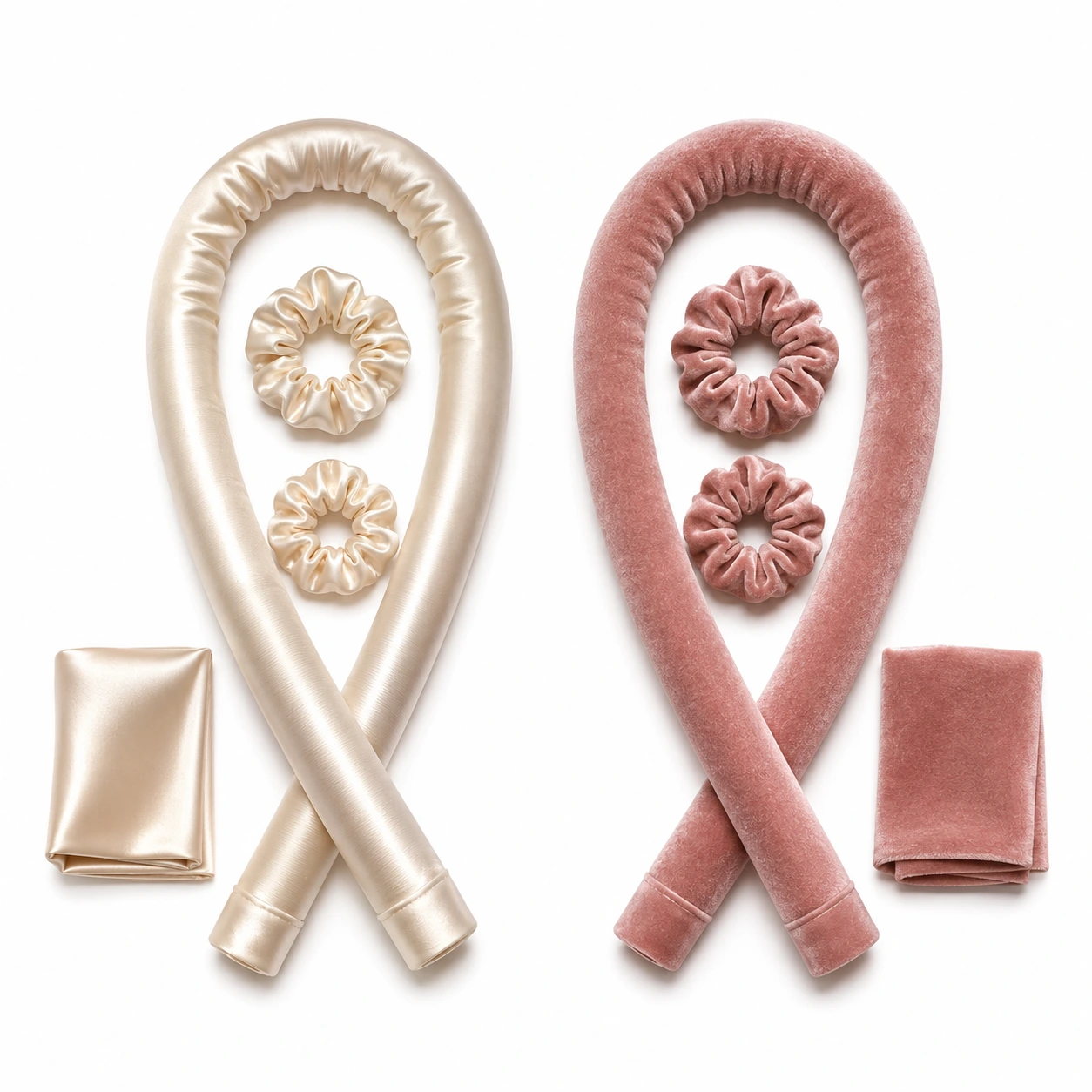
Q&N Beauty develops custom heatless curling rods, scrunchies, clips, labels and retail packaging for beauty brands. Buyers can define diameter, length, filling, satin or velvet cover, color and branding as one coordinated set. Visit Q&N Beauty to discuss a private-label heatless curler collection.
Pros and Cons of Heatless Curlers by Size
| Diameter choice | Pros | Cons |
|---|---|---|
| Small | More rotations, visible definition, works on shorter hair | Can look too tight and takes longer to wrap |
| Medium | Broadest compatibility and easy consumer positioning | May be too loose for resistant hair or too tight for a blowout |
| Large | Soft curls, movement and smoother-looking ends | Needs more length and may relax faster |
| XL | Maximum volume and broad blowout curves | Can slip, overwhelm short hair or create only a weak bend |
Frequently Asked Questions
What size heatless curling rod should I use?
Start with 20–30 mm for versatile curls. Move toward 15–20 mm for stronger definition or short hair, and 30–50 mm for loose waves and long-hair blowouts.
Do bigger heatless curling rods make looser curls?
Generally, yes. A bigger circumference uses more hair length per turn, creating fewer and broader curves. Section size, tension and hair texture can still change the outcome.
What diameter is best for short hair?
About 15–22 mm is a practical starting range for chin-to-shoulder hair. It allows shorter layers to travel farther around the form. Larger rods are better for lift than defined curl.
How do I measure a heatless curling rod?
Measure straight across the center of the finished rod at its widest point without squeezing it. Record several points if the filling is soft. Do not rely only on the internal foam measurement.
Is rod length the same as rod diameter?
No. Diameter controls curl radius; length controls available wrapping space. Long or dense hair often needs a longer rod without necessarily needing a larger diameter.
Why did a small rod give me loose curls?
Likely causes include large sections, damp hair at release, loose wrapping, insufficient set time, heavy products or humidity. Confirm those variables before changing size.
Can a brand call any size “medium”?
Size names are not standardized. Brands should publish the actual finished diameter in millimeters and inches, explain the intended result and keep tolerances consistent across production.
Conclusion: Choose Heatless Curlers by Diameter
The right size depends first on the intended curl, then on hair length and behavior. Small 15–20 mm rods create definition. Medium 20–30 mm rods cover the widest range. Large 30–40 mm rods create loose movement, while XL rods above 40 mm focus on blowout volume. Because the released curl expands, resistant hair often benefits from a rod slightly smaller than the final target.
The next generation of heatless curlers will be easier to compare. Expect numeric diameter labels, result-led names, multiple lengths within the same diameter, replaceable covers and better before-and-after testing over a full day. Brands that publish measurable dimensions will earn more trust than those relying on “standard” and “XL” alone.
For beauty and haircare brands: define finished diameter, tolerance, usable length, weight, core recovery and cover material before requesting a sample. Then contact Q&N Beauty to develop a custom size range, branded accessories and retail-ready packaging.