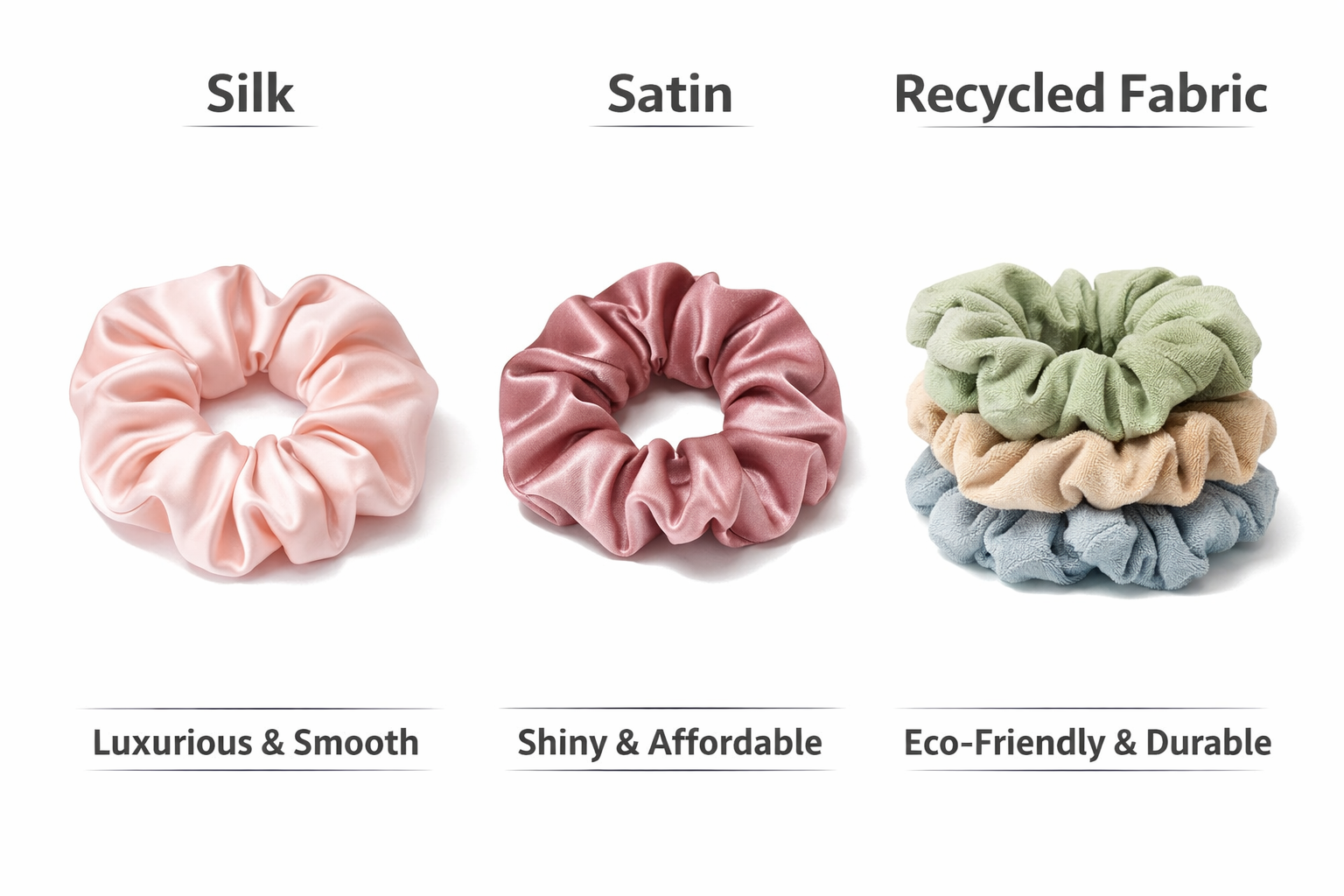
and how customers review them. If you’re building a private label line, your best-selling scrunchie usually
comes down to one question: Are you selling “premium hair care” or “everyday value”?
This guide compares silk vs satin vs recycled-fabric scrunchies from a practical B2B angle:
performance, positioning, cost drivers, and the specs that reduce returns.
Quick Comparison: Silk vs Satin vs Recycled
| Factor | Silk | Satin (often polyester) | Recycled Fabric |
|---|---|---|---|
| Positioning | Premium hair care, gifting | Mid-range to value; strong color options | Sustainability story; value to mid-range |
| Feel / friction | Very smooth (when high grade) | Smooth; can be very consistent | Varies by weave/finish (must be tested) |
| Durability | Can snag; needs careful finishing | Often durable and easy-care | Varies; depends on fiber and construction |
| Care | More delicate | Easy-care | Usually easy-care |
| Cost drivers | Fabric cost + authenticity + sewing quality | Fabric grade + dye/finish + elastic | Certification + fabric consistency + elastic |
| Best for | Beauty-focused brands, premium sets | Everyday scrunchies, multi-color drops | Eco collections, story-led retail |
Material matters, but specs matter more.
Silk Scrunchies: Pros, Cons & Best Use Cases
- Premium perception: natural fiber story and giftable positioning
- Smooth feel: often chosen for “gentle hair care” messaging
- Higher AOV potential: sets and bundles perform well
- Delicate: may snag if finishing is not smooth
- Care expectations: some customers expect special-care instructions
- Quality variance: silk grade and weave affect feel
Best channel fit: DTC beauty brands, boutiques, gifting, and premium subscription boxes.
If you want a premium story, pair silk scrunchies with clear care guidance and strong seam construction.
Satin Scrunchies: Pros, Cons & Best Use Cases
- Consistent production: stable color matching and repeat orders
- Easy-care: customers like simple washing and durability
- Flexible price tiers: good for multi-packs and trend drops
- Confusion risk: some customers assume “satin” means silk
- Heat sensitivity: finishing can change with poor ironing/handling
- Gloss level varies: must align with brand aesthetic
Recycled-Fabric Scrunchies: Pros, Cons & Best Use Cases
- Sustainability storytelling: great for eco collections and brand values
- Wide material options: recycled polyester, recycled blends, etc.
- Good for sets: can pair with recycled packaging for a cohesive story
- Surface feel varies: must test for snagging and friction
- Certification questions: buyers may ask for documentation
- Batch consistency: can vary if supply chain changes
Best channel fit: eco-focused DTC, lifestyle retailers, and brands that want to build a “responsible materials” message.
Performance depends on fabric smoothness and elastic recovery—test both.
How to Choose by Customer & Channel
Use this simple decision logic when planning a collection:
For “Premium Hair Care” Positioning
- Primary: Silk (or premium-feel satin if price-sensitive)
- Colors: neutrals, soft pastels, “spa” palette
- Packaging: gift-ready sets, care card, premium hangtag
For “Everyday Value” & High Volume
- Primary: Satin (durable, scalable)
- Colors: large range, seasonal drops, multi-packs
- Packaging: clear hair-type and use-case labels
For “Eco Collection” Storytelling
- Primary: Recycled fabrics
- Colors: earthy tones + minimal branding
- Packaging: recycled paper, traceability messaging
For Fine Hair vs Thick Hair Coverage
- Fine hair: smaller scrunchie diameter + gentler elastic
- Thick hair: wider elastic + larger body + stronger seam
- Labeling: “fine hair friendly” / “strong hold for thick hair”

Silk vs Satin vs Recycled Fabric Scrunchies
OEM/ODM Specs That Matter (Elastic, Stitching, Fabric)
If you only spec “silk/satin/recycled,” you’ll get wide quality variance.
These specs directly influence customer satisfaction:
| Spec | Why It Matters | How to Specify |
|---|---|---|
| Elastic width & recovery | Controls hold and how fast it loosens | Define width (mm) + stretch/recovery targets; test after repeated stretches |
| Seam construction | Prevents seam splitting | Reinforced stitching; clean seam allowance; stress test on thick hair |
| Fabric smoothness | Frizz, snagging, comfort | Confirm surface finishing and snag resistance; avoid rough weaves |
| Fabric weight (GSM/denier) | Shape, drape, durability | Choose a consistent spec for repeat production; validate colorways |
| Colorfastness | Stops dye transfer and fading complaints | Run wash and rub tests; especially important for dark colors |
| Size / fullness | Defines “look” and target customer | Offer 2–3 sizes (slim/standard/oversized) and label by use case |
QC Tests to Run Before Mass Production
- Elastic fatigue test: stretch cycles and measure recovery (before/after).
- Seam stress test: pull at seam while stretched; check for thread breakage.
- Snag test: rub fabric against hair extensions (or a snag board) to check catching.
- Color rub test: dry and wet rub to reduce dye transfer complaints.
- Wash test: check shrinkage, twisting, and gloss change after washing.
Packaging recommendation: Add a short insert: “How to wear without over-stretching” + care guidance.
It reduces complaints and improves perceived quality.
FAQ
Is silk better than satin for scrunchies?
Silk is often positioned as premium and can feel extremely smooth, but high-quality satin can also be low-friction and consistent.
Choose based on your price point, brand story, and the performance you want to guarantee.
What is the best scrunchie material for frizz and breakage?
Lower-friction fabrics help reduce pulling and frizz. Smooth silk and satin are common “gentle hair” choices.
Recycled fabrics can work well when the surface is smooth and the elastic is properly specced.
Do recycled scrunchies perform well?
Yes—when the fabric surface is smooth and durable and the elastic has strong recovery. Always sample-test for snagging and stretch-out.
What specs matter most when sourcing scrunchies?
Elastic width and recovery, seam construction, fabric smoothness, fabric weight, colorfastness, and size consistency are the key specs.
For premium lines, confirm fabric authenticity and consistent finishing.
Internal originality note (non-third-party): Newly structured and rewritten for SEO intent (material comparison + channel decision logic + specs/QC framework).
Estimated duplication risk: Low. Estimated overlap: ~10%–20% (unavoidable category terms like “silk” and “scrunchies”).