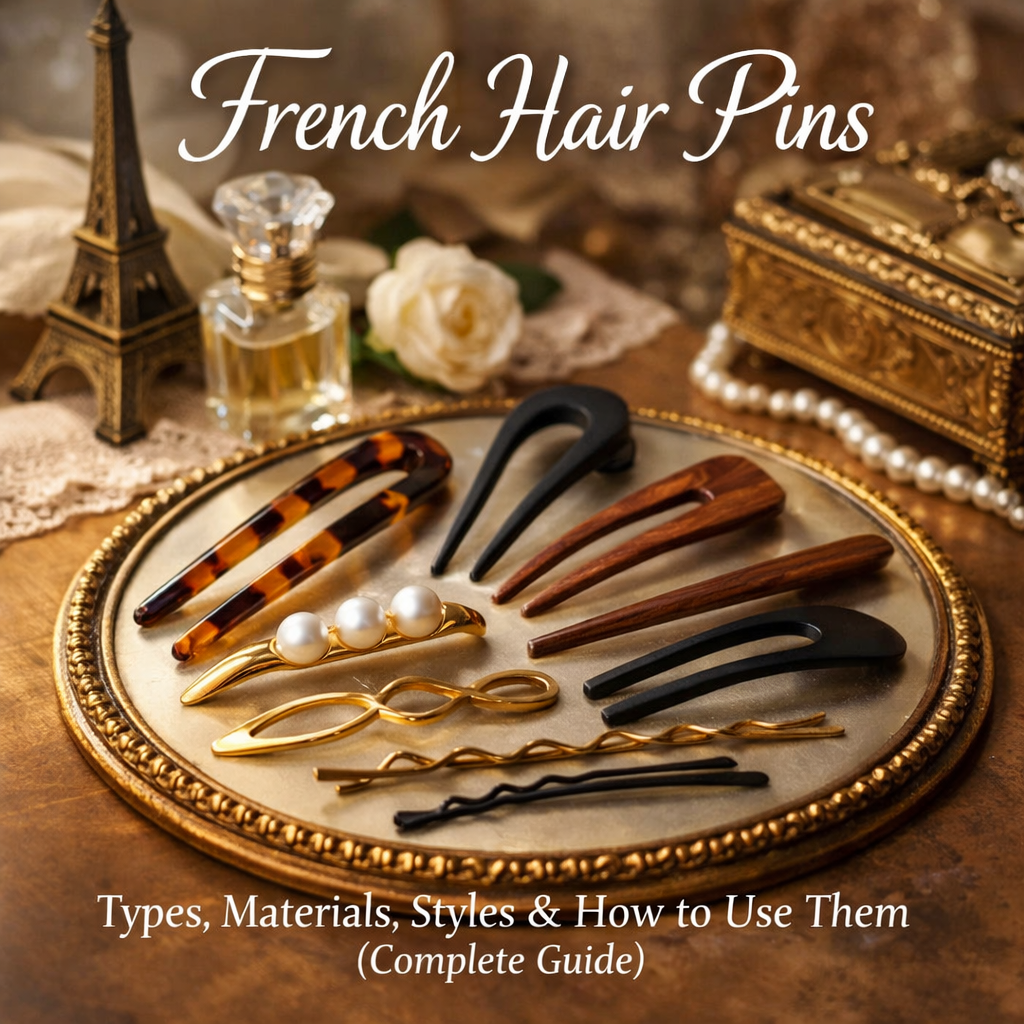
French Hair Pins: Types, Materials, Styles & How to Use Them (Complete Guide)
When you pick the right pin—and insert it the right way—a single pin can secure a twist or bun with surprisingly strong hold.This guide covers the main types of French hair pins, the best materials,
and step-by-step ways to wear them. If you’re a brand or buyer, you’ll also find a practical
B2B sourcing checklist at the end.
Types of French Hair Pins (and What Each One Is For)
| Type | What It Looks Like | Best For | Quick Note |
|---|---|---|---|
| U-Pin (Classic French Pin) | U-shape, straight or slightly curved | Simple buns, twists, everyday updos | Most versatile; great starter pin. |
| Chignon Pin | Longer U-pin / stronger profile | Medium-to-thick hair buns, “chignon” styles | Length = better anchoring for larger buns. |
| Curved Pin | U-pin with a more pronounced curve | French twists and vertical rolls | Curve can hug the head and improve comfort. |
| Twist / Screw Pin | Spiral shape, twists into hair | Quick buns, casual coils | Fast to use; hold depends on coil size and hair texture. |
| Decorative Top Pin | Pin with a decorative head (pearl/metal/acetate) | Statement looks, gifting, bridal | Ensure decorative head is securely bonded. |
Best Materials: Pros, Cons & Positioning
Metal (Brass / Stainless / Alloy)
- Pros: strong, slim, great for thick hair hold
- Cons: must be finished well to avoid snagging
- Best for: minimalist looks, long-wear function, premium sets
Cellulose Acetate / Resin
- Pros: beautiful color depth, giftable, trend-friendly
- Cons: strength varies—design thickness matters
- Best for: boutique collections, seasonal palettes, statement pins
Reinforced Plastic
- Pros: lightweight, cost-effective, scalable
- Cons: can bend if too thin; finishing still matters
- Best for: multi-packs, entry price points
Wood / Bamboo (Specialty)
- Pros: natural aesthetic, lightweight
- Cons: requires good polishing; moisture considerations
- Best for: eco-focused lines and niche positioning
Product-page tip: Describe benefits, not just materials. Examples:
“rounded tips for scalp comfort,” “slim profile for all-day wear,” “strong core for thick hair.”
How to Choose the Right Pin for Your Hair
Thin / Fine Hair
What usually works best
- Type: classic U-pin or decorative top pin
- Length: short to medium (too long can feel loose)
- Finish: slightly textured or matte can improve grip
- Method: smaller bun base + tighter twist
Thick / Long Hair
What usually works best
- Type: chignon pin or curved pin
- Length: longer pin for deeper anchoring
- Strength: sturdy core material (often metal)
- Method: larger bun base; consider using two pins
How to Use a French Hair Pin (Step-by-Step)
The most common mistake is inserting the pin straight into the bun. Instead, use the “in & flip” motion:
insert, rotate, and anchor back toward the scalp.
- Build the base: twist hair into a bun or a French twist roll. Keep it firm (not painful).
- Place the pin on the scalp: rest the pin tip against the scalp right next to the bun’s edge.
- Insert into the bun: slide the pin into the bun at a shallow angle so it catches hair inside the coil.
- Flip to lock: rotate the pin so the tip turns back toward the scalp—this creates the anchor.
- Check stability: gently tug the bun. If it shifts, reposition the pin or add a second pin crossing the first.
Extra-hold trick: For thick or silky hair, start with a small “anchor” section:
pin a half-up mini twist first, then build your bun over it.
6 Easy French Pin Hairstyles
1) Classic Low Chignon
How: gather low, twist into a coil, tuck ends, secure with a chignon pin.
Best for: office, events, “quiet luxury” looks.
2) French Twist Roll
How: twist hair upward into a vertical roll, tuck ends, secure with a curved pin.
Best for: medium-to-long hair; polished silhouettes.
3) Messy Bun with One Pin
How: loosely coil, pin using the “in & flip” motion, pull gently for softness.
Best for: casual days and textured hair.
4) Half-Up French Pin Twist
How: twist the top half once, tuck ends, secure with a small U-pin.
Best for: fine hair that wants volume without a full updo.
5) Double-Pin Secure Bun (Thick Hair)
How: pin one side of the bun, then add a second pin crossing the first for a “lock.”
Best for: thick hair, long wear, active days.
6) Tucked Pony (Effortless Chic)
How: gather low, fold pony upward, pin through the fold to anchor.
Best for: medium hair, quick looks that appear intentional.
B2B Buyer Checklist: Specs That Affect Hold & Returns
For OEM/ODM French hair pins, customers judge performance fast: if it slips, pokes, or snags, returns go up.
These specs help protect product reviews:
| Spec | Why It Matters | Suggested Checks |
|---|---|---|
| Pin length & thickness | Controls anchoring depth and strength | Offer multiple lengths; test on thin vs thick hair buns |
| Tip rounding | Comfort + snag prevention | Run hair “snag test” on extensions; check scalp comfort |
| Surface finish | Grip and perceived quality | Polish consistency; matte vs glossy options; no sharp edges |
| Shape accuracy | Ensures consistent insertion and hold | Check U-gap consistency; confirm curvature doesn’t deform |
| Decorative head bonding | Prevents breakage and returns | Pull test, drop test, heat/cold exposure check |
| Packaging guidance | Reduces misuse and complaints | Include “how to use” diagram + hair-type recommendation |
Need OEM/ODM French hair pins for your brand?
Tell us your target market, preferred material/finish, and the hair types you want to serve.
We can recommend pin lengths, shapes, and finishing options to improve comfort and hold.
Explore more guides on QNBeauty Blog or contact us via
the inquiry form.
Suggested internal links: “Hair Trends 2026 (Accessory Opportunities)”, “Types of Claw Clips”, “Claw Clip Hairstyles for Thick vs Thin Hair”, “Satin vs Silk Scrunchies”.
FAQ
What is a French hair pin?
A French hair pin is a long pin—often U-shaped—used to secure updos by weaving through the bun or twist and anchoring back toward the scalp.
What are the main types of French hair pins?
The most common types are classic U-pins, longer chignon pins, curved pins for twists, and twist/screw pins for fast buns.
How do you use a French hair pin so it stays secure?
Use the “in & flip” method: build a firm bun, insert the pin into the bun, then rotate it so it anchors back toward the scalp.
Are French hair pins good for thick hair?
Yes—thick hair often benefits from longer, stronger pins and sometimes two pins crossed for extra hold.