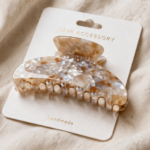
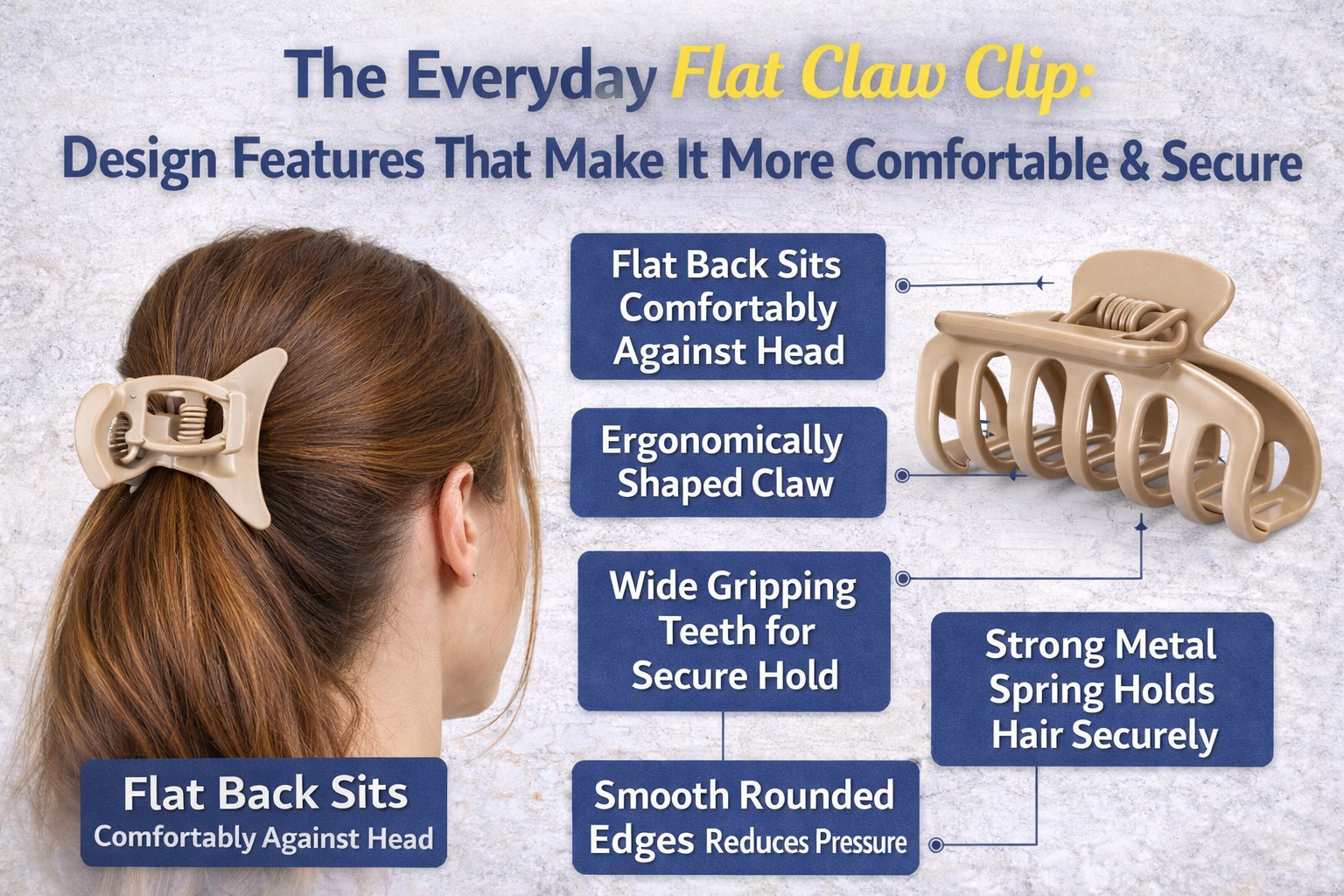
The Everyday Flat Claw Clip: Design Features That Make It More Comfortable & Secure
you’ll probably prefer a flat (low-profile) claw clip.
Flat clips are designed to sit closer to the head, helping many people wear them longer.
In this guide, we’ll explain why flat claw clips feel better, what design details improve hold,
and which specs matter most if you’re sourcing custom claw clips for retail.
Why Flat Claw Clips Feel More Comfortable
A classic claw clip has an arched profile that can stick out from the head.
A flat claw clip reduces that projection, which often improves comfort in everyday situations.
Comfort
Less “headrest bump”
Low-profile clips are less likely to press into your scalp when you drive, sit at a desk, or lean on a couch.
Wear time
Fewer pressure points
Flatter geometry can spread contact more evenly—helpful for all-day wear and sensitive scalps.
Styling
Cleaner silhouette
Because they sit closer to the head, flat clips can look sleeker—especially for minimal or “quiet luxury” styling.
Practical
Better for movement
Many people find flat clips stay out of the way during walking, commuting, and light activity.
Flat vs Classic Arched: What Changes in Fit
Flat / Low-Profile Clips
- Closer to the scalp
- Often more comfortable for driving/leaning back
- Can look sleek and minimal
- May require precise jaw opening + tooth design to avoid slipping
Classic Arched Clips
- More “room” for bulky twists
- Easy to place for quick updos
- Often better for very thick twists if the arch is tall
- Can create a larger bump against headrests
Many brands carry both profiles because they solve different use cases: comfort-focused daily wear vs maximum capacity for bulky twists.
How Flat Clips Stay Secure: 6 Hold Factors
If your flat claw clip slips, it’s usually not “your hair’s fault.” It’s a mismatch between the clip’s grip system and your hair volume/texture.
Here are the six features that most influence hold:
1) Jaw Opening Width
Why it matters: thick hair needs space to close without forcing.
Tip: measure max opening (mm), not only clip length.
2) Spring Tension
Why it matters: too weak = sliding; too strong = discomfort.
Tip: consistent tension across batches reduces returns.
3) Tooth Length & Spacing
Why it matters: long teeth wrap thicker twists; finer spacing grips fine hair.
Tip: for slippery hair, more contact points help.
4) Tooth Tip Rounding
Why it matters: rounded tips reduce scalp poke and snagging.
Tip: finishing quality is a comfort feature, not just aesthetics.
5) Inner Texture / Pads
Why it matters: improves grip without upsizing the clip.
Tip: great for fine, silky hair that slides easily.
6) Hinge & Body Strength
Why it matters: thick hair can force hinges to “creep” open over time.
Tip: reinforced hinges and durable materials prevent cracking.
Simple hold upgrade: If your hair is very smooth, add a tiny amount of texture (dry shampoo or texturizing spray) before clipping.
Flat clips often grip better when hair has a little “bite.”
Which Flat Clip Is Best for Your Hair Type?
Thin / Fine Hair
Choose this combo
- Size: small to medium
- Grip: tighter spring tension + finer tooth spacing
- Anti-slip: inner texture or pads
- Placement: clamp close to the scalp for friction
Thick / Long Hair
Choose this combo
- Size: large
- Capacity: wide jaw opening + longer teeth
- Strength: strong spring + reinforced hinge
- Method: double-twist or “anchor + twist” for extra security
3 Easy Hairstyles That Work Especially Well with Flat Clips
1) Flat Clip Low Twist (Comfort Updo)
How: gather hair low, twist upward 1–2 turns, tuck ends, clamp vertically.
Why it works: low-profile shape stays comfortable against a chair or headrest.
2) Half-Up Anchor + Full Twist (All-Day Method)
How: clip a small half-up section first, then twist remaining hair and clamp over the anchor.
Why it works: the anchor acts like a hook—excellent for smooth or heavy hair.
3) Sleek Half-Up for Minimal Looks
How: take the top third, smooth lightly, fold once, clamp with a medium flat clip.
Why it works: flat profile creates a clean, close-to-head silhouette.
B2B Buyer Notes: Specs That Reduce Returns
If you’re developing custom flat claw clips (OEM/ODM), make sure your sampling focuses on performance—not just color and shape.
These checkpoints help reduce breakage, slipping complaints, and comfort issues:
| Spec | Why it Matters | Suggested Checks |
|---|---|---|
| Jaw opening (mm) | Determines capacity, especially for thick hair | Measure max opening; test on thick-hair twists without forcing closure |
| Spring tension | Controls slip vs comfort | Define target “fine-hair grip” and “thick-hair hold” ranges; compare across samples |
| Tooth geometry | Grip, comfort, snag prevention | Check tooth spacing, length, and rounded tips; run “snag test” on hair extensions |
| Hinge durability | Prevents popping open or cracking | Open/close cycle testing; inspect pins and hinge reinforcement |
| Surface finishing | Comfort and perceived quality | Check edge rounding, polish consistency, coating adhesion and color stability |
| Packaging labeling | Reduces mismatch returns | Mark recommended hair type (fine/medium/thick) and use case (all-day/desk/drive) |
Need OEM/ODM flat claw clips for your brand?
Tell us your target customers (fine-hair grip vs thick-hair hold), preferred materials/finishes, and size range.
We’ll recommend clip structures, tooth designs, and spring tension options for better wear tests and fewer returns.
Browse more guides on QNBeauty Blog or contact us via
the inquiry form.
Suggested internal links: “Types of Claw Clips”, “Claw Clip Hairstyles for Thick vs Thin Hair”, “Acetate vs Plastic Hair Clips”, “MOQ & Lead Time Guide”.
FAQ
What is a flat claw clip?
A flat claw clip is a low-profile clip designed to sit closer to the head than classic arched clips.
It usually feels more comfortable for driving, leaning back, and long wear.
Are flat claw clips better for comfort?
Often yes. The flatter profile reduces the “bump” and can spread pressure more evenly.
Comfort still depends on spring tension, tooth design, and the amount of hair the clip encloses.
Do flat claw clips hold thick hair well?
They can—if the clip has a wide jaw opening, strong spring tension, longer teeth, and a reinforced hinge.
For very thick hair, using an anchor method or a double-twist can improve hold.
What specs matter most when sourcing flat claw clips?
Prioritize jaw opening width, spring tension consistency, tooth geometry and rounded tips, hinge durability, and surface finishing.
These factors directly impact slipping complaints, comfort, and breakage.