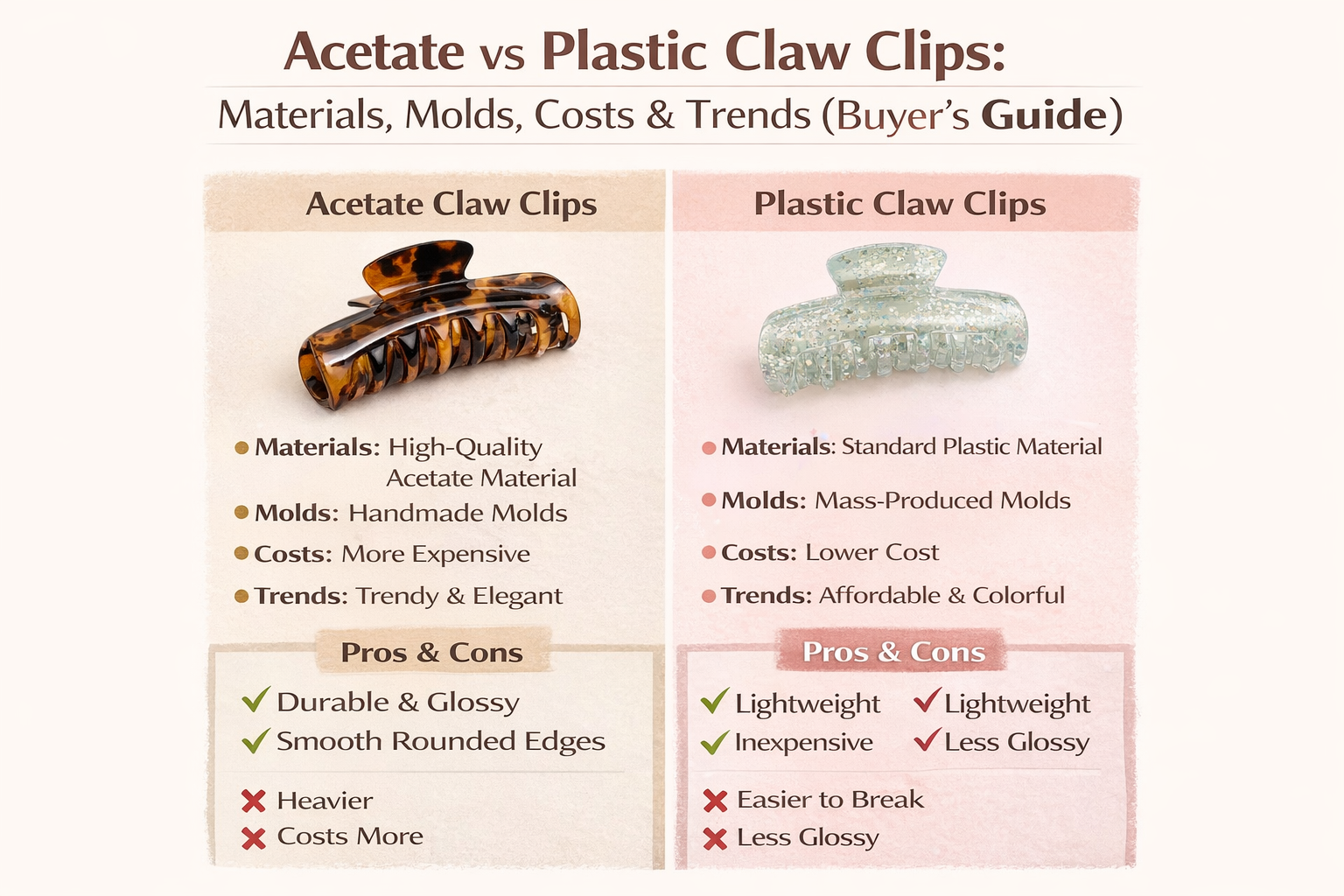
Choosing between acetate and plastic claw clips isn’t just a “premium vs budget” decision.
The material affects everything: how the clip is manufactured, how it feels on the head, how likely it is to crack,
the finishing time required, and even the kinds of colorways you can sell.
This guide compares acetate vs plastic claw clips across manufacturing methods, molds, cost drivers,
durability, and 2026 trend directions—plus a practical OEM/ODM buyer checklist.
Acetate vs Plastic: Quick Comparison Table
| Factor | Acetate Claw Clips | Plastic Claw Clips |
|---|---|---|
| Look & feel | Premium color depth, glossy polish, “weighty” feel | Wide range: from budget to premium; can be matte or glossy |
| Typical manufacturing | Cut/formed + polished + assembled (often more finishing time) | Commonly injection molded for efficient high-volume output |
| Tooling needs | Often lower tooling dependence for sheet/block methods; assembly fixtures may apply | Molds are usually required for injection molding (major upfront cost) |
| Durability risks | Can crack if design is too thin or stress concentrates at hinge | Can deform or snap if resin is low grade; hinges still matter most |
| Best positioning | Boutique/premium sets, gifting, fashion colorways | Mass retail, multi-packs, functional basics, value pricing |
| Best use cases | Everyday elevated looks, statement marbles/tortoise | High-volume programs, performance-focused “hold” clips |
What “Acetate” and “Plastic” Really Mean
Cellulose Acetate (often “acetate”)
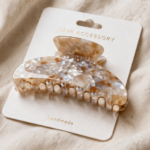
Many premium hair accessories use cellulose acetate because it offers rich, layered color effects
(like tortoise, marble, and multi-tone blends) and can be polished to a smooth, glossy finish.
- Strength note: design thickness and hinge engineering matter—thin walls can crack.
- Perception: often considered more “luxury” in feel and presentation.
Plastics (many resin options)
“Plastic” can mean different things—from low-cost materials used for multi-packs to reinforced resins
designed for higher durability and better finish quality.
- Strength note: resin grade + structural ribbing can improve performance.
- Flexibility: great for consistent mass production and cost control.
If you sell B2B: define the product by performance outcomes (“strong spring for thick hair”, “non-slip teeth for fine hair”)
and then choose the material that supports your target price and durability goals.
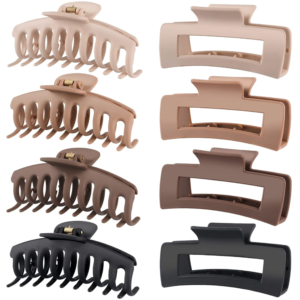
Manufacturing Methods: Cut & Polish vs Injection Molding
Acetate: Cut / Form / Polish / Assemble
Many acetate claw clips are produced by cutting or shaping acetate sheet/block material, then polishing edges and surfaces,
and finally assembling with a hinge and spring. This often delivers the premium look—but increases finishing time.
- Strength: beautiful polish + premium appearance
- Challenge: finishing labor and defect control (scratches, uneven polish)
Plastic: Injection Molding (High Volume)
Plastic claw clips are often injection molded for consistent shape and efficient output.
After molding, parts are trimmed, finished, assembled with spring/hinge, and inspected.
- Strength: consistent shape, scalable volumes
- Challenge: mold cost + tuning (warpage, sink marks, flash)
Molds & Tooling: When You Need Them (and When You Don’t)
Plastic: Tooling Is Often the Big Decision
Injection molding typically requires a mold. Tooling cost depends on cavity count, complexity, surface texture,
and expected output volume.
- Best for: long-running SKUs, repeat orders, stable demand
- Tip: confirm ownership terms (who owns the mold, storage, maintenance)
Acetate: Tooling May Be Lower (But Finishing Is Higher)
When acetate is cut/formed from sheet/block, you may avoid injection molds, but you still need
reliable fixtures, cutting dies, or shaping tools depending on design.
- Best for: premium collections and fashion-driven colorways
- Tip: define acceptable scratch/polish standards before mass production
Cost Drivers: What Changes Your Unit Price
Whether you choose acetate or plastic, these factors usually move your cost the most:
- Material grade: premium acetate/resin costs more, but supports higher retail positioning.
- Finishing time: polishing, edge rounding, and surface treatment increase labor cost (often more for acetate).
- Hinge + spring components: stronger springs and better hinge pins improve hold and reduce breakage.
- Defect rate: scratches, uneven polish, warpage, and cracking impact yield.
- Packaging: gift boxes, sets, and printed inserts add cost but increase perceived value.
- Testing requirements: cycle tests, drop tests, and QC inspections add cost but protect reviews.
Buyer strategy: If you’re price-sensitive, simplify shape and surface finishing. If you’re premium-positioned, invest in finishing and comfort details (rounded tips, smooth edges, consistent spring tension).
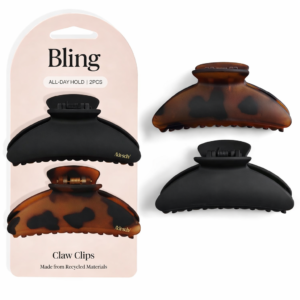
Quality & Durability: Cracking, Hinge Strength, and Finishing
Why clips crack (and how to reduce it)
- Thin walls near the hinge: redesign with more material support or ribbing.
- Stress concentration: smooth transitions (no sharp internal corners).
- Over-strong spring on weak body: balance tension with body strength.
Why clips slip (even “premium” ones)
- Wrong jaw opening for hair volume: thick hair needs capacity; fine hair needs close clamping.
- Tooth geometry mismatch: fine hair benefits from more contact points; thick hair needs longer teeth.
- Over-smooth inner surfaces: add texture or pads for slippery hair.
2026 Trends: What Buyers Are Requesting
Comfort-first profiles
Low-profile and flat claw clips that feel better for driving, desk work, and all-day wear.
Hair-type segmentation
Clear performance programs: “fine-hair grip” vs “thick-hair hold” (different tension and geometry).
Premium visuals in accessible price bands
Tortoise/marbled looks, glossy polish, and minimalist shapes—often pushing acetate demand.
Sustainable storytelling
More interest in recycled plastics, reduced packaging, and material transparency for marketing claims.
B2B Buyer Checklist: Specs to Confirm Before Mass Production
Use this checklist to align design, performance, and QC—especially for private label claw clips:
| Checkpoint | Why It Matters | What to Confirm |
|---|---|---|
| Hair type positioning | Prevents mismatch returns | Define SKUs for fine vs thick hair; label clearly |
| Jaw opening (mm) | Controls capacity and closure comfort | Measure maximum opening; test on thick-hair twists |
| Spring tension | Slip vs comfort balance | Set a target range; compare across samples and batches |
| Tooth design | Grip + comfort | Tooth length, spacing, and rounded tips; snag test |
| Hinge durability | Reduces cracking/popping open | Cycle testing; check hinge pin strength and reinforcement |
| Finishing standards | Perceived quality and comfort | Polish consistency, edge rounding, scratch tolerance |
| Packaging + insert | Improves user success | Include basic “how to use” + hair-type recommendation |
Need OEM/ODM claw clips (acetate or plastic)?
Share your target price band, channels, and hair types you want to serve. We can propose clip structures,
materials, tooth designs, and spring tension options—plus QC standards for mass production.
Browse more guides on QNBeauty Blog or contact us via
the inquiry form.
Suggested internal links: “Types of Claw Clips”, “Flat Claw Clip Comfort Design”, “Claw Clip Hairstyles for Thick vs Thin Hair”, “Sustainable Materials for Hair Accessories”.
FAQ
Is acetate better than plastic for claw clips?
Acetate often looks and feels more premium, but “better” depends on your target price and performance needs.
A well-designed plastic clip can outperform a poorly engineered acetate clip—especially for thick-hair hold.
Are acetate claw clips injection molded?
Many acetate clips are made by cutting/forming acetate material and then polishing and assembling.
Plastic clips are commonly injection molded for efficient high-volume production.
What are the biggest cost drivers in claw clip manufacturing?
Material grade, mold/tooling (for injection molding), finishing time, hinge/spring components, defect rates,
testing requirements, and packaging all affect unit cost.
How can buyers reduce returns for claw clips?
Match specs to hair type, test hinge and spring durability, ensure smooth rounded tooth tips, and label
recommended hair type and use case clearly.
Internal originality note (non-third-party): Newly structured and rewritten for SEO intent (comparison framework + manufacturing logic + cost/QC checklist).
Estimated duplication risk: Low. Estimated overlap: ~10%–20% (unavoidable category terms like “acetate” and “claw clips”).