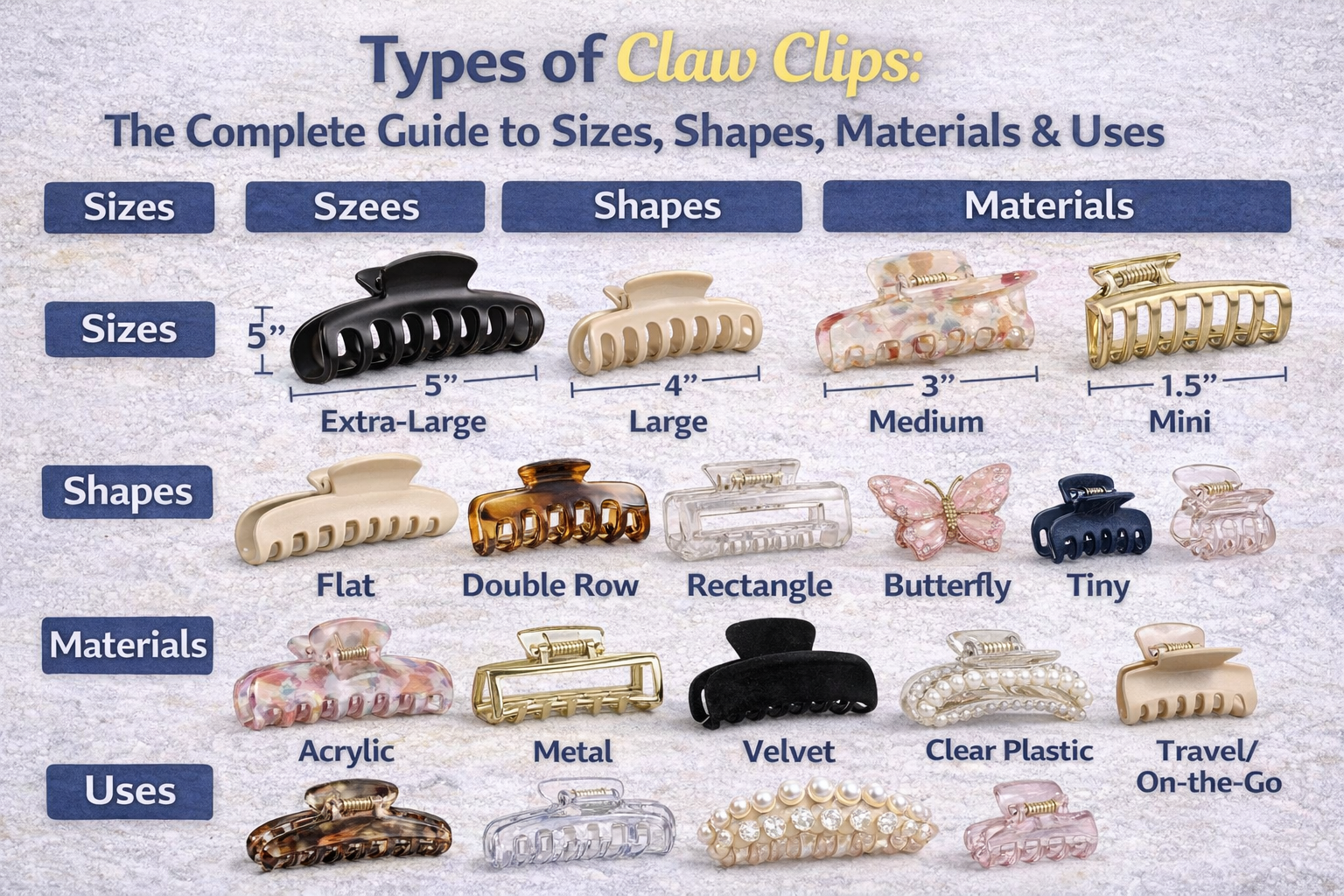
Types of Claw Clips: The Complete Guide to Sizes, Shapes, Materials & Uses
A clip that works perfectly for fine, slippery hair may fail on thick, heavy hair, and vice versa.
This guide breaks down the types of claw clips by size, shape, tooth design, and material, so you can choose the right style (or source the right specs) for your customers.
Quick Glossary: How Claw Clips Are Classified
Most claw clips can be described using four dimensions:
(1) size, (2) shape/profile, (3) tooth geometry + spring tension, and (4) material + finish.
If you’re choosing for yourself, size and grip matter most. If you’re sourcing for retail, hinge strength and finishing often decide customer satisfaction.
Dimension 1
Size
Mini, small, medium, large, jumbo. Size controls how much hair the clip can enclose.
Dimension 2
Shape / Profile
Classic arched clips, flat/low-profile clips, rectangle clips, curved “banana” shapes.
Dimension 3
Teeth + Tension
Wide vs fine teeth, long vs short teeth, textured inner surfaces, and spring tension.
Dimension 4
Material + Finish
Acetate, resin, plastic, metal—plus polishing, edge rounding, and coating quality.
Types of Claw Clips by Size (Mini to Jumbo)
| Size | Best For | Common Uses | Hold Tips |
|---|---|---|---|
| Mini | Very fine hair, short hair, kids | Face-framing twists, small half-up sections, securing ends | Use 2–3 minis for a “clip stack” if hair slips. |
| Small | Fine to medium hair | Half-up twist, small bun, low tuck | Tighter spring tension helps fine hair grip. |
| Medium | Most hair types (average volume) | Classic twist, half-up styles, quick updos | Match tooth length to hair thickness for better closure. |
| Large | Thick hair, long hair | Full French twist, large buns, heavy half-up | Look for longer teeth and a wider jaw opening. |
| Jumbo | Very thick, very long, curly/coily | All-hair-up twists, high-volume coils | Strong hinge + spring prevents “popping open.” |
Types of Claw Clips by Shape (Classic, Flat, Rectangle, and More)
1) Classic Arched Claw Clip
What it is: The most common curved profile that hugs the head.
Best for: Everyday twists and half-up styles.
Why people like it: Easy to place and generally stable.
2) Flat / Low-Profile Claw Clip
What it is: A flatter silhouette that sits closer to the scalp.
Best for: Driving, working at a desk, leaning back—more comfort.
Why it matters: Comfort often increases repeat purchase.
3) Rectangle Claw Clip
What it is: A more geometric shape, often “minimal” in style.
Best for: Medium hair, sleek looks, modern fashion styling.
Design note: Internal tooth layout is key to avoid slipping.
4) Curved Rectangle / “Banana” Profile
What it is: Longer clips that distribute grip across a wider area.
Best for: Longer hair and styles that need broader support.
Benefit: Can reduce pressure points compared to compact clips.
5) Half-Up Claw Clip (Compact Jaw)
What it is: Designed for top sections rather than all-hair-up.
Best for: Fine hair volume boosts and quick “polished” half-up looks.
Tip: Pair with light texture spray for silky hair.
6) Interlocking / Double-Row Claw Clip
What it is: Teeth interlock more tightly or use two tooth rows for grip.
Best for: Slippery hair that needs extra bite without upsizing.
Watch out: Rounded tooth tips reduce snagging.
Types of Claw Clips by Tooth Design & Grip
Two clips can look identical but perform differently because of tooth geometry and spring tension.
For real-world hold, these details matter:
Wide Teeth
- Pros: comfortable, less “pinchy,” good for thick hair
- Cons: can slip on very fine hair
Fine Teeth
- Pros: more contact points, often better grip for fine hair
- Cons: can snag if finishing is poor
Long Teeth
- Pros: wraps thick twists, improves enclosure
- Cons: can feel bulky if the profile isn’t flat
Textured Inner Surfaces / Pads
- Pros: reduces slip without needing a bigger clip
- Cons: must be durable and securely attached
Types of Claw Clips by Material (Acetate, Resin, Plastic, Metal)
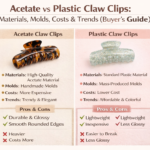
Cellulose Acetate (Premium Look & Feel)
Why it’s popular: glossy depth, smooth edges, elevated appearance.
Best for: premium collections, fashion colorways, giftable products.
Note: finishing quality (polish + edge rounding) often matters as much as the material.
Resin (Style Variety + Cost Flexibility)
Why it’s popular: wide range of patterns and colors, scalable pricing.
Best for: seasonal drops and mid-range retail.
Note: check odor, brittleness, and hinge stress performance.
Plastic (Lightweight + Budget-Friendly)
Why it’s popular: lightweight, easy for large volumes, economical.
Best for: mass retail, multi-packs, promotional programs.
Note: reinforcement and spring selection are crucial for thick-hair performance.
Metal (Durable, Minimal, Must Be Finished Well)
Why it’s popular: slim silhouette, strong structure.
Best for: sleek looks and long-wear clips with good comfort design.
Note: coatings and rounded edges prevent snagging and scalp discomfort.
Pro tip for product pages: Instead of listing only “material,” describe what it does:
“smooth rounded teeth,” “strong spring for thick hair,” “non-slip inner texture for fine hair,” etc.
These phrases match how shoppers search—and reduce mismatched expectations.
How to Choose a Claw Clip: Thin vs Thick Hair (Decision Guide)
Thin / Fine Hair
Choose this combination
- Size: small to medium
- Teeth: finer or closer spacing
- Tension: tighter spring
- Anti-slip: textured inner teeth or pads
Thick / Long Hair
Choose this combination
- Size: large to jumbo
- Teeth: longer teeth + wider jaw opening
- Tension: strong spring + reinforced hinge
- Profile: consider flat clips for comfort
For curly/coily hair, many customers prefer large clips with wide teeth to reduce snagging. Finishing quality becomes even more important.
B2B Buyer Checklist: Specs That Reduce Returns
If you’re developing custom claw clips (OEM/ODM), these are the specs that typically decide
whether customers love the product—or return it.
- Spring tension target: define a range for “fine-hair grip” vs “thick-hair hold.”
- Jaw opening (mm): measure maximum opening, not just clip length.
- Tooth geometry: tooth length, spacing, rounded tip radius (comfort + snag prevention).
- Hinge strength: reinforcement, pin quality, and fatigue resistance (open/close cycles).
- Surface finishing: polishing, edge rounding, coating adhesion, and color consistency.
- Packaging & labeling: include “recommended hair type” to reduce mismatch returns.
Sourcing claw clips for your brand?
Share your target audience (fine-hair grip or thick-hair hold), preferred material (acetate/resin/plastic/metal),
size range, and retail positioning. We can recommend clip structures, tooth design, and spring tension for better wear tests.
Visit QNBeauty or send an inquiry via Contact Us.
Suggested internal links: “Claw Clip Hairstyles for Thick vs Thin Hair”, “Acetate vs Plastic Hair Clips”, “MOQ & Lead Time Guide”, “Private Label Packaging for Hair Accessories”.
FAQ
What are the main types of claw clips?
Most claw clips are categorized by size (mini to jumbo), shape (classic arched, flat/low-profile, rectangle),
tooth design (wide vs fine teeth), and function (half-up clips, bun clips, interlocking/double-row designs).
Which claw clip is best for thin hair?
Thin hair generally holds best with small-to-medium clips that have tighter spring tension and some anti-slip design.
Oversized clips can slide because they don’t clamp close enough to create friction.
Which claw clip is best for thick hair?
Thick hair typically needs large or jumbo clips with strong spring tension, longer teeth, and a wider jaw opening.
If comfort matters (driving/leaning back), a flatter clip profile can help.
What material is best for claw clips?
There isn’t one “best” material—choose based on positioning and durability needs. Premium acetate/resin can look elevated,
reinforced plastics can be lightweight and affordable, and metals can be durable if edges and coatings are finished well.